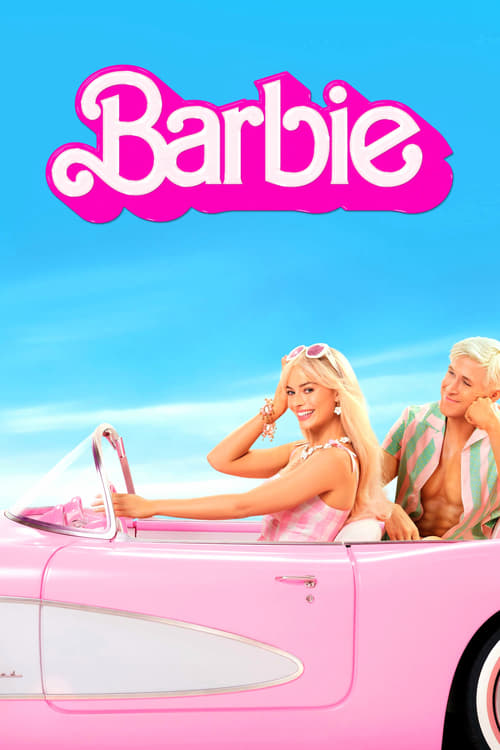
Barbie
2023 · Greta Gerwig
A billion-dollar toy movie that launched a thousand essays on whether it was feminist subversion or brand laundering, dyed the world pink, and produced an Oscar-snub controversy (Gerwig, Robbie) that reached the floor of cultural debate for weeks.
For a bright, buoyant night when you want to laugh hard and still feel something — great with friends, family, or anyone who ever owned (or resented) a Barbie. Pure comfort with a thoughtful center.
What it's about
In the candy-colored utopia of Barbie Land, every day is perfect — until Stereotypical Barbie is blindsided by thoughts of death and other distinctly un-Barbie malfunctions. To fix herself she must cross into the real world, with a lovestruck Ken tagging along, and both discover that life among actual humans works nothing like their plastic paradise. What starts as a fish-out-of-water comedy becomes a surprisingly sincere reckoning with womanhood, identity, and what a doll is for.
The experience
It's a sugar rush with a soul — big musical numbers, relentless sight gags, and deadpan satire, punctuated by moments of real ache that sneak up on you. You laugh for two hours and then find yourself unexpectedly moved.
Performances
Margot Robbie makes an impossible role look effortless, playing plastic perfection cracking into personhood, while Ryan Gosling's fully committed, gloriously ridiculous Ken nearly steals the film and earned him some of the best notices of his career.
The craft
Gerwig built Barbie Land as a practical, hand-painted world of soundstage skies and life-size dreamhouses, and the tactile artificiality is a joy on a big screen. The script she wrote with Noah Baumbach pivots from parody to sincerity without dropping either, and the production design and costuming are wall-to-wall pleasure.
Why it matters
Half of the 'Barbenheimer' phenomenon and the biggest film of 2023, it proved a toy-brand movie could be personal, essayistic filmmaking — and became a genuine cultural event argued about at dinner tables everywhere.
Snapshot
Barbie is a studio-scaled comedy-fantasy that turns a toy franchise into a vehicle for reflexive satire about womanhood, patriarchy, consumer identity, and mortality. Directed by Greta Gerwig from a screenplay she co-wrote with Noah Baumbach, the film stars Margot Robbie as "Stereotypical Barbie," whose sudden intrusive thoughts of death propel her out of the sealed utopia of Barbie Land and into the human world, with Ryan Gosling's Ken trailing after her. What could have been a feature-length advertisement instead became one of the defining cultural events of 2023 — released the same day as Christopher Nolan's Oppenheimer in the phenomenon nicknamed "Barbenheimer" — and a rare case of a major intellectual-property product functioning as personal, essayistic filmmaking. Its distinguishing achievement is tonal: it holds broad slapstick, musical pastiche, corporate self-mockery, and sincere feminist argument in a single register without any one collapsing the others.
Industry & production
The film is a landmark in the contemporary logic of brand-driven cinema: a project originating with Mattel's toy line, developed through Mattel Films (under Robbie Brenner) alongside Robbie's LuckyChap Entertainment and David Heyman's Heyday Films, and distributed by Warner Bros. The Mattel doll had been circling a film for years — an earlier iteration was associated with other stars and filmmakers before the property landed with LuckyChap — but the decisive move was hiring Gerwig and Baumbach, auteur-identified filmmakers, and granting them latitude to make something pointedly ambivalent about the brand itself. That a toy company would greenlight a film in which its own boardroom is played for satire (Will Ferrell as the Mattel CEO leading a comic all-male executive suite) is central to the picture's meaning and to its industrial novelty.
Principal photography took place largely in the United Kingdom, with Warner Bros. Studios Leavesden serving as the base for the extensive built environments of Barbie Land. The production leaned heavily on physical sets and painted backdrops rather than green-screen extension, a choice with both aesthetic and logistical consequences. Production designer Sarah Greenwood has spoken publicly about the sheer volume of pink paint the sets consumed; reporting at the time framed this as contributing to a run on a particular manufacturer's fluorescent pink, an anecdote widely circulated though best treated as a colorful production story rather than a precisely documented supply event.
Commercially, Barbie became the highest-grossing release of 2023 and, by wide consensus, the highest-grossing film directed solely by a woman — a genuine watershed given how persistently that ceiling had held. Exact figures are best confirmed against box-office records rather than asserted here, but the scale of its success reordered assumptions about the commercial ceiling for female-authored, female-fronted studio comedy.
Technology
Barbie's most interesting technological posture is its partial refusal of the digital-effects default. The Barbie Land sequences privilege in-camera solutions — practical sets, hand-painted skies and backdrops evoking the flats of a soundstage musical, forced perspective, and doll-logic sight gags (Barbie "floating" from her rooftop to her car, drinks with no liquid, shower with no water) staged through rigging and design rather than seamless compositing. This deliberately handmade artificiality is the point: the world is meant to look like an assembled toy set, so the seams are a feature. Visual effects are present, particularly at the boundaries between Barbie Land and the real world and in the more overtly fantastical passages, but the film's guiding instinct is toward tangible, photographable objects.
Technique
Cinematography
Rodrigo Prieto photographed the film, and his work is organized around a controlled maximalism: high-key, saturated lighting that recalls the Technicolor musical, clean symmetrical framings for the ordered perfection of Barbie Land, and a looser, grainier, more naturalistic palette for the human world of Los Angeles and Mattel headquarters. The visual grammar deliberately quotes classical Hollywood — the bright, shadowless "glamour" lighting of MGM production numbers — and then lets that idealized image curdle as reality intrudes. The contrast is structural rather than decorative: the film's argument about artifice versus lived experience is carried in the difference between how the two worlds are lit and graded.
Editing
Nick Houy, Gerwig's editor on Lady Bird and Little Women, cut the film. The editing manages an unusually wide tonal bandwidth — musical numbers, montage, dialogue comedy, direct-address bits, and the sincere emotional turns — and its chief accomplishment is rhythmic control: knowing when to let a joke breathe, when to accelerate into a number, and when to hold on a face (Robbie's, especially) so a moment of genuine feeling can register through the candy-colored surface. The film's pace is brisk but not frantic; the comic set-pieces are built with clear beats rather than smeared into chaos.
Mise-en-scène / staging
This is the film's signature dimension. The production design of Sarah Greenwood (with set decoration by Katie Spencer) and the costume design of Jacqueline Durran translate the material culture of the doll — molded plastic, snap-on accessories, dream houses with no fourth wall — into a fully realized built world. Durran's costumes reconstruct decades of Barbie fashion with archival specificity while functioning as character and comedy. Staging exploits doll physics throughout: characters move as if manipulated, spaces have the open-backed geometry of playsets, and the choreographed "every day is the best day" routines of Barbie Land are blocked as ensemble spectacle. The staging is also where the film's homages live most densely — the opening is a direct parody of the "Dawn of Man" prologue of 2001: A Space Odyssey, with a monumental Barbie standing in for the monolith, and the world-design broadly evokes the artificial totalities of the classic musical and of Jacques Tati's engineered modernity.
Sound
The music is by Mark Ronson and Andrew Wyatt, who supplied both score and the architecture of a soundtrack that became a cultural artifact in its own right. The film operates partly as a musical: Ken's power ballad "I'm Just Ken" is its clearest set-piece, staged as an earnest-absurd emotional aria that pivots into a full production number, and the soundtrack's array of commissioned pop songs functions diegetically and thematically rather than as mere accompaniment. Sound design elsewhere reinforces the toy-world conceit — the clean, slightly unreal acoustics of Barbie Land against the messier ambience of the human world.
Performance
Robbie's performance is the film's fulcrum: she plays radiant plastic perfection with complete commitment and then lets doubt, fear, and grief seep through without ever breaking the comic frame, carrying the film's turn toward the elegiac. Gosling's Ken is the film's comic engine and, arguably, its critical breakout — a performance of wounded, insecure masculinity played at full theatrical pitch, mining the character's dependency and his discovery of "patriarchy" for both laughs and satire. The supporting ensemble is deep: America Ferrera anchors the human world and delivers the film's most-discussed passage, a direct monologue cataloging the contradictory demands placed on women; Kate McKinnon's "Weird Barbie" and Michael Cera's Allan operate as knowing outsiders; Rhea Perlman appears as Mattel's late co-founder Ruth Handler; Helen Mirren narrates with dry authority, at one point wittily commenting on the film's own casting.
Narrative & dramatic mode
Structurally the film is a fish-out-of-water quest crossed with a fable of consciousness. Barbie's existential glitch — thoughts of death, flat feet, cellulite — sends her on a journey to find the child whose play is disrupting her, a premise that literalizes the relationship between object and owner. The dramatic mode is reflexive and essayistic: the film repeatedly steps outside its own fiction to comment on Barbie's cultural history, on its narration, and on the audience's expectations, using direct address and metafictional narration as recurring devices. Beneath the satire runs a coming-into-being arc closer to myth than to conventional character comedy — a manufactured being choosing mortal, embodied humanity over frictionless perfection. The screenplay braces its comedy with genuine melancholy, and its climax is less a plot resolution than a philosophical choice.
Genre & cycle
Barbie sits at the intersection of several cycles. It belongs to the 2010s–2020s wave of IP and toy-based studio filmmaking (a lineage that includes the LEGO films, to which it is often compared for turning branded product into knowing, self-aware entertainment), but it distinguishes itself by foregrounding critique rather than affection. It is also a musical-inflected comedy drawing on the classical Hollywood musical, a satire in the tradition of corporate and social send-ups, and a feminist fable. Its closest structural cousin among recent branded films is The LEGO Movie in its combination of commercial property, formal invention, and sincere thematic ambition; its closest sensibility among Gerwig's peers is the reflexive, culturally literate comedy of Baumbach's own work.
Authorship & method
The film is fully legible as a Greta Gerwig picture despite its blockbuster scale. Gerwig emerged from American independent cinema — as a performer and co-writer in the mumblecore milieu and in her ongoing creative and personal partnership with Noah Baumbach (Frances Ha, Mistress America) — before directing Lady Bird (2017) and Little Women (2019), both concerned with young women negotiating identity, expectation, and self-authorship. Barbie extends those preoccupations onto a mythic-comic canvas. The Gerwig–Baumbach screenplay supplies the film's dialectical structure and its density of allusion. Her key collaborators here are largely continuous with her indie work scaled up: editor Nick Houy carries over from her previous two features, while the design and music teams — Prieto (cinematography), Greenwood and Spencer (production/set design), Durran (costume), and Ronson and Wyatt (music) — bring blue-chip craft to a strongly authored vision. The method is auteur-driven maximalism: a personal, argumentative sensibility executed with the full resources of a major studio, and protected enough from brand management to bite the hand that funded it.
Movement / national cinema
Barbie is not a movement film, but it is legible as a product of American independent cinema's absorption into the studio system — the trajectory by which filmmakers formed in low-budget, dialogue-driven, personal work (Gerwig, Baumbach) migrate to franchise-scale projects while retaining an authorial signature. Its production is transnational in the ordinary contemporary sense (an American studio film shot substantially in the UK), but its cultural frame of reference is emphatically American: Hollywood iconography, Los Angeles, and the specifically American mythology of Barbie as a mass-market object.
Era / period
The film is a document of the early 2020s: post-pandemic theatrical exhibition anxious about whether audiences would return for anything but established franchises, a moment answered — spectacularly — by the "Barbenheimer" convergence that turned two very different studio films into a shared communal event. It also registers a particular stage of mainstream feminist and anti-patriarchal discourse, deploying terms and arguments (about the double binds of womanhood, about male fragility and its compensations) with a directness that itself became a subject of debate. As a cultural artifact, it is inseparable from the ecosystem of memes, pink-carpet marketing, and social-media participation that surrounded its release.
Themes
The film's central theme is the contradiction of idealized womanhood — the impossibility of the perfection Barbie embodies, articulated explicitly in Ferrera's monologue about the irreconcilable expectations imposed on women. Around this cluster several others: patriarchy and its allure, dramatized through Ken's arc from accessory to would-be ruler and back toward a self not defined by Barbie; consumer identity and the relationship between people and the objects that shape them; and, most surprisingly for a toy movie, mortality and embodiment — Barbie's arc bends toward the choice to become human, to accept aging, feeling, and death as the price of a real life. The film is also self-consciously about Barbie the product: it stages, rather than resolves, the tension between the doll as an emblem of impossible beauty standards and as an icon of female possibility, letting that ambivalence stand as its most honest gesture.
Reception, canon & influence
Critical reception was broadly strong and unusually engaged, treating the film as a serious cultural text: praise concentrated on Gerwig's direction, the Gerwig–Baumbach script's wit and ambition, the design and music, and the Robbie and Gosling performances, with Gosling's Ken singled out as a comic revelation. Critique tended to fault the film's argument as too explicit or its politics as contained by the very corporation it satirized — a debate that became part of the film's reception history rather than a marginal complaint. It featured prominently in the major awards conversation, and discussion of the specific nominations it did and did not receive (including for Gerwig and Robbie) became its own cultural flashpoint; readers should confirm the precise awards record against authoritative sources.
Looking backward, the film's influences are worn openly: the 2001 prologue parody; the Technicolor MGM musical and its high-key glamour; The Wizard of Oz as a template for a journey between a heightened world and a mundane one; the engineered artificial environments of Tati and the flat, painterly worlds of the classic soundstage picture; and the reflexive, allusive comedy of Gerwig and Baumbach's own indie lineage. Looking forward, its most concrete legacy is industrial: it validated the idea that toy and brand IP could sustain auteur-driven, thematically ambitious filmmaking aimed at adults, accelerating studio interest in the Mattel catalog and comparable properties, and it demonstrated a commercial ceiling for female-authored studio comedy that the industry had long treated as fixed. Its cultural legacy — the "Barbenheimer" event as a model of communal theatrical moviegoing, and the film's saturation of the visual and musical vernacular of its year — is already established; its longer-term place in the canon of studio filmmaking and of feminist popular cinema will be settled by time, but its immediate impact on what a branded film is permitted to be is not in doubt.
A Deleuzian reading
The Dreamhouse has no fourth wall.
The full Deleuzian reading of Barbie →
Reception
Arrived as the box-office event of 2023 — half of the 'Barbenheimer' phenomenon and the year's biggest hit at $1.4 billion — then curdled into Oscar-season irony when Greta Gerwig and Margot Robbie were snubbed for directing and acting while Ryan Gosling's Ken got nominated. It's since settled in as the defining pop-culture object of its summer, still argued over.
How Barbie was received, from release to now →
How to watch Barbie: what to notice on a first viewing
- Look at the Dreamhouse: one wall is simply missing. Sarah Greenwood builds Barbie Land as a playset, open at the back, with painted skies and no plumbing. Barbie steps off her roof and arrives at her car without falling. The missing wall is where the camera stands, and where whoever is playing with these dolls would be.
- Watch how Barbie moves: she is carried, not walking. The shower has no water. The cup has no liquid. Figures float down from the roof and hold their poses. Nothing inside a shot causes the motion in it. Nobody in Barbie Land starts anything. They are moved, which is precisely what a doll is.
- Notice that nobody in Barbie Land casts a shadow. Rodrigo Prieto lights it high-key and saturated, borrowing the shadowless glamour of MGM musicals. When the film reaches Los Angeles the image turns grainier, cooler and less even. The two worlds are graded differently, so the argument about artifice arrives through the light before anyone says it.
- Watch Gosling play Ken completely straight, at full volume. Ken has no job, no house and no standing except Barbie's attention. Gosling plays the hurt of that at theatrical pitch and never winks at the audience. The comedy comes from total commitment. The joke works because he means it.
- Watch the opening: it restages the first scene of 2001. Little girls smash their baby dolls beneath a monumental Barbie, where Kubrick had apes and a monolith. Helen Mirren narrates throughout, and at one point comments on the film's own casting. The film keeps stepping outside itself to tell you it is a made thing, starting before the plot does.
The whole guide to watching Barbie, with the keys for a rewatch →
Influences: the films it descends from and the films it influenced
- 2001: A Space Odyssey (1968) — The prologue restages Kubrick's 'Dawn of Man' beat-for-beat — a towering monolith becomes the giant Barbie, and the girls smash their baby dolls where the ape-men bludgeon, aping the match-cut grammar and Ligeti-style choral awe.
- The Wizard of Oz (1939) — Supplies the structural template of a quest between a saturated, heightened fantasy realm and a mundane 'real' world, with the threshold crossing marked by a shift in color and register.
- Singin' in the Rain (1952) — The high-key Technicolor MGM musical's integrated production number — dance staged flat to a proscenium soundstage with wall-to-wall glamour lighting — is the direct model for the Dreamhouse dance sequences.
- An American in Paris (1951) — Ken's 'I'm Just Ken' descends from the Minnelli dream-ballet: an extended, painterly dance interlude that externalizes a character's emotional crisis rather than advancing plot.
- Playtime (1967) — The doll-physics gags (no water in the shower, floating off the roof) and engineered flat environments extend Tati's method of building an entire artificial, architecturally-designed set where the environment itself is the joke.
- The Red Shoes (1948) — Model for the deliberately hand-painted, in-camera Technicolor soundstage world — matte backdrops and theatrical artifice embraced as beauty rather than disguised as realism.
- Edward Scissorhands (1990) — Establishes the pastel, high-key suburban soundstage as a fable set — candy-colored uniform houses and heightened production design used to frame an outsider's arrival.
- The Stepford Wives (1975) — Pioneers production design of manufactured feminine perfection — the uncanny, immaculate housewife as satirical object — that Barbieland's flawless plastic womanhood critiques.
- The Lego Movie (2014) — The proof-of-concept for auteur toy-IP satire: turns a branded product's own artificiality into its subject and breaks from the toy world into live-action reality — Barbie's most direct industrial and formal precedent.
- Frances Ha (2012) — Source of the Gerwig–Baumbach script DNA: allusion-dense, dialectical comic dialogue and a heroine's project of self-authorship, carried directly into Barbie's screenplay.
- Annie Hall (1977) — Template for the metafictional direct address and knowing narration that lets Barbie step outside its fiction to comment on itself and the audience.
- Don't Worry Darling (2022) — Later, larger execution of the same idea — an artificial, symmetrical mid-century-adjacent utopia built on prescribed gender roles, its pastel perfection ruptured by intrusions that expose the patriarchal machinery beneath.
- The Truman Show (1998) — Shares the engineered sun-drenched idyll as an unknowing enclosure whose protagonist gradually detects the artifice and walks out through its literal edge into the real.
- Pleasantville (1998) — Builds the same monochrome-vs-saturated world contrast, staging idealized mid-century Americana and then destabilizing it through the intrusion of messy reality and mortality.
- Enchanted (2007) — The fish-out-of-water engine of a heightened storybook heroine decanted into the drab real city, keeping her native musical-number staging intact as comic dissonance.
- Team America: World Police (2004) — Comedy mined from deliberately exposed puppet/doll physics — stiff articulated bodies and impossible movement played straight — the same gag logic as Barbie's un-jointed, gravity-defying doll staging.
- Legally Blonde (2001) — The hyper-pink, aggressively feminine visual code weaponized as comic feminist argument, insisting girlishness and intelligence coexist rather than cancel.
- Lady Bird (2017) — Gerwig's own recurring craft — a young woman negotiating identity and expectation, staged with warm specificity — scaled from realist coming-of-age to mythic-comic canvas.
- Speed Racer (2008) — A hyper-saturated pop-art color world extracted from a branded property, treating flat candy-bright artifice as an aesthetic thesis rather than a limitation.
- The Devil Wears Prada 2 (2026) — The proof-of-concept that a female-audience, star-led adult comedy can be a billion-dollar theatrical event — the exact commercial argument, measured in greenlights, that Prada 2 extends.
- Promising Young Woman (2020) — A fellow LuckyChap production that turns a hyper-saturated candy palette into an instrument of gendered social critique, consolidating the same producing model that channels formally bold, female-authored work into the awards mainstream.
- The Fantastic 4: First Steps (2025) — Sibling wager that a walled-off, saturated, fully-committed stylized design world can be played with total sincerity — an aesthetic-conviction-first blockbuster like First Steps.
- A Minecraft Movie (2025) — Contemporaneous toy-IP-to-live-action built on constructed-world stagecraft and against-type star casting, sharing the 'impersonal mega-brand meets idiosyncratic auteur' authorship collision.
- Her Story (2024) — A mainstream commercial blockbuster that delivers its feminist argument openly through monologue set-pieces — the same willingness to make the case in public comedy that defines Her Story.
Similar films
- Lady Bird (2017) — influence & lineage
- The Lego Movie (2014) — influence & lineage
- Frances Ha (2013) — shared sensibility
- Toy Story 5 (2026) — shared sensibility
- Little Women (2019) — shared sensibility
- Her Story (2024) — shared sensibility
- Inside Out 2 (2024) — shared sensibility
- The Worst Person in the World (2021) — shared sensibility