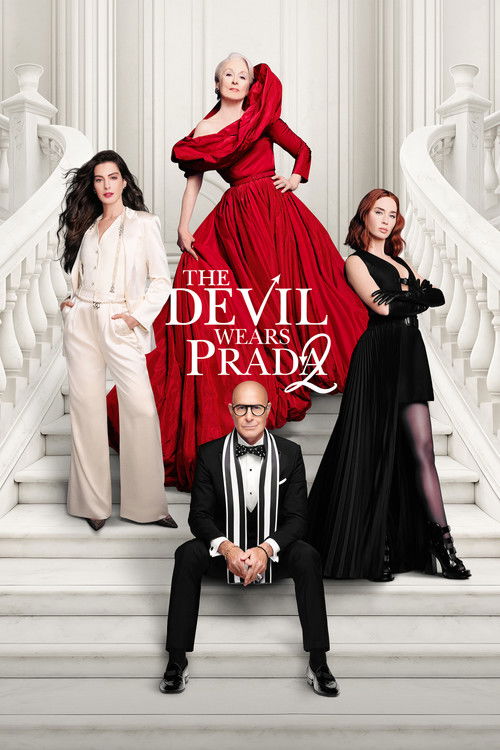
The Devil Wears Prada 2
2026 · David Frankel
For a stylish night in when you want wit, fashion, and delicious workplace power games — comfort viewing with claws. Perfect with friends who can quote the original.
What it's about
Andy Sachs walks back into Runway years later, as Miranda Priestly fights to keep the magazine relevant in a media landscape that's left print behind. Their lifeline may be Emily Charlton — the former assistant, now running a luxury brand with money Runway desperately needs. Old power dynamics get renegotiated with the roles reshuffled.
The experience
Sharp, glossy, and quotable — barbed one-liners over couture, with a real dramedy undertow about ambition, aging institutions, and who owes whom. It goes down like champagne with a twist of vinegar.
The craft
David Frankel returns to the world he first brought to the screen, and the pleasures are the same ones: needle-sharp comic dialogue, immaculate costume design as characterization, and New York media life rendered in high gloss. The clothes alone are a spectacle.
Why it matters
A legacy sequel to one of the defining workplace comedies of its era — a film whose lines and looks became permanent pop-culture shorthand — arriving just as the industry it skewered faces extinction, which is the joke and the drama at once.
Snapshot
The Devil Wears Prada 2 is a twenty-years-later sequel to David Frankel's 2006 comedy of manners, reuniting Meryl Streep, Anne Hathaway, Emily Blunt, and Stanley Tucci in the roles that helped define a certain register of 2000s glossy workplace filmmaking. The sequel transposes the original's central tension — the clash between Andy Sachs's earnestness and Miranda Priestly's imperial standards — onto a media economy in collapse: two decades on, Andy is an award-winning journalist at a New York paper who loses her job and is hired to help save a struggling Runway, reuniting her with Miranda in a landscape of cost-cutting, tech disruption, and corporate ownership. The film premiered April 20, 2026 at Lincoln Center and was released in US theaters by 20th Century Studios on May 1. At 119 minutes, it proved a major commercial success — $693.5 million worldwide against a $100 million budget, on a $233.6 million worldwide opening — and drew warm audience response (an A− CinemaScore) against more temperate reviews. It is, in essence, a franchise-revival prestige comedy: a film built on returning talent, fashion-world spectacle, and the successful wager that a beloved rivalry could be reanimated inside the anxieties of the streaming-and-scroll era.
Industry & production
The production is a study in continuity by design. Frankel returns as director and Aline Brosh McKenna returns to write the screenplay, and the reunion extends below the line: Florian Ballhaus, ASC returns as cinematographer and Theodore Shapiro as composer, a deliberate institutional memory that treats the first film's craft team as part of the brand. The notable changes are generational rather than disruptive — Andrew Marcus edits, Jess Gonchor designs the production, and Molly Rogers, who was costume assistant to Patricia Field on the first film, steps into the costume role from inside the same New York lineage.
Principal photography ran from June 30 to October 20, 2025, shooting in Manhattan and Newark, New Jersey, with Italian work in Milan and on Lake Como to anchor the fashion-capital material. The film thereby reprises the original's New York-as-character strategy while extending it toward the European luxury axis the story requires. Disney's 20th Century Studios positioned the release as a spring event picture, and the bet paid off emphatically: the $233.6 million worldwide opening was among the year's largest, and the final global figure split into $220.6 million domestic and $472.9 million international — a genuinely transatlantic hit for a film about a transatlantic industry. The scale of the production matched the ambition: the Runway offices were rebuilt at Kaufman Astoria Studios at eight times the size of the original sets, and the fashion world itself turned out for the picture, with cameo appearances by Donatella Versace, Marc Jacobs, Naomi Campbell, and Lady Gaga's double contribution as on-screen cameo and songwriter.
Technology
The sequel was shot on the ARRI Alexa 35, a choice Ballhaus made for the camera's dynamic range and true-4K capture — headroom that let him photograph the film through lenses he owns, including Zeiss Ultra Primes carried over from the original production and Leitz Summilux-C glass. The pipeline also made room for a deliberately rougher instrument: a handheld Leica SL2-S rig used for montage sequences, giving them a documentary feel that recalls the first film's 16mm passages without resorting to film stock. The fashion material demanded meticulous color management so garment tones read true — a non-trivial concern given that the original made a literal plot point of color fidelity in the cerulean monologue — and the finished grade did become a minor talking point: online commentary cited the film in a broader debate about industry-wide standardization of color palettes. Beyond the pipeline, the picture's most relevant technology remains the one it depicts rather than the one it was shot on — the collapse of the twentieth-century media apparatus, from print economics to content farms, that the first film could still take for granted.
Technique
Cinematography
Ballhaus's return is the clearest line of visual continuity, and his stated goal was realism inside a dreamy world: lighting that supports the comedy rather than drawing attention to itself. The lighting approach is naturalistic and close to the 2006 film's, with very light Schneider Classic Soft filtration and a conscious resistance to the glamorizing big-Hollywood close-up. He avoids lens flares on principle, regarding them as hostile to comedy. The focal-length discipline serves the same end — the film lives mostly between 25mm and 66mm, keeping the camera physically close to the actors so that comic timing plays in proximity rather than through long-lens compression; the Leitz Hugo 66mm, which Ballhaus prizes for its combination of dreaminess and clarity, is his close-up lens of choice. Critics registered the results as of a piece with the franchise: Phil de Semlyen in Time Out described a slickly familiar style trading on New York skylines, Milanese cityscapes, and unabashed fashion spectacle. The handheld SL2-S montage work, meanwhile, supplies the picture's texture contrast — a documentary roughness set against the magazine-clean interiors.
Editing
Editing is handled by Andrew Marcus rather than the original's Mark Livolsi, who died in 2018 — the most significant below-the-line change from the first film. The 2006 picture was cut for brisk comic tempo, with the montage of Andy's wardrobe transformation as its signature editorial set piece, and the sequel preserves the montage as a structural unit, now shot on its dedicated handheld rig. On the larger architecture, one dissent registered: USA Today found the third act too similar to the original's and the arc of Andy winning Miranda over repetitive — a familiarity of shape that is the legacy sequel's occupational hazard.
Mise-en-scène / staging
Here the film's design authorship is richest. Molly Rogers's costumes carry forward the franchise's central premise that clothing is argument, not decoration — dress encoding power, status, capitulation, and self-invention. Rogers herself has pointed to a Dries Van Noten tassel jacket worn by Streep's Miranda as a possible standout while insisting that audiences, not designers, decide which garment they will latch onto; she has also noted, with a historian's relish, that the famous cerulean monologue was simply written as "blue" in the original script before the specific color was chosen. James Harvey in Film Stories praised the costume work's sharpness, singling out a callback to the first film's Chanel boots and, more structurally, the wardrobe's visual argument: glamorous legacy media set against corporate mediocrity. Jess Gonchor's production design pushes in the same direction, aiming for something bigger, more glamorous, and glossier than the original: Rubelli Venetian fabrics, hand-painted tablecloths for a Milan gala, a licensed Wayne Thiebaud painting, and a return to Miranda's townhouse with its blue rug and staircase — set decorator Stephanie Bowen considered at least twenty-five blue fabrics and rugs to get the continuity right. The Italian material occasioned the film's most extravagant craft: a hand-painted replica of Leonardo's Last Supper, executed by craftspeople under an opera-house set designer, for a dinner staged in a Milan refectory, and a Milan runway set by Italian set decorator Sandro Piccarozzi built from glossy, transparent, reflective materials under bold red lighting, for which Gonchor drew on the stage design of Lady Gaga's Mayhem tour.
Sound
Theodore Shapiro returns as composer, extending the original's score-plus-pop template into the sequel; the score album runs twenty tracks across thirty-nine minutes. The pop axis is anchored by Lady Gaga, who contributed three original songs to the film in addition to her on-screen cameo — a casting-and-soundtrack convergence that folds a reigning figure of fashion-adjacent pop stardom into the film's musical identity, much as the first film's soundtrack bottled the mid-2000s.
Performance
Performance is the film's engine and its principal draw. Streep reprises Miranda Priestly, and critics found the instrument undiminished: Time Out judged her staggeringly good in Miranda's guilt trips and put-downs, and the critical consensus converged on the sense that she inhabits the role as comfortably as ever. Hathaway returns as Andy, Blunt as Emily Charlton, and Tucci as Nigel Kipling, whom Time Out singled out as excelling. The ensemble is expanded with Kenneth Branagh as Stuart Simmons, Justin Theroux as Benji Barnes, Lucy Liu as Sasha Barnes, and B.J. Novak as Jay Ravitz, with a run of fashion-world cameos. The off-screen texture changed with the decades: Blunt has recounted that Streep, famously remote on the first shoot, did not stay in character between takes this time and joined her castmates for martinis. The audience's A− CinemaScore attached largely to the pleasure of this company reassembled.
Narrative & dramatic mode
The dramatic mode is the workplace comedy of manners crossed with the mentor-antagonist melodrama that powered the first film. The sequel's premise restages the central dyad under inverted conditions: Andy, now an accomplished journalist rather than an ingénue, loses her job in a contracting industry and is brought back to help save the magazine that once nearly consumed her, while Miranda presides over a Runway fighting for survival amid cost-cutting, tech disruption, and corporate ownership. The older woman is now the party defending a dying institution — a genuine reversal of the 2006 power dynamic. The action moves between New York and Milan, and the comedy remains character- and status-driven rather than situational, trading on reversals of hierarchy, the humiliations of professional obsolescence, and the wit of characters who weaponize taste. Harvey's observation about the tone is apt: the humor is less acidic than the first film's, but the film underneath is considerably angrier.
Genre & cycle
The film sits at the intersection of two cycles. The first is the fashion/glamour workplace comedy the original itself helped canonize — the lineage of women-in-the-industry pictures running back through Funny Face and forward to a wave of aspirational-workplace narratives. The second, more determinative cycle is the 2020s legacy sequel or "requel": the studio strategy of resurrecting a beloved property decades on, reuniting the original cast, and mining both nostalgia and the passage of time for meaning. The Devil Wears Prada 2 is a comparatively "soft" instance of the cycle — less interested in generational hand-off than in aging its original protagonists in real time and letting their world's decline supply the stakes — and reviewers placed it there explicitly: Time Out's comparison was Top Gun: Maverick with better hats, offered with the caveat that the film largely avoids box-ticking fan service. Its commercial performance confirms the cycle's core thesis: a dormant, affection-rich property can open enormous with the right cast intact.
Authorship & method
Authorship here is diffuse in the auteur sense and concentrated in the collaborative-continuity sense. David Frankel — a director whose filmography (Marley & Me, The Big Year, television including Sex and the City) favors accessible, performer-forward mainstream comedy — is less a stylist than a facilitator of star chemistry, and the sequel plays to that strength. Aline Brosh McKenna's screenplay supplies the structural idea that justifies the reunion: relocating the rivalry inside the collapse of the industry that made it. Around them, the method is stewardship — Ballhaus shooting on lenses literally carried over from 2006, Shapiro extending the musical template, Gonchor rebuilding Miranda's townhouse down to the blue rug, Rogers working within the Patricia Field lineage she trained in. The newcomers' mandate was not revision but amplification: Gonchor's stated aim was bigger, better, more glamorous, glossier. This is authorship as curation of a property's established sensibility, and the film's craft interviews describe it in exactly those terms.
Movement / national cinema
The film belongs squarely to American studio commercial filmmaking — a Disney/20th Century Studios production in the mainstream Hollywood comedy tradition, with no meaningful alignment to an art-cinema movement. Its gestures beyond the national frame are industrial and diegetic: the Milan and Lake Como shoots, the Italian craft contributions (Piccarozzi's runway set, the hand-painted Last Supper), and the European luxury imaginary the story inhabits. The film's grammar, financing, and address remain thoroughly Hollywood.
Era / period
As artifact and as text, the film is precisely of its moment — the mid-2020s. It is a post-pandemic, streaming-era theatrical release whose existence tested whether adult-skewing, star-driven comedy could still open big in cinemas; its $233.6 million worldwide opening and near-$700 million total became part of that industry argument. Thematically it is set roughly two decades after the original and metabolizes the intervening transformation of media: the near-death of print, the rise of content farms and platform competitors, the reframing of influence itself. Where the 2006 film could treat Runway as an unquestioned seat of cultural power, the sequel's period is defined by that power's erosion — and, as Harvey noted, by Miranda's own cultural migration across those decades from devil to girlboss to icon.
Themes
The governing theme is obsolescence and adaptation. From it flow the film's more specific concerns, which critics catalogued consistently: the death of print journalism and the content-farm economy that replaced it; tech disruption and corporate ownership of media; social-media accountability; and workplace power in an industry that prizes novelty, particularly as experienced by women in mid-career. Harvey pushed the reading furthest, arguing that the legacy sequel here functions as an ironic vessel for cultural critique — a film that uses late-capitalist franchise machinery to ask why we have built a world in which smart, capable people cannot make good things. Beneath these runs the franchise's durable preoccupation with taste as power — aesthetic judgment as a currency of authority and exclusion — now inflected by the question of whether that currency still buys anything in a democratized, algorithmic culture.
Reception, canon & influence
Critical reception was favorable but tempered: 78% on Rotten Tomatoes across 345 reviews, a Metacritic score of 63 from 57 critics, and the gap-closing enthusiasm of audiences at an A− CinemaScore. The consensus centered on Streep — the Rotten Tomatoes summary's image was of an actress wearing the role as comfortably as a finely tailored suit — and on the pleasures of the ensemble. Justin Chang in The New Yorker allowed that the film sells preposterous goods but sells them with unfeigned assurance; Time Out praised its avoidance of rote fan service; a dissenting notice dismissed it as champagne gone flat; USA Today faulted the third act's resemblance to the original's. The pattern — critical caution against audience affection — is characteristic of the legacy-sequel cycle.
On the backward axis of influence, the film descends most immediately from its own 2006 predecessor and, through it, from Lauren Weisberger's roman-à-clef novel and the wider tradition of fashion-industry cinema; its comic-dramatic engine is the mentor-antagonist relationship the first film crystallized. On the forward axis, the demonstrable legacy as of late 2026 is industrial: one of the year's biggest openings and a $693.5 million total that reasserted the commercial viability of adult-oriented, star-led theatrical comedy — an influence measured in greenlights rather than imitators. Whether the sequel acquires the durable quotational afterlife of the original, whose cerulean monologue and wardrobe montage entered the culture, is a judgment that belongs to a longer horizon; its own most-cited artifacts so far — the Dries Van Noten tassel jacket, the Chanel boots callback, the red-lit Milan runway — suggest the franchise's language of influence remains, fittingly, sartorial.
Sources: Wikipedia, Leitz Cine — Florian Ballhaus interview, Time Out — review, Film Stories — review, Paper — Jess Gonchor on the production design, Entertainment Now — Molly Rogers on the costumes.
A Deleuzian reading
At the bottom of Miranda Priestly's staircase there is a blue rug.
The full Deleuzian reading of The Devil Wears Prada 2 →
Reception
Critics shrugged at it in May 2026 — 'flat champagne' was the emblematic pan — while audiences handed it an A- CinemaScore and a $77M domestic opening, roughly triple the original's debut. Two months on, it's settled as the year's great critic-proof crowd-pleaser, the fourth-biggest grosser of 2026.
How The Devil Wears Prada 2 was received, from release to now →
How to watch The Devil Wears Prada 2: what to notice on a first viewing
- Notice how close the camera stays to the actors. Ballhaus shoots almost everything between 25mm and 66mm, so the camera sits physically near Streep and Hathaway instead of compressing them from across the room. No lens flares, no glamour close-up; the light stays soft and plain. Comic timing plays in proximity: you catch the beat before a put-down because you are standing in the room.
- Watch what each person wears into a meeting. Rogers dresses the Runway side in glamorous legacy pieces and the corporate side in mediocrity. Look for Miranda's Dries Van Noten tassel jacket and a callback to the first film's Chanel boots. In this franchise clothing is argument, not decoration; an outfit states rank and intent before a line is spoken.
- Look at how glossy every Runway surface is. Gonchor builds bigger and glossier than 2006: Rubelli Venetian fabrics, a Wayne Thiebaud painting on the wall, Miranda's townhouse rebuilt down to the blue rug and staircase. The talk around all this shine is cost-cutting and survival. The shine and the money point opposite ways; the magazine keeps its manners while its footing goes.
- Watch for the montages shot rough and handheld. Ballhaus shoots the montages on a separate handheld rig, so their documentary roughness jumps against the magazine-clean interiors around them. The wardrobe montage, the first film's signature set piece, returns as one of these units. Two textures run side by side: polished rooms for the status game, rough handheld for the stretches where someone remakes herself.
- Listen for Lady Gaga's songs arriving over Shapiro's score. Shapiro returns with the original's score-plus-pop template, and Gaga supplies three original songs on top of her on-screen cameo. The first film bottled the mid-2000s with its soundtrack; this one folds in a reigning fashion-pop star. The music dates the film on purpose, the way the original's did; the songs tell you which year's fashion world this is.
The whole guide to watching The Devil Wears Prada 2, with the keys for a rewatch →
Influences: the films it descends from and the films it influenced
- The Devil Wears Prada (2006) — The direct source: Prada 2 reruns its comic-dramatic engine of the mentor-antagonist boss, its wardrobe-transformation montage, and the fashion-label-as-character costume grammar Patricia Field established.
- All About Eve (1950) — Supplies the template of an imperious older woman and an ambitious younger rival dueling through barbed, aphoristic dialogue — Miranda Priestly's withering verbal power descends from Margo Channing and Addison DeWitt.
- Funny Face (1957) — Introduces the glossy fashion-magazine editor (modeled on Diana Vreeland) and the couture-photoshoot montage as narrative spectacle — the visual vocabulary of editorial glamour the Prada films revived.
- Working Girl (1988) — The New York female-ascent workplace comedy where wardrobe visibly signals class mobility and a formidable woman boss is the structural obstacle to overcome.
- Broadcast News (1987) — The smart ensemble workplace comedy-drama built on media-ethics dilemmas and professional ambition; McKenna's stated wish for 'meaty' modern-media material descends from Brooks's method.
- Nine to Five (1980) — Establishes the female-led office comedy that pits capable subordinates against a tyrannical superior, framing the workplace power struggle as farce with an edge.
- Prêt-à-Porter (1994) — The insider satire of the fashion-show industry — runways, editors, and PR as a self-regarding ecosystem — that legitimized couture-world backstage cinema.
- Sex and the City (2008) — Extends Patricia Field's costume-as-character styling and label-name-dropping into feature form; Frankel directed the series and costumer Molly Rogers apprenticed under Field here before inheriting the Prada role.
- 27 Dresses (2008) — An Aline Brosh McKenna screenplay carrying her signature of a competent heroine defined through the professional/commercial world she inhabits and the wardrobe that codes it.
- Morning Glory (2010) — McKenna's screenplay about a young woman navigating a formidable veteran inside a modern-media institution — the same 'dilemmas of modern media' engine reviewers flagged in Prada 2.
- It's Complicated (2009) — The upscale, star-led adult comedy engineered for a female audience through aspirational surfaces and performer chemistry rather than high-concept — the commercial lane Prada 2 occupies.
- Sex and the City 2 (2010) — A female legacy-property continuation whose craft rests on fashion spectacle and returning-ensemble chemistry, the same reunion-as-selling-point logic Prada 2 must justify.
- Mamma Mia! Here We Go Again (2018) — The female-skewing legacy sequel that reactivates a beloved property by banking on returning stars and audience affection over critical substance — Prada 2's precise commercial playbook.
- Top Gun: Maverick (2022) — The legacy-sequel craft of re-centering original stars decades later to convert nostalgia into event-scale box office — the industrial template Prada 2 replicates for adult comedy.
- Barbie (2023) — The proof-of-concept that a female-audience, star-led adult comedy can be a billion-dollar theatrical event — the exact commercial argument, measured in greenlights, that Prada 2 extends.
Similar films
- The Devil Wears Prada (2006) — influence & lineage
- Barbie (2023) — influence & lineage
- Babylon (2022) — shared sensibility
- Phantom Thread (2017) — shared sensibility
- Ocean's Eight (2018) — shared sensibility
- Spider-Man: Brand New Day (2026) — shared sensibility
- The Housemaid (2025) — shared sensibility
- Shrek 2 (2004) — shared sensibility