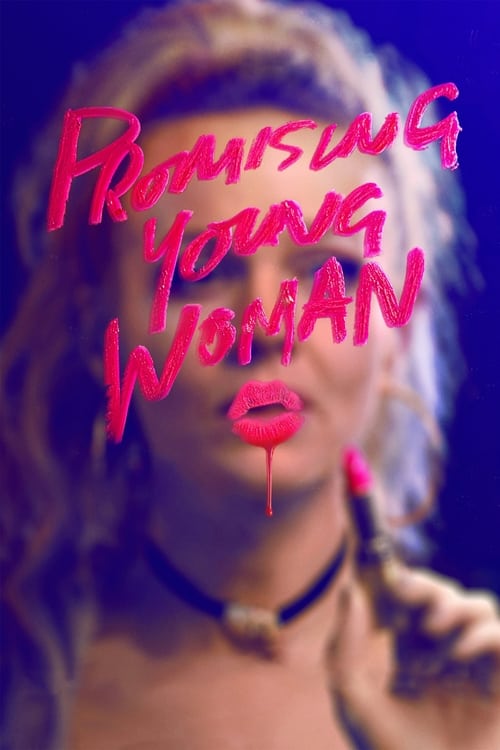
Promising Young Woman
2020 · Emerald Fennell
Saltburn made her the queen of divisive: bathwater scene memes, "eat the rich but make it horny" think-pieces, and class-tourism accusations, with her Wuthering Heights (Robbie/Elordi casting outrage) pre-generating discourse a year out. Criticizing or defending her is a personality.
When you want a film to chew on — provocative, stylish, and built to start conversations. Not a comfort watch despite the bubblegum surface; pick it when you're up for something that entertains you and then unsettles you.
What it's about
Cassie was a medical-school star until a tragedy involving her best friend derailed her life; now she's thirty, living with her parents, and working in a coffee shop. By night she goes to bars, pretends to be blackout drunk, and waits to see which self-styled nice guy will try to take her home — then confronts them stone sober. When a face from her past resurfaces, her private ritual sharpens into a plan.
The experience
It's a revenge thriller wrapped in candy colors and pop songs, and the clash is the point — funny, flirty, and poisonous by turns, with a mounting dread about where it can possibly go. It leaves you arguing with it, and with yourself, for days.
Performances
Carey Mulligan is extraordinary — she plays Cassie's charm, fury, and grief as one continuous performance, switching registers mid-scene, and Bo Burnham brings a disarming sweetness that the film uses expertly.
The craft
Emerald Fennell's Oscar-winning script is a machine of setups and reversals, and her direction weaponizes prettiness — pastel production design, needle-drop pop covers, romantic-comedy grammar — against the ugliness underneath. The casting of beloved comic actors as ordinary predators is its own sly device.
Why it matters
One of the defining films of the post-#MeToo moment, it won Fennell the Academy Award for Best Original Screenplay in her feature debut and reignited a broader argument about what the revenge movie owes its victims.
Snapshot
Promising Young Woman is the feature directorial debut of Emerald Fennell — a British actress and writer then best known for playing Camilla Parker Bowles in The Crown and for running the second season of Killing Eve — and it arrived as one of the defining films of the immediate post-#MeToo moment. Working from her own original screenplay, Fennell takes the exploitation architecture of the rape-revenge picture and reupholsters it in candy-colored, pop-scored irony. Carey Mulligan plays Cassie Thomas, a former medical-school prodigy who has abandoned her career and lives with her parents, spending her nights feigning drunkenness in bars to expose the predatory "nice guys" who try to take advantage of her. The film's central wound — the assault and subsequent death of Cassie's best friend Nina — is withheld and metered out, so that what looks like a stylish revenge caper reveals itself as a study of grief, institutional complicity, and the impossibility of catharsis. Its bleak, much-argued-over final act, in which Cassie is killed and her revenge completed posthumously, made it a lightning rod. It won Fennell the Academy Award for Best Original Screenplay and secured her a nomination for Best Director, making her the first British woman nominated in that category.
Industry & production
The film was produced by Margot Robbie's LuckyChap Entertainment — the company that would become a significant engine for female-driven projects, later culminating in Barbie — alongside FilmNation Entertainment, with Focus Features handling the release. This lineage matters: LuckyChap had positioned itself explicitly around stories foregrounding women, and Promising Young Woman was an early, comparatively low-budget statement of that mandate. Robbie, Josey McNamara, Tom Ackerley, and Ben Browning are among the credited producers.
The production was, by widely reported accounts, extremely compressed — Fennell shot the film on a tight schedule of roughly three-and-a-half weeks (commonly cited as around 23 days), and she was pregnant during the shoot. That economy is legible in the finished film's controlled, set-driven aesthetic rather than sprawling location work.
The release history was shaped by the pandemic. The film premiered at the Sundance Film Festival in January 2020 to strong notices, but its theatrical rollout was delayed by COVID-19 from an intended spring release to December 2020, positioning it squarely within an awards season conducted largely at home. Rather than a wide commercial play, it functioned as a specialty, discourse-driven release — the kind of mid-budget original that studios were increasingly reluctant to make and that its awards run helped justify. I won't cite specific grosses here, as I can't verify exact figures, but its cultural footprint far exceeded its scale.
Technology
Promising Young Woman was captured digitally, in keeping with standard practice for a contemporary specialty feature of its budget and schedule; the compressed shoot in particular favored the flexibility of digital acquisition. Cinematographer Benjamin Kračun built much of the film's look through lighting and production design rather than exotic capture technology — saturated neons, pharmacy-fluorescent whites, and pastel gels doing the heavy lifting. I don't want to assert a specific camera or lens package that I can't verify. The more consequential "technology" of the film is arguably its sound and music pipeline: the digital-era ease of licensing and re-arranging pop recordings underwrites its whole sensibility, most famously in a menacing string re-orchestration of Britney Spears's "Toxic."
Technique
Cinematography
Kračun's photography is essential to the film's central bait-and-switch. The visual grammar borrows from romantic comedy and music video — glossy, symmetrical, high-key, drenched in candy pastels and hot neon — precisely so that it can weaponize prettiness. The pharmacy where Cassie works, with its rows of confectionery and fluorescent brightness, becomes a recurring stage; nightclub and bar interiors are washed in reds, blues, and purples that recall both seduction and warning. The camera frequently holds Cassie in poised, deliberate compositions, and the film's palette curdles as the narrative darkens, culminating in the desaturated, greenish register of the bachelor-party climax. The look is a thesis: the surfaces of a culture that presents predation as charm.
Editing
Frédéric Thoraval's cutting governs the film's controlled release of information and its tonal whiplash. The structure is chaptered and episodic — Cassie's nocturnal "lessons" recur as variations on a theme — and the editing sustains an unstable comedy-to-menace rhythm, letting scenes read as flirtation before they tip into threat. The withholding of Nina's story is fundamentally an editorial strategy, doling out the backstory so that the audience's understanding of Cassie deepens retroactively. The final act's extended, agonizingly protracted violence is edited to deny the genre's usual release, and the closing volley of scheduled text messages is a piece of editorial sleight-of-hand that reframes everything preceding it.
Mise-en-scène / staging
Production designer Michael Perry and costume designer Nancy Steiner construct a world of deliberate, ironic sweetness. Cassie's wardrobe — pastels, cardigans, manicured nails, a look that reads as girlish and non-threatening — is a costume in the literal sense, a disguise she wears against a culture that reads femininity as availability. Her disguises for successive "targets" (a corporate professional, a nurse) foreground the theme of performance. The suburban parental home, the bubblegum pharmacy, and the sterile professional interiors all trade on a bright, ordered surface concealing rot. The climactic bachelor party stages horror inside kitsch — the color, costume, and music of celebration surrounding an act of murder.
Sound
The music supervision (by Susan Jacobs) and Anthony Willis's score are among the film's most discussed elements. The soundtrack leans on pop associated with feminized, disposable culture — Charli XCX's "Boys," Paris Hilton's "Stars Are Blind" (scoring a deliberately, disarmingly sincere romantic interlude) — and then turns that same idiom sinister. Willis's slowed, string-drenched instrumental arrangement of Britney Spears's "Toxic" is the signature gesture: a throwaway pop hook rebuilt as ominous, tragic underscore, the film's whole strategy of subversion compressed into a cue.
Performance
Carey Mulligan's Cassie anchors everything, a performance that modulates between deadpan control, flickers of warmth, and a hollowed-out grief that the film treats as her true condition; the character's affect is itself a performance-within-a-performance, and Mulligan calibrates when to let the mask slip. Bo Burnham, as the pediatrician Ryan, supplies genuine charm precisely so the film can interrogate it. Fennell's casting of recognizable, likeable comic and character actors — Adam Brody, Christopher Mintz-Plasse, Max Greenfield, Sam Richardson, Chris Lowell, Alison Brie — is a structural choice: familiar affable men cast as the "nice guys" whose decency dissolves under pressure. Supporting turns from Clancy Brown and Jennifer Coolidge (Cassie's parents), Laverne Cox, Connie Britton, Alfred Molina, and Molly Shannon fill out the moral ecology.
Narrative & dramatic mode
The film operates as a genre-inverting revenge narrative built on withheld information and tonal instability. Its dramatic mode is ironic and controlled: it presents itself first as a dark comedy of manners about dating and consent, then reveals the tragic structure underneath. Crucially, Cassie's "revenge" for most of the runtime is non-violent — she exposes, frightens, and shames rather than maims, a pointed refusal of the exploitation genre's bodily retribution. The narrative escalates from these ritualized lessons toward the men directly implicated in Nina's assault: the perpetrator Al Monroe, the enabling classmate, the dismissive dean, the lawyer who intimidated victims. The ending is the film's defining dramatic gambit and its most divisive: Cassie's plan ends with her own death at Al's hands, and her retribution is delivered from beyond the grave via pre-scheduled evidence and text messages that arrive during his wedding. The mode is deliberately anti-cathartic — it denies the audience the triumphant survival the rape-revenge form conventionally promises.
Genre & cycle
Promising Young Woman belongs to the rape-revenge tradition while functioning largely as its critique. The classical cycle — I Spit on Your Grave, Abel Ferrara's Ms. 45, and their descendants, up through Quentin Tarantino's Death Proof — resolves trauma through the victim's own escalating violence. Fennell adopts the revenge premise but withholds the genre's exploitation payoff: her protagonist inflicts fear and truth rather than injury, and the film's grimmest irony is that the one time genuine physical violence enters the story, it is enacted upon her. It sits at the intersection of neo-noir, dark comedy, and social-issue thriller, part of a broader post-#MeToo cycle preoccupied with female rage, institutional complicity, and the aftermath of assault. Its pastel-pop styling also connects it to a strain of ironic, feminized aesthetics that reads sweetness as camouflage.
Authorship & method
This is unmistakably Fennell's film — she conceived, wrote, and directed it, and its authorial signature is the collision of glossy, ingratiating surface with moral savagery, a sensibility she would extend and push further into transgression with Saltburn (2023). Her method here is one of controlled tonal subversion: recruit the visual and musical language of the romantic comedy and the pop single, then betray it. The key collaborators translate that vision: Benjamin Kračun's saturated, seductive cinematography; Frédéric Thoraval's whiplash, information-managing editing; Anthony Willis's score, with its subversive pop re-arrangements, alongside Susan Jacobs's music supervision; and Nancy Steiner's semiotically loaded costuming. As a writer, Fennell's craft is in the structural withholding and the casting logic that makes the audience complicit in liking the "nice guys." The screenplay's recognition — the Academy Award for Best Original Screenplay — reflects that the film's boldest work is architectural.
Movement / national cinema
Fennell is a British filmmaker, and Promising Young Woman is in part a product of British creative talent working within an American independent framework — a Hollywood-set, English-language film financed and distributed through the U.S. specialty system (Focus Features / FilmNation) with LuckyChap's Australian-British-American producing team behind it. It does not belong to a formal movement so much as to a transnational, post-#MeToo wave of women-directed films examining sexual violence and its institutional cover. Fennell's nomination as the first British woman for the directing Oscar situates the film within a moment of belated recognition for women behind the camera in the Anglo-American mainstream.
Era / period
The film is thoroughly of the late-2010s / 2020 reckoning that followed the 2017 Weinstein revelations and the #MeToo movement. Its concerns — the "he was just a kid," "boys will be boys" logic of institutions, the reflexive protection of promising young men (the title's bitter inversion of the phrasing often used to excuse assailants), the disbelief of victims — are direct engagements with the cultural conversation of its immediate moment. Its pandemic-shaped release in December 2020 also locates it precisely: an awards contender consumed largely on home screens during a period when the theatrical model itself was in crisis.
Themes
At its core the film is about grief masquerading as revenge — Cassie is not healing but arrested, her life suspended around a loss she cannot metabolize. It indicts complicity as much as perpetration: the "nice guys," the bystanders, the female administrators and friends who looked away, the lawyers who did the institution's dirtiest work. The title itself is the thesis, redirecting a phrase of sympathy usually reserved for male offenders back toward a woman whose promise was destroyed. Related threads run throughout: the performance of femininity as both disguise and trap; consent and the blurred, self-serving lines men draw around it; the failure of institutions — universities, the law, the police — to deliver justice; and the corrosive, self-consuming nature of vengeance. The ending's refusal of catharsis is itself thematic — an argument that revenge does not restore what was lost.
Reception, canon & influence
Critically, the film was widely praised and hotly debated from its Sundance premiere onward, singled out for Mulligan's performance, Fennell's audacious direction, and its formal daring, even as its ending divided viewers. The disagreement was substantive: some read the conclusion as a devastatingly honest refusal of feel-good vengeance and an indictment of a system that leaves women dependent on institutions that fail them; others found it bleak, punishing, or read the reliance on the arriving police as an unsatisfying deferral to authority. A notable flashpoint in the reception was a Variety review that made remarks about Mulligan's suitability for the role which drew significant backlash and to which the publication ultimately appended an apologetic note — an episode that became part of the film's larger conversation about how women's bodies and performances are appraised.
Its awards standing cemented its place: five Academy Award nominations including Best Picture, Best Director, Best Actress, and Best Film Editing, with a win for Best Original Screenplay.
Looking backward, the film draws on the rape-revenge exploitation lineage (from I Spit on Your Grave and Ms. 45 through Death Proof) chiefly in order to subvert it; on the "unlikeable," strategically self-presenting female protagonist associated with Gone Girl and Gillian Flynn's cultural moment; and on a candy-toned, ironic aesthetic tradition in which feminine surfaces mask danger. Looking forward, it stands as a defining entry in the post-#MeToo cycle of female-rage and reckoning films, and it launched Fennell as a provocateur-auteur whose subsequent Saltburn extended her method of seductive surface and transgressive content. As a LuckyChap production it also helped consolidate a producing model that channels female-authored, formally adventurous stories into the awards mainstream. Its most durable influence may be tonal: the demonstration that the visual and musical language of pop pleasure could be turned into an instrument of social critique.
A Deleuzian reading
A man is being kind.
The full Deleuzian reading of Promising Young Woman →
Reception
It detonated out of Sundance 2020 as the awards season's biggest lightning rod, winning Emerald Fennell the Original Screenplay Oscar — but the instant-classic glow has since curdled into something more contested, and it's now the standard exhibit in arguments about whether the #MeToo-era revenge movie ever really worked.
How Promising Young Woman was received, from release to now →
How to watch Promising Young Woman: what to notice on a first viewing
- Notice how bright, symmetrical, and pastel every scene looks. Kračun's candy-colored, high-key photography starts glossy and rom-com clean, then curdles into a desaturated green as the story darkens. The look is a thesis: it shows how prettiness can disguise predation until the surface finally cracks.
- Watch the faces of the 'nice guys' in early scenes. Fennell casts familiar, likable comic actors like Adam Brody and Max Greenfield, whose easy charm dissolves the moment they're alone with Cassie. concept
- Listen for a pop song rebuilt as a slow, ominous string arrangement. The soundtrack borrows bubblegum pop (Charli XCX, Paris Hilton) then turns the same idiom sinister with Anthony Willis's slowed cover. A throwaway pop hook becomes dread; the film's whole method of subversion is compressed into one cue.
- Notice Cassie's cardigans, pastels, and manicured nails. Her wardrobe shifts with each 'lesson'-a corporate professional, a nurse-but always reads as girlish and non-threatening. Costume functions as literal disguise against a culture that reads soft femininity as availability, not danger.
- Count how many nighttime 'lessons' repeat the same setup. Each episode plays as flirtation right up until it tips into threat, over and over, as a chaptered variation on one scene. concept
The whole guide to watching Promising Young Woman, with the keys for a rewatch →
Influences: the films it descends from and the films it influenced
- I Spit on Your Grave (1978) — Supplies the foundational rape-revenge grammar — assault, transformation, methodical hunting of perpetrators — that Fennell quotes structurally in order to withhold its promised bodily catharsis.
- Ms. 45 (1981) — Pioneers the avenger who weaponizes coded femininity as camouflage (the nun costume at the party), the direct precursor to Cassie's disguise-as-drunk-girl stings.
- Thelma & Louise (1991) — Establishes the anti-cathartic terminal ending in which female defiance is foreclosed by death rather than triumph, the structural gamble PYW extends by killing its heroine before delivering revenge.
- Death Proof (2007) — Models the genre-literate reclamation of exploitation cinema by a female collective, scored with cool pop cues and authorial irony rather than leering — the reflexive-revenge posture Fennell inherits.
- Gone Girl (2014) — Defines the strategically self-presenting 'unlikeable' woman whose performance of feminine niceness is itself the weapon, plus the meticulous information-management that doles out backstory as reveal.
- American Psycho (2000) — Demonstrates glossy consumerist surface and needle-drop set-pieces deployed satirically to mask predation — kitsch-conceals-rot staging filtered through a female director's ironic remove.
- The Virgin Suicides (1999) — Originates the candy-pastel palette and dreamy pop scoring of a lethal feminine surface, a lineage made literal by shared costume designer Nancy Steiner dressing both films' semiotics.
- Heathers (1988) — Weds a bright croquet-pastel color scheme to lethal high-school satire, the color-as-thesis technique of using saccharine hues to conceal moral rot.
- Blue Velvet (1986) — Pioneers the ironic rearrangement of a familiar pop standard (Roy Orbison) over kitsch-Americana surfaces that hide violence — the sonic template for Willis's slowed, sinister 'Toxic' cover.
- Lady Vengeance (2005) — The structural core of Geum-ja's deception — performing socially legible vulnerability or 'kindness' as the operative weapon of vengeance — is the direct formal precedent; Fennell's hyper-saturated pastel palette as ironic commentary on performed femininity extends Park's chromatic irony into a contemporary register.
- Molly's Game (2017) — Extends the competence-porn formal vocabulary into genre territory, with a female protagonist whose calculated strategic intelligence is revealed gradually through unreliable-narrator withholding — developing the gap between what the narrative tells us and what the protagonist actually knows into a full genre mechanism rather than a character-study device.
- The Last Duel (2021) — Uses pastel rom-com visual grammar as a rhetorical device — genre surface as argument — for demonstrating that institutional disbelief of women's assault testimony has been normalized into entertainment; the formal disjunction between visual register and subject matter develops the same genre-as-epistemology-argument The Last Duel pursues in historical costume.
- Saltburn (2023) — Directly extends Fennell's authorial method of seductive, immaculate surface betraying transgressive content, again using calculated needle-drops and class predation as its engine.
- Fresh (2022) — Builds on the subversive nice-guy casting gambit (Sebastian Stan's charm as trap) and pop-scored, femininity-as-bait staging, inheriting PYW's casting logic that makes the audience complicit.
- Do Revenge (2022) — Adopts the candy-pastel color-as-thesis and femininity-as-disguise playbook for teen revenge, explicitly styling saccharine surfaces as the mask over vengeful intent.
- Revenge (2017) — Reclaims the rape-revenge form through hyper-saturated, female-authored stylization, treating lurid color and design as reparative authorship rather than exploitation — Fennell's project in a bloodier key.
- The Assistant (2019) — Renders institutional complicity through anti-cathartic restraint, refusing any revenge payload — the same post-#MeToo indictment of enabling systems reached via minimalism instead of pastel irony.
- A Simple Favor (2018) — A Gone-Girl-descended pastel thriller trading in tonal whiplash between comedy and menace and the glamorous, self-mythologizing unreliable woman — the same surface-versus-rot register.
- Barbie (2023) — A fellow LuckyChap production that turns a hyper-saturated candy palette into an instrument of gendered social critique, consolidating the same producing model that channels formally bold, female-authored work into the awards mainstream.
- Woman of the Hour (2024) — Post-#MeToo female-authored genre revisionism that reorients sympathy toward victims and weaponizes a candy-coated surface to expose ordinary men's predation — the cycle Kendrick's film belongs to.
- Strange Darling (2024) — Weaponizes a candy-saturated palette and against-type casting inside a chaptered revenge structure to subvert victim/predator coding, the bright-genre-as-trap approach Strange Darling shares.
- Sorry, Baby (2025) — A post-#MeToo film whose candy-colored genre payoff is precisely what Sorry, Baby critiques by refusing depiction, catharsis, and revenge structure.
- Don't Worry Darling (2022) — Shares the candy-colored, hyper-stylized production design deployed against reactionary gender politics — the 'craft-outruns-thesis' elevated-genre mode staging a pointed critique of male entitlement.
- Blink Twice (2024) — An actress-directed post-#MeToo revenge film that weaponizes a candy-bright pastel palette against its own subject and runs the same tonal bait-and-switch of seductive surface curdling into indictment.
- "Wuthering Heights" (2026) — Source of Fennell's core method carried directly here: genre-and-beauty-as-bait that implicates the viewer, candy-saturated surfaces weaponized against their pleasure, and diegetic pop needle-drops scoring transgression.
Similar films
- Saltburn (2023) — influence & lineage · often watched together
- Gone Girl (2014) — influence & lineage
- Fresh (2022) — influence & lineage
- Three Billboards Outside Ebbing, Missouri (2017) — often watched together
- Emma. (2020) — shared sensibility
- "Wuthering Heights" (2026) — shared sensibility
- Anora (2024) — shared sensibility
- Strange Darling (2024) — shared sensibility