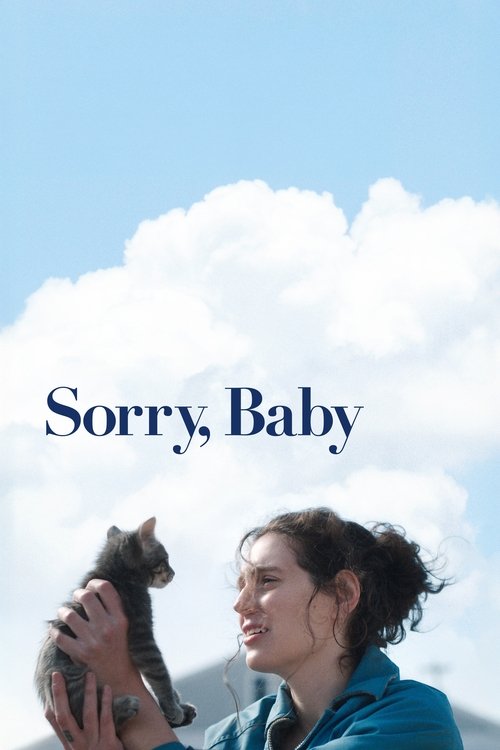
Sorry, Baby
2025 · Eva Victor
When you need a good cry that comes with real laughs attached — a film for feeling less alone about the slow, unglamorous work of getting better. Tender, honest, and ultimately a comfort.
What it's about
Agnes teaches English at the small New England college where she went to grad school, living alone in the house she once shared with her best friend Lydie — who has since moved to New York and is expecting a baby. A few years ago a 'bad thing' happened to Agnes, and despite her best efforts life hasn't gotten back on track. Told in chapters that hop around the years, it's a story about surviving something, and about the friendship that keeps a person tethered while they do.
The experience
Deadpan funny and quietly devastating, often in the same scene — it approaches the worst thing sideways, through awkward jokes, long silences, and a cat. It doesn't wallow; it observes, and its gentleness hits harder than melodrama would.
Performances
Eva Victor, writing and directing her own debut, gives Agnes a singular comic rhythm — brittle, hilarious, achingly guarded — and the film runs on the lived-in warmth between her and Naomi Ackie's Lydie, one of the truest screen friendships in recent memory.
The craft
Victor's script refuses every convention of the trauma drama: the assault happens offscreen, registered in a single patient exterior shot of a house at dusk, and the film's real subject is the recursive years after. The chaptered structure and dry, exact dialogue make grief and comedy share the frame without cheapening either.
Why it matters
A breakout of the 2025 Sundance festival, picked up by A24, it announced Eva Victor as a distinctive new writer-director voice and became a touchstone for how movies can handle sexual assault without exploiting it.
Snapshot
Sorry, Baby is the feature writing-directing debut of Eva Victor, who also takes the lead role of Agnes, a young English professor living alone in the New England house she once shared with her closest friend during graduate school. The film is organized around a "bad thing" — a sexual assault committed by Agnes's graduate thesis advisor — but it refuses the conventions of the trauma drama almost entirely. The assault is never sensationalized; it occurs largely offscreen, registered through an extended exterior shot of a house at dusk, and the film's real subject is the slow, recursive aftermath: the way a single event reorganizes a life around itself while the world keeps demanding that the survivor "get back on track." Premiering in the U.S. Dramatic Competition at the 2025 Sundance Film Festival and distributed by A24, the film arrived as one of the most acclaimed American independent debuts of its year, praised for marrying deadpan comic sensibility to a structurally daring, deeply controlled study of survivorship. It is at once a friendship film, a campus film, and an anti-trauma-narrative — a work that locates healing not in catharsis but in continuance.
Industry & production
Sorry, Baby was produced under Pastel, the production company founded by Barry Jenkins, Adele Romanski, and Mark Ceryak, with Jenkins among the film's producers — a significant institutional endorsement for a first-time feature director and a lineage that connects the film to the same independent ecosystem that produced Moonlight and Aftersun. A24 handled distribution, placing the film squarely within the most recognizable American art-house brand of the era, the company that has cultivated precisely the audience for formally adventurous, tonally idiosyncratic dramas of interiority.
The film's path ran through Sundance, where it premiered in January 2025 in the U.S. Dramatic Competition and won the Waldo Salt Screenwriting Award, an honor specifically recognizing the screenplay — fitting for a film whose achievement is so bound up in structure and voice. Eva Victor came to the project as a writer-performer with a background in online comedy and short-form video, plus acting credits including television work; Sorry, Baby represents a substantial leap from that profile to a triple role as writer, director, and star. Precise budget and box-office figures are not something I can state reliably, and I will not invent them; the film should be understood as a modestly budgeted independent feature whose value to its backers lay in prestige, festival positioning, and the launch of a distinctive new authorial voice rather than in commercial scale.
Technology
Sorry, Baby is, technologically, a film of restraint rather than spectacle, and it would be a mistake to read its quietness as a lack of craft. It was shot digitally — standard for an American independent of its budget and period — and its visual program depends on the controlled, naturalistic image latitude that contemporary digital capture affords in low and available light, particularly in interior and dusk scenes. The film makes no use of conspicuous effects, large-format gimmickry, or virtual production; its "technology" is essentially the disciplined deployment of lens, frame, and ambient light in service of a chamber drama. The exact camera and lens package is not something I can specify without risk of fabrication. What matters is the aesthetic decision the technology serves: a stable, often static image that resists the restless coverage and reactive handheld grammar typical of contemporary trauma realism, choosing instead duration and composure.
Technique
Cinematography
The cinematography is credited to Mia Cioffi Henry, and it is central to the film's meaning. The most discussed formal choice is the handling of the assault: rather than depict the act, the camera holds on the exterior of the advisor's house as time passes and the light fails, the violence elided entirely. The technique enacts the film's ethics — it refuses to make spectacle of suffering, and it locates the event's gravity precisely in what is withheld. Across the film the camera tends toward stillness, medium and wide framings, and a patient observational distance that lets discomfort accumulate within the shot rather than be cut around. This composure is what allows the comedy to breathe: deadpan exchanges play out in held frames where the actors' timing, not the editing, carries the joke. The New England settings — domestic interiors, the campus, cars, a roadside — are rendered in a muted, lived-in palette that privileges atmosphere and seasonal melancholy over prettiness.
Editing
The film's structure is its most striking technical signature: it is told non-chronologically, divided into titled chapters ("The Year with…" constructions) that reorganize Agnes's timeline around relationships and intervals rather than plot causality. This chaptering allows the film to place the "bad thing" not at a climax but embedded in the middle of an ongoing life, so that aftermath precedes and surrounds cause. The editing rhythm is unhurried, favoring scenes that run long enough to shift register — from comic to painful and back — within a single sustained beat. I cannot reliably name the editor without risk of error, so I will not attribute the cut to a specific individual; the editorial intelligence, however, is inseparable from the screenplay's architecture, and the two should be read as a single design.
Mise-en-scène / staging
The film's world is built around a single anchoring location — the graduate-era house that Agnes still inhabits — which functions as both refuge and trap, a space saturated with the absence of her departed friend Lydie. Staging emphasizes Agnes alone in rooms, the domestic frame underscoring stasis and isolation, against which the arrivals of others (Lydie, a kindly neighbor, a sympathetic stranger) register as ruptures of warmth. Props and recurring spaces — the house, the campus office, a car, a sandwich shop — carry emotional weight through repetition. The mise-en-scène consistently externalizes the theme of being "stuck": Agnes is repeatedly framed within thresholds and interiors while the people who have moved on inhabit elsewhere.
Sound
The sound design favors quiet and the textures of ambient, everyday life over scoring, in keeping with the film's naturalism. Music is used sparingly and pointedly rather than as continuous emotional underlining. I believe the original score was composed by Lia Ouyang Rusli, though I flag a degree of uncertainty on that attribution and will not overstate it. What is clear from the film itself is that silence and restraint are load-bearing: the absence of swelling music during the film's hardest passages is precisely what keeps them from tipping into melodrama, and the comedy likewise depends on dry acoustic space in which awkward pauses can land.
Performance
Performance is the film's beating heart, and Eva Victor's central turn as Agnes is its defining achievement — a performance built on deadpan deflection, comic precision, and a guardedness that periodically gives way to raw feeling. Victor's background in comic timing is fully integrated into a dramatic role; the humor is never a relief valve bolted onto pain but the very idiom through which Agnes survives. Naomi Ackie, as Lydie, supplies the film's emotional ballast: the friendship between the two women is rendered with a tactile, unforced intimacy that makes Lydie's departure for New York and impending motherhood quietly devastating. The supporting ensemble — including Lucas Hedges as a gentle romantic presence and John Carroll Lynch in a memorable sequence of unexpected kindness — works in the same key of understatement. The casting of recognizable performers in small, warm roles reinforces the film's thesis that recovery comes in glancing human encounters rather than grand gestures.
Narrative & dramatic mode
Sorry, Baby operates in a mode that might be called comic realism in the service of trauma, and its dramaturgy is deliberately anti-climactic. The non-linear, chaptered structure dissolves the conventional rising action of the assault narrative; by the time the "bad thing" is depicted, the audience already knows Agnes both before and after it, so the event is recontextualized as one node in a continuing life rather than the engine of a revenge or recovery plot. The dramatic mode privileges the texture of duration — the long tail of recovery, the relapses and small advances — over resolution. Crucially, the film grants Agnes interiority and humor rather than victimhood, and it resists the genre's habit of routing healing through confrontation, prosecution, or romantic rescue. Its emotional climaxes are conversational and intimate, and its ending offers continuation rather than closure.
Genre & cycle
The film sits at the intersection of several traditions. As a comedy-drama it belongs to a contemporary American independent cycle of tonally hybrid, female-authored character studies that fuse deadpan humor with serious emotional inquiry. As a treatment of sexual assault it participates in, and pointedly revises, the post-#MeToo cycle of survivor-centered films — but where many such works (e.g., the confrontational Promising Young Woman or the procedural She Said) foreground justice, retribution, or institutional reckoning, Sorry, Baby deliberately turns inward and downward in scale, toward the private and the ongoing. It also draws on the friendship film and the campus/academic film, using the university not as a site of intellectual romance but as the institution that both houses the harm and blandly fails to address it.
Authorship & method
The dominant authorial signature is Eva Victor's, and the film is best understood as a unified author's work: Victor wrote, directed, and stars, controlling tone, voice, and rhythm to an unusual degree for a debut. The method is one of tonal control — the disciplined management of the slide between comedy and pain that defines every scene. Among collaborators, cinematographer Mia Cioffi Henry is the most consequential, her composed, withholding camera giving Victor's screenplay its formal correlative; the elided-assault sequence is as much a directorial-photographic decision as a written one. The producing presence of Barry Jenkins and Pastel situates Victor within a mentorship lineage notable for first- and second-feature directors working in registers of memory, interiority, and elliptical structure. I will not assert specific editor or composer credits beyond what I have flagged, but the screenplay-editing relationship — the chaptered, achronological design — is the clearest evidence of authorial method, recognized concretely by Sundance's screenwriting award.
Movement / national cinema
The film belongs to contemporary American independent cinema, specifically the A24-adjacent strain of the late 2010s and 2020s that prizes auteur-driven, emotionally precise, formally controlled small-scale dramas. It is not part of a formal movement in the historical sense, but it is legible within a loose tendency of female and queer-authored American indies foregrounding interiority and structural experiment. Its New England setting roots it in a regional American milieu — academic, autumnal, withdrawn — that reinforces its themes of isolation and stasis.
Era / period
Sorry, Baby is firmly a film of its post-#MeToo moment, made and received in a period when cinematic depictions of sexual violence were under intense scrutiny and when audiences and critics had grown wary of both exploitation and pious advocacy. Its achievement is partly historical timing: it answers the question of how to represent assault after that cultural reckoning by choosing elision, interiority, and humor over depiction and didacticism. It also reflects a 2020s independent climate in which festival debuts by multi-hyphenate creators — particularly those emerging from online and comedic spaces — could be elevated rapidly to prestige status through institutions like Sundance and A24.
Themes
The film's central theme is survivorship as continuance rather than recovery — the recognition that a "bad thing" does not resolve but is instead lived alongside. Closely bound to this is the theme of being stuck: arrested in place while others (Lydie, with her move and her pregnancy) advance into conventional adult futures. Friendship emerges as the film's true love story and its primary mode of care, set against the failures of institutions — the university, ostensibly therapeutic or legal channels — to offer meaningful redress. The film also meditates on time itself, its chaptered structure arguing that trauma scrambles chronology and that healing is non-linear. Kindness from near-strangers recurs as a quietly redemptive motif, and humor is figured throughout as a survival technology, a way of holding terror at a livable distance. The closing notes around Lydie's baby — and the title's address, "sorry, baby" — gesture toward tenderness, futurity, and self-forgiveness.
Reception, canon & influence
Critically, Sorry, Baby was received as a standout debut, widely praised for its tonal control, its ethical handling of assault, and the strength of Victor's central performance and screenplay; the Waldo Salt Screenwriting Award at Sundance 2025 is the most concrete marker of that esteem. Reviews tended to single out the same qualities I have emphasized: the elision of the assault, the deadpan-to-devastating tonal command, and the foregrounding of female friendship. I will not cite specific quotations, scores, or grosses, as I cannot verify exact figures.
Its influences run backward to several lineages: the A24/Pastel house style of elliptical, memory-inflected interiority (the Aftersun and Moonlight tradition behind its producers); the post-#MeToo survivor film, which it both joins and critiques; and a broader vein of deadpan American indie comedy-drama in which humor and grief share a single tonal space. Its forward influence is, given its recency, still emerging and should not be overstated — but its most likely legacy is as a model for how to dramatize sexual trauma without depiction or didacticism, and as a launchpad for Eva Victor as a multi-hyphenate authorial voice. Where the historical record of its long-term impact is genuinely thin, that is because the film is too new for its influence to be assessed; what can be said with confidence is that it arrived as a calling-card debut that reframed the trauma drama around endurance, friendship, and the stubborn persistence of ordinary life.
A Deleuzian reading
The camera stays outside.
The full Deleuzian reading of Sorry, Baby →
Reception
Premiered as the word-of-mouth sensation of Sundance 2025 — Waldo Salt Screenwriting Award, 100% on Rotten Tomatoes, an $8M A24 bidding war — and unlike many festival darlings it held: by year's end it was the consensus debut of 2025, with Victor winning Best Directorial Debut from the National Board of Review and a Golden Globe acting nod.
How Sorry, Baby was received, from release to now →
How to watch Sorry, Baby: what to notice on a first viewing
- Watch how still the camera stays during hard conversations. Cioffi Henry holds medium and wide shots at a patient distance instead of cutting in, letting discomfort or joy sit in the frame instead of being edited around. The stillness lets you sit with a scene as long as Agnes does, instead of being told how to feel.
- Notice the chapters are named for people, not dates. The story is broken into chapters named for relationships and stretches of time, not a straight timeline, so events are grouped by who Agnes was with rather than by when they happened. Grouping the story by relationship instead of date changes what counts as the film's real subject.
- Listen for how rarely music plays under a scene. The film mostly withholds a score, leaving quiet and ordinary background noise even in its hardest and funniest moments, so nothing is telling you how to feel. The silence keeps the film from tipping into melodrama in either direction, sad or funny.
- Watch Agnes deflect with a joke, then watch her face. Victor plays Agnes through deadpan deflection and dry comic timing that periodically drops to let raw feeling show through, without the film underlining the shift. The humor is not relief from the pain. It is how Agnes carries it.
- Notice how often Agnes is filmed alone in the house. The graduate-era house Agnes still lives in keeps reappearing, and she is staged alone in its rooms even when the film cuts to people who have moved elsewhere. The house becomes a visible measure of how long Agnes has stayed in one place.
The whole guide to watching Sorry, Baby, with the keys for a rewatch →
Influences: the films it descends from and the films it influenced
- Aftersun (2022) — The direct Pastel-house model: an elliptical, memory-inflected structure and a composed, withholding camera that lets emotional rupture occur off-frame — the formal template for Mia Cioffi Henry's photography here.
- Moonlight (2016) — Jenkins's tripartite chaptered architecture and interior, close-register direction is the producing-mentor lineage Victor inherits through Pastel, including the chaptered achronological scaffolding.
- Manchester by the Sea (2016) — Non-chronological design that structurally withholds the central trauma and reveals it late, while grief and deadpan comedy share a single uninterrupted scene — Victor's exact tonal/editing strategy.
- You Can Count on Me (2000) — Naturalistic deadpan two-hander dialogue in which humor and pain occupy the same line of speech, the template for managing the comedy-to-devastation slide.
- Certain Women (2016) — Static, withholding framing and anti-climactic minimalism where significant events register in stillness and duration rather than incident or score.
- 4 Months, 3 Weeks and 2 Days (2007) — The long-take static frame that stages trauma by keeping the violence off-screen and the camera fixed — elision-as-form rather than depiction.
- The Souvenir (2019) — Autobiographical elliptical structure with the abuse kept off-screen, built from composed, distanced static tableaux and pointed temporal gaps.
- Frances Ha (2012) — Episodic, intertitled chaptered structure organized around female friendship, with a deadpan writer-star register charting arrested adulthood.
- Tiny Furniture (2010) — The multi-hyphenate writer-director-star calling-card debut, deadpan and single-location-leaning, establishing the authorial-voice launchpad model Victor follows.
- Women Talking (2022) — Post-#MeToo survivorship drama that elides the assaults entirely and dramatizes only the aftermath, foregrounding female collectivity over depiction.
- Promising Young Woman (2020) — A post-#MeToo film whose candy-colored genre payoff is precisely what Sorry, Baby critiques by refusing depiction, catharsis, and revenge structure.
- Obvious Child (2014) — Comedian-led female indie that fuses stand-up deadpan timing with a serious women's-body subject, handled without didacticism.
- Lady Bird (2017) — A writer-director's tonal control over the comedy/pain seam in a deadpan coming-of-age register, advancing the female multi-hyphenate authorial model.
- The Worst Person in the World (2021) — Explicitly chaptered, intertitled episodic structure tracking a young woman's drift, holding comedy and melancholy in one tonal register.
- Appropriate Behavior (2014) — Multi-hyphenate writer-director-star debut using non-chronological, achronological cutting and deadpan delivery to stage personal rupture.
- The Tale (2018) — Reconstructs sexual trauma through fractured, non-chronological memory and elision, dramatizing survivorship as an act of editing one's own narrative.
Similar films
- Lady Bird (2017) — influence & lineage · same viewing thread
- The Worst Person in the World (2021) — influence & lineage · same viewing thread
- Promising Young Woman (2020) — influence & lineage
- Twinless (2025) — same viewing thread
- Cha Cha Real Smooth (2022) — same viewing thread
- A Man Called Ove (2015) — same viewing thread
- Blue Heron (2026) — same viewing thread
- Humanist Vampire Seeking Consenting Suicidal Person (2023) — same viewing thread
All the films related to Sorry, Baby →
Watch it with: curated runs of related films
- Funny Because It Aches — A run of tender, deadpan dramedies where love, grief, and the panic of becoming yourself all get metabolized through jokes — watch these when you want to laugh and cry in the same scene.