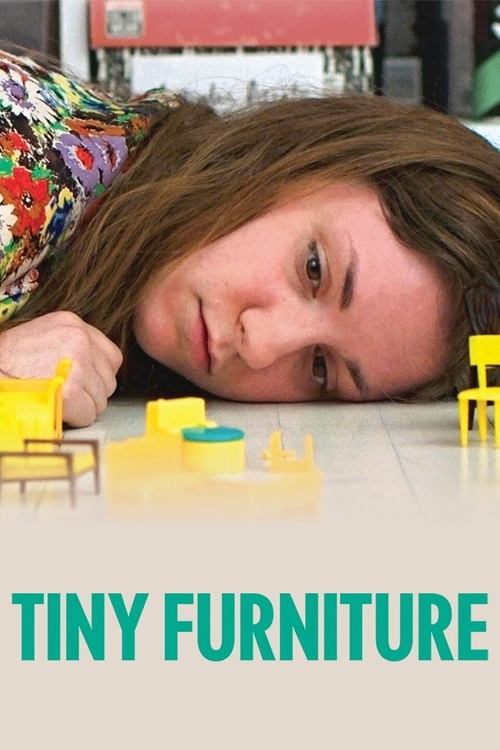
Tiny Furniture
2010 · Lena Dunham
For when you're feeling adrift and want a film that admits how unglamorous that is — best watched when you can laugh at aimlessness rather than needing rescue from it. Prickly comfort, not a warm bath.
What it's about
Aura, twenty-two and fresh out of film school, moves back into her mother's TriBeCa loft with a useless degree and no plan. She takes a hostessing job, orbits two unpromising men, feuds with her overachieving younger sister, and tries to figure out whether her little internet video makes her an artist. Lena Dunham wrote, directed, and stars — filming in her actual family home, with her real mother and sister playing versions of themselves.
The experience
Deadpan, uncomfortable, and sneakily funny — it studies its heroine's floundering with a candor that refuses to flatter her. The humiliations are small, precise, and painfully plausible; you cringe and laugh in the same breath.
Performances
Lena Dunham's willingness to play Aura entirely without vanity is the film's engine, and casting her real mother, artist Laurie Simmons, gives the mother-daughter scenes a lived-in friction no script could fake.
The craft
A defining micro-budget experiment: shot on a consumer digital camera inside the family's own loft, its clean, composed frames making poverty of means look like a deliberate aesthetic. The writing does the heavy lifting — flat, funny, exactingly awkward dialogue that turns privilege and drift into comedy.
Why it matters
Its SXSW prize and breakout reception made it a landmark of the DIY filmmaking wave and launched Dunham toward creating the HBO series Girls — proof that a self-made, self-starring feature could open every door.
Snapshot
A twenty-two-year-old film-school graduate returns to her mother's TriBeCa loft with a useless degree, a YouTube video of herself in a fountain, and no plan. Over roughly ninety minutes she takes a hostessing job, sleeps with a chef in a construction pipe on the street, lets a semi-famous internet comedian squat on her sofa, fights with her sister, and ends up in her mother's bed. That is the whole of it. Tiny Furniture is one of the defining American micro-budget features of its decade less for what happens in it than for the conditions of its making: written, directed by, and starring Lena Dunham; shot inside her actual family home; co-starring her actual mother, the artist Laurie Simmons, and her actual sister, Grace Dunham. It won the Best Narrative Feature jury prize at SXSW in 2010, was picked up by IFC Films, earned Dunham the Independent Spirit Award for Best First Screenplay, and — extraordinarily for a debut made for a reported sum in the tens of thousands of dollars — was inducted into the Criterion Collection in 2012, months before HBO's Girls made its director a generational lightning rod. It is simultaneously a small, tossed-off film about being stuck and a hinge document in three larger stories: the DSLR's arrival as a legitimate feature format, the passage of American indie autofiction from festival curio to television, and the still-unresolved argument about whose drift gets to be treated as universal.
Industry & production
The economics are the argument. Tiny Furniture was made under conditions that had become newly available around 2009–2010 and that the film exploits with unusual self-awareness: a free and photogenic location (the Simmons–Dunham loft in TriBeCa, home of Laurie Simmons and the painter Carroll Dunham), a cast drawn from family and friends, a crew small enough to fit in that loft, and a camera body that cost less than a single day's rental of a film package. The budget is widely reported at roughly $65,000, with lower figures also in circulation; the precise number, like the exact shooting schedule, is one of those production details the public record has never firmly fixed, and it is worth naming that vagueness rather than papering over it. Producers Kyle Martin and Alicia Van Couvering — the latter a significant connective figure in the New York micro-budget scene of the period — brought it to SXSW, where the jury prize converted a self-financed project into a distributed one.
Dunham arrived with a track record, if a small one. The web series Delusional Downtown Divas and the feature Creative Nonfiction (2009), also a SXSW premiere, had already established her method: shoot cheap, cast yourself, mine the immediate surround. Tiny Furniture is that method applied to a better location with a better cinematographer.
IFC Films handled the release in November 2010, on the day-and-date theatrical/VOD model the company had been building out — a distribution architecture that suited a film with no stars, no marketable premise, and a young audience already accustomed to watching things at home. The theatrical footprint was modest; the film's real diffusion was digital and, subsequently, disc. Criterion's 2012 edition, packaging Creative Nonfiction and a recorded conversation between Dunham and Nora Ephron among its supplements, functioned as a canonization event that preceded the work usually cited to justify it. Judd Apatow saw the film, and the line from that viewing to Girls (HBO, 2012–2017) is the single most consequential fact of its industrial afterlife: Tiny Furniture is the pilot that got made as a feature.
Technology
The film is inseparable from the Canon EOS 7D. Canon's 5D Mark II (2008) had put usable full-frame video into the hands of anyone with a few thousand dollars, and the 7D (2009) followed with an APS-C sensor at a lower price. Within two years these bodies had gone from stills cameras with a video afterthought to a legitimate acquisition format — 2010 was also the year an episode of network television was shot on a 5D — and Tiny Furniture stands as one of the format's proof-of-concept features.
The DSLR's technical profile in 2010 was a set of constraints as much as affordances: H.264 recording with limited grading latitude, rolling-shutter skew on fast pans, moiré and aliasing on fine patterns, twelve-minute clip limits, no usable onboard audio (dual-system sound and post-sync were mandatory), and a shallow depth of field that most first-time users treated as a toy. What distinguishes Tiny Furniture from the wave of DSLR work around it is that cinematographer Jody Lee Lipes and Dunham declined nearly all of the format's temptations. The camera mostly sits still. Stops are held closed enough to keep whole rooms legible. The shallow-focus effect that defined amateur DSLR aesthetics in this period is largely absent. The technology enabled the film's existence; it did not dictate its look.
Technique
Cinematography
Jody Lee Lipes — who had come from documentary and dance film (Brock Enright: Good Times Will Never Be the Same, NY Export: Opus Jazz) and who would go on to shoot Martha Marcy May Marlene, episodes of Girls, and Manchester by the Sea — gives the film a compositional rigor that is genuinely anomalous for its budget class and its moment. Where mumblecore had made a virtue of handheld drift, blown windows, and available-light murk, Lipes shoots the loft as a white gallery box: locked-off tripod frames, clean horizontals, doorways and thresholds used as internal framing devices, figures placed small within large volumes of empty architecture. Wide shots hold rather than cut in. The visual grammar borrows from Laurie Simmons's own photographic practice — carefully staged interiors, deadpan frontality, a subject arranged inside a designed space — which turns the film's style into an argument about its subject. Aura is a figure posed in her mother's composition.
Editing
Lance Edmands (later the director of Bluebird) cuts long. Scenes are permitted to run past the point of dramatic utility into embarrassment; the humor and much of the pain live in the seconds after a line lands badly and no one rescues it. There is little coverage-driven shot/reverse-shot; conversations play in sustained two-shots or single wides, which places the burden on staging and performance and denies the audience the reassurance of a cutting rhythm. Transitions between episodes are abrupt, with minimal connective tissue — a structure that reads as shapelessness on first viewing and as accurate description of an unemployed summer on second.
Mise-en-scène / staging
The loft does enormous work. It is white, high-ceilinged, art-filled, expensive, and almost entirely without soft surfaces — a home that photographs beautifully and comforts no one. Class is not discussed in the film; it is built into the walls. Simmons's miniature-furniture photographs, the source of the title, hang and appear as objects: images of dolls arranged in domestic dioramas, which the film places behind a daughter who cannot arrange her own life. Aura's sleeping arrangements — displaced from her room, on a sofa, eventually in her mother's bed — track her regression spatially. The exteriors are equally pointed: the sex scene inside a length of street construction pipe is the film's most-cited image precisely because it stages intimacy as something conducted in public infrastructure, without shelter or dignity, by two people who have nowhere else to go.
Sound
Sound design is naturalistic and unshowy, built on location recording and room tone, with the loft's hard surfaces giving dialogue a slightly cool, reverberant quality that reinforces the space's inhospitability. Scoring is sparse — Teddy Blanks, a frequent Dunham collaborator on music and title design, is credited with the film's music — and used in brief, unsentimental passages rather than as emotional underwriting. Long stretches play dry. The restraint matters: without score to tell the audience how to feel about a humiliation, the humiliations stay ambiguous.
Performance
The casting is the film's riskiest device and its most productive one. Laurie Simmons and Grace Dunham are not actors; they play versions of themselves opposite a daughter and sister playing a version of herself, in their own home. What this produces is not documentary naturalism but a peculiar flatness — line readings delivered slightly askew, timing that lands a half-beat off, an affectlessness that reads as both the milieu's actual social register and as amateurs concentrating. Around this core, Dunham places practiced performers: Jemima Kirke as Charlotte, whose brittle glamour and unearned confidence supply the film's comic engine; Alex Karpovsky as Jed, importing the deadpan he had honed in Andrew Bujalski's and Joe Swanberg's films; David Call as Keith; Merritt Wever and Amy Seimetz in restaurant-world roles. The mixture is deliberate. Kirke and Karpovsky would both follow Dunham to Girls.
Dunham's own performance is the historically consequential one. She puts her body on screen unglamorously and repeatedly — eating, undressing, working, having bad sex — in a register that refuses both self-deprecation and defiance. Much of the criticism the film attracted, and vastly more that Girls attracted, organized itself around this choice.
Narrative & dramatic mode
The film is episodic and deliberately anticlimactic: a picaresque of small humiliations rather than a story with an arc. Aura wants something she cannot name, pursues two men who are respectively indifferent and exploitative, fails at a job she is overqualified for and bad at, and arrives at no decision. The nearest thing to a turn is her discovery of her mother's college-era diaries, which reveal Siri to have been, at twenty-two, as adrift and as unimpressive as Aura is now. The final scene — the two women in bed, talking about those diaries — supplies not resolution but recognition: the drift is inherited, and it ended in a loft and a career, which is either consoling or maddening depending on how much you think that outcome was available to Aura in the first place.
The mode is autofiction, and the film is unusually literal about it. The house is the house, the mother is the mother, the art on the walls is the art. Aura's viral-ish video of herself in a fountain in her underwear corresponds to Dunham's own early video work; Aura's Ohio film school stands in for Dunham's Oberlin. The film neither confesses this nor conceals it, and the resulting instability — is this a performance of a self or the self performing? — is the actual subject.
Genre & cycle
Formally it is a comedy of embarrassment; generically it belongs to the post-collegiate drift film, a durable American cycle running from The Graduate through Noah Baumbach's Kicking and Screaming, Terry Zwigoff's Ghost World, and Andrew Bujalski's Funny Ha Ha. Its immediate cycle is the recession indie: films made cheap, about young people whose credentialed expectations had just been invalidated by the 2008 collapse. Where earlier drift films could treat aimlessness as a phase, Tiny Furniture arrives at the moment when moving home became a demographic condition, and it registers this without ever mentioning the economy.
Authorship & method
Dunham's authorship is total and unusually undisguised: writer, director, lead, and — through the casting of her family and the use of her home — the film's raw material. Her method is to convert access into production value. She could not afford a set, so she used a museum-grade loft she had keys to; she could not afford actors, so she cast people whose real relationships supplied subtext no rehearsal could manufacture. Against the mumblecore norm, the film was scripted rather than improvised, which accounts for the dialogue's shapely cruelty — these are written lines performed with amateur timing, a combination with no obvious precedent.
The key collaborators are load-bearing. Lipes supplies the formal seriousness that separates the film from its DIY peers and makes the Criterion induction defensible on craft grounds. Edmands's patient cutting sets the tonal temperature. Blanks's minimal score and design sensibility establish the deadpan-graphic register Dunham would carry into Girls. Producers Kyle Martin and Alicia Van Couvering connected the project to the New York micro-budget infrastructure that got it seen.
Movement / national cinema
Tiny Furniture is routinely filed under mumblecore and sits awkwardly there. It shares the movement's personnel (Karpovsky, Seimetz), its scale, its subject matter, and its refusal of plot. It does not share its aesthetic: the film is composed where mumblecore is casual, scripted where mumblecore is improvised, and set among inherited Manhattan wealth where mumblecore was largely a cinema of unremarkable apartments in unremarkable cities. It is better understood as the hinge at which the American micro-budget mode acquired production polish and metropolitan class specificity — post-mumblecore, and pointedly downtown rather than outer-borough.
Era / period
2010 is legible in the film at three levels. Economically: the boomerang generation, the devalued liberal-arts degree, the service job as the terminus of an expensive education. Technologically: the DSLR, YouTube micro-celebrity as a plausible identity (Jed's "Nietzschean Cowboy" persona), the early social-media self as something one curates and is then trapped inside. Industrially: day-and-date VOD, festival-to-distributor pipelines running through SXSW rather than only Sundance, and the imminent migration of this exact voice to premium cable, where budgets, audiences, and scrutiny were all an order of magnitude larger.
Themes
Inheritance and its inadequacy: Aura has been given everything except a way to use it. Class as an unspoken medium rather than a topic. The daughter-as-artwork — a young woman raised inside her mother's photographic practice, unable to become a subject rather than an object. Female embodiment refused the usual cinematic management. Sexual encounters as transactions of attention in which the woman consistently overpays. And, running under all of it, the question of whether a life can be authored at all when the materials are entirely borrowed.
Reception, canon & influence
Critical reception was strong and, from the outset, split along a fault line the film could not resolve. Reviewers praised the writing's precision, Lipes's images, and the nerve of Dunham's self-presentation; the SXSW jury prize and the Independent Spirit Award for Best First Screenplay ratified that view. The counter-position — that the film was a nepotistic artifact asking audiences to find a wealthy white Manhattanite's inertia universal, and that it mistook privileged self-scrutiny for candor — was present in 2010 and became the dominant frame after Girls. Both readings survive; the film is honest enough about its milieu that it supplies evidence for each. Criterion's 2012 release was the most consequential single act of reception, granting a $65,000 debut the institutional standing of a classic before its director had a body of work, and provoking its own round of argument about what canonization is for.
Looking backward, the influences are legible and largely acknowledged: Woody Allen's Manhattan chamber comedies and the aestheticized interiors of Interiors; Whit Stillman's Metropolitan, another Criterion-blessed film about articulate, useless young people in expensive apartments; Nicole Holofcener's Walking and Talking for female friendship rendered without softening; Baumbach's post-graduate paralysis; Bujalski's Funny Ha Ha for the template of the drifting young woman filmed without judgment; Miranda July for the deadpan-confessional register; and, most directly, Laurie Simmons's own photography, whose staged domestic miniatures the film reproduces at human scale.
Forward, its influence runs along two channels. The first is Girls, which took the film's voice, two of its actors, its cinematographer, and its method to HBO and made all of it culturally central for five years. The second is broader: Tiny Furniture helped establish a viable model for the female-authored, self-starring autofictional comedy in which the writer-director is also the body on screen and the discomfort is the point. Desiree Akhavan's Appropriate Behavior, Gillian Robespierre and Jenny Slate's Obvious Child, Emma Seligman and Rachel Sennott's Shiva Baby, and the television lineage running through Broad City, Fleabag, Insecure, and Search Party all operate in territory this film helped make legible to financiers and audiences alike. It is also, alongside a handful of contemporaries, the film that retired the assumption that a feature's image quality could be read off its budget.
A Deleuzian reading
A length of construction pipe sits on a street, the way pipe does before it goes into the ground.
The full Deleuzian reading of Tiny Furniture →
Reception
A SXSW 2010 breakout that had critics anointing Dunham a generational voice, it got swallowed almost immediately by Girls — and then by the backlash to Dunham herself. Watched now, it's either a time capsule of early-2010s DIY indie or the origin story people revisit to argue about.
How Tiny Furniture was received, from release to now →
How to watch Tiny Furniture: what to notice on a first viewing
- Watch the camera stay locked off instead of following anyone. Lipes shoots the loft on a tripod with clean horizontals, holding wide rather than cutting in, so the space around Aura stays as legible as she is. The stillness of the camera makes the apartment feel like a designed space she has to live inside.
- Notice the mother's miniature-furniture photographs hanging on the walls. Images of tiny dolls arranged in perfect domestic dioramas hang behind a daughter who cannot arrange her own life at any scale. The art on the walls keeps commenting on the daughter standing in front of it.
- Notice conversations held in one wide shot without a cut. Edmands lets scenes run past their dramatic point into discomfort, refusing the reassurance of shot and reverse shot most comedies rely on. You watch the awkwardness at the same distance the characters do, with nowhere to cut away to.
- Watch where Aura sleeps change over the course of the film. She moves from her old bedroom to the sofa to her mother's bed, and the film tracks her situation through where she is allowed to sleep. Her decline is measured in furniture and floor space, not in speeches about how she feels.
- Watch the family members deliver lines a half-beat off from natural. Dunham cast her actual mother and sister rather than actors, and their timing lands slightly askew, unlike any professional performance in the film. You can never quite decide if you're watching a family or three people concentrating hard on acting like one.
The whole guide to watching Tiny Furniture, with the keys for a rewatch →
Influences: the films it descends from and the films it influenced
- Jeanne Dielman, 23 quai du Commerce, 1080 Bruxelles (1975) — Frontal locked-off camera at a fixed height holding domestic action long past narrative utility, with figures framed through doorways into adjoining rooms — the duration-as-pressure grammar Dunham and Lipes transpose from a Brussels flat to a Tribeca loft.
- Interiors (1978) — Gordon Willis's treatment of a monochrome designed apartment as a composed gallery box, blocking figures against furniture and blank wall so the décor itself carries the family's status and chill — the direct model for the loft's white-cube framing.
- Metropolitan (1990) — Fully scripted epigrammatic dialogue about articulate idlers, delivered by inexperienced actors in unemphatic near-flat readings inside borrowed upscale apartments covered in wide static masters — the same written-lines/amateur-timing combination.
- Kicking and Screaming (1995) — Structures post-graduate paralysis as verbal duel rather than plot: scenes built on defensive wit that deflate into anticlimax, the shape of Aura's returns-home conversations.
- Walking and Talking (1996) — Female friendship written for mutual small cruelties and left unresolved, with the camera declining to soften the exchange or side with either woman — the register of the Aura/Charlotte scenes.
- Funny Ha Ha (2002) — Template of the drifting young woman filmed without authorial judgment — non-professional cast, dead air deliberately retained in the cut, scenes cut off before a decision is reached.
- Me and You and Everyone We Know (2005) — Artist-director installed as onscreen lead in a deadpan-confessional register where staged art objects and gestures perform the emotional labor the dialogue withholds.
- The Music of Regret (2006) — Simmons's own staged-miniature grammar — dolls and dioramas standing in for domestic tableaux — which Tiny Furniture reproduces at human scale by casting Simmons, her loft, and her actual work as set and subject.
- Momma's Man (2008) — The exact device of casting one's own artist parents as themselves and shooting inside their real art-crammed downtown loft, so the apartment's accumulated objects supply biography no production design could fabricate.
- Afterschool (2008) — Lipes's prior grammar in full: locked-off wides at deep stops, subjects shoved to frame edges or half-occluded by door jambs, editing that refuses shot-reverse-shot coverage, and reverberant room tone standing in for score.
- The Last Days of Disco (1998) — Flat, symmetrical, near-static wide framing of a post-college drift narrative in which every joke is carried by talk and scenes resolve into anti-climax rather than incident.
- Girls (2012) — Ports the film's locked-off two-shot, deep-focus apartment framing, sparse diegetic sound and refusal of coverage into episodic television, carrying over Lipes, Karpovsky, Kirke and Blanks's deadpan graphic design wholesale.
- Appropriate Behavior (2014) — Writer-director-star autofiction that plays its own sexual humiliation in flat unhurried takes and organizes itself as episodic anticlimax around apartment-hunting inertia rather than a resolving arc.
- The Souvenir (2019) — Autofiction cast with the author's surrogate opposite the lead's real mother, staged in a curated apartment shot in locked-off wides and through-doorway views, with art-world props doing the characterization.
- Shiva Baby (2020) — A single-location pressure box built from threshold framing and bodies wedged into doorways, with the self-authored performer's unflattering physical comedy as the film's primary instrument.
- Coherence (2014) — The canonical Canon 5D Mark II feature shot in the director's own family home — establishes the shallow-focus, available-light DSLR aesthetic and the shoot-where-you-live economics that let Coherence be made in Byrkit's living room for the price of a used car.
- Nights and Weekends (2008) — A co-director filming her own unglamorous nudity and post-coital tedium in a cramped apartment, making the authorship and the exposed body the same person's liability — the risk Dunham takes in the pipe scene.
- Archipelago (2010) — Locked-off static compositions inside one well-appointed house, no score, reverberant location sound, and a cast whose real-world rapport supplies subtext, with scenes that stop rather than climax.
- Martha Marcy May Marlene (2011) — Lipes pushes the threshold-framing device further, cutting across matched doorways and depth planes so two time frames obey a single compositional logic rather than conventional coverage.
- Frances Ha (2012) — Another micro-budget feature shot on a Canon DSLR (5D, Sam Levy) whose image quality is deliberately uncoupled from its budget, pairing shapely scripted dialogue with a co-authoring lead performing a version of herself.
- Sorry, Baby (2025) — The multi-hyphenate writer-director-star calling-card debut, deadpan and single-location-leaning, establishing the authorial-voice launchpad model Victor follows.
Similar films
- Me and You and Everyone We Know (2005) — influence & lineage
- Kicking and Screaming (1995) — influence & lineage
- Frances Ha (2013) — shared sensibility
- Lady Bird (2017) — shared sensibility
- The Forty-Year-Old Version (2020) — shared sensibility
- Microhabitat (2018) — shared sensibility
- Her Story (2024) — shared sensibility
- The Watermelon Woman (1997) — shared sensibility