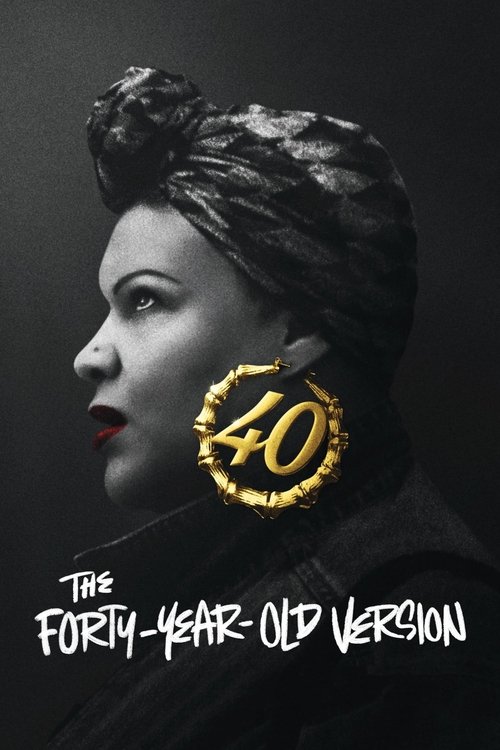
The Forty-Year-Old Version
2020 · Radha Blank
For when you need a laugh that also says something — especially if you've ever felt stalled, overlooked, or too old to start again. Comfort viewing with a spine.
What it's about
Radha is a Harlem playwright who was a '30 under 30' honoree a decade ago and is now broke, teaching high-schoolers, and staring down her fortieth birthday. Rather than keep contorting her work to please the white gatekeepers of New York theater, she reinvents herself as a rapper — RadhaMUSprime — and starts over from the booth. Radha Blank wrote, directed, produced, and stars in this semi-autobiographical comedy.
The experience
Funny, sharp-tongued, and unexpectedly tender — the theater-world satire draws blood while the story of starting over at midlife keeps sneaking up on your heart. It's talky in the best way, with bars that actually land.
Performances
Radha Blank carries the film herself with a wry, lived-in charisma that never begs for sympathy — the humor and hurt both feel earned because she lived a version of this hustle.
The craft
Shot on 35mm in silvery black and white that deliberately recalls New York independent film of the eighties and nineties, it gives a scrappy underdog story a classic look. The sharpest writing skewers the theater world's appetite for 'authentic' Black poverty narratives — satire from someone who watched it happen from the inside.
Why it matters
It won Blank the directing prize in Sundance's U.S. Dramatic competition, making her one of the very few Black women ever to take it, and announced a complete filmmaker arriving fully formed at forty.
Radha Blank wrote, directed, produced, and stars in this semi-autobiographical comedy about a once-promising Harlem playwright — a '30 under 30' honoree now staring down forty — who finds her voice again by picking up a microphone as the rapper RadhaMUSprime. Shot on 35mm in a silvery black and white that consciously echoes the New York independent cinema of the eighties and nineties, it earned Blank the Best Director prize in the U.S. Dramatic competition at Sundance, making her one of the very few Black women ever to win it. The film's sharpest material is its satire of the theater world: white gatekeepers commissioning 'authentic' Black poverty narratives, then noting them to death — a hustle Blank skewers from the inside, having lived it. But its warmth is what lingers: the beat-maker who hears something in her, the students who roast her lovingly, the city itself photographed like a collaborator. Blank's radical proposition is quiet and stubborn — that a Black woman's artistic coming-of-age can happen at forty, and be a first act rather than a last chance.
Reception
It arrived a triple threat — Sundance directing prize, rave reviews, instant Netflix deal — then promptly got swallowed by the algorithm; ever since, it's been the poster child for 'acclaimed Netflix original nobody was shown,' kept alive by cinephiles pressing it into each other's hands.
How The Forty-Year-Old Version was received, from release to now →
Influences: the films it descends from and the films it influenced
- She's Gotta Have It (1986) — Established the template Blank works in — a self-financed, black-and-white NYC indie where the Black multi-hyphenate directs, writes, and pushes their own comic voice through low-budget location shooting.
- Do the Right Thing (1989) — Its saturated block-as-character staging and use of hip-hop/rap as the neighborhood's declamatory voice is the eighties-nineties NYC-indie grammar Blank samples for Harlem and RadhaMUSPrime.
- Manhattan (1979) — Gordon Willis's black-and-white 35mm 'love letter' framing of the city — treating skyline and street as a lyrical collaborator — is the widescreen monochrome idiom Blank's cinematographer Eric Branco directly quotes.
- Stranger Than Paradise (1984) — Codified the deadpan, grainy black-and-white American independent character study built from static long-take vignettes on real NYC locations rather than plot machinery.
- Wanda (1970) — The founding case of a woman writing, directing, and starring in her own semi-autobiographical portrait of drift and reinvention — the writer-director-as-lead lineage Blank inherits.
- Killer of Sheep (1978) — Black neorealism shot in unadorned black-and-white on location, letting a specific working-class Black neighborhood carry texture and rhythm — the observational documentary-inflected register beneath Blank's Harlem.
- Girlfriends (1978) — A shoestring NYC indie about a woman artist's stalled ambitions, using cramped apartment blocking and vérité street footage to make creative frustration comic — the female-artist-in-the-city coming-of-age template.
- Hollywood Shuffle (1987) — Self-financed Black satire that skewers an industry demanding 'authentic' (i.e. degrading) Black narratives — the direct precursor to Blank's racial-gatekeeping theater-world satire and its white-liberal producer scenes.
- Wild Style (1983) — Located hip-hop as cinematic voice and NYC-street authenticity, using rap performance as narrative engine — the aesthetic root of Blank's rapping as a channel for reinvention.
- Frances Ha (2012) — The nearest contemporary parallel: a black-and-white NYC portrait of an artist stalled at a life-stage threshold, co-written by and starring its subject, mixing self-deprecating comedy with formal monochrome elegance.
- Obvious Child (2014) — Builds a NYC comedy around a stand-up/performer protagonist whose stage act voices her semi-autobiographical crisis — the same use of live performance-as-confessional that Blank gives the rap cypher.
- Appropriate Behavior (2014) — Writer-director-as-lead delivering a wry, semi-autobiographical Brooklyn identity comedy, using the multi-hyphenate's own body and voice as the film's primary comic instrument.
- Pariah (2011) — Sundance-launched Black-women-authorship coming-of-age shot with painterly attention to a specific NYC milieu, foregrounding a young Black woman finding her artistic/expressive voice.
- Patti Cake$ (2017) — Structures its underdog reinvention arc entirely around rap as the protagonist's escape and authorship, staging the amateur's climb through cyphers and homemade tracks as Blank does with RadhaMUSPrime.
- The Incredible Jessica James (2017) — Centers a Black woman playwright navigating rejection and the gatekept downtown theater scene, using her outsized comic voice against an indifferent NYC arts establishment.
- Lady Bird (2017) — A Sundance-era female auteur's semi-autobiographical coming-of-age whose Best-Director recognition and personal comic specificity mark the same multi-hyphenate authorship moment Blank arrives in.
Similar films
- Lady Bird (2017) — influence & lineage
- She's Gotta Have It (1986) — influence & lineage
- Pariah (2011) — influence & lineage
- Rap World (2024) — shared sensibility
- Tiny Furniture (2010) — shared sensibility
- Origin (2023) — shared sensibility
- Frances Ha (2013) — shared sensibility
- The Watermelon Woman (1997) — shared sensibility