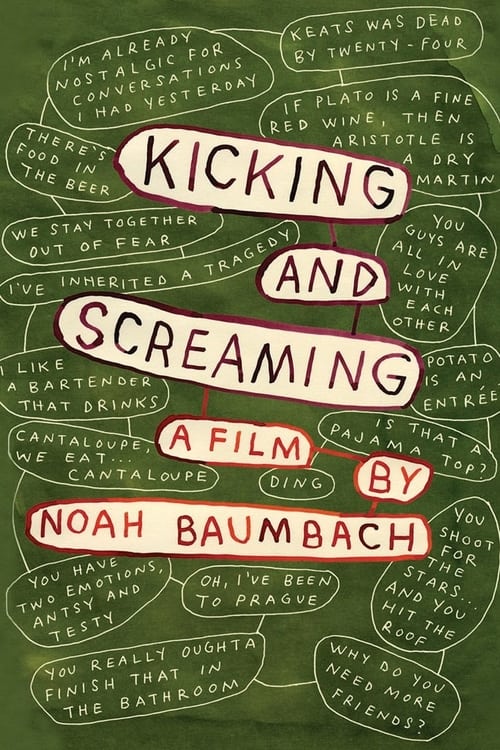
Kicking and Screaming
1995 · Noah Baumbach
For anyone in — or nostalgic for — that unmoored stretch after school ends, when you want to laugh at people exactly as stuck as you've ever been. A hangout movie with a lump in its throat.
What it's about
Four friends graduate from a liberal arts college and then simply fail to leave — renting a house within sight of campus, haunting the same bar and the same trivia games while real life idles outside. Grover's girlfriend has left for Prague to write; he stays, talks, and doesn't decide anything. It's a comedy about the year after graduation when every option is open and nobody can bring themselves to pick one.
The experience
Talky, wry, and quietly melancholy — the jokes come fast and articulate, but underneath the banter is the low hum of panic about growing up. It's very funny in a way that occasionally, deliberately, makes you wince in recognition.
Performances
Chris Eigeman is the standout, delivering Baumbach's epigrams with immaculate deadpan superiority, and Eric Stoltz brings unexpected soul to Chet, the perpetual student the others dread becoming.
The craft
Noah Baumbach's debut runs entirely on writing: dense, quotable, hyper-verbal dialogue in which characters talk brilliantly precisely so they won't have to act. The structure is all drift and deferral — the shapelessness is the point, and the script keeps it buoyant.
Why it matters
The film that started Baumbach's career and a touchstone of nineties American indie comedy — the articulate, low-stakes, dialogue-first mode that a generation of post-college movies grew out of.
Snapshot
Noah Baumbach's first feature is a comedy about people who have run out of structure. Its four principals graduate from an unnamed liberal arts college in the opening minutes and then simply fail to leave — renting a house within sight of the campus, drifting back to the same bar, the same trivia games, the same jokes, while the girlfriend of the ostensible protagonist departs for Prague to write. Nothing much happens, on purpose. The film's dramaturgy is deferral: its characters generate enormous verbal energy precisely so they will not have to spend any of it on a decision. Made when Baumbach was in his mid-twenties and roughly four years out of Vassar himself, it is a film about a condition observed at almost no distance, which accounts for both its precision and the charge of complacency that has followed it since release. It arrived at the height of the American independent boom, was modestly received, was somewhat eclipsed, and was then retrieved — by the success of The Squid and the Whale a decade later, by a Criterion Collection edition, and by a generation of viewers who found in it the founding grammar of a whole strain of literate, self-aware, post-collegiate comedy.
Industry & production
Kicking and Screaming was produced independently and distributed in the United States by Trimark Pictures, a mid-size genre-and-specialty outfit rather than one of the boutique labels — Miramax, Fine Line, Sony Pictures Classics — that dominated the prestige end of the 1995 indie market. That distribution profile shaped its life: a limited release, a respectful but contained critical footprint, and no commercial breakout. The film played the New York Film Festival in 1995, which conferred a certain seriousness on a first feature by an unknown director, and it was received as a promising debut rather than as an event.
Baumbach wrote the screenplay from a story credited to himself and Oliver Berkman. His background is relevant industrially as well as biographically: he is the son of the novelist and critic Jonathan Baumbach and the film critic Georgia Brown, and he entered filmmaking from a literary and critical milieu rather than from film school or the music-video pipeline that fed many of his contemporaries. The script reads accordingly — it is a writer's film, structured around sentences.
Production details beyond the principal credits are thinly documented in the critical literature, and it is worth saying plainly that much of what circulates about the shoot is anecdotal. What is clear from the film itself is the economy of the production: a small ensemble, a handful of standing locations (a rented house, a campus bar, a video store, a diner, an airport counter), almost no crowd work, no effects, no period dressing, and a compressed schedule implied by the dominance of interiors and daylight exteriors. The casting is the one place where money and taste are visible — a group of actors who were, in 1995, exactly at the point of becoming familiar.
Technology
The film is a 35mm, spherical, 1.85:1 production with sync-recorded dialogue and a photochemical finish — utterly conventional for a low-budget American feature of 1995, and worth noting precisely because of that conventionality. Kicking and Screaming sits on the near side of a technological break. Within three years, digital video and non-linear editing would make talk-driven micro-budget filmmaking radically cheaper, and the aesthetic that followed — Dogme 95's influence in the U.S., then the DV features of the late 1990s, then mumblecore in the mid-2000s — would look nothing like this. Baumbach's debut has the tonal texture of an amateur's life but the material texture of a professional movie: proper lenses, proper lighting units, proper coverage. That gap between subject and surface is part of its effect. When later filmmakers took up the same subject with camcorders, the shabbiness became the point; here, the polish quietly insists that these small stalled lives are worth the format.
Technique
Cinematography
Steven Bernstein photographed the film in a register of deliberate unobtrusiveness. The dominant unit is the medium group shot: three or four bodies arranged across a kitchen, a porch, a bar rail, held long enough for a conversational volley to complete inside a single frame. Coverage is modest and cutting patterns are simple, because the comedy depends on characters hearing each other and on the audience watching reactions arrive in the same space as the line. The palette is warm and autumnal — table lamps, bar light, campus afternoon — and interiors are lit to look practically motivated rather than modeled. There is essentially no camera flourish: few crane moves, minimal handheld, no expressive lens distortion. The flashbacks to Grover and Jane are distinguished less by optical treatment than by scale and proximity — two people rather than five, closer framing, less air — so that the film's visual argument becomes structural: intimacy is what the group shot squeezes out.
Editing
Cut by J. Kathleen Gibson, the film's most important editorial decision is architectural. Present-tense scenes are interleaved with flashbacks of the Grover–Jane relationship, unannounced and unlabeled, so that the emotional stakes the present tense keeps refusing are supplied laterally by the past. The film's forward motion is therefore illusory; it advances by remembering. Within scenes, the comic timing is built on a distinctive deflation cut — holding a beat past the punchline to catch the non-response, then moving on. Jokes are frequently allowed to die in frame. The final movement inverts the whole structure by ending not on the airport but on a flashback, refusing resolution and relocating warmth permanently in the past. It is a bleak formal joke, and it lands as one.
Mise-en-scène / staging
The world is aggressively unplaced. The college is never named, the state is never identified, and there are no establishing landmarks; the film could be set at any of a hundred small East Coast institutions, which is the intended effect. The recurring spaces — the shared house, the bar where Chet works, the video store where Otis takes a job, the diner — form a closed loop, and the staging keeps re-composing the same bodies in the same rooms to make the loop legible. Costume is thrift-collegiate: cardigans, oxfords, corduroy, a register adjacent to but pointedly distinct from the grunge iconography of the same years. These are not slackers in the Northwest sense; they are readers. Props do heavy thematic work — books, cigarettes, beer bottles, the endlessly resumed trivia game — because in a film where nobody acts, objects are what hands do instead.
Sound
The soundtrack is dialogue-first to an almost radio-play degree, with clean sync recording that privileges intelligibility over ambience. Overlapping speech is used for comic density but never to the point of obscuring a line. Phil Marshall's score is sparing and unassertive, appearing mainly to bridge transitions and to mark the flashbacks, and the film pointedly declines the wall-to-wall needle-drop scoring that was becoming a default indie signature after Reservoir Dogs and Pulp Fiction. Silence is a real instrument here: the pauses after failed jokes are audibly empty.
Performance
The ensemble is the film's engine. Josh Hamilton plays Grover as a recessive center — passive, wounded, and rhetorically capable of talking his way out of any feeling. Chris Eigeman's Max supplies the film's most quotable cruelty in a clipped, over-articulated delivery imported almost intact from Whit Stillman's Metropolitan and Barcelona; his casting is effectively a citation. Carlos Jacott's Otis is shambling and anxious, the group's soft target. Parker Posey, in a year that also brought Party Girl, brings a brittle comic exactness to Miami. Eric Stoltz plays Chet, the tenth-year student tending bar, as the film's oracle and its warning label. And Elliott Gould, as Grover's father, imports the residual authority of New Hollywood into the parent generation — a casting choice that quietly dates the sons.
Narrative & dramatic mode
This is a hangout film with a withheld plot. The inciting incident — Jane's departure — is also the refused incident: Grover declines to follow, and the film's remaining runtime is the elaborate accounting of that refusal. There is no antagonist, no escalating obstacle, no third-act crisis in the conventional sense. What substitutes for structure is the flashback braid, which allows the film to keep re-entering the one relationship in which its protagonist was actually present. The dramatic mode is comedy of manners rather than situation comedy: characters are judged by how they speak, and speech is understood as a moral instrument. Everyone in this film is fluent, and fluency is the disease. Max's much-quoted line — "I'm nostalgic for conversations I had yesterday. I've begun reminiscing events before they even occur" — is the film's thesis delivered as a gag, and it is characteristic that the thesis arrives pre-ironized so no one has to sit with it.
Genre & cycle
The film belongs to the post-collegiate ensemble comedy, a small but persistent American form running from Diner (1982) through The Big Chill (1983) and into the 1990s. Its immediate cycle is the mid-decade indie talk comedy: Whit Stillman's Metropolitan (1990) and Barcelona (1994), Richard Linklater's Slacker (1991) and Dazed and Confused (1993), Hal Hartley's deadpan Long Island films, Kevin Smith's Clerks (1994). Against the "slacker" label often applied to it, Kicking and Screaming is a class-specific variant: its characters are not economically stranded but electively stalled, cushioned by educations and families that make inaction survivable. That distinction is the film's real generic contribution, and it opened a lane — the affluent-malaise comedy — that American independent film has worked continuously ever since.
Authorship & method
Baumbach's method here is essentially literary. The screenplay is built from aphorism, deflection, and quiz-like verbal games; characters compete rather than converse, and the film's chief pleasure is watching wit function as a defense mechanism. His key collaborators support that priority rather than competing with it: Bernstein's camera clarifies rather than comments, Gibson's cutting serves comic timing and the flashback architecture, Marshall's score stays out of the way. Chris Eigeman is arguably the most consequential collaborator of all — not as a technician but as a bridge, carrying a performance idiom from Stillman into Baumbach's world and legitimizing the lineage. Eigeman would return in Baumbach's Mr. Jealousy (1997) and Highball (1997), the latter a troubled production Baumbach effectively disowned, crediting it pseudonymously.
The film also establishes the durable Baumbach method: dialogue that is funnier than the characters deserve, sympathy withheld until very late, and autobiographical proximity treated as a scalpel rather than a comfort. He would sharpen all three across The Squid and the Whale (2005), Greenberg (2010), Frances Ha (2012), The Meyerowitz Stories (2017), and Marriage Story (2019).
Movement / national cinema
Kicking and Screaming is an artifact of the American independent movement in its consolidation phase — after sex, lies, and videotape (1989) proved the market and before the late-1990s DV rupture reset the economics. Its national character is specific: this is an East Coast, literary, Ivy-adjacent independent cinema, distinct from the Texan regionalism of Linklater, the New Jersey retail comedy of Smith, and the Sundance social realism that would follow. Its European debts are frankly worn — Éric Rohmer's moral tales for the structure of self-deception through talk, and Woody Allen's Annie Hall and Manhattan for the flashback-braided romance and the conviction that a joke can be a symptom.
Era / period
1995 is a crowded year and a useful frame: Kids, Safe, The Brothers McMullen, Party Girl, Living in Oblivion, Mallrats. The independent sector was simultaneously radicalizing and professionalizing, and studio specialty divisions were forming to absorb it. Culturally, the film catches a specific mid-decade Gen X moment: the recession-shadowed graduating classes of the early 1990s, the post-Cold War expansion of Central Europe as a bohemian destination for American twentysomethings — Prague functions here as a real historical option, not merely a metaphor — and the maturing of irony from a subcultural stance into a default social register. The film's characters have the vocabulary of critique and no object for it.
Themes
The governing theme is arrested development as a class privilege: these men can afford to defer because deferral costs them nothing immediate. Beneath it runs a fear of narrative itself — an intuition that to act is to become a story with consequences, and that staying inert keeps every possibility notionally alive. Irony operates as armor, and nostalgia as a preemptive strike: Max's reminiscence of events before they occur is an attempt to convert the present into the past, where it can be safely handled.
The film is also, more quietly, about a gendered asymmetry. Jane goes; the men stay. Women in the film — Jane, Miami, Kate — are consistently the ones with plans, motion, or clear terms, and the men experience this as something happening to them. Baumbach does not fully press this in 1995; he would return to it, with a woman at the center and considerably more generosity, in Frances Ha.
Finally, there is the campus as amniotic space, and Chet as its terminal case — the tenth-year student who has converted stalling into a life. He is the film's only figure at peace, which the film presents as neither aspiration nor punchline but as an open question.
Reception, canon & influence
Reviews at release were broadly favorable but not fervent, and they divided along a fault line that has never quite closed. Admirers praised the dialogue's precision, the ensemble's rhythm, and the unusual maturity of a first feature that declined to supply a plot. Detractors found the film smug, insular, and pleased with its own articulacy — a portrait of privileged inertia that shared too many of its subjects' assumptions to critique them. Both readings survive; the film's defenders now generally argue that its complicity is deliberate and that the ending's retreat into flashback is a verdict rather than an indulgence.
Backward, its influences are unusually legible: Rohmer's conversational moral comedy; Allen's Annie Hall for structure and Manhattan for tone; Diner for the ensemble of men stalling before adulthood; and, most directly, Whit Stillman, whose comedy of manners about educated young people the film both extends and roughens — a debt made explicit by Eigeman's presence.
Forward, its influence is broad enough to be hard to see. It substantially established the template for the literate, upper-middle-class, verbally armored American indie comedy about the years after college, and the DNA is traceable through the mumblecore filmmakers of the mid-2000s (who inherited the subject while rejecting the polish and the scripted wit), through Tiny Furniture and Girls, and through a generation of festival comedies about articulate people avoiding decisions. Within Baumbach's own filmography it is the source text: Frances Ha and Mistress America are recognizably its descendants, with the anxiety reassigned and the sympathy increased.
Its canonization was retroactive. After The Squid and the Whale made Baumbach a major American director in 2005, Kicking and Screaming was reissued by the Criterion Collection, which effectively settled the argument about its standing regardless of the argument about its characters. One lingering piece of trivia has shaped its afterlife more than any critical judgment: the 2005 Will Ferrell soccer comedy of the same name, which for two decades has sent viewers to the wrong film — a fate the movie's own characters would have found unbearably apt.
A Deleuzian reading
Somebody lands the joke, and the camera doesn't cut.
The full Deleuzian reading of Kicking and Screaming →
Reception
Barely a blip on release in 1995 — a small indie that came and went — it got fully reappraised once The Squid and the Whale made Baumbach a name, culminating in a Criterion edition in 2006 and its current status as a beloved debut.
How Kicking and Screaming was received, from release to now →
How to watch Kicking and Screaming: what to notice on a first viewing
- Notice flashbacks arrive with no dissolve or signal at all. Scenes of Grover and Jane's relationship interrupt the present unannounced, marked only by closer framing and fewer people, so the past keeps supplying feeling the present refuses. The film's forward motion is a trick, it actually advances by remembering.
- Watch the trivia game get resumed again and again. The same quiz keeps returning across the film, a way for the group to keep being graded and ranked after the actual grading has stopped. The game is not filler, it is the plot, a whole social order performed as a pastime.
- Notice how many bodies the camera holds in one shot. Bernstein favors the medium group shot, three or four people across a kitchen or bar rail, held long enough for a full conversation to play out. No one gets promoted above the group, which is exactly the point.
- Listen for the pause after a joke that does not land. The editing holds a beat past the punchline to catch the silence, and the score stays out of the way instead of covering it. The audible empty pause is where the film's real feeling actually lives.
- Watch how well everyone here can talk their way past anything. Grover and his friends are fluent, quick, and self-aware enough to see their own routines as routines, and they keep performing them anyway. Knowing you are repeating a cliche has never once been a way out of it.
The whole guide to watching Kicking and Screaming, with the keys for a rewatch →
Influences: the films it descends from and the films it influenced
- My Night at Maud's (1969) — Builds an entire feature out of extended, near-real-time moral argument staged in unobtrusive medium two-shots, so that a character's self-justifying rhetoric — not event — is the dramatic action; Baumbach's argument-as-plot scenes run on the same engine.
- Annie Hall (1977) — Establishes the unannounced flashback braid — cutting to the past with no dissolve, title, or optical marker, and closing on a memory that retroactively judges the present — which is precisely the Grover/Jane architecture and the final shot's logic in Kicking and Screaming.
- Manhattan (1979) — Codifies conversation-as-ranking (lists, canons, cultural scorekeeping) as a comic unit, held in wide/medium group compositions by Gordon Willis where the cut is dictated by the line rather than the look — Baumbach's quiz games and bar-table blocking inherit both.
- Diner (1982) — Invents the stalled-male ensemble anchored to one recurring hangout, with scenes built from digressive non-plot dispute (the Sinatra-vs-Mathis argument) that resolves nothing and advances nothing — the direct model for the closed-loop bar/porch rotation.
- Withnail and I (1987) — Writes unemployed articulacy as aria — literary, quotable self-pity delivered at performance pitch inside a handful of shabby interiors — proving that verbal display can substitute for narrative momentum across a feature.
- Metropolitan (1990) — Supplies the deadpan comedy-of-manners idiom Baumbach roughens: educated young people theorizing their own conduct in flat declarative sentences, staged in a rotation of enclosed rooms, with Chris Eigeman's specific condescending-explainer delivery as the load-bearing performance style.
- Barcelona (1994) — Second refinement of the Eigeman register — pedantic certainty as comic armor — which Baumbach imports wholesale by casting him, making the lineage a matter of transplanted performance technique rather than homage.
- Dazed and Confused (1993) — Demonstrates a feature sustained with no inciting incident, structured only by drift among a few locations inside a fixed time bracket, with ensemble rhythm and dialogue-first sound doing the work a plot would otherwise do.
- Trust (1990) — Inherits the over-verbal, aphoristic deadpan register — arrested young adults trading precise, witty, feeling-suppressing dialogue in the clipped indie tempo Hartley codified.
- Mr. Jealousy (1997) — Immediate self-extension: re-casts Eigeman, keeps the aphoristic script and dialogue-first mix, and adds omniscient literary voiceover — externalizing the novelistic narration that Kicking and Screaming had kept inside the dialogue.
- Funny Ha Ha (2002) — Inherits the refused inciting incident and the post-graduation drift structure while stripping out the polish — 16mm handheld, hesitant non-professional delivery — deliberately inverting the scripted-wit half of the template it descends from.
- The Squid and the Whale (2005) — Sharpens the same method to a scalpel: dialogue wittier than its speakers deserve, sympathy withheld until the final scene, and a closed-loop map of a few Brooklyn locations standing in for a whole social world.
- Tiny Furniture (2010) — Transposes the post-collegiate ensemble to a single affluent loft — closed-loop staging, flat-lit domestic interiors, deflation cuts on self-aware monologues — with the arrested-development-as-privilege premise treated as the comic subject rather than an accusation.
- Frances Ha (2012) — The acknowledged rewrite: same aphoristic dialogue and episodic locations-as-chapters structure, but the flashback braid is replaced by forward address-card titles and the withheld sympathy is granted early instead of at the last shot.
- Mistress America (2015) — Restages the ensemble comedy of manners as a single-location screwball set piece — a house full of articulate people cross-talking in medium group shots — reviving the competitive-conversation blocking of the bar scenes at higher velocity.
- Shiva Baby (2020) — Compresses the closed-loop location to one house and one afternoon, running the same technique of educated evasion — wit as defense, questions answered sideways — and cutting away on deflation before any exchange can resolve.
- Igby Goes Down (2002) — Sets the template of over-educated young men wielding literate wit as defensive armor, the ensemble comedy where cleverness masks paralysis and arrested development.
- Cha Cha Real Smooth (2022) — Template for the hyper-verbal, dialogue-driven arrested-transition comedy — men stalling articulately at a life threshold, their emotional evasions carried entirely by talk rather than plot.
- Before Sunrise (1995) — Same-year commitment to a dialogue-first mix with almost no score and no needle-drop punctuation, letting continuous walking two-shots run long enough that the talk itself becomes the shot's subject.
- Walking and Talking (1996) — Parallel East Coast literary-indie method: warm practical-lit apartment interiors, scenes ended on a deflation cut that clips the joke before it lands cleanly, and comedy generated from articulate people declining to say the necessary thing.
- The Last Days of Disco (1998) — Runs the Eigeman idiom back through the same ensemble comedy of manners after Baumbach had borrowed it, confirming the shared technique — group scenes composed as debating floors, with wit measured out as social currency.
- Bottle Rocket (1996) — Contemporaneously stages arrested-development men whose verbal elaborateness substitutes for action, cutting comedy on held conversational beats rather than punchlines — the same deadpan-through-overwriting method Anderson and Owen Wilson were developing, and Baumbach would later co-write with Anderson.
Similar films
- The Squid and the Whale (2005) — influence & lineage
- The Last Days of Disco (1998) — influence & lineage
- Metropolitan (1990) — influence & lineage
- Before Sunrise (1995) — influence & lineage
- Tiny Furniture (2010) — influence & lineage
- Frances Ha (2013) — shared sensibility
- White Noise (2022) — shared sensibility
- Synecdoche, New York (2008) — shared sensibility