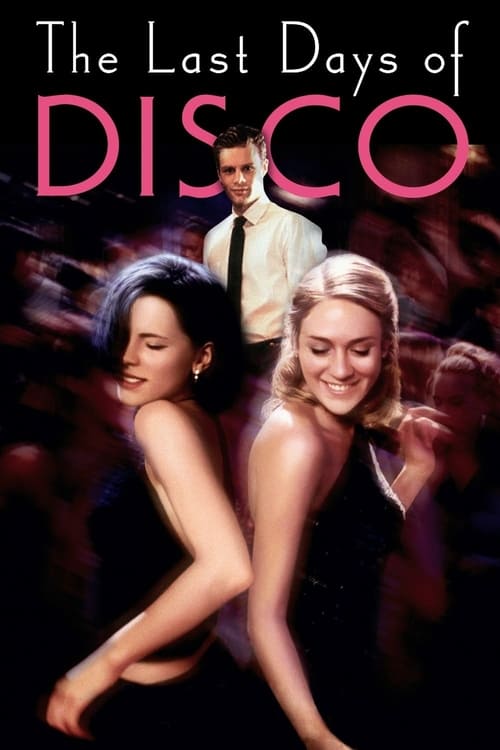
The Last Days of Disco
1998 · Whit Stillman
For when you want something urbane and quotable — a film of great talk, great outfits, and low-key heartbreak. Cozy on the surface, with a bittersweet aftertaste that lingers.
What it's about
In Manhattan at the very start of the 1980s, two recent college graduates — cautious Alice and sharp-tongued Charlotte — work junior publishing jobs by day and spend their nights at an exclusive disco, orbiting a shifting crowd of young men in advertising, law, and club management. Friendships, romances, and careers tangle on the dance floor as the era that made the club possible quietly runs out.
The experience
Dry, talky, and slyly funny — the comedy lives in perfectly turned conversations where people rationalize their worst behavior in the most articulate way possible. Underneath the wit runs a real melancholy about youth ending, which sneaks up on you.
Performances
Chloë Sevigny gives Alice a wounded, hopeful stillness, while Kate Beckinsale is razor-sharp as Charlotte — a friend whose every compliment contains a small act of sabotage. Their double act is the engine of the film.
The craft
Whit Stillman's dialogue is the star: mannered, epigrammatic, and precisely calibrated so you're never sure whether to laugh at these people or ache for them. The disco soundtrack is wall-to-wall and glorious — this one earns good speakers — and the club scenes glow with end-of-an-era warmth.
Why it matters
The closing film of Stillman's loose 1990s trilogy of comedies about articulate young strivers, and a cult touchstone whose reputation — like the era it mourns — has only grown since its release.
Snapshot
The Last Days of Disco is the third and final film in what Whit Stillman has retrospectively called a loose trilogy — following Metropolitan (1990) and Barcelona (1994) — and the one that closes the circle by looking backward. Released in 1998 by Gramercy Pictures, it follows Alice Kinnon (Chloë Sevigny) and Charlotte Pingress (Kate Beckinsale), two recent Hampshire College graduates working as junior editorial assistants at a Manhattan publishing house, as they orbit an exclusive nightclub and a shifting group of young men in advertising, law, and club management. The setting is "the very early 1980s" — Stillman's own arch title card formulation — a period deliberately positioned after disco's commercial peak and during its collapse.
The film is a comedy of manners in the most precise sense: its subject is the codes by which a small social class talks, courts, ranks, and excludes, and its comedy comes from the gap between the elaborate articulateness of its characters and their almost total failure to understand themselves. Nothing much happens in the way of plot — jobs are gained and lost, couples form and dissolve, the club is raided — but the film's real event is the disappearance of a shared social space and the particular kind of youth it made possible. It is Stillman's most melancholy film and, in the decades since, his most re-evaluated: a modest performer on release that has become a touchstone for a generation of American independent filmmakers interested in talk, taste, and the comedy of class.
Industry & production
The Last Days of Disco was made within the specific mid-1990s ecosystem of studio-affiliated specialty divisions that briefly made films like Stillman's financeable. It was produced by Castle Rock Entertainment and released through Gramercy Pictures, the PolyGram-backed distributor that handled a run of American independent and semi-independent films in the decade. This placed Stillman in a different position from Metropolitan, which had been an outsider production in the truest sense — famously self-financed and made on a shoestring by a first-time director with no industry background, then picked up after a festival showing and carried to an Academy Award nomination for Best Original Screenplay. Barcelona had already moved Stillman into Castle Rock's orbit; Disco was the largest and most conventionally resourced production of the three, with period design, a substantial licensed music catalog, and a cast of rising performers.
That scale carried costs. A period film set in New York nightlife requires either access to surviving spaces or the construction of them, and it requires music rights — the single most expensive category of clearance in a film built around a soundtrack of well-known recordings. Stillman has spoken in interviews about the constraints music licensing placed on the production, and the released soundtrack album, drawing on the era's dance catalog, was part of the film's commercial architecture in the way soundtrack albums often were for period-music films of the 1990s.
Commercially, the film did not break out. It was a modest theatrical performer, and its afterlife has been substantially a home-video and repertory one — most consequentially through the Criterion Collection, which released the film on DVD in 2009 and later on Blu-ray, and whose imprimatur did a great deal to fix it in the canon of 1990s American independent cinema. The film also stands at a hinge in Stillman's own career: after Disco, he did not complete another feature until Damsels in Distress in 2011, a gap of thirteen years that has itself become part of the film's reception, giving it the retrospective character of an ending. Stillman later returned to the material in prose, publishing a novel, The Last Days of Disco, with Cocktails at Petrossian Afterwards (2000), narrated by the film's least reliable character — an unusual instance of a director extending a film's world through an unreliable first-person literary adaptation of his own screenplay.
Technology
Disco is a late example of a film made entirely within the photochemical norms that were about to be displaced. It was shot on 35mm and finished photochemically, at the very end of the period when that was simply what a film of this budget did — digital intermediate finishing would not become standard for another few years, and the film predates the wave of DV independent production that The Blair Witch Project, Dogme 95, and the early digital features would make visible within a year or two of its release.
The relevant technology, though, is less the camera than the club. The film is at some level an essay on a technological-social apparatus: the discotheque as a machine made of sound systems, lighting rigs, mirrored surfaces, and the DJ's control over sequence and tempo. Stillman shoots the club as an environment produced by equipment — the mirror ball and its scattered light, the colored washes, the sound that renders conversation both intimate and effortful. The historical irony the film is alert to is that the technology of the discotheque was inseparable from the format economics of the twelve-inch single and the DJ's ability to extend and mix records; when the cultural backlash came, the machinery remained but the meaning drained out of it.
The film also belongs, technologically, to the moment when catalog music became newly available and newly expensive as a filmmaking resource. The 1990s saw the compilation soundtrack become a standard tool of period signification, and Disco both uses and interrogates that tool: it plays the era's records straight, at length, as objects of genuine pleasure, while framing them within a narrative about the exhaustion of the culture that produced them.
Technique
Cinematography
The film was photographed by John Thomas, who had shot Barcelona for Stillman and would remain his most consistent visual collaborator across this period. Thomas's approach is notable for its restraint given the subject: a film set largely in a nightclub could easily be an excuse for expressive camera movement and kinetic montage, and Disco declines almost all of it. The camera favors medium and medium-long shots, holds on groups in conversation, and lets the club's light do the work of atmosphere rather than the lens.
The visual scheme divides cleanly between two registers. Interiors at the club are saturated and unstable — colored gels, the roving specular light of the mirror ball, faces caught in shifting washes of red and blue — while the daytime world of offices, apartments, and the subway is flat, even, and slightly drab, shot with a naturalism that makes the club's artifice legible as artifice. Stillman and Thomas resist the temptation to shoot dancing as spectacle. Dance sequences are covered plainly, often from a fixed or slowly moving position, so that the pleasure registers as something the characters are having rather than something the film is performing. The one place the film permits itself lyricism is in the treatment of the club's floor and light as a kind of collective image — bodies made anonymous and beautiful by the machinery around them.
Editing
Andrew Hafitz cut the film. The editing follows the logic of the dialogue rather than of action: scenes are built as conversational units, allowed to run to their argumentative conclusion, and then cut away from cleanly. Stillman's characters argue their way through positions — the famous set-pieces about Lady and the Tramp and about Scrooge McDuck's economic function are the best-known examples — and the cutting protects the shape of those arguments, holding on speakers and reactions long enough for the absurdity to land without underlining it.
The film's structure is episodic and elliptical: it moves through a season of nights without conventional plot escalation, and time passes in gaps between scenes rather than through marked transitions. The last movement of the film, in which legal and financial consequences arrive for the club and its staff, tightens somewhat, and the final passages — including the film's celebrated coda on a subway platform and train — shift into a different, freer register, releasing the film's accumulated melancholy into something closer to a musical number without ever quite becoming one.
Mise-en-scène / staging
Stillman's staging is theatrical in the productive sense: groups arranged so that everyone remains visible, conversation blocked as social geometry, entrances and exits used to reconfigure alliances. The club functions as a stage set with distinct zones — the door (where inclusion is adjudicated), the bar, the floor, the back offices — and characters' movement between them tracks their standing.
Production design and costume do enormous work with restraint. The film's period signification is deliberately understated compared with the popular caricature of the disco era: Stillman's characters dress as young professionals of the early 1980s rather than as Saturday Night Fever pastiche, in the muted, slightly stiff clothes of people who have just started to earn money and are dressing to be taken seriously. This is a historiographical choice as much as an aesthetic one. The film argues implicitly that the disco era's iconography has been flattened by memory into camp, and it stages the period as it might have felt to people living in its final months — ordinary, ongoing, not yet a costume.
Sound
Sound is where the film's argument lives. The music is diegetic almost throughout: records played in the club, at parties, on the subway platform. This is a crucial discipline. Because the songs are things the characters hear rather than score imposed on them, the film can treat listening as a form of characterization — who dances, who talks over the music, who takes the records seriously.
The mix consistently works against the fantasy of the club as a place of communion. Dialogue in the club is fought for, staged in shouted proximity or in the relative quiet of side rooms, and the film is precise about the way loud music makes some kinds of talk possible and others impossible. Mark Suozzo, Stillman's regular composer since Metropolitan, provides original music that sits alongside the licensed catalog, and his contribution is easily underrated: his cues bridge between the period records and the film's own affect, allowing the film to be wistful about the era without the records having to carry that weight themselves.
Performance
The ensemble playing is calibrated to a very particular register — characters who are extremely fluent and not at all self-aware. Chloë Sevigny's Alice is the film's center of gravity: a performance built on hesitation, correction, and a slightly delayed responsiveness that reads as intelligence rather than shyness. Sevigny, coming from Kids (1995) and the downtown independent scene, brings a documentary flatness that grounds the film's stylization. Kate Beckinsale's Charlotte is the harder and better role — relentlessly, cheerfully cruel under the guise of helpfulness — and Beckinsale plays her without any bid for sympathy, which is what makes the character funny rather than merely unpleasant.
Around them, Chris Eigeman and Taylor Nichols return from earlier Stillman films, importing a house style of clipped, confident delivery; Eigeman's Des, the club manager who breaks up with women by claiming to have discovered he is gay, is the film's engine of bad faith. Matt Keeslar, Robert Sean Leonard, Mackenzie Astin, and Jennifer Beals fill out an ensemble in which nearly every character is given at least one speech that reveals more than they intend. The casting of Beals carries its own historical charge, given her association with Flashdance (1983) and that film's place in the era's dance-culture imagery.
Narrative & dramatic mode
The film's dramatic mode is the comedy of manners, and Stillman's practice of it is unusually strict. There is no protagonist in the conventional sense with a goal and obstacles; there is a social milieu, observed across a period of months, in which characters pursue advantage, romance, and self-justification. Conflict is almost entirely verbal. The film's crises are misunderstandings, betrayals of confidence, and reputational damage — the standard machinery of Austen, redeployed among people who work in publishing and go dancing.
Stillman's signature narrative device is the character who explains a moral position at length and is undone by it. The dialogue is written as argument: characters advance theses about advertising, about literature, about the ethics of dating, about Disney films, and the film's comedy comes from taking these theses seriously enough to let them be fully articulated before reality declines to cooperate. Crucially, the film does not mock its characters from a superior position. Its irony is affectionate and structural rather than satirical in the punitive sense — it is interested in why people talk this way, which is to say in the social function of articulateness among the anxious and privileged.
The narration is elliptical and anti-climactic. Key events happen offscreen or are reported. The film ends not with resolution but with dispersal — the club gone, the group scattered, one character's absurd defense of the disco movement's historical significance delivered on a subway platform — and then with a final sequence that converts loss into collective motion. It is one of the most emotionally effective endings in 1990s American independent film precisely because the film has spent ninety minutes refusing sentiment.
Genre & cycle
Disco sits at the intersection of several cycles. It is, first, part of the 1990s American independent talk-comedy — a body of work in which dialogue is the primary attraction, extending from the Sundance-era boom that Metropolitan helped inaugurate. It is also a nightclub film, and it belongs to a small tradition of films about the discotheque as a social institution, including Saturday Night Fever (1977), which Disco explicitly discusses and partly argues with, and Thank God It's Friday (1978).
It arrived, coincidentally, in a brief cluster of late-1990s films revisiting the disco and post-disco moment — most notably Mark Christopher's 54 (1998), a fictionalized Studio 54 film released the same year, and Paul Thomas Anderson's Boogie Nights (1997), which shares the periodization of a hedonistic seventies giving way to a harder eighties. Stillman's film is by far the least sensational of these: it has no interest in celebrity, excess, or the drug narrative, and it treats the club as a workplace and a social club rather than a den.
Genealogically, the film's deepest affiliation is with the literary comedy of manners — Austen above all, whom Stillman has repeatedly cited as a model and to whom he would return explicitly with Love & Friendship (2016), his adaptation of Austen's Lady Susan. The two-heroine structure of Alice and Charlotte, with its contrast of reserve and forwardness, is an Austenian architecture transplanted to Manhattan nightlife.
Authorship & method
Stillman's method is writerly. He writes his own screenplays, and the films are constructed to serve dialogue rather than to decorate it: the camera's job is legibility, the editing's job is rhythm, and the design's job is to establish social coordinates precisely enough that the audience can read status without exposition. His authorship is also unusual in American cinema for its subject position — he writes about the American upper-middle and professional classes from inside their idiom, without either the contempt or the aspiration that usually accompanies such material.
The collaborations that define this period are consistent and worth naming. John Thomas (cinematography) shot both Barcelona and Disco, and established the visual restraint that lets Stillman's dialogue carry. Mark Suozzo (music) scored all three films of the trilogy and has remained Stillman's composer across his later work; his contribution — light, ironic, unexpectedly tender orchestral and jazz-inflected writing — is the strongest through-line in Stillman's sound design. Andrew Hafitz (editing) cut Disco, shaping its conversational rhythm and its elliptical structure. On the performance side, Chris Eigeman and Taylor Nichols function as something like a repertory company across the three films, and the recurrence of performers is part of how the trilogy reads as a single project despite its different settings.
The trilogy's internal logic is worth stating plainly, since it structures the film. Metropolitan concerns Manhattan debutante season in the recent past; Barcelona concerns Americans abroad in "the last decade of the Cold War"; Disco concerns the very early 1980s in New York. Together they form a portrait of a class in a specific historical window, and Disco — made last, set in the middle — functions as the trilogy's retrospective summary, with characters from the earlier films glancingly present in ways that reward viewers of all three.
Movement / national cinema
The film belongs to the American independent cinema of the 1990s, but to a particular and somewhat isolated strand of it. The dominant registers of that movement — the crime-genre reinvention associated with Tarantino and his imitators, the transgressive downtown realism of Larry Clark and Harmony Korine, the regional realism of the early Sundance winners — have little in common with Stillman's mode. His closest kin are filmmakers of talk and class: Noah Baumbach, whose Kicking and Screaming (1995) shares Stillman's interest in over-articulate young people; Hal Hartley, though Hartley's stylization is more Brechtian; and, at a distance, the Éric Rohmer of the Comedies and Proverbs, whose influence Stillman has acknowledged and which is legible everywhere in Disco's structure of conversation, moral self-examination, and romantic reshuffling among a small group.
Stillman is, in this sense, a French-inflected American: his films practice a European art-cinema economy — talk, ellipsis, moral seriousness delivered lightly — within an American social world. That combination made him a critical favorite and a commercial outlier, and it is part of why the 1998–2011 gap in his filmography happened. His subsequent career, including Damsels in Distress, Love & Friendship, and the Amazon series The Cosmopolitans (2014, pilot), has confirmed the consistency of the mode rather than revising it.
Era / period
Disco is set in what the film's own title card calls the very early 1980s, and that dating is the film's central historical argument. Disco's commercial collapse is usually anchored to the "Disco Demolition Night" backlash of 1979 and the rapid retreat of the major labels from the genre; the film takes place in the trailing aftermath, when the clubs still operated but the cultural consensus had turned. This is why the film is called The Last Days rather than anything celebratory: it is about being young in the final months of something without knowing it.
The period is rendered with attention to institutions rather than iconography. The publishing house where Alice and Charlotte work — with its junior-assistant pay, its casual sexism, its gatekeeping by pedigree — is as much a period portrait as the club. So is the environment of young lawyers and advertising men, of shared apartments, of a Manhattan that was cheaper and rougher than the one that would follow. The film is quietly attentive to the economic transition underway: the professional-class ascendancy of the 1980s is visible at its beginning, and several characters are already positioning themselves for it.
The film also gestures, with characteristic obliqueness, at what was coming for this generation — the AIDS crisis is not the film's subject but is unmistakably part of the historical horizon against which "the last days" is written, and the film's sense of an ending has an undertow that its comic surface does not name.
Themes
The film's largest theme is social space and its disappearance. The club is not merely a setting but an institution that makes a certain kind of sociability possible; when it closes, the friendships and romances organized around it lose their infrastructure. Stillman is unusually attentive to the material conditions of social life — where people can meet, on what terms, and who decides.
Taste as class marker runs throughout. Characters use cultural judgment — about music, literature, films, dancing — as a currency of distinction, and the film's comedy repeatedly exposes taste-talk as status-talk. The Lady and the Tramp argument is the film's clearest statement of this: an elaborate ideological reading of a children's cartoon that is really a performance of interpretive sophistication.
Self-deception and the rhetoric of self-justification is Stillman's abiding subject. Nearly every character offers a theory of their own conduct that the film gently disproves. Des's serial claim to have discovered he is gay in order to end relationships is the most flagrant instance, and the film treats it as both a very funny running joke and a genuine moral failure.
Female friendship as competition structures the central relationship. Alice and Charlotte are allies, rivals, and — in Charlotte's case — actively destructive to one another under cover of candor. The film's honesty about the cruelty available within female friendship is one of the things that has kept it alive for later viewers.
Finally, the defense of the discredited gives the film its emotional payoff. Its characters insist on the significance of a cultural movement everyone else has agreed to mock, and the film ultimately sides with them — not because the argument is correct in every particular, but because the insistence itself, the refusal to let a shared pleasure be retroactively erased, is treated as an act of loyalty.
Reception, canon & influence
Critical reception on release was largely positive but not ecstatic; the film was received as a characteristic Stillman work — praised for its dialogue and its ensemble, and by some reviewers found slight or overly cool. Its commercial performance was modest, and it did not generate the discovery narrative that had attached to Metropolitan. The subsequent thirteen-year gap in Stillman's filmography meant the film sat for a long time as an apparent terminus.
Its reputation has risen substantially since. The Criterion Collection edition (DVD 2009; later Blu-ray) was the decisive event in its canonization, placing it alongside Metropolitan — also a Criterion title — as part of a coherent authorial body of work rather than as a one-off period comedy. Sevigny's and Beckinsale's performances have been repeatedly reassessed, with Beckinsale's Charlotte in particular now widely regarded as among the sharpest comic performances of the decade, and notable as a role of a kind Beckinsale's subsequent career in genre cinema did not often offer her.
Influences on the film (backward): Jane Austen is the acknowledged structural model, and Stillman has been explicit about it across his career. Éric Rohmer is the cinematic model — the Comedies and Proverbs in particular, with their conversational architecture and their moral comedy among young people. Saturday Night Fever is a direct intertext, discussed within the film itself. Stillman's own Metropolitan and Barcelona are the immediate antecedents, supplying cast, idiom, and the class milieu. Beyond film, the tradition of the American social novel — Fitzgerald above all in its concern with a moneyed young world and its endings — informs the film's tone.
What it shaped (forward): The film's influence runs most clearly through the strain of American independent comedy concerned with articulate, self-deceiving young people. Noah Baumbach's work — particularly Frances Ha (2012), with its two-women friendship, its New York, and its comedy of thwarted self-presentation — sits in direct conversation with it, and Greta Gerwig has been associated with Stillman's world as a performer as well, having starred in Damsels in Distress. The film's rehabilitation of disco as a subject for serious, non-camp treatment has been echoed in later cultural writing and filmmaking about dance music's social history. Its handling of a nightclub as workplace and social institution rather than as spectacle anticipates a good deal of later film and television about scenes and subcultures.
Perhaps its most durable legacy is tonal: Disco demonstrated that a film could be simultaneously very funny about its characters and unironically grieved about their world — that the comedy of manners could carry real historical weight. That combination, rare in American cinema of any period, is what has made the film's reputation grow rather than fade, and what makes it, twenty-five years on, the Stillman film most often cited by filmmakers working now.
A Deleuzian reading
A man is explaining that *Lady and the Tramp* has damaged the romantic expectations of a generation of American women.
The full Deleuzian reading of The Last Days of Disco →
Reception
A flop in 1998 — it lost the summer's 'disco movie' showdown to 54 and effectively sent Whit Stillman into a 13-year filmmaking exile — it then spent years hard to find before a 2009 Criterion release kicked off its reappraisal as the sharpest of his talky-yuppie comedies.
How The Last Days of Disco was received, from release to now →
How to watch The Last Days of Disco: what to notice on a first viewing
- Watch where each person stands relative to the club's door. The club has zones, the door, the bar, the floor, the back office, and characters' movement between them tracks their standing in the group. You can read someone's social rank from where they are allowed to stand, without a line of dialogue.
- Notice how long each argument runs before the film cuts away. Stillman lets a thesis, about Lady and the Tramp, about Scrooge McDuck, play out to its full shape before moving on, never cutting for a punchline. The talk is taken as seriously as any plot event, which is where the comedy actually lives.
- Watch the mirror ball wash faces in red and blue. Club interiors stay saturated and unstable under shifting colored light, while the daytime scenes of offices and apartments stay flat and drab by contrast. The color tells you which world you are in before a word of dialogue does.
- Listen for how the music is always something a character put on. The songs are diegetic almost throughout, records played in the club or on a stereo, so listening itself becomes a way of showing who a character is. No score tells you how to feel here. Only what the characters themselves chose to play.
- Watch Alice hesitate half a beat before she answers anyone. Sevigny plays the delay as intelligence rather than shyness, a documentary flatness that grounds the film's more stylized talkers around her. She notices the group's machinery of status and taste more clearly than anyone, without being able to work it.
The whole guide to watching The Last Days of Disco, with the keys for a rewatch →
Influences: the films it descends from and the films it influenced
- Metropolitan (1990) — Establishes the method Disco reuses wholesale: scenes built as static wide group shots that hold an entire argument in a single setup, with a semi-amateur repertory speaking fully written-out formal debate rather than naturalistic overlap — and the film's plot literally continues here through Chris Eigeman's rhetorician type.
- Barcelona (1994) — The immediate technical predecessor: John Thomas's flat, low-contrast, legibility-first lighting and Mark Suozzo's small-combo period-pastiche score were both worked out here, along with the Eigeman/Nichols repertory that Disco redeploys.
- My Night at Maud's (1969) — Source of the technique of letting a moral argument run to full length at near-real-time duration, camera parked at conversational distance and cuts timed only to speech rhythm, so the editing serves the sentence rather than the sightline.
- Pauline at the Beach (1983) — Supplies the comic engine of misreported and overheard speech circulating through a young group, each member stating a self-serving doctrine of love aloud that the plot then quietly falsifies — Stillman's Comedies-and-Proverbs template.
- Full Moon in Paris (1984) — Shoots a nightclub as social geography rather than spectacle — diegetic contemporary pop, dancers framed in ordinary medium shots, the heroine's two worlds mapped by who she can talk to in each; Disco's Club economy of admission and exit is built on this.
- Saturday Night Fever (1977) — The explicit intertext Disco argues with: it supplies the mirror-ball/lit-floor lighting grammar and the isolating dance-spotlight, both of which Stillman quotes and then deliberately de-dramatizes by keeping the camera at conversational distance and refusing the star-turn solo.
- American Graffiti (1973) — Model for wall-to-wall period source music that is always diegetically motivated — jukebox, DJ, club PA — so the soundtrack functions as the characters' own environment and as the film's structural clock instead of as commentary laid over the picture.
- Nashville (1975) — Origin of the loud-room mix Disco depends on: ensemble dialogue recorded live in genuinely noisy performance spaces so that speech has to compete with the music, making audibility itself a dramatic condition of the scene.
- Manhattan (1979) — The New York professional-class comedy shot with a deliberately immobile camera and wide held compositions (Gordon Willis), where pre-existing music is treated as the city's own score — the restraint that lets talk carry the film.
- Diner (1982) — Establishes the fixed social institution as the film's stage, with digressive competitive argument among friends staged in repeated group blocking, and scenes permitted to end on a joke rather than on plot advancement.
- Damsels in Distress (2011) — Stillman's own continuation of the method with a new repertory lead (Gerwig): doctrine-speaking heroines, Suozzo scoring, and a closing dance number that resolves feeling through choreography rather than plot.
- Love & Friendship (2016) — Makes the Austen structural model explicit and reunites Beckinsale and Sevigny in the same paired-women dynamic, deriving comedy from characters who narrate their own motives in impeccably formal period syntax.
- Frances Ha (2012) — Builds a New York film around the rupture of a two-women friendship as its actual plot, chaptered by elliptical jumps between addresses, with comedy generated by a heroine's failed self-presentation in speech.
- Tiny Furniture (2010) — Flat, symmetrical, near-static wide framing of a post-college drift narrative in which every joke is carried by talk and scenes resolve into anti-climax rather than incident.
- Eden (2014) — Treats a dance-music scene as labor and institution across years of unmarked ellipses, using diegetic club sound as the structural spine and ending in quiet dissolution rather than triumph — the elegiac non-camp reading of dance culture Disco opened.
- 24 Hour Party People (2002) — Films the nightclub as a business and social institution — door policy, bookings, payroll, closure — rather than as spectacle, taking seriously the scene-as-workplace framing Disco introduced.
- Kicking and Screaming (1995) — Casts Chris Eigeman in the identical register of self-delighted rhetorician and writes dialogue as timed epigram exchange rather than exposition, closing on the same refusal of a climactic decision.
- Unrelated (2007) — Extends the same Rohmer-derived apparatus into British cinema: locked-off wide shots of articulate middle-class people at leisure, status read entirely from diction and seating position, live sound with talk overlapping across the frame.
Similar films
- Metropolitan (1990) — influence & lineage
- Manhattan (1979) — influence & lineage
- Kicking and Screaming (1995) — influence & lineage
- Frances Ha (2013) — shared sensibility
- Cabaret (1972) — shared sensibility
- Synecdoche, New York (2008) — shared sensibility
- When Harry Met Sally... (1989) — shared sensibility
- Before Sunset (2004) — shared sensibility