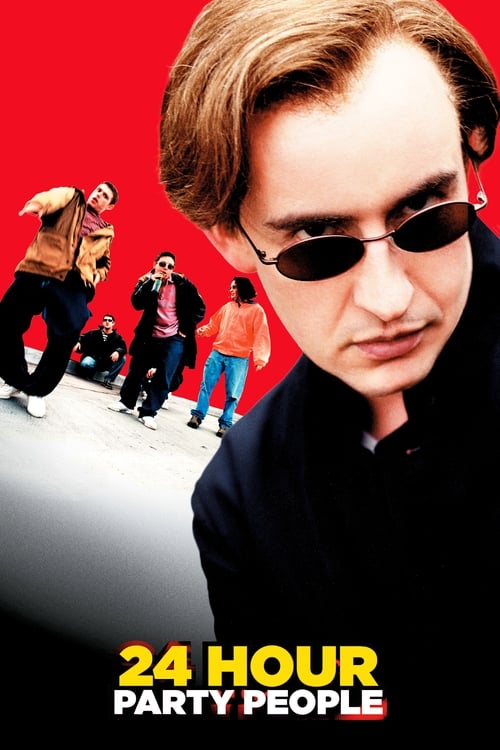
24 Hour Party People
2002 · Michael Winterbottom
For when you want a riotous night with great music and zero reverence — the music biopic to reach for when you're allergic to earnest music biopics. Loud, irreverent, surprisingly moving.
What it's about
Manchester, 1976: local TV presenter Tony Wilson sees the Sex Pistols play to forty people and decides history has just happened. What follows is his gloriously shambolic run through two musical revolutions — founding Factory Records, signing Joy Division and the Happy Mondays, and opening the Haçienda nightclub — told by Wilson himself, straight to camera, cheerfully admitting which parts are made up.
The experience
Fast, funny, and anarchic — a party of a film that keeps winking at you, then blindsides you with real tragedy. It runs on the giddy energy of the music it celebrates.
Performances
Steve Coogan is perfect casting as Tony Wilson — pompous, quixotic, and self-aware enough to puncture his own legend mid-sentence. It's a comic performance with genuine affection underneath.
The craft
Winterbottom shoots on rough, immediate digital video (with the great Robby Müller behind the camera), and Frank Cottrell Boyce's script gleefully breaks the fourth wall to question its own accuracy. The soundtrack — punk to Joy Division to acid house — is the real spine; play it loud.
Why it matters
It rewrote the rules for the music biopic by mocking the genre's pieties, and helped canonize the Factory Records story as modern British folklore.
Snapshot
24 Hour Party People is Michael Winterbottom's mock-biographical account of the Manchester music scene from the punk explosion of 1976 to the collapse of Factory Records and the Haçienda nightclub in the early 1990s. Steve Coogan plays Tony Wilson — the Cambridge-educated television presenter, label boss, and self-styled impresario — who narrates his own legend directly to camera, openly admitting where the story bends away from fact. Written by Frank Cottrell Boyce and shot on digital video by Robby Müller, the film fuses the British social-realist lineage with postmodern, fourth-wall-breaking comedy. It is at once a chronicle of two musical revolutions (post-punk, embodied by Joy Division and New Order; and acid-house "Madchester," embodied by the Happy Mondays) and a meditation on how cultural myth is manufactured. Its governing principle, spoken aloud by Wilson, is borrowed from John Ford: when forced to choose between the truth and the legend, print the legend.
Industry & production
The film was produced by Andrew Eaton through Revolution Films, the company Eaton co-founded with Winterbottom, and was financed within the orbit of British public-service and independent backers including the United Artists/film-council ecosystem and Channel 4–adjacent funding typical of Winterbottom's projects of the period (precise financing splits are best confirmed against the credits rather than asserted from memory). It emerged from a remarkably prolific stretch in Winterbottom and Eaton's careers, in which Revolution turned out features at a near-annual clip on modest budgets, treating filmmaking as a fast, low-overhead craft rather than a prestige event.
That working method shaped the film materially. Shooting on consumer-grade and prosumer digital video kept costs low and crews small, allowing Winterbottom to stage the period nightclub and concert scenes with large crowds and improvisational energy that a heavier 35mm production could not have afforded. The decision also reflected a deliberate aesthetic and economic argument about what a music film should look like in 2002.
The production drew heavily on the real participants. Tony Wilson, then still alive and a working broadcaster, was closely involved and appears in a cameo (as a television gallery director), and numerous figures from the actual scene turn up in walk-ons. The film premiered in competition at the 2002 Cannes Film Festival, which gave a comparatively cheap, DV-shot British comedy an international platform. It went on to a healthy critical reception and modest theatrical life, becoming a durable cult title rather than a wide commercial hit; specific box-office figures should be checked against trade records rather than guessed.
Technology
24 Hour Party People is one of the signal early-2000s examples of a theatrical feature embracing digital video as its native format rather than as a cost-saving compromise to be disguised. It was shot on DV and subsequently blown up to 35mm for cinema projection, which contributes to its grainy, smeared, video-bright texture. The choice placed it in conversation with the Dogme 95 movement and with Lars von Trier's Dancer in the Dark (2000) — not coincidentally, since cinematographer Robby Müller had shot for von Trier and brought a practiced sensibility for what video could and could not do.
The small cameras enabled a documentary mode of capture: handheld coverage in cramped clubs, available-light shooting, multiple cameras running simultaneously to catch performance and crowd, and a willingness to let the image degrade — flaring, blooming, banding — as a marker of authenticity. The film thus uses the limitations of the format as expressive content, aligning the low-resolution image with the rough, lo-fi spirit of the music and the amateur-turned-legend ethos of Factory itself.
Technique
Cinematography
Robby Müller's work here is a deliberate inversion of his celebrated 35mm lyricism for Wim Wenders and Jim Jarmusch. Working in DV, he favors a restless handheld camera, snatched focus, and the harsh contrast of digital sensors under club and stage lighting. The aesthetic is reportorial — the camera behaves like a news crew or a fan with a camcorder — which suits a protagonist who is himself a television reporter and a film that pretends to be a documentary even as it stages obvious fictions. Concert sequences are shot from inside the crowd, prioritizing immersion over coverage clarity, and the period is conjured less through pristine reconstruction than through the texture of the medium.
Editing
Trevor Waite's cutting is brisk, elliptical, and episodic, advancing the narrative in vignettes rather than smooth dramatic arcs. The editing is built to accommodate Coogan's direct-address asides, which interrupt scenes, comment on them, and sometimes fast-forward over years of history in a sentence. Archival footage, on-screen captions, freeze-frames, and the running device of Factory catalog numbers are interleaved with dramatized scenes, so the cut itself performs the film's argument that history is a montage of selected, embellished fragments. The pace mirrors the music: punchy in the punk passages, looser and more druggily expansive in the acid-house second half.
Mise-en-scène / staging
The film is organized around a handful of iconic spaces: the Lesser Free Trade Hall (site of the near-mythic 1976 Sex Pistols gig), the Factory offices, recording studios, and above all the Haçienda (FAC 51), the cavernous, beautiful, financially ruinous club that becomes the film's central monument. Staging emphasizes crowds, sweat, and improvisation over composed tableaux; period detail is present but never fetishized into nostalgia. Wilson is repeatedly framed as a figure slightly apart from the scenes he narrates — standing at the edge, addressing us — which physicalizes his dual role as participant and mythographer.
Sound
Source music is the film's spine. It is wall-to-wall with the actual recordings of the scene it depicts — Sex Pistols, Joy Division, New Order, Happy Mondays and the wider Manchester catalog — and these tracks carry as much narrative and emotional weight as the dialogue. Rather than commissioning a conventional dramatic score, the film lets the real records do the work, which reinforces its documentary pose and roots each era in its own sound. The mix moves between the thin, immediate sound of live performance and the engineered atmospheres associated with producer Martin Hannett, whose sonic ideas are themselves dramatized as part of the story.
Performance
Steve Coogan's Tony Wilson is the film's engine. Coogan, then best known for the comic monster Alan Partridge, plays Wilson as a genuinely intelligent, self-aware, vain, and oddly likeable showman — a man who quotes Boethius and situationist theory while presiding over financial chaos, and who is in on his own joke. The performance sustains the direct-address conceit without collapsing into smugness. Around him, the ensemble is studded with British actors who would become far better known: Andy Serkis as the volatile, brilliant producer Martin Hannett; Paddy Considine as manager Rob Gretton; Sean Harris as Ian Curtis; Danny Cunningham as Shaun Ryder; John Simm as Bernard Sumner; Shirley Henderson as Wilson's wife Lindsay; with Lennie James, Ralf Little and others filling out the world. The acting register is naturalistic and improvisational against Coogan's heightened, theatrical narration.
Narrative & dramatic mode
The film is a self-reflexive, picaresque mock-biopic. Its dominant device is Brechtian distanciation: Wilson narrates to camera, breaks scenes to flag exaggerations, and explicitly tells us that some events did not happen as shown or did not happen at all. This unreliability is not concealed but flaunted — most famously when a real participant appears in cameo (Howard Devoto) to deny that a scene we have just watched ever took place, while Wilson cheerfully insists on printing the legend. The structure is two-part and episodic, tracking two distinct cultural waves separated by years, with Wilson as the connective thread. Rather than the rise-fall-redemption shape of the conventional biopic, the film offers a comedy of glorious, idealistic failure: Factory's refusal of normal contracts (the famous arrangement signed in Wilson's blood, giving the artists everything) and the Haçienda's losses are presented not as mistakes to be mourned but as the price and the point of a genuine cultural gift.
Genre & cycle
24 Hour Party People sits at the intersection of the music biopic, the mockumentary, and British comedy. It belongs to a lineage of self-aware music films that runs through This Is Spinal Tap in its willingness to puncture rock mythology even while celebrating it, but it is unusual in dramatizing real, named figures and real history rather than parody surrogates. Within British cinema it is part of the post-Trainspotting (1996) cycle of films about youth subculture, drugs, regional identity, and music, and it is the definitive screen treatment of the "Madchester" moment. As an anti-biopic — one that foregrounds the gap between event and story — it anticipates a later wave of biographical films skeptical of their own genre.
Authorship & method
The film is a product of the Winterbottom–Eaton–Cottrell Boyce axis. Michael Winterbottom is among the most eclectic and prolific of contemporary British directors, refusing a signature style in favor of restless genre-hopping; his constants are fast, cheap, flexible production through Revolution Films and a documentary-inflected approach to fiction. Frank Cottrell Boyce's screenplay supplies the verbal wit, the literary and theological allusions in Wilson's mouth, and the structural audacity of the direct address; the writing treats Wilson as both subject and unreliable author. Robby Müller's DV cinematography lends the project its visual argument, applying the eye of a master of celluloid to the new digital format. Trevor Waite, a recurring Winterbottom editor, gives the film its collage rhythm. Steve Coogan's collaboration is itself near-authorial: his comic intelligence and improvisational instincts shape the tone, and the film inaugurated a fruitful ongoing partnership between Coogan and Winterbottom. Notably, the film largely forgoes an original composer in the traditional sense, treating the existing recorded music as a found-score — an authorial decision in its own right.
Movement / national cinema
This is emphatically a work of British cinema, and specifically of a Manchester regionalism set defiantly against London. It draws on the British realist tradition — the documentary impulse, working-class settings, unglamorous locations — but hybridizes it with continental and postmodern devices (Brechtian address, situationist references, DV experimentation) in a way that distinguishes it from straight kitchen-sink realism. It also participates in the international turn toward digital filmmaking around 2000, sharing DNA with Dogme 95 and von Trier's digital experiments while remaining tonally its own thing. Its celebration of provincial cultural production as world-historic is a pointed statement about where British creativity actually comes from.
Era / period
The film operates on two temporal planes. Its subject spans roughly 1976 to 1992 — punk, post-punk, the founding of Factory, the death of Ian Curtis, the reinvention of New Order, the rise of house music, the ecstasy-fuelled Haçienda years, and the financial implosion that ended the enterprise. Its moment of making, 2002, is equally significant: the film arrives at the threshold of cheap digital production and looks back on the analog era of independent music with a self-conscious awareness that one DIY revolution (post-punk's "anyone can do it") rhymes with another (DV's democratization of the moving image). The film is thus a period piece made by, and about, the same impulse.
Themes
The central theme is myth-making and the unreliability of history — the explicit "print the legend" thesis, dramatized through narration that admits its own embellishments. Around it cluster several others: idealism versus commerce, embodied in Factory's principled refusal to exploit its artists and the noble bankruptcy that follows; regional pride and cultural democracy, the conviction that epochal art can erupt from an unfashionable northern city; the romance of failure, in which losing money becomes proof of integrity; and a persistent strain of Catholic feeling — grace, sin, redemption, and the saint-and-fool figure of Wilson, who frames his own story in quasi-religious and intellectual terms. Death punctuates the comedy, above all in the treatment of Ian Curtis, and the film is alert to the cyclical, recurring nature of youth movements: two revolutions, one impresario, the same exhilaration and the same crash.
Reception, canon & influence
Critically, 24 Hour Party People was well received and is widely regarded as one of Winterbottom's finest films and a high point for Coogan as a dramatic-comic actor; its Cannes competition slot signaled its seriousness despite its irreverence. It has aged into a cult classic, particularly beloved by audiences attached to the music and the era it depicts, and is frequently cited as a benchmark for how to make a music film that resists hagiography. (Specific awards tallies are best verified against the record rather than asserted here.)
The influences on the film run in several directions: John Ford's The Man Who Shot Liberty Valance supplies its guiding aphorism; the mockumentary tradition (notably This Is Spinal Tap) underwrites its tone; Brechtian theater and situationist theory inform its self-reflexive form; the British realist tradition grounds its texture; and von Trier/Dogme-era digital practice shapes its look. Above all it is shaped by the primary sources — the music, memoirs, and surviving witnesses of the Factory story, many of whom literally appear on screen.
Its influence forward is substantial. It demonstrated that DV could carry a theatrically released, internationally screened feature with confidence, contributing to the normalization of digital production. It is the foundational dramatized account of Factory Records and Madchester, and it stands as a companion piece to Anton Corbijn's Control (2007), which retells the Ian Curtis story in a starkly different, monochrome-elegiac register — the two films together bracketing the Manchester myth from comic and tragic poles. It cemented the Winterbottom–Coogan partnership that would continue across later projects, and its knowing, fourth-wall-breaking approach helped license a more skeptical, self-aware mode of biographical filmmaking in the years that followed. As both a chronicle and a critique of how legends are made, it remains the definitive screen rendering of its scene.
A Deleuzian reading
Halfway through the film a man in a public toilet looks at the camera and tells you the scene you just watched never happened.
The full Deleuzian reading of 24 Hour Party People →
Reception
Premiered at Cannes in 2002 to warm reviews but modest box office; it's since settled in as a cult classic — regularly cited as the anti-biopic that shames every by-the-numbers music biopic made since, and the film that kicked off the Coogan–Winterbottom partnership (Tristram Shandy, The Trip).
How 24 Hour Party People was received, from release to now →
Influences: the films it descends from and the films it influenced
- The Man Who Shot Liberty Valance (1962) — Supplies the film's governing thesis verbatim — Tony Wilson quotes 'when you have to choose between the truth and the legend, print the legend' to camera, importing Ford's print-the-legend ethics of myth-making as an organizing structural principle.
- This Is Spinal Tap (1984) — Establishes the rock-mockumentary grammar — deadpan treatment of a band as a real documentary subject, faux-vérité interviews and backstage access — that underwrites the film's comic-skeptical register toward the music industry.
- A Hard Day's Night (1964) — Originates the run-and-gun handheld pop-film aesthetic — restless framing chasing musicians through real spaces — that the DV camerawork updates for the gig and club sequences.
- Tom Jones (1963) — Pioneers sustained direct-address-to-camera within a British comic narrative, the fourth-wall-breaking device Coogan's Wilson deploys to narrate, editorialize, and undercut his own legend.
- F for Fake (1973) — Models the essayistic, collage-edited film built around a charming unreliable narrator who openly toys with truth and forgery, prefiguring Wilson's authorial self-commentary on his own fabrications.
- The Great Rock 'n' Roll Swindle (1980) — Provides the situationist anti-rockumentary template — the impresario as prankster-mythologist staging his own legend — that informs Wilson's self-aware role as Factory's Mephistophelean spin-master.
- Reds (1981) — Interpolates real surviving witnesses into a dramatized history, the documentary-into-fiction move echoed by casting actual Factory participants (Mark E. Smith, Howard Devoto, et al.) in cameo alongside their fictional counterparts.
- The Idiots (1998) — Demonstrates Dogme-95 handheld digital practice — available light, jostling intimacy, rules-as-provocation — that shapes the film's argument that DV could carry a serious theatrical feature.
- Down by Law (1986) — Showcases Robby Müller's available-light, painterly-naturalist cinematography, the celluloid sensibility Müller then transposed onto the new digital format for this film's visual texture.
- Velvet Goldmine (1998) — Structures a music-scene myth around a journalistic investigation that refuses hagiography, anticipating the film's fragmented, anti-biopic interrogation of how a legend gets assembled.
- Sid and Nancy (1986) — Makes explicit what Sid and Nancy practiced — music history staged as unreliable myth, with the surviving participants' objections folded into the film's own text rather than corrected out of it.
- Quadrophenia (1979) — Adopts the British form Quadrophenia codified — a regional music scene reconstructed with archaeological period detail and scored entirely from its own back catalog — while restaging the crowd-versus-solitude staging of the gig and the club.
- Control (2007) — Explicit companion piece retelling the Ian Curtis/Joy Division story in monochrome-elegiac register, deliberately bracketing the same Factory myth from the tragic pole this film handles comically.
- A Cock and Bull Story (2005) — Extends the Winterbottom–Coogan meta-method — Coogan playing a version of himself, the film openly narrating its own construction — pushing this film's fourth-wall reflexivity into full making-of recursion.
- I'm Not There (2007) — Advances the anti-biopic into fragmentation — multiple actors as one mythologized musician — extending this film's refusal of linear hagiography and its 'subject as unstable author' premise.
- Walk Hard: The Dewey Cox Story (2007) — Weaponizes into parody the very music-biopic clichés this film satirizes, inheriting its skeptical, self-aware stance toward the rise-fall-redemption template of the genre.
- I, Tonya (2017) — Gives the music biopic a narrator who breaks the fourth wall to concede his own legend is embellished or invented, pre-empting the audience's distrust exactly as I, Tonya does.
- Kneecap (2024) — An unreliable, self-mythologizing direct-address narrator who mixes real music-scene figures with open fabrication — the docu-fiction hybrid voice that Kneecap, made by a documentarian, runs on.
- 28 Days Later (2002) — Released the same year, it likewise proved DV's viability for an internationally distributed theatrical feature, jointly normalizing digital acquisition in British cinema.
- American Splendor (2003) — Deploys the same device of placing the real subject on screen beside the actor portraying him, blurring documentary and fiction to interrogate the biographical act itself.
- The Filth and the Fury (2000) — Builds its punk history from collage editing and surviving-witness testimony rather than authoritative narration, sharing the elliptical, source-driven assembly method this film applies to Madchester.
- The Big Short (2015) — Docudrama with Brechtian direct-address self-consciousness: Steve Coogan as Tony Wilson breaks the fourth wall to correct his own account, acknowledge the film's artifice, and contextualize events for the audience — the same self-aware docudrama formal playfulness applied to cultural-institutional history that Big Short systematizes.
Similar films
- Control (2007) — influence & lineage
- A Hard Day's Night (1964) — influence & lineage
- Sid and Nancy (1986) — shared sensibility
- The Story of Lovers Rock (2011) — shared sensibility
- High Fidelity (2000) — shared sensibility
- La Commune (Paris, 1871) (2003) — shared sensibility
- Moonage Daydream (2022) — shared sensibility
- Quadrophenia (1979) — shared sensibility