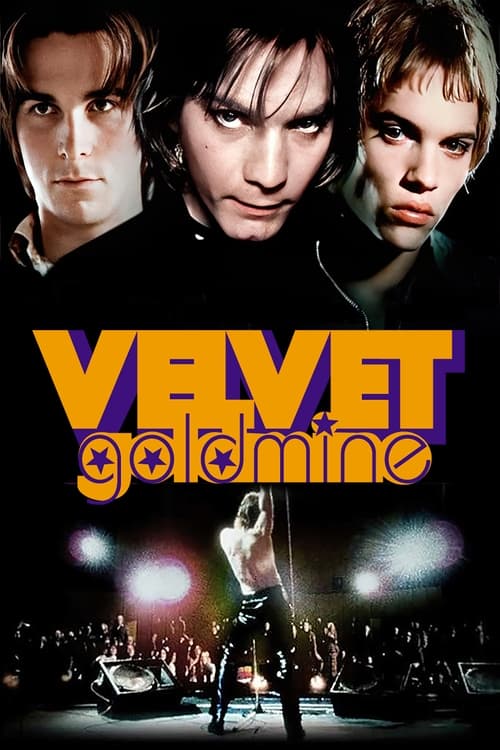
Velvet Goldmine
1998 · Todd Haynes
For when you want to fall into a world — a late-night film for music obsessives, anyone nostalgic for a scene they were too young for, or anyone who once had a poster on their wall that meant everything. More intoxicating than tidy; come for the vibe, stay for the heartbreak.
What it's about
A decade after glam-rock superstar Brian Slade faked his own onstage assassination and vanished, a British-born journalist in New York is assigned to find out what became of him. The trail leads back through the glitter and wreckage of early-'70s London — Slade's marriage, his combustible bond with a feral American rocker named Curt Wild, and the fans, including the journalist himself, whose lives the music cracked open.
The experience
Less a story than a swoon: it flares and fragments like memory, jumping between eras, music videos, and confessions, all soaked in glitter, longing, and loud guitars. It's rapturous if you give in to it, and it carries a real ache underneath the spectacle.
Performances
Jonathan Rhys Meyers makes an eerily perfect alien pop idol, Ewan McGregor throws himself into the wild-man rocker with total, shirtless abandon, and Toni Collette is quietly devastating as the wife watching the myth swallow her marriage. Christian Bale grounds it all as the fan whose awe curdles into questions.
The craft
Todd Haynes builds the film like a great double album — costumes and production design that resurrect glam in all its feathers and sequins, a soundtrack mixing era classics with new songs by an assembled supergroup, and staged performance sequences that are worth the ticket alone. Turn it up.
Why it matters
A cult object from the start, it became a touchstone of 1990s queer cinema and the definitive screen tribute to glam rock, its influence visible in every music film since that treats a scene as a dream rather than a docudrama.
Snapshot
Velvet Goldmine is Todd Haynes's fevered, fractured ode to the glam-rock moment of the early 1970s — a film that loves its subject too much to make a tidy biopic of it, and knows better than to try. Borrowing the investigative scaffolding of Citizen Kane, it follows a London-born New York journalist, Arthur Stuart (Christian Bale), assigned to reconstruct the rise and disappearance of Brian Slade (Jonathan Rhys Meyers), a Bowie-like glam idol who faked his own onstage assassination, watched his career collapse, and vanished. Through Arthur's interviews, the film spirals backward into the decade that made and unmade Slade, his American proto-punk lover Curt Wild (Ewan McGregor), and his wife Mandy (Toni Collette). Around that armature Haynes builds a lush, citational meditation on artifice, sexual liberation, fandom, and the way cultural radicalism gets domesticated. It is at once a musical, a memory film, a roman à clef, and a deliberately Wildean essay on the politics of the mask. Polarizing on release and a commercial disappointment, it has since become a durable cult object and a touchstone for queer cinema and the pop-music film alike.
Industry & production
Velvet Goldmine emerged from the late-1990s ecosystem of transatlantic art-house financing that produced much of the decade's ambitious mid-budget cinema. It was produced by Christine Vachon's Killer Films — Haynes's long-standing creative home since Poison (1991) — with Zenith and Single Cell, and was substantially financed through Channel 4 / FilmFour in Britain, with Miramax handling US distribution. The production was British-based, shooting largely in and around London, which suited a story rooted in the specific geography of the early-70s UK glam scene.
The defining production constraint was musical. Haynes sought permission to use David Bowie's songs and, by most accounts, was refused; Bowie declined to license his catalog, reportedly wary of a project that drew so transparently on his own persona and his relationship with the music's mythology. (Bowie later mounted his own retrospective projects.) That refusal forced the film to become something other than a documentary-by-other-means: it leans instead on Roxy Music, T. Rex, Brian Eno, Steve Harley, Lou Reed and Iggy Pop material, alongside newly recorded songs performed by purpose-built bands — Shudder to Think, and the supergroup Venus in Furs (featuring Thom Yorke and Bernard Butler) who supplied Slade's Roxy-inflected numbers, while Wild's proto-punk songs drew on the Stooges lineage. The absence of Bowie's actual songs is, in retrospect, generative: it pushes the film away from impersonation and toward archetype.
The picture premiered in competition at the 1998 Cannes Film Festival, where it won a prize for its artistic contribution (a Special Jury award recognizing its design and music). It was not a box-office success — Miramax gave it a limited release and it failed to break through commercially — and reviews were sharply divided. Its reputation has been a slow build rather than an opening-weekend phenomenon.
Technology
The film was shot photochemically on 35mm, in an era before digital intermediate grading was standard, which matters to its look: the saturated glitter palette, the bleeding reds and golds, were achieved through lighting, gels, costume, and lab work rather than the kind of post-production color sculpting that became routine within a decade. Haynes and cinematographer Maryse Alberti pursue a heightened, almost lurid chromaticism that reads as analog — grain, halation around light sources, the physical glint of sequins and lamé caught on emulsion.
Equally important is the film's archival and pastiche dimension: Velvet Goldmine constantly imitates other media formats — grainy television broadcasts, music-press photo spreads, concert-film grain, home-movie textures, the look of period documentary. These are constructed rather than found, a self-conscious counterfeiting of the historical record that is thematically central. The film's "technology," in other words, is partly the technology of memory and mediation itself: it reproduces the textures through which the 1970s were recorded and later recalled.
Technique
Cinematography
Maryse Alberti's camerawork is one of the film's glories. She moves fluidly between registers: swooning crane and Steadicam moves through concert spaces; intimate, grainy handheld in the documentary-pastiche passages; static, painterly tableaux in the more Wildean interludes. The color design is maximalist — emeralds, magentas, golds — but Alberti modulates it, reserving the most saturated glam palette for the early-70s heyday and cooling the film into gray, Orwellian blue for its 1984 framing present, where Arthur trudges through a dystopian-tinged Reagan/Thatcher-era cityscape. The contrast between the warm, hyperreal past and the desaturated present encodes the film's central elegy: the loss of color, in every sense.
Editing
Cut by James Lyons — Haynes's regular editor and frequent collaborator — the film is structurally a montage of recollection. Following the Citizen Kane template, it organizes itself as a series of nested flashbacks triggered by interviews, but Haynes and Lyons push the device past Welles into something more associative and musical. Time folds; the same green brooch (a recurring talisman, supposedly Oscar Wilde's) passes hand to hand across decades; performance numbers erupt as full set-pieces and then dissolve. The editing privileges rhythm and rhyme over linear causality, and the film's pleasures are as much those of the musical sequence as of the mystery plot.
Mise-en-scène / staging
Sandy Powell's costume design — she was by then among the most inventive designers in British cinema — is arguably the film's primary expressive instrument, conjuring the feathers, platform boots, body glitter, and androgynous tailoring of glam with both fidelity and invention. The production design stages the era as a series of thresholds: dressing rooms, stage wings, press conferences, decadent parties. Haynes frequently composes in deep, dressed frames crowded with period detail, and stages key emotional beats as performances-within-performances, so that sincerity and pose become impossible to separate — which is the point.
Sound
The soundtrack is the film's engine. Music supervision and original songwriting carry as much narrative weight as dialogue; the performance numbers are not interludes but arguments about the meaning of the scene. The decision to use covers and newly composed pastiche rather than original Bowie recordings gives the music an uncanny doubling — recognizable yet displaced. Carter Burwell, a frequent Haynes and Coen brothers collaborator, contributed score work knitting the song-driven sequences together. Sound design also exploits the textures of mediation — the compressed buzz of television, the roar of crowds, the hiss of memory.
Performance
The acting is pitched deliberately at the boundary between embodiment and impersonation. Jonathan Rhys Meyers plays Slade as a beautiful, withholding cipher — closer to icon than character, which some critics read as a flaw and others as the design. Ewan McGregor's Curt Wild, modeled on Iggy Pop and Lou Reed, supplies the film's raw physical charge, including a famously uninhibited stage performance. Christian Bale grounds the film as the watchful, repressed fan Arthur, whose own sexual awakening is the secret emotional spine. Toni Collette, as Mandy, shifts accent and register across the years and arguably gives the film its most fully human performance. Eddie Izzard appears as Slade's manager.
Narrative & dramatic mode
The film's boldest move is to graft a glam-rock musical onto the architecture of Citizen Kane. Arthur is the reporter sent to solve the riddle of a vanished great man; the interviews structure the recollections; the unanswered question hangs over everything. But Haynes refuses Welles's eventual disclosure — there is no "Rosebud" that resolves Slade, and the film's withheld secret turns out to be Arthur's, not Slade's. The dramatic mode is elegiac and essayistic rather than propulsive: the mystery plot is a pretext for an emotional and historical inquiry into what the glam moment promised and why it failed. Voiceover, direct address, fairy-tale narration (the film opens with the literal birth of Oscar Wilde delivered by spaceship, dropped on an Irish doorstep), and self-conscious literary framing all keep the viewer aware that this is a constructed myth, not a reconstructed life.
Genre & cycle
Velvet Goldmine sits at the crossroads of several traditions: the rock biopic (which it both invokes and refuses), the backstage musical, the New Queer Cinema, and the memory-film. It belongs to a small lineage of films that take pop music seriously as a subject for art cinema rather than nostalgia — closer in spirit to Nicolas Roeg's Performance (1970), which it openly echoes, than to the conventional music biopic. Within the pop-music film cycle it stands as the great anti-biopic: where the genre typically launders its subjects into uplift, Haynes preserves contradiction, decadence, and political ambivalence.
Authorship & method
Todd Haynes is among the most rigorously intellectual of American auteurs, and Velvet Goldmine is a quintessential Haynes object: a film built out of other texts, governed by theory yet animated by genuine longing. His method is citational and structuralist — Superstar (1987) told Karen Carpenter's story with Barbie dolls; Far from Heaven (2002) would reconstruct Douglas Sirk; I'm Not There (2007) would shatter Bob Dylan across six actors. Velvet Goldmine is the bridge between these: the Dylan film's multiplied-persona strategy is plainly rehearsed here. Haynes's deep engagement with Oscar Wilde, Jean Genet, and queer theory (Wilde's epigrams literally seed the script) makes the film as much a thesis on the performance of identity as a period piece.
His collaborators are central to the achievement: cinematographer Maryse Alberti, editor James Lyons (who also shares story credit and was a crucial creative partner across Haynes's early work), costume designer Sandy Powell, and the roster of musicians — Yorke, Butler, Shudder to Think, Shawn Colvin's contemporaries in the alt-rock world — who built the diegetic catalog. The screenplay is Haynes's own, from a story he developed with Lyons.
Movement / national cinema
The film is a transatlantic hybrid. Its director, producers (Killer Films), and queer-cinema lineage are American — Haynes was a defining figure of the New Queer Cinema that B. Ruby Rich named at the start of the decade. But its financing, setting, crew, and sensibility are substantially British, rooted in the FilmFour-funded culture of 1990s UK art cinema and in the specifically British social history of glam. It thus belongs simultaneously to American independent cinema and to a British strand of pop-cultural period filmmaking, without sitting comfortably in either.
Era / period
The film operates across two periods at once. Its subject is the glam interval of roughly 1971–1974 — a brief, intense window of sexual and aesthetic experiment in British pop, sandwiched between the 1960s counterculture and the punk reaction. Its framing present is 1984, chosen for its Orwellian resonance: a gray, conformist near-future-as-recent-past in which the liberating energies of glam have curdled into corporate rock and political reaction (the Slade-as-stadium-act coda gestures at a Bowie-like 1980s mainstream reinvention). The film is thus structurally about the death of a utopian moment, viewed from the disenchanted decade that followed.
Themes
Artifice and authenticity sit at the film's core: glam's wager that the constructed self is the true self, that the mask reveals rather than conceals. Sexual fluidity and queer possibility run through every scene — the film treats bisexuality and androgyny not as scandal but as liberation, and mourns the cultural retreat from that openness. Fandom and identification form the secret subject: Arthur's story argues that pop's deepest work happens in the bedroom of the lonely fan for whom the idol's freedom becomes permission. Wilde presides as patron saint — the film proposes a queer genealogy running from Wilde's dandyism through glam, an inheritance of style as resistance. And underneath it all is loss: the elegy for a radical moment betrayed, sold off, and forgotten.
Reception, canon & influence
On release in 1998, Velvet Goldmine divided critics sharply. Admirers praised its visual audacity, its soundtrack, and its intellectual ambition; detractors found it cold, diffuse, and emotionally evasive, faulting the opacity of its central figure and the dispersal of its narrative. It won an artistic-contribution prize at Cannes and earned an Academy Award nomination for Sandy Powell's costume design, but it underperformed commercially and was not a consensus success.
The influences on the film are openly worn. Citizen Kane supplies the structure; Nicolas Roeg's Performance the sensibility and the theme of identity-exchange; Ken Russell's florid music films a precedent for excess; Oscar Wilde and Jean Genet the literary spine; and the real glam canon — Bowie above all, but also Roxy Music, T. Rex, Iggy and the Stooges, Lou Reed — the raw material it reworks into myth.
Its legacy has grown steadily. The film became a foundational text of queer film culture and a perennial cult favorite, championed for its unembarrassed celebration of bisexuality and androgyny in a period when mainstream cinema offered little of either. Within Haynes's own work it is the clear ancestor of I'm Not There, extending the strategy of treating a musician as a constellation of personas rather than a single biographical subject — and it stands as an implicit rebuke to the biopic formula that Bohemian Rhapsody and Rocketman would later ride to commercial success, films whose conventional uplift throws Haynes's refusals into relief. Its fingerprints are visible in subsequent pop-music art films and in a broader critical reappraisal that now ranks it among the major works of 1990s American independent cinema. The Bowie songs it could never obtain remain, fittingly, its great absent presence — the missing center around which an entire myth was built.
A Deleuzian reading
The gun goes off onstage and Brian Slade folds into the lights.
The full Deleuzian reading of Velvet Goldmine →
Reception
Booed-adjacent at Cannes '98 (it did win a jury prize for Artistic Contribution) and a box-office flop that even some critics called a glittery mess, it's since been fully reclaimed — now a beloved queer cult classic that many rank among Todd Haynes' best.
How Velvet Goldmine was received, from release to now →
Influences: the films it descends from and the films it influenced
- Citizen Kane (1941) — Supplies the literal armature — a journalist (Arthur Stuart standing in for Thompson) interviews surviving witnesses whose contradictory testimonies reconstruct an opaque mogul-icon, with a withheld 'Rosebud' secret (the green pin) as the missing center.
- Performance (1970) — Models the rock-star-as-shapeshifter and the merging of performer and observer through associative jump-cut editing that dissolves one identity into another.
- The Man Who Fell to Earth (1976) — Roeg's elliptical cross-cutting and Bowie's own alien-arrival iconography feed directly into the Maxwell Demon / fallen-spaceman myth Haynes builds for Brian Slade.
- Cabaret (1972) — Backstage-musical architecture in which decadent, sexually ambiguous stage numbers are intercut as ironic commentary on the offstage narrative rather than as integrated spectacle.
- Tommy (1975) — Precedent for florid rock-opera excess — pop songs staged as delirious, maximalist theatrical set-pieces with saturated, hallucinatory mise-en-scène.
- Ziggy Stardust and the Spiders from Mars (1973) — Concert-film documentation of glam costume, makeup and persona-retirement that supplies the visual grammar Sandy Powell and Haynes reconstruct for Slade's stage act.
- Un Chant d'Amour (1950) — Genet's outlaw queer eroticism and poetic imagery form the literary spine the film cites directly — the green jewel passed hand to hand as a Genet/Wilde talisman.
- Jubilee (1978) — Glam-and-punk queer-Britain tableau staging Wildean theatricality and anachronistic pageant as a model for fusing pop subculture with art-cinema artifice.
- Superstar: The Karen Carpenter Story (1987) — Establishes Haynes's citational, structuralist method of treating a pop musician as a constructed text built from borrowed materials rather than a biographical subject.
- The Doors (1991) — Haynes directly responds to The Doors' mythographic biopic form by constructing a glam-rock subject through unreliable fragmented testimony and Citizen Kane investigative structure, extending Stone's anti-hagiographic insight that mythic rock figures exceed unified biographical representation and must be approached through the distortions of myth itself.
- The Rocky Horror Picture Show (1975) — Extends the glam-rock-1970s queer-liberation aesthetic — Bowie/Ferry-era androgyny, glitter and feather-boa mise-en-scène, and lip-synced performance as a mode of gender revolt.
- Funeral Parade of Roses (1969) — Uses a reflexive, fragmented nonlinear structure around an androgynous glam icon to stage identity-as-performance — the face/mask meditation rebuilt with New Wave editing devices.
- Hedwig and the Angry Inch (2001) — Extends the glam-androgyny embodiment and songs-as-narrative form, performing a fluid gendered persona rather than impersonating a real star.
- 24 Hour Party People (2002) — Anti-biopic music film built on self-aware, unreliable narration that refuses the standard rise-and-fall arc — the same anti-hagiographic stance toward a music scene.
- Far from Heaven (2002) — Carries forward the saturated photochemical-35mm palette and the wholesale reconstruction of a prior film idiom (Sirk) as critical pastiche, the method rehearsed here on glam cinema.
- I'm Not There (2007) — Directly extends the multiplied-persona strategy — fragmenting a musician across multiple actors and identities, the logic of Slade shedding selves taken to its conclusion.
- Rocketman (2019) — Adopts the song-as-interior-fantasy musical device for a glam-era star while reverting to the redemptive recovery arc Haynes pointedly refused, marking the lineage by contrast.
- Mysterious Skin (2005) — Deploys glam-saturated color and music-as-emotional-narration within a queer memory structure, teaching the shimmer-score-plus-lush-image grammar Araki uses to render recovered memory.
- All About Lily Chou-Chou (2001) — Structures its whole narrative around devotion to an invented pop icon, using fandom and myth-making as the film's organizing principle rather than plot.
- Cruella (2021) — Glam/punk-scene template for building identity through costume and constructed persona, with a doubled self-invention narrative carried on saturated performance-driven needle drops.
- Latin Blood – The Ballad of Ney Matogrosso (2025) — Establishes the glam-biopic grammar of androgynous performance photographed as spectacle and a fractured, multi-witness structure where the star exists only through others' staged memories — the same performance-as-narrative and theatricality-as-liberation Filho applies to Matogrosso.
- C.R.A.Z.Y. (2005) — Deploys Bowie/glam-rock iconography as a text of queer self-invention, staging pop stardom as coming-out mythology — the lineage behind Zac's 'Space Oddity' bedroom fantasy.
- Teenage Sex and Death at Camp Miasma (2026) — The musical number as load-bearing structure: interludes that carry exposition and jump years, hung on a fan's investigation of the star he once worshipped.
- Poison (1991) — Founding New Queer Cinema text using Genet-derived multi-strand structure and 35mm pastiche of distinct period idioms, the formal toolkit Velvet Goldmine expands.
- Edward II (1991) — New Queer Cinema anachronism — collapsing historical period into present-day queer politics through deliberately ahistorical costume and staging, the device Haynes applies to glam-era Britain.
- Moulin Rouge! (2001) — Shares the pastiche-cover strategy of reworking anachronistic pop songs into diegetic numbers amid maximalist, saturated-color spectacle.
- Beyond the Valley of the Dolls (1970) — A glam-rock pastiche assembled from heightened theatrical performance and ironic music-scene mythmaking, treating the pop-stardom-and-corruption arc with the same knowing, artifice-forward register.
- Love Is the Devil: Study for a Portrait of Francis Bacon (1998) — Same-year anti-biopic that fragments a glam artist across a nonlinear Kane-like structure, refusing the unitary cradle-to-grave biography just as Maybury refuses the painter's canvases.
- Nowhere (1997) — New Queer Cinema glam maximalism staging pop-art musical tableaux around polymorphous sexuality, a parallel deployment of saturated artifice and queer desire.
- Phantom of the Paradise (1974) — Glam-rock mythmaking built on a Faustian mentor/protégé bargain and theatrical, image-manufactured pop personas — the music-industry-satire lineage extended.
Similar films
- Hedwig and the Angry Inch (2001) — influence & lineage
- I'm Not There (2007) — influence & lineage
- Rocketman (2019) — influence & lineage
- Moulin Rouge! (2001) — influence & lineage
- Superstar: The Karen Carpenter Story (1987) — influence & lineage
- Performance (1970) — influence & lineage
- Moonage Daydream (2022) — shared sensibility
- Almost Famous (2000) — shared sensibility
All the films related to Velvet Goldmine →