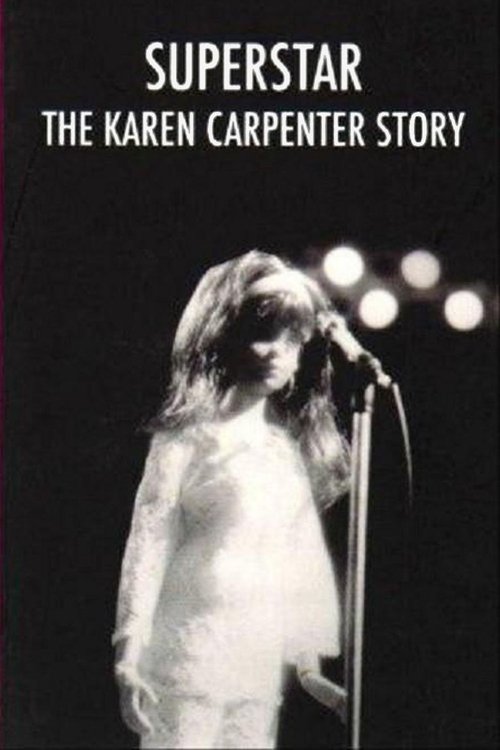
Superstar: The Karen Carpenter Story
1987 · Todd Haynes
For when you want something bold, sad, and unlike anything else — a film to argue about and think through afterward. Definitely a challenge pick; the pop songs make the darkness hit harder.
What it's about
The life and death of Karen Carpenter — her rise to soft-rock stardom with the Carpenters and her hidden struggle with anorexia — told almost entirely with modified Barbie dolls on miniature sets. What sounds like a stunt becomes the point: the plastic, mass-produced female body literalizes the impossible ideal that helped destroy her. It's a biography, a critique of fame and family, and an underground legend in 43 minutes.
The experience
Uncanny and genuinely upsetting — the dolls are funny for about two minutes, and then the artifice starts to cut deeper than any conventional biopic could. It's short, strange, and stays with you far longer than its running time.
The craft
Haynes shot on 16mm with hand-modified dolls and dollhouse sets, whittling his lead figure down as the illness progresses — a formal idea so effective it feels like the only way this story could be told. The collage of pop hits, mock-documentary inserts, and melodrama conventions is remarkably assured for a debut.
Why it matters
Suppressed after a music-rights lawsuit and never legally released, it survived for decades as a bootleg — becoming one of the most influential American underground films of its era and announcing Todd Haynes as a major filmmaker.
Snapshot
Superstar: The Karen Carpenter Story is a roughly 43-minute independent film, shot on 16mm, that recounts the life and death of the Carpenters' vocalist Karen Carpenter—her rise to soft-rock stardom, her struggle with anorexia nervosa, and her death from the disease's cardiac complications in 1983 at age 32. Its notorious formal gambit is to stage this biography largely with dolls, principally modified Barbie and Ken figures, on miniature sets. The choice is not a gimmick but the film's argument: the plastic, mass-produced female body becomes a literalization of the impossible ideal that the story implicates in Karen's illness. Directed by Todd Haynes at the very start of his career and co-written with Cynthia Schneider, Superstar is one of the most influential American underground films of its decade—and one of the most difficult to see, having been withdrawn from circulation after Richard Carpenter and the owners of the Carpenters' recordings pursued Haynes over the unauthorized use of the music. It survives chiefly as a bootleg and as legend.
Industry & production
Superstar is a product of the New York independent scene of the mid-to-late 1980s, made outside any studio structure on a minuscule budget. Haynes had come to filmmaking after undergraduate study at Brown University (in art and semiotics) and graduate work at Bard College; the film was completed in 1987, shortly after that training. It is closely associated with Apparatus Productions, the nonprofit Haynes co-founded with producer Christine Vachon and cinematographer Barry Ellsworth to support short experimental work, though Superstar itself is best understood as a small collaborative effort between Haynes and Schneider rather than a conventional "produced" picture.
The film's most consequential production fact is legal rather than logistical. Haynes used Carpenters recordings throughout without securing the rights to them. Richard Carpenter—Karen's brother, bandmate, and the custodian of the group's legacy—objected, and the ensuing copyright action led to the film being enjoined from distribution around 1990. The precise terms of the outcome are frequently muddled in popular retellings; what is well established is that the film was found to infringe the musical copyrights and was pulled from legitimate circulation, becoming effectively unavailable through official channels ever since. Popular accounts sometimes add that Mattel objected to the use of Barbie, but the operative and decisive legal issue was the music. This suppression is inseparable from the film's reputation: its scarcity turned it into a sought-after artifact and a fixture of festival and museum "clandestine" screenings, cementing a cult status that a freely available film might never have acquired.
Technology
Technically Superstar is modest and deliberately so. It was shot on 16mm film, the workhorse gauge of American independent and student production, and its images carry the grain, soft resolution, and slightly unstable registration that mark that format and that budget level. The dominant "technology" of the film is not a camera system but a fabrication practice: the sculpting, dressing, and repainting of dolls and the construction of miniature domestic and stage sets at doll scale. As Karen's illness advances, the Karen doll is physically altered—whittled and reshaped—so that the object itself registers the body's wasting. That practical, hand-built quality is the point; the film's meaning depends on our seeing manufactured objects and recognizing their artifice, so any move toward slicker imaging technology would have undercut it. Where the film reaches beyond staged doll footage, it does so with appropriated and pseudo-appropriated material—text, graphics, still imagery, and the borrowed songs—assembled in the manner of a scrapbook or a classroom filmstrip.
Technique
Cinematography
Barry Ellsworth is credited with the cinematography. The camerawork treats the doll sets with a curious mixture of reverence and clinical scrutiny: close framing that lets small tableaux read as full-scale rooms, and shallow-focus miniatures whose shifts in scale keep reminding the viewer of the objects' smallness. Lighting alternates between the flat, even illumination of instructional cinema and warmer, more "cinematic" setups for emotional beats, so that the visual register itself oscillates between the didactic and the melodramatic. The film also intercuts and overlays other kinds of imagery—text cards, documentary-style inserts, and found or staged fragments—so the photography is only one layer in a composited visual field rather than a continuous window onto a world.
Editing
The editing (a task Haynes and Schneider undertook themselves, consistent with the film's handmade authorship) is the film's true engine of meaning. Superstar is built through juxtaposition: doll drama is cut against title cards, mock-medical exposition, images of food and consumption, and moments of near-subliminal or aggressive intercutting during passages about bingeing, purging, and self-scrutiny. The rhythm swings between the measured pacing of an educational film and bursts of associative montage that force the viewer to connect Karen's private ordeal to the surrounding culture of dieting, femininity, and celebrity. This collage logic is what allows a story told with dolls to feel argued rather than merely narrated.
Mise-en-scène / staging
The mise-en-scène is the most immediately legible expression of the film's thesis. Everything is staged at doll scale within constructed interiors—the family home, recording and performance spaces—so that the Carpenters' world becomes a dollhouse in the fullest sense: a controlled, decorated, patriarchal domestic order in which the daughter is an ornament. Props at human scale (especially food) recur at unsettling proportions against the tiny figures. The physical modification of the Karen doll across the film is itself a staging decision, letting the set design and object design carry the arc of the disease. The persistent doubleness—cute artifact and horror—arises directly from these staging choices.
Sound
Sound is where the film is boldest and where it courted its legal fate. The Carpenters' own recordings run through the film, their lush, immaculately produced softness set against images of suffering to devastating ironic effect; the sweetness of the music becomes unbearable precisely because we watch what it accompanies. Over and around the songs, the film layers narration and expository voice in the register of documentary and health-class filmstrip, plus sound design that punctuates the anorexic passages. The clash between the seductive commercial surface of the songs and the grim clinical voice is one of the film's central meanings, which is exactly why the music could not simply be swapped out or removed.
Performance
The dolls do not "perform" in any conventional sense, and that is the provocation. Emotion is generated by everything around the inert figures—framing, cutting, music, narration, and the viewer's own projection onto familiar faces. The result is a Brechtian estrangement that, paradoxically, produces genuine pathos: denied naturalistic acting, the audience supplies feeling, and becomes newly aware of doing so. To the extent that human presence enters, it is through voice and through the appropriated recordings rather than through embodied acting. The film thus stages a critique of performance and stardom by withholding the performing body altogether.
Narrative & dramatic mode
Superstar adopts the shape of a biographical melodrama—the rise, the private affliction, the decline, the early death—but filters it through the didactic apparatus of the educational and public-health film. It repeatedly interrupts its own story to lecture the viewer about anorexia nervosa, to define terms, and to situate Karen's illness within social forces. This yields a hybrid dramatic mode: sincere tragedy and analytic essay at once. The film neither fully immerses us in Karen's subjectivity nor holds her wholly at arm's length; it toggles between empathy and diagnosis, so that we grieve a person and interrogate a system in the same gesture. The tone is likewise doubled—camp and mourning, irony and tenderness—held in a tension the film never resolves and never wants to.
Genre & cycle
The film sits at the crossing of several genres: the musical biopic, the "disease-of-the-week" and educational-hygiene film it pastiches, and the avant-garde/appropriation short. It belongs to a lineage of found-footage and collage filmmaking and to the tradition of camp reappropriation of mass culture, but it turns those tools toward earnest social critique rather than pure irony. In cycle terms, Superstar is most often read retrospectively as an early landmark of what the critic B. Ruby Rich would later (in 1992) name New Queer Cinema—a wave of formally daring, politically charged independent work by queer American filmmakers. Haynes became one of that movement's central figures with Poison (1991), and Superstar is routinely treated as its prologue, even though it predates the term.
Authorship & method
Superstar is a foundational statement of Todd Haynes's authorship, announcing preoccupations he would pursue for decades: femininity and its performance, illness and the body under social pressure, the seductions and dangers of popular culture, and the use of borrowed genre forms (melodrama, the biopic, the pop film) as instruments of critique. His method here is appropriation and pastiche in service of feeling—a strategy he would refine in Safe (1995), the Douglas Sirk homage Far from Heaven (2002), the glam-rock fantasia Velvet Goldmine (1998), and the fractured Dylan portrait I'm Not There (2007). Central collaborators include co-writer Cynthia Schneider, who shared in the writing and the hands-on editing and production, and cinematographer Barry Ellsworth; both were part of the Apparatus circle alongside Christine Vachon, who would become Haynes's long-term producing partner. Because the film was made so cheaply and communally, its "authorship" is genuinely shared at the level of craft, even as its sensibility is unmistakably Haynes's. There is no conventional "composer": the score is the appropriated Carpenters catalog, and that curatorial choice is itself an authorial act.
Movement / national cinema
As American independent cinema, Superstar belongs to the fertile late-1980s New York scene that produced the filmmakers, producers, and institutions of the coming queer independent wave. Its intellectual DNA is visible—the semiotics and theory current in the art-school milieu Haynes came from, feminist critiques of representation, and the appropriation strategies of contemporaneous visual art. It is best located within that domestic experimental-independent tradition rather than any national style abroad, though its estrangement techniques share ancestry with the broader modernist, Brechtian current in political cinema.
Era / period
The film is doubly period-bound. Its story spans roughly the mid-1960s to 1983—the era of the Carpenters' wholesome, chart-topping soft rock and of a particular postwar American ideal of the family and the feminine that the film anatomizes. Its making, in 1987, places it in the Reagan-era independent scene, at a moment of intense debate about the body, health, and public messaging. The film's use of the educational-film aesthetic evokes an earlier era of instructional cinema even as its politics are pointedly contemporary. Its suppression around 1990 then fixed it in yet another temporal frame—as a lost object whose unavailability became part of its historical meaning.
Themes
The governing theme is the violence of the feminine ideal: the way an image of slender, smiling, controllable womanhood—embodied literally by the Barbie—can be internalized to lethal effect. Anorexia is presented not as private pathology alone but as the extreme endpoint of ordinary pressures around dieting, appearance, and self-discipline, pressures the film ties to family, industry, and consumer culture. Related strands include control and its loss (over the body, over one's image, over one's career under a brother's and a label's management); the commodification of the female performer; the gap between a glossy public surface and private suffering; and consumption in every sense—food, records, celebrities. The doll functions as the master metaphor binding these together: manufactured, idealized, posable, and, finally, damaged.
Reception, canon & influence
Because Superstar was withdrawn from legitimate distribution shortly after it began to circulate, its reception history is unusual. It never had a normal theatrical or home-video life; instead it built its reputation through festival and museum screenings and, above all, through bootleg copies passed hand to hand and, later, online. Among critics and scholars it is widely regarded as a landmark—celebrated for making a profound, moving film out of dolls, and for its audacious fusion of camp and grief—and it is a standard reference point in writing on Haynes, on New Queer Cinema, and on appropriation in film. I would caution that specific contemporary reviews, awards, and any box-office or viewership figures are not something I can responsibly cite here: the film's semi-clandestine existence means the reliable public record of its immediate reception is genuinely thin, and I will not invent quotations or numbers to fill it.
Looking backward, the film draws on the American educational and hygiene film, on found-footage and collage traditions, on camp's reclamation of mass culture, and on the theoretical and feminist currents of Haynes's art-school formation; the Carpenters' recordings are themselves the raw cultural material it re-purposes. Looking forward, its influence is substantial relative to its length and its unavailability. It launched Haynes toward Poison and the body of work that followed, and it stands as a touchstone for the New Queer Cinema that crystallized in the early 1990s. More broadly, it became a defining example of appropriation-based independent filmmaking and a recurring case study in debates over fair use, artistic freedom, and copyright—precisely because the very act that made it powerful (the unlicensed songs) is what got it suppressed. Its afterlife as a "banned" film has, if anything, extended its reach, keeping it in circulation as an underground classic decades after it officially disappeared.
A Deleuzian reading
Halfway through, the Karen doll's face is not the face it started with.
The full Deleuzian reading of Superstar: The Karen Carpenter Story →
Reception
A festival-circuit sensation in the late '80s, it was legally banned in 1990 after Richard Carpenter's copyright suit over the Carpenters' music — and the ban is exactly what made it immortal. Decades of degraded bootlegs and furtive uploads turned a 43-minute student film into one of the most mythologized objects in American indie cinema.
How Superstar: The Karen Carpenter Story was received, from release to now →
How to watch Superstar: The Karen Carpenter Story: what to notice on a first viewing
- Notice food dwarf the six-inch dolls in scale. Doll-scale rooms make the Carpenter house a dollhouse. Ordinary props like food appear at human size beside the tiny figures, turning a dinner plate into something monstrous. Scale alone turns an ordinary plate into an enormity beside a six-inch figure, without a line of dialogue saying so.
- Listen for the Carpenters' own songs under scenes of illness. Their lush, immaculately produced hits keep playing straight through images of suffering. The music never darkens or comments; its sweetness just keeps going. The sweetness fails to notice the suffering it plays under, which lands worse, and truer, than a comment would.
- Notice the flat, clinical narrator interrupting Karen's story. The film keeps stopping its own melodrama to define anorexia in the tone of a health-class filmstrip, toggling between sincere tragedy and clinical lecture. The double register keeps you from settling into grief or diagnosis alone, so you end up doing both at once.
- Watch the dolls hold one fixed expression through everything. Denied any naturalistic acting, you start supplying the feeling yourself: sorrow, fear, hope read onto a face that cannot change. A painted smile does the emotional work an actor usually would, and catching yourself feeling it is the point.
- Watch close framing make tiny sets read as full rooms. Shallow-focus miniatures keep shifting scale, so a tabletop set reads as a house until something in the shot reminds you how small it is. The camera's mix of reverence and clinical scrutiny is what lets a toy carry a real woman's story.
The whole guide to watching Superstar: The Karen Carpenter Story, with the keys for a rewatch →
Influences: the films it descends from and the films it influenced
- All That Heaven Allows (1955) — Establishes the women's-picture melodrama repurposed as social indictment — the borrowed, 'devalued' genre form Haynes reactivates to dignify Karen's suffering rather than parody it.
- Scorpio Rising (1963) — Pioneers laying unlicensed pop records over images as ironic emotional counterpoint — the exact appropriated-song-as-score strategy (and copyright vulnerability) Haynes builds Superstar's entire soundtrack on.
- A Movie (1958) — The founding American collage film, cutting found archival footage into associative montage — the interpolation of stock disaster/consumer imagery Haynes splices between the doll scenes descends directly from it.
- 2 or 3 Things I Know About Her (1967) — Models the essayistic, whispered didactic voiceover and Brechtian analytic interruption that halts identification — the lecturing narrator and diagrammatic asides in Superstar work the same distanciating way.
- Flaming Creatures (1963) — The touchstone of American underground camp built from cheap, hand-fabricated tawdry mise-en-scène, sanctifying discarded mass-culture glamour — the sensibility Haynes applies to dime-store dolls and cardboard rooms.
- Reefer Madness (1936) — Supplies the educational/hygiene scare-film grammar — alarmist authoritative voiceover, clinical case-study framing, moralizing intertitles — that Haynes appropriates to narrate anorexia.
- Chelsea Girls (1966) — Warhol's flattening of celebrity into camp surface and durational observation established the reclamation of pop icons as art material that underwrites Superstar's treatment of the Carpenters as cultural readymade.
- Poison (1991) — Extends Superstar's method into a triptych of appropriated genre registers (horror, hygiene-film, Genet homage) intercut so form itself becomes the argument.
- Safe (1995) — Carries forward the clinical, distanced study of a woman's body failing under social pressure, using flat framing and withheld affect where Superstar used dolls and voiceover to block easy empathy.
- Velvet Goldmine (1998) — Reprises the pop-fantasia-as-critique built from appropriated glam iconography and a curated period soundtrack standing in for an original score.
- Far from Heaven (2002) — Fulfills Superstar's Sirkian debt directly — a full-fidelity 1950s melodrama pastiche wielded, not mocked, to expose repression.
- I'm Not There (2007) — Radicalizes the anti-biopic here: instead of dolls standing in for a star, six actors fracture the subject, again refusing the unified impersonation the musical-biopic demands.
- Tarnation (2003) — Inherits the appropriated-pop-plus-collage confessional — home footage and licensed songs edited associatively to score a portrait of illness and a damaged mother-figure.
- Barbie (2023) — Weaponizes literal dolls and plastic hand-built miniature sets to critique the commodified feminine ideal — the same object-as-Brechtian-device Haynes used, now at studio scale.
- Thirty Two Short Films About Glenn Gould (1993) — Reconceives the music biopic as a formal problem rather than an impersonation contest, routing the life through a declared substitution device while the subject's actual recordings do the emotional work the dramatization refuses to do.
- Street of Crocodiles (1986) — Contemporary mastery of hand-built miniature sets shot in shallow-focus macro to make small fabricated figures feel inhabited — the same doll-scale cinematography Haynes uses to make Barbies emotionally legible.
- Swoon (1992) — Fellow Apparatus/New Queer Cinema film that reconstructs a true story through appropriated period sound, anachronistic collage, and Brechtian stylization rather than naturalistic reenactment.
- The Living End (1992) — Crystallizes the same Reagan-era queer independent mode — cheap, ironic, formally confrontational appropriation of genre (here the road movie) as political provocation.
- The Watermelon Woman (1996) — Shares the fabricated-archive strategy, manufacturing fake documentary/found footage to interrogate how mass culture constructs (and erases) a woman's image.
- Hairspray (1988) — Contemporaneous experiment in the same operation: period pop needle-drops carrying the emotional load, Sirkian melodramatic pitch played without irony, and a body-politics narrative staged in deliberately artificial frontal tableau.
Similar films
- I'm Not There (2007) — influence & lineage
- Barbie (2023) — influence & lineage
- Velvet Goldmine (1998) — influence & lineage
- Mandy (2018) — often watched together
- Suspiria (1977) — often watched together
- Mad God (2021) — often watched together
- The Texas Chain Saw Massacre (1974) — shared sensibility
- Christine (1983) — shared sensibility
All the films related to Superstar: The Karen Carpenter Story →