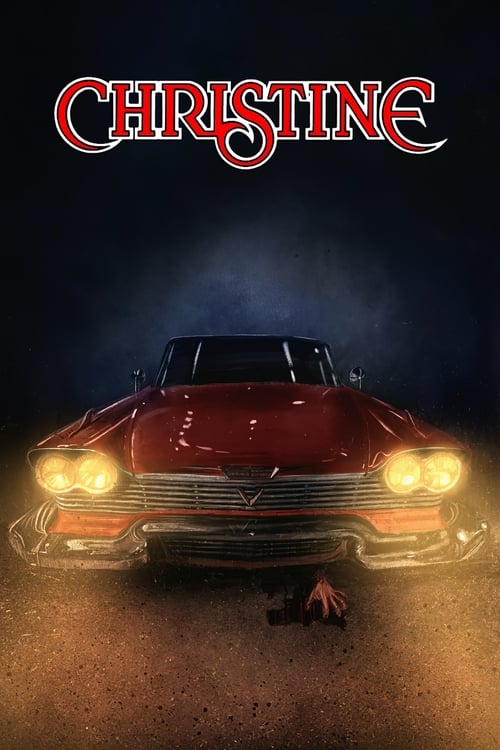
Christine
1983 · John Carpenter
For a night when you want classic 80s horror with style and a mean streak — more creeping unease and cool menace than gore, with a tragic undertow. An easy, atmospheric watch that still leaves a chill.
What it's about
Arnie Cunningham, a bullied high schooler, buys a rusted-out 1958 Plymouth Fury named Christine and pours himself into restoring her. As the car comes back to gleaming life, Arnie changes too — the glasses go, the swagger arrives, and the meekness curdles into something cruel. His best friend Dennis and girlfriend Leigh watch him slip away, and soon learn the car has a jealous will of its own, and a vicious way with anyone who crosses her or her owner.
The experience
Sleek, patient, and darkly funny — the dread builds through small changes in a boy's posture and tone as much as through the car's violence. When Christine does move, the set pieces have a gliding, predatory grace, all chrome and headlights in the dark, scored to vintage rock 'n' roll that turns sinister in context.
Performances
Keith Gordon is the reason the film works: his Arnie transforms from twitchy pushover to sneering greaser so completely it's almost two performances, and the change is scarier than the car.
The craft
John Carpenter directs in controlled widescreen compositions and lights the car like a femme fatale, with his own pulsing synth score set against 50s radio hits. The restoration and destruction effects are practical and startling — a burning car prowling a night highway is one of the decade's great horror images, and it rewards a big screen and loud speakers.
Why it matters
Made fast off the back of Stephen King's novel during the early-80s boom of King adaptations, it became one of the most stylish of them and a cult favorite, proof that Carpenter could turn an absurd premise into genuine menace through pure craft.
Snapshot
Christine is John Carpenter's adaptation of Stephen King's novel about a 1958 Plymouth Fury that is malevolent from the moment it leaves the assembly line, and about the bullied teenager whom the car remakes in its own image. Columbia Pictures released it in December 1983. It came out in a year crowded with King adaptations, alongside David Cronenberg's The Dead Zone and Lewis Teague's Cujo, and the film went into production before the novel was published. Carpenter took it on as a commission at a low point in his career: The Thing (1982) had just failed commercially and with critics. He made a controlled, widescreen, wryly funny film that plays as a possession tragedy, a teen film and a hymn to 1950s rock 'n' roll all at once. Carpenter himself has often described it as a job he took to keep working rather than a personal project. Even so, it is now one of the best-regarded King adaptations. Its tensions between studio product and personal style, and between nostalgia and menace, make it a revealing point in the arc of American genre cinema in the early 1980s.
Industry & production
The project was developed by producer Richard Kobritz, who had produced Tobe Hooper's television miniseries Salem's Lot (1979) and had worked with Carpenter on the TV thriller Someone's Watching Me! (1978). The rights were bought from King's manuscript before publication, and Bill Phillips wrote the screenplay. The novel was published in spring 1983 and shooting followed that year. That compressed schedule let Columbia release the film in December, only months after the book arrived.
Carpenter's situation explains why he took it. He had been attached to direct Universal's planned adaptation of King's Firestarter, but after The Thing disappointed at the box office, that project went to other hands. Christine was a studio assignment that he did not originate, and he has said it was a way to keep working after that setback. The budget was moderate by studio standards. The film's commercial performance is generally described as modest: it was profitable but no hit, and it did not restore Carpenter's standing with the studios the way a breakout success might have. (Exact figures vary between sources and are not given here.)
The film's major practical undertaking was the car itself. The production bought a large number of late-1950s Plymouths, including Furies and the closely related Belvederes and Savoys, many of which were wrecked during filming. They were dressed to match Christine's red-and-white livery. The real 1958 Fury was sold only in a beige-and-gold scheme, a fact the novel itself works around.
Technology
The film's best-known technical achievement is the car's self-repair. Mechanical-effects supervisor Roy Arbogast, who had worked with Carpenter on The Thing, built cars whose bodies could be pulled inward and crumpled by hydraulics and internal rigging. That deformation was filmed and then run in reverse, so that dents appear to smooth out and metal to unfold back into shape. Because the effect was done in camera, it has a physical, plastic quality: the car seems to flex like muscle. Optical compositing could not have produced that look at the time.
The other set pieces are physical as well: the car on fire as it chases a victim down a dark highway, the gas-station explosion, the car forcing its way into a too-narrow loading bay, and the final destruction by bulldozer. These were achieved with practical fire, stunt driving and full-scale vehicles, in keeping with Carpenter's preference for tangible effects. The film was shot in anamorphic Panavision, the 2.39:1 format Carpenter had used since Halloween (1978). Its score came out of the synthesizer-based workflow Carpenter had developed with Alan Howarth.
Technique
Cinematography
Donald M. Morgan shot the film. He would work with Carpenter again on Starman (1984), and his earlier credits included Carpenter's TV biopic Elvis (1979). The scope frame suits the subject, since a car is a horizontal object, and Christine is often placed low and wide so that its grille and headlights fill the screen. The camera tends to give the car a point of view. Slow tracking shots move toward it in the dark garage, and its headlights snapping on act as a kind of awakening.
Night photography dominates the second half: sodium-lit streets, the glow of the burning car, and the sealed darkness of Darnell's garage. The look is polished rather than gritty. It is closer to the studio sheen of Carpenter's mid-1980s work than to the raw economy of Assault on Precinct 13 (1976). Some critics have read that polish as a sign of the film's commissioned status.
Editing
Marion Rothman edited the film, and the cutting is patient. Much of the first hour is given to character, establishing the friendship between Arnie and Dennis, Arnie's oppressive home life and the high-school pecking order before the car does anything overtly supernatural. The murder set pieces are built from carefully shaped sequences rather than rapid montage. The loading-dock killing in particular stretches suspense through repeated cutting between the cornered victim and the car slowly squeezing into a space too small for it. The film's rhythm is a slow build toward kinetic release, a structure common across Carpenter's work.
Mise-en-scène / staging
The film opens on a 1957 Detroit assembly line, where the newborn Christine injures one worker and kills another. That prologue establishes the car's evil as innate rather than inherited. Arnie's town is a bland suburb, and the visual world sets clean modern tract homes against the cluttered, quasi-industrial space of Darnell's do-it-yourself garage, where Arnie restores the car. The garage is the film's main interior: a cavern of oil and steel in which Arnie's transformation takes place. Carpenter frames scenes symmetrically and tends to hold the camera still, and his feel for space lets the car lurk inside the frame before it attacks.
Arnie's transformation is also carried by costume and grooming. The glasses go, the hair is slicked back and his clothes harden into a 1950s greaser silhouette, so that the boy visibly turns into the period the car came from.
Sound
Sound is central to the film's design. Christine "speaks" through her radio, which plays only 1950s rock and R&B. The songs work as the car's voice, its threats and its seductions. The selection includes George Thorogood and the Destroyers' "Bad to the Bone" over the assembly-line prologue (an anachronism, since that song is from 1982), Buddy Holly's "Not Fade Away," Little Richard, Ritchie Valens, Dion and the Belmonts, and Johnny Ace's "Pledging My Love." The lyrics often comment ironically on the action.
Set against these songs is Carpenter and Howarth's score, built from synthesizer drones and slow, pulsing motifs. It is cold and modern, deliberately at odds with the warm, period pop coming from the car. The film's sound design rests on that contrast between nostalgic diegetic music and minimalist electronic underscore. Engine roars, revving and the sound of metal flexing during self-repair give the car a quasi-animal sound presence.
Performance
Keith Gordon, then known for Jaws 2 (1978) and Brian De Palma's Dressed to Kill (1980), carries the film as Arnie Cunningham. His performance is widely singled out. He moves from stooped, apologetic nerd to swaggering, contemptuous possessed man, and his voice, posture and timing shift step by step rather than all at once. John Stockwell plays Dennis Guilder, the decent jock friend, as a steady moral centre, and Alexandra Paul plays Leigh Cabot, the girlfriend whom the car treats as a rival.
The supporting cast is strong in a character-actor way. Robert Prosky plays Will Darnell, the profane garage owner. Harry Dean Stanton plays Rudolph Junkins, the laconic police detective. Roberts Blossom plays George LeBay, the seller of the car, whose sour monologue about his late brother supplies the history. Christine Belford plays Arnie's domineering mother, and William Ostrander leads the bullies as Buddy Repperton. Kelly Preston has a small role.
Narrative & dramatic mode
The film is structured as a tragedy of possession wrapped in a revenge narrative. The first movement is a coming-of-age story. Arnie buys the wreck against everyone's advice, and restoring it lets him break free of his parents and the school hierarchy. The second movement turns to revenge: the bullies vandalise the car, and Christine, repaired by her own power, hunts them down one by one. The third movement is a rescue and an exorcism. Dennis and Leigh confront the car and destroy it in Darnell's garage, and Arnie dies in the struggle.
The adaptation is markedly streamlined. King's novel is partly narrated in the first person by Dennis, and it gives the car's malevolence a supernatural source in the spirit of its former owner, Roland LeBay, who in effect possesses Arnie through the car. Phillips and Carpenter cut the narration and remove most of the LeBay possession logic. They make the car "born bad," which shifts the story toward a purer, more mythic evil object with no back-story to explain it. The novel's Pennsylvania setting also gives way to a generic California town.
The tone is notably wry. The film is aware of its teen-film conventions and its absurd premise, and it closes on a sardonic coda: a crushed cube of Christine in a junkyard, a twitch of metal, and Dennis grumbling about rock 'n' roll.
Genre & cycle
Christine sits at the intersection of several genres and cycles:
- The killer-vehicle film. Its predecessors include Steven Spielberg's Duel (1971), the TV movie Killdozer (1974) and Elliot Silverstein's The Car (1977). Christine is the version of this subgenre most invested in the vehicle as a character with desire and jealousy.
- The Stephen King adaptation boom. After Carrie (1976) and The Shining (1980), 1983 brought Cujo, The Dead Zone and Christine within months of each other. They established King as a mass source of studio material.
- The teen horror film. The film borrows the high-school milieu, the bullying and the revenge of the outsider, and it echoes Carrie in particular.
- The 1950s nostalgia cycle. That cycle includes American Graffiti (1973), Grease (1978) and the TV series Happy Days. Christine turns its nostalgia inside out, presenting the 1950s as a seductive, dead force that consumes the present.
The film also inverts Disney's The Love Bug (1968), whose sentient car is benign and loyal. It is often read as the dark mirror of that tradition.
Authorship & method
John Carpenter had built his reputation on self-originated, often self-scored genre films with a strong formal signature. Those films include Assault on Precinct 13, Halloween, The Fog (1980), Escape from New York (1981) and The Thing. Christine belongs to a stretch of studio commissions that followed, with Starman (1984) and Big Trouble in Little China (1986). Carpenter has talked about it as a film he made for work rather than out of passion. Still, his signature is clear throughout: the anamorphic composition, the patient suspense, the minimalist synth score, the laconic humour, and a "possession" narrative that recalls the inexorable evil of Halloween and the identity anxiety of The Thing. The film is usually credited as "John Carpenter's Christine," his possessory credit, which reflects how strongly the industry already identified him as a brand.
Bill Phillips (screenplay) compressed a long novel into a lean three-act structure and made the decisive change of removing the possession by LeBay's ghost.
Donald M. Morgan (cinematography) gave the film a sleeker, more studio-polished look than Carpenter's earlier collaborator Dean Cundey had.
Marion Rothman (editing) managed the long character set-up and the drawn-out set pieces.
John Carpenter in association with Alan Howarth (music) continued the partnership they began on Escape from New York. Howarth's work with synthesizer setups and sound design shaped the electronic textures of Carpenter's 1980s scores.
Richard Kobritz (producer) brought the King property and his experience with King on Salem's Lot. Roy Arbogast (mechanical effects) delivered the self-repair effect that the film's reputation rests on.
Movement / national cinema
Christine is a product of Hollywood studio cinema in the early 1980s, at the point where the independent horror of the 1970s was being absorbed into the studio system. Carpenter, like Wes Craven, Tobe Hooper and George A. Romero, had come out of a low-budget scene that produced an American horror renaissance. That renaissance took genre seriously as a vehicle for social anxiety. By 1983 the studios were recruiting these directors and applying their sensibilities to big-budget properties. Christine is a clear example: a studio-owned, best-seller-based film made by a director whose independent work had established his visual and musical identity. There is no formal "movement" here in the art-cinema sense. The relevant context is the commercial American horror revival and its industrial assimilation.
Era / period
The film was made in the early Reagan era, and it is preoccupied with the 1950s, which that era's culture often idealised. Its view of the decade is ambivalent. Christine embodies 1950s glamour, chrome and rock 'n' roll, but she is also possessive, violent and deadly. The film can be read as a critique of a nostalgia that wants to revive an idealised past at the expense of the present. It also belongs to the period's material culture. The automobile is the central object of American adolescence, standing for freedom, identity, sexuality and status. American industrial decline in the early 1980s, Detroit's included, gives the assembly-line prologue an added resonance, though the film does not stress it. Carpenter's synth score also places it firmly in the electronic aesthetic of the 1980s, against the period music it quotes.
Themes
- Possession and transformation. Arnie's rise from victim to tyrant is the emotional core. The car offers him confidence and power, and it takes his humanity in return. The film leaves open how far the change is imposed from outside and how far it releases something already in him, his rage and resentment at a lifetime of humiliation.
- Masculinity and the car. The film draws on American cultural associations between cars and male identity, sexual maturity and power. Arnie's relationship with Christine is coded as a love affair, with jealousy, and the car treats Leigh as a romantic rival. In one of the film's set pieces Christine tries to kill Leigh at a drive-in.
- Nostalgia as a trap. The 1950s return as a seductive, deadly force. The radio's songs are both love songs and threats.
- Adolescence, bullying and revenge. Like Carrie, the film channels the fantasy of the bullied teenager's revenge, then shows its horror.
- The evil object. By making Christine "born bad," the film treats evil as an inexplicable presence, in keeping with Carpenter's recurrent interest in malevolence beyond rational explanation (Michael Myers in Halloween is "the Shape").
- Friendship. Dennis's loyalty to Arnie, even against the possessed version of him, is the film's moral counterweight.
Reception, canon & influence
Critical reception. On release the film drew mixed-to-positive reviews. Critics tended to praise its craftsmanship, the self-repair effects, Keith Gordon's performance and the use of music, while some found it less personal or less frightening than Carpenter's best work. The box office was moderate. In the years since, its reputation has risen steadily. It is now often ranked among the better King adaptations and as one of Carpenter's most accomplished and entertaining films, and it has acquired a cult following, especially among car and 1980s-horror enthusiasts. Carpenter's own ambivalence about it is part of its critical story. It is often cited as a case of a director's style carrying a commissioned project.
Influences on the film (backward).
- Stephen King's novel (1983), its direct source, and the King adaptation tradition, especially Brian De Palma's Carrie (1976) for the bullied-teen revenge structure.
- The killer-vehicle film: Duel (1971), Killdozer (1974) and The Car (1977).
- The 1950s nostalgia cycle, especially American Graffiti (1973), whose wall-to-wall oldies soundtrack and car culture Christine repurposes for horror.
- *Disney's The Love Bug*** (1968), as an inverted reference point for the anthropomorphic car.
- Carpenter's own prior work: the inexorable stalker of Halloween and the identity-consuming evil of The Thing.
Legacy (forward).
- The killer-vehicle and evil-object subgenre. Christine became the reference point for later films about haunted or murderous machines, including King's own directorial venture Maximum Overdrive (1986). Later genre oddities such as Quentin Dupieux's Rubber (2010) are frequently discussed in its shadow. Julia Ducournau's Titane (2021), with its eroticised relationship between a human and a car, has been widely compared to Christine and to Cronenberg's Crash.
- The King adaptation canon. The film is frequently ranked among the most effective King films, and it is often held up as an example of a director's sensibility successfully reshaping King's material.
- Carpenter's musical influence. The Christine score is part of the body of Carpenter's synth scores that later fed into the "retro-synth" revival of the 2010s, in the music of films such as Drive (2011) and the series Stranger Things (2016–). It also fed the renewed attention that led to Carpenter's own Lost Themes albums, though Halloween and Escape from New York are cited more often in that lineage.
- Popular culture and the car. The red-and-white 1958 Plymouth Fury has become an icon in its own right. "Christine" is now cultural shorthand for a car with a malevolent will, and replicas are a fixture of car shows and fan culture.
The specific paths of influence of the film's individual images and techniques on later directors are less well documented. Where they are claimed, they generally rest on critical comparison rather than on acknowledged debts. The film's lasting place in the atlas of influence comes from how it joins three lines: the killer-vehicle film, the King adaptation boom and the American horror renaissance of Carpenter's generation.
Influences: the films it descends from and the films it influenced
- Orpheus (1950) — Cocteau's reverse-printed footage, in which shattered and scattered matter seems to reassemble itself, is the in-camera precedent for Christine's self-repair: the car was crushed with hydraulics on camera and the shot was then run backward.
- Scorpio Rising (1963) — Anger set wall-to-wall period pop songs as ironic, fetishising commentary over lingering shots of chrome and machine worship, the same counterpoint Christine uses when 1950s rock-and-roll plays over Arnie's devotion to the Fury.
- The Love Bug (1968) — Herbie set the screen grammar for a car with a will of its own (doors, headlights and engine noise performing emotion without a driver), and Christine turns that grammar toward jealousy and murder.
- Duel (1971) — Spielberg made a vehicle the antagonist by never showing the driver and shooting the truck from low, grille-level angles, the method Christine uses for its driverless hunts.
- American Graffiti (1973) — Lucas threaded a continuous oldies soundtrack through car radios so that the radio works as the film's voice, and Christine adopts that device directly, with the Fury 'speaking' through its own dial.
- The Car (1977) — Its black car with tinted, driverless windows, a supernatural killer staged in long stalking approaches, is the immediate genre template that Christine refines into a character study.
- Carrie (1976) — De Palma's King adaptation built the bullied-outcast structure, in which high-school humiliations are logged one by one before a supernatural payback, and Christine follows it, with the car carrying out Arnie's revenge on the bullies.
- Halloween (1978) — Carpenter carries over his own Panavision-scope stalking compositions, a minimalist synth pulse and an evil that keeps getting up after it has been 'killed'; Christine's self-repair is the Shape's resurrection rendered in sheet metal.
- The Thing (1982) — Christine continues The Thing's practical-effects regime, with mechanical effects supervisor Roy Arbogast moving straight across from it, and its theme of a takeover that empties out a person from inside comes back as Arnie's possession.
- Maximum Overdrive (1986) — King's only film as director takes up Christine's sentient-vehicle premise, with trucks given faces by their grilles, and pairs the attacks with a wall-to-wall hard-rock soundtrack (AC/DC) in place of Christine's oldies.
- The Wraith (1986) — A supernatural car that rebuilds itself and kills off a teen gang one by one recycles Christine's mix of revenge structure, an invulnerable car and night-road stunt work almost beat for beat.
- Terminator 2: Judgment Day (1991) — The T-1000 re-forming from wreckage is the digital successor to Christine's reverse-motion self-repair: the same image of a damaged machine pulling itself back into shape, now done with CGI morphing rather than footage run backward.
- Death Proof (2007) — Tarantino builds a horror film around a killer car, a deliberately slow build that breaks into a practical, no-CGI stunt chase, and a jukebox soundtrack of period pop playing on the radio, all of which Christine combined.
- Drive (2011) — Refn's polished night photography from inside the car, set against a Carpenter-derived synth score running alongside retro pop, extends Christine's split between synth and period pop into the retro-synth revival.
- It Follows (2014) — Disasterpeace's score openly imitates Carpenter's synth pulse, and the film's slow, inexorable pursuit framed in widescreen depth follows the patient stalker grammar that Christine shares with Halloween.
- Titane (2021) — Ducournau makes Christine's human–car possession bodily and sexual, staging the protagonist's bond with a car as a literal fusion, and keeps the body horror practical in the way the Fury's wounds and repairs were.
- Crash (1996) — Cronenberg makes literal the erotic charge of car metal that Christine only implies through Arnie's caresses of the Fury, and he shoots wreckage and upholstery with the same fetishising close-up attention.
Similar films
- The Thing (1982) — influence & lineage
- Halloween (1978) — influence & lineage
- Carrie (1976) — influence & lineage
- Eraserhead (1977) — shared sensibility
- Child's Play (1988) — shared sensibility
- Hellraiser (1987) — shared sensibility
- Gremlins (1984) — shared sensibility
- A Nightmare on Elm Street (1984) — shared sensibility