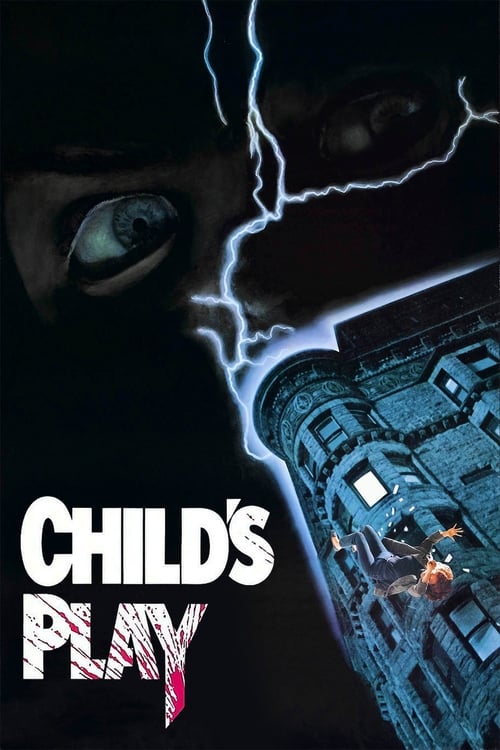
Child's Play
1988 · Tom Holland
When you're craving a classic scare with a wicked sense of humor — a lights-off October staple that's creepy without being punishing. Great for horror fans revisiting the canon or newcomers meeting it.
What it's about
A serial killer, gunned down in a Chicago toy store, uses a voodoo incantation to pour his soul into the nearest vessel: a Good Guy doll, the must-have toy of the season. A struggling single mother buys it secondhand for her six-year-old son's birthday — and when bodies start falling, the boy is the only one who knows his new best friend is doing it, and no adult will believe him.
The experience
Tense, mean, and slyly funny — it plays the long game, keeping the doll still and silent until your nerves are properly wound, then letting Chucky off the leash. The kid-in-danger angle gives it a nastier edge than its later reputation as camp suggests.
Performances
Brad Dourif's voice work as Chucky is the whole engine — profane, gleeful, and genuinely menacing — one of the great vocal performances in horror. Catherine Hicks grounds it as a mother forced to believe the unbelievable.
The craft
Tom Holland directs it as a real suspense picture, withholding the doll's animation until the reveals can detonate, and the puppetry and animatronic effects still impress — Chucky is a physical presence sharing the frame with actors, not a trick. There's a sharp satirical streak, too, about mass-marketed toys and what parents can't afford.
Why it matters
The last of the major 1980s horror icons to be born, Chucky launched one of the genre's longest-running franchises and permanently installed the killer doll in the pop-culture nightmare pantheon.
Snapshot
A serial killer bleeding out on a Chicago toy-store floor chants a voodoo incantation and pours himself into the nearest available vessel: a Good Guy doll, the season's must-have toy. The doll is bought secondhand from a peddler under the El by a widowed department-store clerk who cannot afford the retail price, and given to her six-year-old son. What follows is a film that runs two engines at once — a suspense picture about a child no adult will believe, and a satire of the American toy industry in which a mass-produced friend turns out to contain an actual predator.
Child's Play is the last of the major 1980s horror icons to be born, arriving after Michael Myers, Jason Voorhees, Freddy Krueger and Pinhead, and it knows it. Where its predecessors were silent or laconic, Chucky talks — profanely, wittily, incessantly — and where they stalked campgrounds and dreamscapes, he occupies the safest object in the house. The film's real innovation is not the killer doll, a figure older than sound cinema, but the decision to make the doll a brand: a cartoon tie-in with a jingle, a catchphrase, and a shelf position. Its terror is inseparable from its commerce.
Industry & production
The script began as Blood Buddy, an original spec by Don Mancini, then a recent UCLA film school graduate. Mancini's conception was closer to psychological allegory than to occult horror: a doll animated by a child's blood, functioning as an externalization of a boy's rage, with the ambiguity between imagination and reality left substantially unresolved. Mancini has consistently described the project as a satire of children's advertising, the industry that manufactures desire in six-year-olds.
The producer David Kirschner brought a pointed biography to the material — he had come out of animated family entertainment, having created An American Tail (1986), a property with its own extensive merchandising apparatus. Tom Holland, hired to direct, rewrote with John Lafia; the three share screenplay credit, with story to Mancini. Holland's revisions did the decisive structural work: they made the possession literal and rule-bound (voodoo, a transferable soul, a body slowly turning to flesh), added the detective, and reorganized the first act around sustained ambiguity rather than allegory. Mancini has been publicly ambivalent about the trade — the literalization bought the film a functioning thriller mechanism at the cost of the original's interpretive openness — but it also gave the franchise the mythology it would run on for four decades.
Holland arrived as a screenwriter turned director with a specific track record in genre self-awareness: he wrote The Beast Within, Class of 1984, Psycho II and Cloak and Dagger before directing Fright Night (1985) and Fatal Beauty (1987). United Artists released the film in November 1988. It was a commercial success sufficient to generate an immediate sequel, though the franchise moved to Universal for Child's Play 2 and 3; the rights history is one reason the series has bounced between studios and, eventually, television.
Technology
Child's Play sits at the last possible moment for a film of its kind. It was made before the digital creature became viable — The Abyss was a year away, Terminator 2 three — which means every frame of Chucky's aliveness had to be built, wired, and performed on set.
Kevin Yagher, whose shop had done the Freddy Krueger makeups for the Nightmare on Elm Street sequels, designed and built the doll. The production used not one Chucky but a fleet: cable-actuated hero heads for close dialogue work, radio-controlled servo units for broader expression, simple rod and stick puppets for quick inserts, static "prop" dolls for the many shots in which Chucky must be convincingly inert, and stunt and burn versions for the finale. Full-body locomotion shots were achieved with a performer in a Chucky suit — the actor Ed Gale is credited among the doll's physical performers. The practical constraint shaping the whole design is worth naming: this puppet had to pass as a mass-market toy in the same film in which it delivers extended monologues in medium shot. Any design that read as a monster in repose would collapse the first hour.
The doll's diegetic technology is equally of its moment. The Good Guy is a pull-string talker with an internal battery pack, an object that in 1988 sat between the pull-string Chatty Cathy tradition and the newly arrived animatronic toy — Teddy Ruxpin had reached shelves in 1985, and children were, for the first time at scale, being given toys that appeared to speak on their own initiative. The film's single best plot device turns on this hardware: Karen discovers the batteries still sealed in the box. Everything the doll has said, it said without power. It is a beautifully economical piece of horror engineering — the proof is not a sighting but an absence.
Technique
Cinematography
Bill Butler, ASC shot the film, and his presence is the production's most surprising credit: this is the cinematographer of The Conversation, Jaws, One Flew Over the Cuckoo's Nest (shared with Haskell Wexler) and Grease. Butler brings a New Hollywood craftsman's discipline to a genre assignment, and the film's visual strategy is built around the concealment problem. Chucky is shot from adult standing height when he must read as merchandise — small, inert, slightly comic in the corner of a frame — and from doll height when he must read as a subject. The prowling low-angle tracking shots that stand in for Chucky's movement in the first half are inherited from the subjective camera of Black Christmas and Halloween, but they do double duty here: they generate suspense and they solve a budget problem, since a camera moving at ankle height through an apartment does not require a functioning puppet.
The Chicago exteriors — the elevated tracks, the winter light, the alley commerce beneath the El — give the film a hard, specific working-class geography that most late-80s studio horror lacked. Interior lighting follows a conventional but well-executed arc from warm domestic gold to cold blue-green institutional light as the story moves into the psychiatric facility and the police world.
Editing
Edward Warschilka and Roy E. Peterson cut a film organized around a withholding schedule. For roughly the first half, Chucky is never shown moving and speaking freely in a single sustained shot: the film works in cutaways, off-screen sound, quick inserts, and doorways emptied a beat too late. The audience is trained to police the frame — to watch a stationary doll for the movement that the editing keeps promising and deferring. This is genuinely disciplined suspense construction, and it makes the batteries scene land as a reveal rather than a demonstration.
After the reveal the film commits, and the editing changes character entirely: longer holds, medium shots of the animatronic delivering dialogue, an acceptance of the risk that the puppet is now the co-lead. The extended finale — Chucky burned, dismembered, and repeatedly refusing to die — introduces a rhythm of false endings that would become the franchise's signature and, more broadly, a durable convention of the era's horror climaxes.
Mise-en-scène / staging
The film's principal setting is a middle-floor apartment rendered with unusual attention to its economics: this is a household where a toy is a strain. Staging repeatedly exploits the difference between a child's spatial world and an adult's — under beds, in cabinets, behind furniture, along the floor — so that Chucky occupies precisely the volume of the home that adults do not look at. Two set pieces are exemplary: the first killing, staged as a near-silent domestic sequence with a toy hammer and a fall from a high window, and the attack on Karen from beneath a car seat, which weaponizes the most ordinary possible confinement.
The Good Guy product design — freckles, red hair, striped overalls, oversized eyes — deliberately evokes the large soft-bodied companion dolls then on the market, most obviously Hasbro's My Buddy line. The resemblance is the joke and the threat simultaneously.
Sound
Brad Dourif gives a performance almost entirely without a body, and the sound design draws a sharp line between two vocal registers: the canned, sweet, processed Good Guy phrases that the doll produces on the pull-string, and the raw, unfiltered human voice that emerges once the mask drops. The comedy and the horror both live in the switch.
Joe Renzetti — an Academy Award winner for his adapted score for The Buddy Holly Story — writes music that plays the film's central inversion in miniature, setting chime, celesta and music-box timbres associated with nursery music against dissonant orchestral attack. The score is less individually celebrated than John Carpenter's or Charles Bernstein's work in the same cycle, and the critical record on it is thin, but its strategy is legible: it corrupts the sonic furniture of childhood rather than importing a separate horror idiom.
Performance
Catherine Hicks, then best known for Star Trek IV: The Voyage Home, plays Karen with an exhaustion that grounds the film's economics; she is not a horror heroine but a working mother whose credibility is the story's real stake. Chris Sarandon, reuniting with Holland after Fright Night, plays the detective as a decent skeptic rather than an obstacle. Alex Vincent was six during production, and the film asks of him mostly blocking, reaction, and conviction rather than dialogue — a real gamble, since the entire first act depends on the audience believing a child who is being disbelieved on screen.
Dourif's vocal work is the film's engine and one of the great genre performances of the decade. A rhyme worth noting: Dourif and Bill Butler both came out of One Flew Over the Cuckoo's Nest, Dourif Oscar-nominated as Billy Bibbit.
Narrative & dramatic mode
The film runs on a three-stage structure. First, an ambiguity phase in which the possibility that Andy is himself the killer is kept alive — the classic Invaders from Mars / Night of the Hunter problem of the child whose testimony is structurally inadmissible. Second, the transfer of belief: Karen learns the truth, and the film shifts from ambiguity to conspiracy, with mother and child now jointly discredited and Andy institutionalized. Third, the clock: Chucky learns from his voodoo teacher that his body is turning human and that he must transfer his soul into the first person to whom he revealed himself — Andy — which converts the monster's goal from murder to a kind of possession-as-theft and gives the third act both urgency and moral horror.
The dramatic mode is suspense-forward rather than shock-forward, with a comic register that is present from the start but held in reserve. Chucky's profanity is funny; the film mostly declines to let it become the point, a restraint the franchise would later, and profitably, abandon.
Genre & cycle
Child's Play arrives late in the slasher cycle's first wave, at the moment when the American horror icon had become a franchise property rather than a monster. It also belongs to the mid-80s "small monster" cycle initiated by Gremlins (1984) and continued by Ghoulies, Critters, Troll, Stuart Gordon's Dolls (1987) and, just after, Puppet Master (1989) — films in which the threat is miniature, numerous, and shot from the floor.
Its most specific generic inheritance is the killer-doll and ventriloquist-dummy tradition: the "Ventriloquist's Dummy" segment of Dead of Night (1945); The Twilight Zone's "Living Doll" (1963), whose Talky Tina speaks canned pull-string phrases before speaking for herself — a structure Child's Play essentially industrializes; the Zuni fetish doll of Trilogy of Terror (1975), adapted from Richard Matheson; Devil Doll (1964); Richard Attenborough's Magic (1978); and the clown doll of Poltergeist (1982).
There is also a neat cross-genre coincidence: 1987–88 was the peak of the body-swap comedy cycle (Like Father Like Son, Vice versa, Big). Child's Play is that cycle's horror inversion — a soul transfer played not for wish-fulfilment but for violation.
Authorship & method
Authorship here is genuinely divided, and the division is legible in the film. Mancini supplies the satirical premise and the marketing critique; Holland supplies the mechanics, the rules, the detective plot, and the tonal control that keeps a talking doll from becoming ridiculous forty minutes in. Holland's directorial signature across Fright Night and Child's Play is consistent: a protagonist whose true account of a supernatural threat is rejected by every adult institution, and a comedy-horror balance held deliberately just short of parody. Lafia's contribution to the screenplay is harder to isolate from the public record; he went on to direct Child's Play 2.
Butler's cinematography supplies unexpected classical solidity; Renzetti's score supplies the nursery-inversion; Yagher's effects work supplies the film's only irreplaceable element. Warschilka and Peterson's cutting is what makes the concealment strategy work.
The franchise's long-term authorship is unusual and worth recording: Don Mancini has written every entry in the original continuity, directed several, and serves as showrunner of the Chucky television series — a degree of single-author continuity almost unmatched in American horror franchises.
Movement / national cinema
This is American commercial studio horror, not a movement film, and it makes no claim otherwise. Two contexts nonetheless matter. First, Chicago: the late 1980s saw the city function as a major American production center, and the film's use of the El, the alleys, and the winter street commerce gives it a regional texture distinct from the suburban and rural settings that dominated the cycle. Second, and paradoxically, the series became a central object in British media politics — see below — which makes the franchise a case study in how an American genre product can be conscripted into another country's regulatory argument.
Era / period
The film is unintelligible outside the specific commercial ecology of 1980s American children's television. Following the FCC's deregulation of children's programming rules in 1984, the "program-length commercial" became standard practice: He-Man, Transformers, My Little Pony, Care Bears — cartoons whose function was to sell a toy line. The Good Guys are exactly this structure, rendered diegetically: a cartoon, a doll, a catchphrase, a scarcity-driven retail frenzy. Karen's inability to buy the doll at retail, and her purchase of a stolen one from a street vendor, is a compressed portrait of the whole system's pressure on a household.
The film also lands in the middle of a decade of American panic about children and hidden predation — the missing-children campaigns, the "stranger danger" discourse, and the long ritual-abuse trials of the 1980s in which the central public question was whether children's accounts could be believed. Child's Play's plot is literally that question: a child reports that an adult, concealed inside something innocuous, is hurting people, and the adults respond by institutionalizing him.
Themes
The organizing theme is commodity fetishism made literal. Marx's figure of the commodity that seems to have a life of its own is here simply true: the product contains a soul, and its appetite is a murderer's. Every other theme radiates from this. The corruption of the safe object — the toy as the last uncontaminated category — gives the film its unease. The economics of desire, in which a mother's love is measured against a price tag, gives it its inciting decision. The disbelieved child gives it its structure.
There is also a family theme the film handles more quietly than it is usually credited for. Andy is fatherless; Chucky arrives as a male presence in a home with none, offering companionship and delivering violence, while Detective Norris is positioned as the possible benign counterpart. The malign surrogate father who wants to become the child is a genuinely disturbing figure, and the film's climax — the child at risk of being replaced from inside — is more psychologically pointed than its reputation suggests.
Reception, canon & influence
Contemporary critical response was divided in the manner typical of late-cycle studio horror: a number of major reviewers granted the film real credit for its craft, particularly the first-act suspense construction, the effects work, and Dourif's voice performance, while others treated the premise as inherently unserious. The film was a solid commercial performer — enough to trigger a sequel within two years — though I would not put weight on any specific figures circulating for its gross. Its critical reputation has risen considerably since, with the concealment-based first half now frequently singled out as its most accomplished stretch.
Backward. Its debts run to Dead of Night, The Twilight Zone's "Living Doll," Trilogy of Terror, Magic, and Poltergeist for the animate-doll tradition; to Halloween and Black Christmas for the subjective-camera grammar; to Invaders from Mars, The Night of the Hunter and Poltergeist for the disbelieved child; to The Exorcist and the possession cycle for the theology; and, structurally, to the mid-80s body-swap comedies it inverts.
Forward. The franchise is the film's largest legacy: Child's Play 2 (1990) and 3 (1991); then Ronny Yu's Bride of Chucky (1998), which relocated the series into knowing self-parody at the height of the post-Scream meta moment and effectively rewrote what a legacy horror sequel could be; Seed of Chucky (2004); the tonal reset of Curse of Chucky (2013) and Cult of Chucky (2017); a 2019 remake made without Mancini, which replaced voodoo with a malfunctioning networked smart toy — updating the satire from toy marketing to surveillance capitalism and connected-device dependence; and the Chucky television series from 2021. Few horror properties have sustained this many tonal reinventions.
Its most consequential extra-cinematic afterlife is British. In 1993, following the murder of James Bulger, the UK press linked Child's Play 3 to the killing, and the film was also invoked in coverage of the Suzanne Capper murder. The evidentiary basis for the Bulger connection was disputed — police reported no evidence the boys had seen the film — but the association was politically potent, feeding directly into the video-violence debate and the tightening of British video certification under the 1994 amendments to the Video Recordings Act. It remains one of the clearest modern cases of a horror film being used as a proxy in a censorship argument it had no part in starting.
Formally, the film's descendants are everywhere in the current killer-object cycle: the Annabelle films within the Conjuring universe, and above all M3GAN (2022), which is Child's Play's premise re-run on contemporary anxieties — the child-marketed companion product whose loyalty program has no upper bound. The lineage is direct enough that the two franchises have publicly acknowledged it. Chucky's own final irony is the one the film would have appreciated: the doll that satirized merchandising became, permanently, merchandise.
Reception
It opened at #1 in 1988 and did solid business, but killer-doll horror was easy to dismiss as a gimmick; decades of increasingly campy sequels made the original easy to forget until fans reappraised it as the rare slasher-era film that plays its absurd premise completely straight — and it's now treated with real respect as the foundation of horror's most continuously creator-driven franchise.
How Child's Play was received, from release to now →
How to watch Child's Play: what to notice on a first viewing
- Watch the floor level for shadows under beds and furniture. Holland's production design keeps Chucky at the height of cabinets, floors, and under-bed space, the part of the room adults never scan. The doll hides in the exact volume of the house that adult vision skips over.
- Notice how scenes cut away before Chucky moves or speaks. For roughly the first half, Warschilka and Peterson never let you see Chucky move and talk in one continuous shot; every scene defers the confirmation. You're trained to police a motionless doll, which is what makes the eventual reveal land.
- Listen for Chucky switching from sweet doll voice to raw voice. Brad Dourif's vocal work splits into two registers, the canned pull-string sweetness and the unfiltered voice underneath, and the film keeps crossing that line. The switch between voices is where the comedy and the horror both live.
- Watch the camera's height whenever Chucky appears in a shot. Butler shoots Chucky from adult standing height when the doll needs to look like merchandise, and drops to doll height when it needs to look like a subject. The camera's height decides, scene by scene, whether you're looking at a toy or a person.
- Watch Andy's face and hands instead of listening for dialogue. Alex Vincent, six years old during filming, is given almost no dialogue; the film builds Andy's credibility on blocking, reaction, and conviction alone. The whole first act rests on whether you believe a child's face, since no one else does.
The whole guide to watching Child's Play, with the keys for a rewatch →
Influences: the films it descends from and the films it influenced
- Dead of Night (1945) — The 'Hugo' episode fixes the grammar of the animate doll by never letting the camera catch the dummy in the act of moving — cutting away at the instant of motion so animacy is inferred across the splice — which is precisely the concealment logic Holland sustains for Child's Play's entire first half.
- The Twilight Zone: 'Living Doll' (1963) — Talky Tina weaponizes the pull-string voice box itself, letting the canned nursery phrase drop into a second, unrecorded register mid-line while only one disbelieved adult hears it — the exact device Child's Play scales to feature length with 'Hi, I'm Chucky, wanna play?'
- Black Christmas (1974) — Establishes the killer as a disembodied voice cycling through incompatible vocal registers while the camera occupies his eyeline inside domestic interiors — the sound-first threat construction Dourif's track inherits, with the phone standing in for the doll.
- The Exorcist (1973) — Mercedes McCambridge's separately recorded, chemically roughened vocal track laid over a child performer is the post-production model for Dourif's off-camera voice, and its rule-bound possession theology supplies the soul-transfer clock Mancini's script runs on.
- Jaws (1975) — Shared DP Bill Butler; the withholding schedule invented to hide an unreliable practical creature — reaction shots, low traveling POV, the thing itself kept off screen — is the same production discipline Butler and Holland apply to a puppet that cannot survive sustained scrutiny.
- Trilogy of Terror (1975) — The Zuni fetish doll segment's floor-level rushing camera, motion-blurred glimpses and knife-point-only inserts is the literal shooting template for Chucky's attacks, and Karen Black performing against an unseen rod-puppet establishes the reaction-based acting method Catherine Hicks and Alex Vincent use.
- Magic (1978) — Hopkins performs Fats's voice live on set in a second register rather than in post, keeping the dummy's autonomy formally undecidable — the dual-vocal-register performance played entirely straight, which is what lets Child's Play stay a thriller instead of a joke.
- Halloween (1978) — The prologue's unbroken subjective take conceals the killer's identity and, crucially, his body by making the lens the killer — the low-mounted traveling POV Butler reuses to hide Chucky's scale and limited articulation until the reveal.
- Poltergeist (1982) — Stages the suburban house at child eye-height and turns a bedroom toy into the set piece, while the family metabolizes the child's accurate testimony as a phase — the disbelieved-child blocking and domestic-object-as-threat framing Child's Play adopts wholesale.
- Gremlins (1984) — Chris Walas's fleet of interchangeable rigs — cable-controlled faces, rod puppets, suit performers — matched to forced-perspective sets so knee-high creatures could share frame with actors, is the multi-rig methodology Kevin Yagher rebuilt for Chucky.
- Fright Night (1985) — Holland's own prior blueprint: a witness whose true account is rejected by every adult institution, with the comedy-horror tone metered to stop one degree short of parody — restaged three years later with a six-year-old, which removes the last of the witness's credibility.
- Puppet Master (1989) — David Allen's stop-motion combined with rod puppets shot from ankle height, with hurtling low-angle stalking POVs standing in for creatures that cannot walk convincingly — Child's Play's floor-level grammar lifted intact and franchised within a year.
- Child's Play 2 (1990) — Discards the withholding schedule for full-body exposure, which forced Yagher to engineer walking and running Chucky rigs plus a mechanized factory climax built specifically so the puppet could be dismembered in continuous shots.
- Bride of Chucky (1998) — Doubles the servo count for lip-sync and micro-expression so the puppet can hold two-shot dialogue and comic reactions, and converts doll-height camera from a concealment necessity into a sustained visual style — the move that made legacy-horror self-parody a viable production model.
- Small Soldiers (1998) — Stan Winston's animatronic action figures staged at floor level against live actors, carrying forward Mancini's toy-marketing satire by making the antagonist an actual licensed product line rather than a possessed one.
- Annabelle (2014) — Inverts the Chucky rule entirely — the doll never visibly animates, so dread is generated purely by the cut back to an unchanged object in a changed position, extending Child's Play's concealed first act across a whole feature.
- M3GAN (2022) — Splits Chucky's single performance across three tracks — a child dancer in a doll body, a separate vocal actor, and CG face replacement over a practical mask — and re-runs the child-marketed companion-product satire on smart-device parenting.
- Five Nights at Freddy's (2023) — Founds the killer-mascot/animate-object subgenre FNAF extends — an uncanny cute figure engineered for children weaponized as a predator, its menace built from stillness broken by sudden mechanical motion.
- Dolls (1987) — Shot in the same window and solving the same problem with a different rig mix — stop-motion inserts, rod puppetry and oversized doll-scale set pieces so miniature killers can occupy real rooms — making it the control case for what Yagher's animatronics bought Holland.
Similar films
- Halloween (1978) — influence & lineage
- Black Christmas (1974) — influence & lineage
- Buddy (2026) — shared sensibility
- Insidious (2011) — shared sensibility
- The Texas Chain Saw Massacre (1974) — shared sensibility
- Candyman (1992) — shared sensibility
- Scream (1996) — shared sensibility
- The Black Phone (2022) — shared sensibility