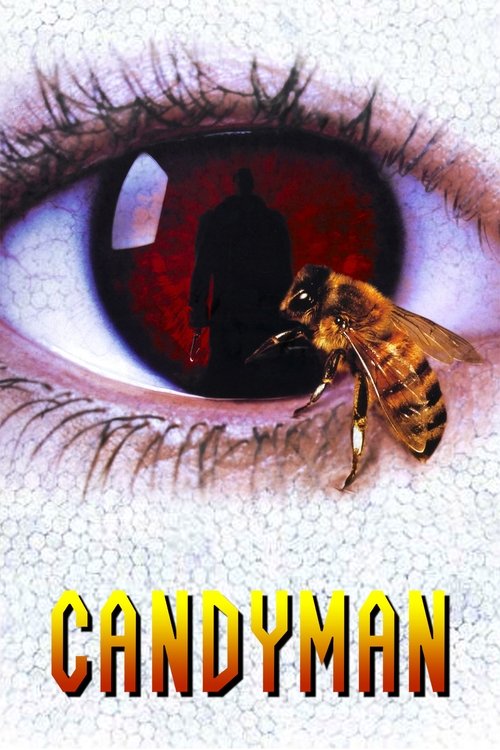
Candyman
1992 · Bernard Rose
For when you want horror with weight — something that scares you and gives you something to argue about afterward. A challenge watch, not a popcorn one, and you may hesitate at your bathroom mirror for a few nights.
What it's about
Helen, a Chicago graduate student researching urban legends, keeps hearing the same story: say "Candyman" five times into a mirror and a hook-handed figure appears. Her fieldwork takes her from the university into Cabrini-Green, the public housing towers where the legend isn't a party game but the accepted explanation for real murders. Determined to prove the myth is just a story, she says the name — and the legend starts writing her into it.
The experience
Less a scare machine than a slow, mournful spell — elegant, dread-soaked, and genuinely unsettling because its horror is rooted in real places and real inequities. It gets under your skin and stays there, more melancholy than most slashers ever attempt.
Performances
Tony Todd's Candyman is one of the great horror figures: a deep, hypnotic voice and tragic gravity that make him seductive rather than merely monstrous. Virginia Madsen matches him, playing Helen's unraveling with total commitment.
The craft
Bernard Rose shoots Chicago — its towers, overpasses, and institutional spaces — with an eerie grandeur, and Philip Glass's organ-and-choir score gives the film the feel of a dark requiem rather than a slasher. Adapted from a Clive Barker story and relocated to American soil, where its ideas about myth, race, and urban neglect gain real charge.
Why it matters
It elevated the urban legend into serious horror material and became a touchstone for the genre's engagement with race, class, and the American city — influential enough to be directly continued by a major studio sequel decades later.
Snapshot
Candyman is a horror film about a graduate student who researches an urban legend and becomes its next chapter. Helen Lyle, a semiotics-adjacent folklorist at the University of Illinois at Chicago, is collecting "urban legend" testimony for a thesis when she keeps encountering the same story: say "Candyman" five times into a mirror and he appears, hook first. The trail leads her from the university to Cabrini-Green, the Chicago public housing development where the legend is not a campfire game but a working explanation for actual murders. Helen's skepticism is the film's engine and its trap. She wants to demystify the legend; the legend requires belief to survive; so it takes her — first by framing her for crimes she cannot remember, then by offering her the only thing her academic career could not give her, which is to be believed.
Adapted by Bernard Rose from Clive Barker's short story "The Forbidden," the film performs a specific and consequential relocation: Barker's original is set in the decaying council estates of Liverpool and is about class, and Rose moved it to Chicago and made it about race and class together. That transposition is the reason the film has outlived nearly all of its early-nineties genre peers. The Candyman of the film is the son of a slave, an artist lynched in the 1890s for fathering a child with a white woman — his hand sawn off, his body smeared with honeycomb, bees called down on him, his ashes scattered over the ground that would become Cabrini-Green. He is a monster whose backstory is American racial violence, hovering over a real housing project that the city had, by 1992, effectively abandoned.
What makes the film unusual is that it is not merely a horror movie with a racial subtext but a horror movie about how stories about Black death circulate, who tells them, and who profits. Helen is a white academic mining a Black community for material; the film is at least partly aware that it is doing the same thing. That doubled self-consciousness — sincere and compromised at once — is what critics have argued about for thirty years, and it is why the film keeps being reopened rather than settled.
Industry & production
Candyman was produced by Propaganda Films, the music-video house co-founded by Sigurjón Sighvatsson and Steve Golin that had become a conduit for stylish, director-driven features (it was the company behind David Lynch's Wild at Heart), and released by TriStar Pictures in October 1992. Clive Barker took an executive producer credit; his name on the poster was a commercial asset in the wake of Hellraiser (1987), and the film was marketed in part as a Barker property even though the screenplay and its central invention — the American racial history — are Rose's.
Bernard Rose was an English director who had come out of music videos and made the eerie children's-horror film Paperhouse (1988), a picture that already showed his interest in porous boundaries between imagination and material fact. He was, in other words, exactly the kind of hire Propaganda made: visually literate, cheap relative to studio directors, and unlikely to deliver a generic slasher.
The production's most consequential decision was to shoot at Cabrini-Green itself rather than build sets or find a stand-in. The Chicago Housing Authority development was, by 1992, a national shorthand for the failure of American public housing — high-rise towers, gang territorial control, extensively documented violence, and a city administration that had largely stopped maintaining the buildings. The film's location work with residents and the negotiated access this required have been discussed by the filmmakers in subsequent interviews and retrospectives; the specific arrangements are the sort of detail that varies between accounts, and I'd rather flag that than reproduce a version I can't verify. What is not in dispute is the result on screen: the graffiti, the gutted apartments, the barricaded corridors, and the sightlines between towers are documentary in a way no built set could be, and the film's most disquieting images are simply photographs of a place that existed.
The casting of Tony Todd was the other decisive move. Todd was a working character actor — he had led Tom Savini's 1990 remake of Night of the Living Dead — and had never carried a horror franchise. He was also, at the time, an unusual choice in a genre whose monsters were overwhelmingly white, and the film's willingness to give its Black antagonist a voice, a history, a grievance, and erotic gravity rather than mute menace was a departure from the slasher template then dominant.
Cabrini-Green's towers were demolished over the following two decades, the last high-rise coming down in 2011. This has given the film an accidental second life as an archival document: the buildings in Candyman no longer exist, which changes how the film's images land.
Technology
Candyman is a 35mm film shot with conventional early-nineties equipment, and its technological interest lies less in innovation than in two areas of practical craft.
The first is the bees. The film's climactic and most-discussed effects are practical: live bees, in enormous numbers, on and around performers. Todd's willingness to perform with bees in and around his mouth became one of the film's durable production stories, and the sequences retain a physical authenticity that computer-generated insects of any era have struggled to match — the bees crawl with the irregular, non-choreographed motion of actual animals, and the actors' micro-flinches are real. The film sits at a hinge point: it is late enough that digital compositing existed as an option and early enough that practical work was still cheaper and better.
The second is the mirror work. The film is structured around reflective surfaces, which is technically demanding — every mirror shot requires hiding a camera and crew, and the film's signature device of a medicine cabinet that opens onto a hole in the wall depends on precise coordination between what the mirror shows and what lies behind it. The Candyman's appearances are staged so that he often materializes in reflections rather than in the space, and the film's spatial logic is built on the gap between the two.
Philip Glass's score was recorded with a chamber ensemble, organ, and choir rather than the synthesizer-and-stinger palette typical of studio horror at the time — a compositional and production choice that is discussed below.
Technique
Cinematography
Anthony B. Richmond, a British cinematographer whose credits included Nicolas Roeg's Don't Look Now (1973) and The Man Who Fell to Earth (1976), shot the film — a lineage that matters, because Roeg's cinema is precisely about premonition, fractured time, and images that turn out to have been warnings. Richmond brought that sensibility to a genre picture.
The film opens with aerial photography of Chicago's expressways and grid, a god's-eye survey that establishes the city as a system before it establishes any character. This overhead vocabulary recurs — the camera looking down on Cabrini-Green's towers, on courtyards, on the bonfire at the climax — and it does specific ideological work: it gives the viewer the planner's view, the view from which the housing project is a diagram rather than a home. The film keeps cutting from that abstraction into the interior of ruined apartments, and the shock of the film is partly the shock of scale collapse.
Richmond's interiors favor wide-angle lenses in the corridors and stairwells, which stretches space and makes the concrete architecture press in. The palette is cool and desaturated in the university and Helen's high-rise apartment, warmer and more sodium-lit in the projects — but the film complicates the obvious reading by revealing that Helen's own building is architecturally identical to Cabrini-Green, converted to condominiums. The camera has been showing us the same building all along in two lighting registers, and the film says so out loud.
The Candyman's appearances are shot with a stillness that departs from the era's horror grammar. He does not lunge into frame; he is simply there, held in medium shot, allowed to speak. Richmond frequently lights Todd from below and behind so that the fur-collared coat reads as silhouette and the eyes catch light — closer to the visual treatment of a romantic lead in a gothic melodrama than a slasher villain.
Editing
Dan Rae's cutting is notably patient for the genre. The film withholds its monster for a long first act and, once he arrives, refuses to cut around him. The most distinctive structural device is the film's use of ellipsis around Helen's blackouts: the film cuts from Helen confronting the Candyman to Helen waking covered in blood, with the violence excised. We are placed exactly in her epistemic position — we did not see it either, so we cannot exonerate her. This is a rigorous formal commitment, and it is what makes the middle section of the film play as psychological thriller rather than stalk-and-slash. The audience's inability to verify events is the plot.
The film also uses hypnosis and dissolve-like transitions to move between registers — the Candyman's voice narrating over images, the past bleeding into the present in the mural sequence — and the cutting between Helen's academic environment and the projects is often direct and hard, so that a lecture hall gives way to a stairwell without cushioning.
Mise-en-scène / staging
The film's production design (Jane Ann Stewart) turns Cabrini-Green's real surfaces into text. The most famous set is the derelict apartment reached through the medicine-cabinet hole, where a vast painted mouth surrounds the opening — the Candyman's lair rendered as a face, so that entering the story means walking into it. Graffiti in the film functions as a competing archive: the murals and tags carry the legend's history in a form the university's tape recorders cannot process.
Helen's own apartment is staged as a mirror-image of the projects — same slab construction, different fixtures — and the film's revelation that the developments were built as public housing and that the private conversions differ mainly in maintenance and rent is delivered spatially rather than through dialogue.
The Candyman's costume — long coat, fur collar, bare chest, the hook prosthesis — deliberately evokes an older, courtlier register than the workwear and masks of the slasher canon. He is dressed like a nineteenth-century gentleman, which is what his backstory says he was.
Sound
Philip Glass's score is the film's most-cited element and one of the strangest scores ever attached to a studio horror picture. Written for organ, piano, chamber forces, and wordless choir, it operates in Glass's characteristic arpeggiated minimalism — cycling figures that build without releasing. Crucially, it is not frightening in the conventional sense: it is elegiac, liturgical, and mournful. The music treats the Candyman as a tragedy rather than a threat, and the friction between what the score feels and what the images show is the source of much of the film's unease. Glass has spoken publicly about his dissatisfaction with the finished film, having understood the project differently than it turned out; the score's persistence in the culture — it is one of the few horror scores by a major concert composer — has outlasted that disagreement.
Beyond the score, the film's sound design is built on Todd's voice, which is treated with reverb and low-end weight so that it seems to come from the architecture rather than a body. The buzzing of bees is used as a leitmotif, sometimes arriving before the Candyman does, and the film's most reliable dread cue is not a stinger but a low hum that has already started before you notice.
Performance
Virginia Madsen's Helen is the film's structural spine, and it is a performance that has to move through skepticism, humiliation, institutional abandonment, and finally a kind of terrible acceptance without ever becoming a passive victim. Madsen plays the early scenes with a slightly brittle confidence — a researcher enjoying her own cleverness — which makes the collapse legible.
Tony Todd's Candyman is the performance the film is remembered for. He plays the character with unhurried gravity, at a volume just below the scene, so that other actors have to lean toward him. The seductive register is deliberate: the character courts Helen rather than hunts her, and Todd finds the line where erotic and predatory are indistinguishable. It is a performance of enormous stillness in a genre built on kinetics.
Kasi Lemmons plays Bernadette, Helen's colleague and the film's most grounded presence; Lemmons would go on to direct Eve's Bayou (1997), one of the significant American independent films of the decade. Vanessa Williams plays Anne-Marie McCoy, the Cabrini-Green resident who supplies the film's most emotionally direct scenes and whose skepticism about Helen's project functions as internal critique. Xander Berkeley plays Helen's husband Trevor with an efficient, unflattering ordinariness.
Narrative & dramatic mode
The film is built as an investigation that turns into a possession narrative. Its dramatic mode is closest to the female-gothic tradition: a woman enters a space with a buried history, is disbelieved by husband and institutions, is confined (here, in a psychiatric ward rather than an attic), and discovers that the supernatural explanation is the true one and her sanity was never the question.
The screenplay is unusually disciplined about information. Helen's research is dramatized as actual research — interviews, tape recorders, archival photographs, a trip to the murder site — and the film respects the procedural rhythm long enough that the supernatural intrusion has something to break. The turn at the midpoint, where Helen loses control of the narrative and becomes its subject, is executed by simply removing the footage of the crimes.
The ending is a genuine reversal rather than a twist: Helen saves the child, dies in the bonfire, and is memorialized in a new mural — she becomes a legend herself, and her final act is to appear in Trevor's mirror. The film's last move is to hand the legend's power to the woman who tried to explain it away, which reads as both vengeance and a bleak joke about the academy: she got her subject position at last.
Genre & cycle
Candyman arrives at the end of the slasher cycle and belongs only glancingly to it. By 1992 the Freddy/Jason/Michael franchises had exhausted themselves into self-parody, and the American horror film was in a commercial trough between the video-era boom and the Scream revival of 1996. Candyman is better understood as part of a small early-nineties tendency toward "prestige" or literary horror — films with real cinematographers, real composers, and adult dramatic ambitions — alongside The Silence of the Lambs (1991), Coppola's Bram Stoker's Dracula (1992), and Barker's own Nightbreed (1990).
Within horror taxonomy it is an urban-legend film, and arguably the urban-legend film: it dramatizes the folkloric mechanism (the summoning ritual, the friend-of-a-friend testimony, the story that must be repeated to live) more rigorously than the later, glossier Urban Legend (1998) cycle it helped make possible. It is also a haunted-place film in which the haunting is historical rather than personal — the ground is guilty, not a house.
Its most important generic position, though, is as a Black horror landmark. Robin R. Means Coleman's scholarship on Black horror has placed Candyman at a pivot: a film with a Black monster whose monstrousness is caused by white violence, made by white filmmakers, watched by a mass audience. Whether the film transcends or reproduces the exploitation it depicts is a live scholarly argument, not a resolved one.
Authorship & method
Rose's method here is adaptation-as-relocation. He took roughly the skeleton of Barker's "The Forbidden" — the researcher, the estate, the legend that demands belief, the bonfire — and grafted onto it an American historical body that Barker's story does not contain. Rose has said in interviews that the racial history was his addition and that Chicago and Cabrini-Green were chosen deliberately; the specific framing varies between tellings, so treat any single quotation with care.
Rose's collaborators are the film's argument. Anthony B. Richmond's Roeg pedigree supplies the premonitory image-logic; Philip Glass supplies a score that refuses genre affect; Dan Rae's editing supplies the ellipses that make Helen unreliable to herself. Clive Barker's contribution is the underlying conceit — that monsters are sustained by belief and that being feared is a form of immortality — which is a preoccupation across his work from The Books of Blood forward.
It is worth naming the film's central authorial tension plainly: a white English director made a film about American anti-Black violence, using a real Black community as location and subject, with a white protagonist as audience surrogate. The film knows this — Helen is explicitly critiqued in the text by Anne-Marie and by Bernadette — but knowing is not the same as escaping, and the film's most serious critics have said so.
Movement / national cinema
Candyman is an American studio film made by a British director within a company culture (Propaganda Films) shaped by music video. It belongs to the small early-nineties wave of British directors working in American genre — a group that also includes Adrian Lyne and, later, Danny Boyle's American ventures — and its visual polish, its willingness to be beautiful, marks it as an outsider's film about America.
It is also, unmistakably, a Chicago film. The city is not a backdrop: the film's geography — Loop expressways, the near-North Side, Cabrini-Green's proximity to the Gold Coast — is the argument. The film understands that the projects and the wealth are separated by a few blocks, and it shoots that adjacency directly.
Era / period
1992 is the year of the Los Angeles uprising following the Rodney King verdict, and Candyman opened that October into a national conversation about race, policing, and urban abandonment that the film's images could not avoid intersecting. It is also the peak of a decade-long moral panic about American public housing, and the film both exploits and interrogates the imagery of that panic: it uses Cabrini-Green as a horror location while insisting, in dialogue and in its architecture reveal, that the horror is a policy outcome.
Formally, the film sits at the end of the practical-effects era and just before digital compositing became routine, and at the end of the analogue-research era — Helen's tape recorder and darkroom photographs date the film precisely.
Themes
Belief as infrastructure. The Candyman exists because he is believed in, and his stated grievance against Helen is that her research would end that belief. This makes the film a fable about scholarship's power to kill what it studies, and about the folk archive's resistance to being cataloged.
Historical violence as ground condition. The film's supernatural mechanism is a lynching. The Candyman's ashes are in the soil of Cabrini-Green; the haunting is literally the residue of racial murder in a place the state later built and abandoned. The film argues that American cities are constructed on this material.
The interchangeability of the towers. The revelation that Helen's condominium and Cabrini-Green are the same building is the film's sharpest single idea: the difference between safety and terror is not architecture but capital and maintenance.
Extraction. Helen goes to a Black community to take a story and make a career. The film's plot punishes her for it, but the film itself performs the same act. This unresolved circularity is the film's most discussed feature.
Legend and immortality. The ending proposes that becoming a story is a form of survival — and that the price is losing the ability to be a person.
Reception, canon & influence
Contemporary critical reception was substantially better than the horror norm of the period; the film was widely noted as unusually intelligent and well-made for a genre release, with the Glass score, Richmond's photography, and Todd's performance singled out. It was a moderate commercial success rather than a phenomenon — enough to produce Candyman: Farewell to the Flesh (1995, dir. Bill Condon) and Candyman: Day of the Dead (1999), both considerably weaker. I don't have reliable box-office figures to hand and won't guess at them.
The film's reputation has risen substantially since. It has become a standard text in academic horror studies, particularly in scholarship on race and the genre — Robin R. Means Coleman's Horror Noire (2011) and the 2019 documentary derived from it treat it as a central case — and in discussions of gentrification and cinematic space. Its critical status is now higher than that of nearly any other American horror film of its decade.
Backward — what shaped it. Clive Barker's "The Forbidden" (from In the Flesh, 1985) supplies the plot skeleton and the belief-metaphysics. Nicolas Roeg's cinema, via Richmond, supplies the premonitory editing and image logic — the debt to Don't Look Now is visible in the film's use of red, its foreshadowing, and its fatal ending. The female-gothic tradition (Gaslight, Rebecca, and their descendants) supplies the disbelieved-woman structure. Folklore studies itself is a source: the film's mirror-summoning ritual is a version of the real "Bloody Mary" legend, and the academic apparatus around urban legend research is depicted with accuracy.
Forward — what it shaped. The film established the urban-legend-as-mechanism film, feeding directly into the late-nineties cycle (Urban Legend, and the ritual-summoning logic of countless later films) and into the mirror-summoning device that has become genre furniture. It gave horror one of its few Black icons and one of its very few tragic, articulate, sexually potent monsters — a template that later filmmakers explicitly engaged. It legitimized the composer-of-record horror score, an approach later extended by Jonny Greenwood, Mica Levi, and Colin Stetson.
Its clearest legacy is Nia DaCosta's Candyman (2021), co-written and produced by Jordan Peele, which returns to a gentrified Cabrini-Green — the towers gone, luxury developments in their place — and rewrites the mythology so that Candyman is a lineage of murdered Black men rather than one, and so that the story is told from inside the community rather than by a visiting researcher. That film is best understood as an argument with the original, and its existence confirms the 1992 film's status as a text worth arguing with. Peele's own Get Out (2017) and the broader post-2017 wave of Black-authored horror operate in a space Candyman helped open, even where they were opening it against him.
Reception
A modest hit in 1992 with respectable reviews, it's since climbed to consensus status as one of the smartest American horror films of the '90s — a reappraisal supercharged by the 2021 Nia DaCosta/Jordan Peele continuation, which sent a new generation back to the original.
How Candyman was received, from release to now →
How to watch Candyman: what to notice on a first viewing
- Listen for the low hum that arrives before the bees. The buzzing works as a leitmotif that often starts before Candyman appears, so the dread announces itself as sound before he is ever seen. The most reliable scare here is not a jump but a hum that has already started.
- Notice the opening aerial shots of Chicago's expressways and grid. Richmond's camera surveys the city from above before it ever meets a face, then keeps returning to that overhead view on the towers and the closing bonfire. That planner's-eye view turns the housing project into a diagram before the film lets you inside it.
- Watch the light shift from cool blue to warm sodium orange. The university and Helen's apartment glow cool and desaturated. Cabrini-Green glows warmer, more sodium lit. Richmond keeps the two palettes visually distinct throughout. The color coding tells you which world the film treats as safe long before anyone says so.
- Watch for Candyman appearing inside mirrors, not in the room. The legend requires his name said five times to a mirror, so reflective surfaces become the film's real threshold between disbelief and belief. Saying his name into a mirror is what starts the story, so the mirror is where belief actually happens.
- Notice how quietly Tony Todd delivers every line he speaks. Todd is held in medium shot, never lunging into frame, speaking just below the scene so other actors lean toward him. His stillness makes him closer to a courtly suitor than a slasher, which is the point of his backstory.
The whole guide to watching Candyman, with the keys for a rewatch →
Influences: the films it descends from and the films it influenced
- Gaslight (1944) — Supplies the female-gothic engine Rose reuses wholesale — a woman's accurate testimony converted by male institutional authority into a diagnosis, which Candyman literalizes in the psychiatric-ward interrogation where Helen's evidence becomes the case notes against her.
- Night of the Demon (1957) — Establishes the researcher-becomes-subject mechanism: a debunking academic must submit to the folklore's own procedural rules to survive it, so the curse operates as machinery with conditions rather than as atmosphere — exactly Helen's move from taping interviews to speaking the name five times.
- The Innocents (1961) — Freddie Francis's wide-angle deep focus bows interior space around a woman whose sightings are never externally corroborated, and the film declines to adjudicate — the same refusal Richmond's distorted apartment interiors and Rose's withheld point-of-view build into Helen.
- Repulsion (1965) — Model for the housing-block-as-psyche: wide-angle lenses that swell flat interiors, subjective insect/drone sound bleeding over cuts, and elisions that deposit the protagonist in the aftermath of violence she cannot account for — the direct template for Candyman's elliptical blackouts.
- Night of the Living Dead (1968) — Ends by having a mob destroy and burn its Black protagonist and then converting that death into still images — the grammar Rose reruns twice, in Candyman's lynching-and-bonfire origin and in Helen's own pyre becoming a mural.
- Don't Look Now (1973) — Shot by Anthony B. Richmond, who brings its premonitory editing logic to Candyman intact — red as an image that reports a death before it happens, and a protagonist whose investigation is revealed to have been a route toward their own already-glimpsed corpse.
- The Shining (1980) — Pairs an aerial approach survey with a droning non-genre score, moves a wide-angle camera through architecture as a ledger of a prior massacre, uses a mirror to release the truth, and closes by absorbing the protagonist into a picture on the wall — the exact four-part structure Rose rebuilds at Cabrini-Green.
- Koyaanisqatsi (1982) — Invents the Glass-scored aerial city survey — arpeggiated organ and wordless choir over helicopter passes reading urban infrastructure as a single organism — which Candyman quotes almost as a formal citation in its opening flight over the Chicago expressways.
- Hellraiser (1987) — Barker's own direction of his belief-metaphysics: a summoning object operated by ritual gesture, and a ceremonial monster who addresses the victim in seductive liturgical cadence as a supplicant rather than prey — the mirror and Todd's vocal register are the same design.
- Paperhouse (1988) — Rose's own prior film builds the device of a hand-made image that becomes an inhabitable architecture with its own rules, which returns as Candyman's painted-mouth lair — a wall painting the camera walks the protagonist into.
- A Nightmare on Elm Street (1984) — Inherits the summoned, personality-driven supernatural killer whose existence depends on belief and speech rather than physical stalking, plus the withheld-monster policy — Todd, like Englund, is rationed across the first act so the character rather than the kill count carries the film.
- Ringu (1998) — Extends the urban-legend-as-mechanism film into a rule-governed transmission system, with a journalist-researcher whose act of investigating the legend is the same act that propagates it and an archive dig that recovers the ghost's suppressed biography.
- Urban Legend (1998) — Takes Helen's folklore-seminar framing device literally — a lecture cataloging the legends becomes the film's kill index — turning Candyman's academic apparatus into the structural spine of the late-nineties cycle.
- The Blair Witch Project (1999) — Builds an entire film from the fieldwork method Candyman opens with — recorded local interviews, contested versions, site visits — and ends in a ruin whose handprint-covered walls function as Rose's graffiti-as-archive, with the researchers written into the legend they came to document.
- Oculus (2013) — Fuses the mirror-summoning device with the researcher's documentation apparatus — a protagonist rigs cameras and timers precisely to prove her perception is reliable — and then intercuts timelines so that neither she nor the viewer retains custody of what was witnessed.
- Get Out (2017) — Operates the genre machinery Candyman opened, and argues with it: the hypnosis-and-diagnosis sequence rebuilds the psychiatric scene from inside the Black subject's perspective rather than the white researcher's, reversing whose perception the film asks you to doubt.
- Candyman (2021) — Retains the mirror ritual and quotes Glass's cues directly while replacing the visiting-academic point of view with an artist inside the community, and converts Rose's graffiti-as-archive into shadow-puppet interstitials that narrate the murders the original left as backstory.
- Stoker (2013) — The precedent for commissioning Philip Glass to score domestic Gothic horror: arpeggiated keyboard cycling used as a seduction figure rather than a fear cue, which is exactly the register of Glass's four-hands piano 'Duet' written for Stoker's central consummation-by-music scene.
- Session 9 (2001) — Treats a condemned institutional building as the recording medium itself — voice on tape and reverberant corridor acoustics carrying the atrocity, with an elliptical structure that hides the protagonist's own violence from him, the same architectural-voice and blackout pairing Rose uses.
- Under the Skin (2013) — Carries forward the composer-of-record score Candyman legitimized — Mica Levi writing against genre affect rather than cueing fright — alongside a void-black lair and silhouette-against-nothing staging that matches Richmond's underlit compositions of Todd.
- Final Destination Bloodlines (2025) — Establishes Tony Todd's mythic, sonorous reciter-of-doom persona — the calm figure who narrates the rules of an inescapable supernatural death — directly feeding his William Bludworth role and making Bloodlines his valediction.
Similar films
- The Shining (1980) — influence & lineage
- Night of the Living Dead (1968) — influence & lineage
- Halloween (1978) — shared sensibility
- The Black Phone (2022) — shared sensibility
- Scream (1996) — shared sensibility
- The Texas Chain Saw Massacre (1974) — shared sensibility
- Suspiria (1977) — shared sensibility
- Child's Play (1988) — shared sensibility