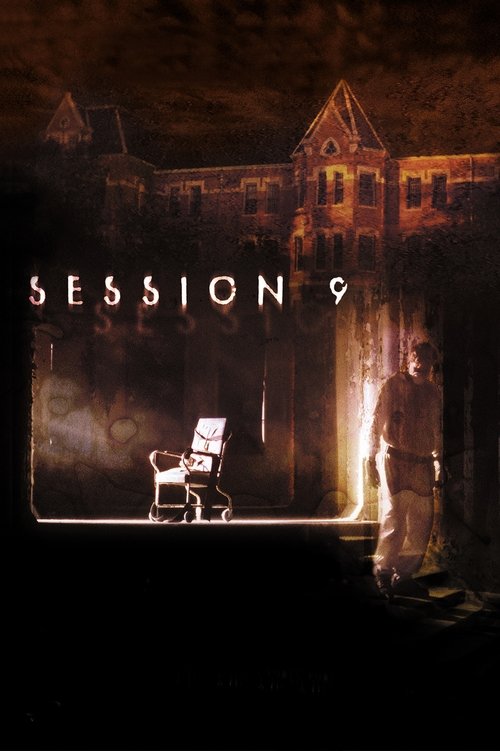
Session 9
2001 · Brad Anderson
For when you want to be unsettled rather than startled — a patient, atmospheric slow burn for viewers who like their horror ambiguous and psychological. Not a crowd-pleaser; a late-night film for when you want something that whispers.
What it's about
A small asbestos-removal crew, led by a contractor drowning in money trouble, takes a rush job: clear a vast abandoned mental asylum in one week. As the days grind on, the building's history surfaces two ways — through the crew's own frayed nerves, grudges, and secrets, and through a set of reel-to-reel tapes documenting a former patient's therapy sessions, counting up toward a ninth.
The experience
A slow, creeping dread that never shows its hand — no monsters, almost no effects, just a real derelict asylum, mounting paranoia, and those tape-recorded sessions getting under your skin. It's quiet horror that trusts silence and suggestion, and it leaves a residue that lasts days.
Performances
Peter Mullan is quietly devastating as the contractor coming apart under financial and private pressure, and David Caruso gives the crew's tensions a live-wire edge.
The craft
Brad Anderson shot inside the actual derelict Danvers State Hospital, and the location does what no set could — peeling paint, endless corridors, real decay. Early digital video gives it a stark, documentary-flat look, and the sound design, built around the hiss and voices of old therapy tapes, is the film's best weapon; headphones or good speakers are almost mandatory.
Why it matters
Barely seen in theaters, it grew into one of the defining cult horror films of the 2000s, regularly cited as a masterclass in low-budget, location-driven dread and a touchstone for slow-burn psychological horror.
Snapshot
Session 9 is a slow-burn psychological horror film set and shot in the derelict Danvers State Hospital in Massachusetts. Its premise is plain: a small asbestos-abatement crew, led by a financially desperate contractor, takes a job to clear the abandoned asylum in one week. The building's history comes to the surface in two ways. One is the crew's own frayed nerves, grudges and private wounds. The other is a set of reel-to-reel tapes recording the therapy sessions of a former patient, Mary Hobbes, whose dissociated personalities lead up to a ninth session. Brad Anderson was then best known for the romantic comedy Next Stop Wonderland (1998). He made the film on a modest independent budget and shot it on early 24p high-definition video. The film refuses explicit supernatural confirmation, uses a real location as its main source of dread, and ends on an ambiguous reveal that recasts what came before. Its release was small and commercially marginal, but it built a strong cult following on home video. It is now often cited as one of the most effective American horror films of the early 2000s, and as a touchstone for the "abandoned asylum" subgenre that followed.
Industry & production
The film came out of the American independent sector of the late 1990s and early 2000s, when low-budget genre work could still get specialty distribution. Anderson wrote the screenplay with actor Stephen Gevedon, who also plays Mike, the crew member who finds the tapes. It was distributed theatrically in the United States in August 2001 by USA Films, the specialty label that was folded into Focus Features the next year. The theatrical release was limited and the box office slight. The film's reputation was built largely after release, through DVD, cable and word of mouth among horror audiences. Reported production budgets vary between sources, and no authoritative figure is given here.
The decisive production fact is the location. Danvers State Hospital opened in the late 1870s and was built to the Kirkbride Plan, the nineteenth-century model of asylum architecture with a central administration block and staggered wings. By the time of filming it had been closed for years and was badly decayed. Anderson and his crew shot inside the real building, using its peeling corridors, hydrotherapy rooms, tunnels and abandoned patient records. They did not build sets. Most of the complex was demolished in the mid-2000s and the site was redeveloped as housing, so the film is now also an unintended document of a lost building. Local lore has long linked Danvers to H. P. Lovecraft's fictional Arkham Sanatorium. That association is part of the building's mythology, but it plays no explicit part in the film.
Technology
Session 9 is often cited as one of the first theatrical features shot on 24p high-definition video, using Sony's then-new HDCAM system (the HDW-F900 generation of cameras). It came out at a moment when digital capture was mostly associated either with consumer-grade DV (the Dogme 95 films, The Blair Witch Project) or with experimental big-studio adoption, as with George Lucas's work on Star Wars: Episode II. Anderson's film took a middle path. It used HD as a cost-effective tool for a professional-looking independent feature, not as a lo-fi aesthetic statement.
The format suited the material. Early HD handled the asylum's mixed and often meagre light with a particular flat clarity: cold fluorescents, daylight through grimy windows, work lights and flashlights. The image has a hard, slightly clinical sharpness, with a desaturated palette leaning toward institutional greens, greys and bruised browns. Some viewers and critics have noted that the image has a video-ish quality compared with film stock. Many others argue that this quality adds to the documentary plainness that makes the building feel real, not stylised. The film's other key technology is diegetic and analog: the reel-to-reel tapes. The crackle and hiss of mid-century magnetic recording sets the past against the crisp digital present.
Technique
Cinematography
The film was shot by Uta Briesewitz, who had worked with Anderson before. She went on to shoot much of HBO's The Wire and later became a prominent television director. Her approach here is restrained and observational. Many compositions use the asylum's architecture to dwarf the actors: long corridors running into darkness, symmetrical framings of the Kirkbride wings, and wide shots in which a worker in a hazmat suit is a small figure in a decayed room. Exteriors, including aerial and wide views of the hospital on its hill, establish the building as a single brooding presence. Inside, the camera often lingers on empty spaces a beat longer than is comfortable. This invites the viewer to search the frame, a strategy that creates unease without shock cuts. Flashlight-lit sequences, especially in the tunnels, narrow the visual field to small pools of light.
Editing
Anderson has typically edited his own features, and he is credited with editing Session 9. The cutting is patient and accumulative. The film saves its rare sharp jolts for a handful of moments and builds most of its tension through cross-cutting between parallel strands. Mike listens to the tapes. Hank sneaks into the tunnels after valuables. Jeff, the youngest, fears the dark. Phil and Hank's personal hostility festers. Gordon's composure frays. As the week goes on, the tape sessions are paced to escalate alongside the crew's breakdown, so the two timelines rhyme. The final movement uses fragmented flashback-style inserts to reveal what has actually happened. This forces a retrospective re-reading of the entire film, which in hindsight has withheld key information through ellipsis.
Mise-en-scène / staging
The production design is largely found. The film's most striking visual material is what was already in Danvers: rusting equipment, patient records and photographs, graffiti, collapsed ceilings, institutional furniture, and the remains of hydrotherapy and treatment rooms. Small invented details carry great weight. Coins and objects found hidden in the walls, the tape boxes, and a single wheelchair or chair placed in an empty room all become charged. The asbestos work itself, with its plastic sheeting, respirators and protective suits, adds another layer of quarantine and contamination imagery. The workers literally seal themselves off from the building while working inside its walls. Staging often isolates characters in separate parts of the complex. This disperses the ensemble and leaves each man alone with the place.
Sound
Sound design is central to the film's effect. The score is by the Seattle experimental group Climax Golden Twins, and it is less conventional film music than ambient texture. Drones, found sounds, distorted tones and low hums often blur the line between score and the noise of the building itself. Anderson leaves long stretches nearly silent apart from creaks, drips, wind and electrical buzz. The Mary Hobbes tapes are the film's sonic centrepiece. The calm, probing voice of the psychiatrist alternates with the patient's shifting registers as her personalities emerge: a childlike "Princess," the protective "Billy," and finally "Simon." The last is a voice that, in the climactic session, speaks of living "in the weak and the wounded." The film never shows Mary. She exists only as sound, so the audience's imagination does the frightening work.
Performance
The ensemble pairs established and emerging actors. Peter Mullan plays Gordon Fleming, the contractor under financial and domestic strain. He gives a quietly devastating performance of a man whose decency and exhaustion hide something worse, and his reticence becomes, in retrospect, the film's key. David Caruso, in a role widely seen as part of his return to film after leaving NYPD Blue, plays Phil, Gordon's second-in-command, clipped and resentful. Josh Lucas plays the swaggering Hank. Stephen Gevedon plays Mike, the law-school dropout drawn to the tapes. Brendan Sexton III plays Jeff, Gordon's nephew, who is new to the work and afraid of the dark. Paul Guilfoyle appears as the town official overseeing the contract. The performances are naturalistic, built on working-class banter and believable professional routine, and that grounds the horror in a recognisable world of labour and money.
Narrative & dramatic mode
The film is built as a countdown across the work week, with the ninth taped session as a structural horizon. The two narrative lines, the crew's job and Mary Hobbes's case history, run in parallel. The film invites the audience to connect them without stating how. Its dramatic mode is ambiguity. Supernatural possession is suggested: is "Simon" a presence in the building that passes from Mary to Gordon? So is a strictly psychological account of a man breaking down under pressure, and the film never settles which is true. The late reveal of Gordon's actions, toward his family and toward his colleagues, works as a classic recontextualising twist. But it is folded into the ambiguity and does not resolve it. The film follows the tradition of the unreliable focal character more than the external monster narrative. Much of its horror comes from what has already happened offscreen.
Genre & cycle
Session 9 sits at the junction of several horror lineages. It is a haunted-house film in which the house is an institution. It is a psychological horror film in the line of The Haunting (1963) and The Shining (1980). It also belongs to the cycle of "quiet" or atmospheric horror that, around 2001, offered an alternative to the self-referential slasher revival that followed Scream (1996). It shares that summer with Alejandro Amenábar's The Others (2001), another restrained, ambiguity-driven ghost story. Its use of the abandoned asylum, and its attention to real psychiatric history (records, treatment rooms, the debris of institutional care), helped consolidate what became a recognisable subgenre. Later asylum films and television drew on similar imagery, often in a more sensational register. It also anticipates the "urban exploration" sensibility, with decay as spectacle and trespass as dread, that later fed found-footage horror.
Authorship & method
Brad Anderson came out of the Boston-area independent scene. His early features, The Darien Gap (1996), Next Stop Wonderland (1998) and Happy Accidents (2000), were character-driven comedies and romances. Session 9 marked his turn toward the psychological thriller and horror, a direction he pursued in The Machinist (2004), Transsiberian (2008), Vanishing on 7th Street (2010) and Stonehearst Asylum (2014). The last of these returns explicitly to the asylum setting. A consistent strand across this work is interest in fractured or unreliable consciousness: guilt, insomnia, delusion and dissociation shown from inside a character's perspective. Anderson also became a prolific television director, including episodes of The Wire, Fringe and Boardwalk Empire.
His method on Session 9 was to let the location dictate atmosphere and to rely on performance and sound over effects. Key collaborators:
- Stephen Gevedon co-wrote the script and acted in the film.
- Uta Briesewitz shot it. Her naturalistic, architecture-sensitive camera became central to the film's identity.
- Climax Golden Twins gave it a non-traditional, texture-based score.
- Anderson himself edited the film, which gave him direct control of its slow pacing and its reveal.
Movement / national cinema
The film belongs to American independent cinema at the turn of the millennium. This was a period when the infrastructure built in the 1990s (festivals, specialty labels, affordable new capture technologies) let regional filmmakers make genre work outside the studio system. It is also strongly regional. Its New England setting, Massachusetts working-class voices and decaying nineteenth-century institutional architecture link it to a long tradition of New England gothic, from Hawthorne to Lovecraft. It does not belong to any formal movement. It is better understood as one of a scattered group of independent horror films of the late 1990s and early 2000s that relied on atmosphere, ambiguity and low budgets.
Era / period
Released in August 2001, Session 9 arrived just before the shifts that reshaped American horror over the following decade. These included the post-9/11 cycle of "torture porn," the J-horror remake wave that began with The Ring (2002), and later the commercial explosion of micro-budget found-footage horror after Paranormal Activity. The film sits in a transitional period. It is digital, but not yet in the found-footage vernacular, and restrained in a commercial climate that was moving toward extremity. It also reflects a specific moment in the history of American psychiatric institutions. The great state hospitals emptied out during deinstitutionalisation in the later twentieth century, and their ruins had become sites of public fascination, trespass and preservation debates. The film's treatment of dissociative identity disorder and recovered memory also reflects the heavily contested psychiatric discourse of the 1980s and 1990s. The film draws on that discourse for dramatic effect and does not offer a clinical position.
Themes
- The institution as memory. The asylum is a container of buried history: records, tapes, objects in the walls. The film suggests that institutions keep the suffering they processed, and that clearing them out is never only physical work.
- Contamination and labour. Asbestos abatement is literally the removal of a hidden toxin from a building's fabric. The film makes this a metaphor for psychic contamination, and grounds it in the economic precarity of small contractors who take dangerous jobs on impossible deadlines.
- Fractured selfhood. Mary Hobbes's personalities mirror Gordon's split between a decent, struggling family man and something he cannot face. The question of whether "Simon" is an external entity or an internal one is the film's central uncertainty.
- Masculinity under strain. The crew is a world of men: rivalries, jokes, debts, sexual jealousy, unspoken grief. The horror grows out of what these men cannot say to each other.
- Guilt and repression. The structure enacts repression itself. The film hides from the viewer what its protagonist hides from himself, until both are forced to confront it.
Reception, canon & influence
Critical reception. On release the film drew mixed-to-positive reviews. Admirers praised its atmosphere, its use of location and Mullan's performance. Some critics found the pacing slow and the ending either too opaque or too conventional a twist. Its very limited theatrical run meant it reached few viewers at the time. Its standing rose steadily through home video and cable, and through horror-community discussion in the 2000s and 2010s. It now regularly appears on critics' and fans' lists of the best horror films of the 2000s and of underrated modern horror, and it is commonly described as a cult classic. The Mary Hobbes tapes, and the line about "the weak and the wounded," are among the film's most widely quoted elements.
Influences on the film (backward). Critics have frequently compared it to Kubrick's The Shining, which also centres on a man isolated in a vast building under economic and domestic pressure, who turns on those around him and whose possession is left ambiguous. The suggestive, offscreen approach to fear recalls the Val Lewton RKO productions of the 1940s and Robert Wise's The Haunting. Its use of a real decaying space for horror connects it to the documentary turn in late-1990s horror, of which The Blair Witch Project was the most prominent example. The case-history structure draws on the popular culture of multiple personality, as dramatised in works such as The Three Faces of Eve (1957) and Sybil (1976), though the film does not cite any particular source directly. The wider tradition of New England gothic, including Lovecraft's institutions and ruined estates, provides a regional backdrop.
Legacy (forward). Session 9 is regularly named as a forerunner of the abandoned-asylum horror that grew in the following decade. Examples include the found-footage Grave Encounters (2011), the anthology season American Horror Story: Asylum (2012) and South Korea's Gonjiam: Haunted Asylum (2018). Direct influence on any single title is not documented, but its imagery recurs throughout the cycle: decaying Kirkbride corridors, patient records, recorded sessions, and an institution's past "leaking" into the present. Its early adoption of 24p HD makes it a small landmark in the history of digital feature production. It showed that the format could support a professionally composed, atmospheric genre film. For Anderson it opened a career in psychological thrillers that continued through The Machinist and Stonehearst Asylum. Because Danvers State Hospital was largely demolished soon afterward, the film has also become a historical record of the building. That has given it lasting interest among architectural historians, urban explorers and preservationists, as well as horror audiences.
Influences: the films it descends from and the films it influenced
- The Haunting (1963) — Wise frames Hill House's architecture as the antagonist through wide-angle compositions that dwarf the figures and leave the threat offscreen, and Session 9 builds its Danvers corridors the same way.
- Cat People (1942) — The Lewton unit's suggestive method generates fear from shadow, empty frame and offscreen sound, and Session 9 uses that method in place of visible effects.
- The Shining (1980) — A caretaker under financial and domestic pressure is isolated in a vast institutional building that seems to absorb him, with long empty-space compositions and possession left ambiguous, which is the template for Gordon's arc.
- The Three Faces of Eve (1957) — It dramatises a dissociative case history through clinical interview sessions in which alters emerge, the structure the Mary Hobbes tapes adapt.
- Sybil (1976) — Its therapy-session framework, where a therapist questions named alters to uncover a buried trauma, supplies the escalating 'Session 1–9' structure of Mary's recordings.
- The Conversation (1974) — A reel-to-reel recording is replayed and reinterpreted until its meaning flips, the same audio-forensic device that drives Mike's listening scenes and the final recontextualising tape.
- The Blair Witch Project (1999) — Low-budget video horror shot in a real, unlit location, with fear coming from sound and absence rather than effects, opened the door that Session 9's prosumer-digital, real-location approach went through.
- Titicut Follies (1967) — Wiseman's observational footage inside Bridgewater State Hospital, another Massachusetts institution, established the desaturated, unadorned look of the state asylum that Session 9's documentary-styled location work echoes.
- Jacob's Ladder (1990) — It sustains an ambiguity between supernatural and psychological explanations of a working man's breakdown and resolves it with a final recontextualising reveal, the same structure Session 9 follows.
- Carnival of Souls (1962) — Makes a real abandoned ruin (Danvers State Hospital) the film's principal apparatus rather than a set, shooting it in flat digital daylight and generating the horror from room tone, tape hiss and offscreen voices instead of staged apparitions.
- The Machinist (2004) — Anderson carries Session 9's methods forward: a desaturated industrial-blue palette, a labourer's dissociated perspective and a guilt-based twist that recontextualises the whole film.
- Stonehearst Asylum (2014) — Anderson goes back to the asylum setting, again using institutional architecture and a reversal of who is patient and who is keeper as the main narrative device.
- Grave Encounters (2011) — It turns the night-crew-in-a-condemned-Kirkbride-hospital premise into found footage, with corridors that loop and swallow the intruders.
- American Horror Story: Asylum (2012) — It builds a serial narrative from a New England asylum's patient files and recorded case histories, reusing Session 9's idea of institutional records leaking into the present.
- Gonjiam: Haunted Asylum (2018) — It uses a real abandoned psychiatric hospital and its numbered room as the locus of the horror, with the crew's recording gear capturing presences offscreen, the same structure as Session 9's tapes.
- Lake Mungo (2008) — Repeated replays of recorded media slowly surface a hidden figure, and atmospheric drift outweighs shocks, which develops Session 9's quiet, tape-based method of uncovering the past.
- The Innkeepers (2011) — It plays out in a real, condemned New England building, with long takes through empty corridors and an EVP-recorder sound device, extending the quiet New England-gothic, recording-led horror Session 9 defined.
- The Autopsy of Jane Doe (2016) — Single decaying institutional location where dread is built through immersive sound design and slow procedural exploration as the characters' rationality dissolves.
- Hokum (2026) — An early 24p digital shoot inside one decaying building, using available low light rather than fighting it, with recorded voices carrying the story from offscreen — the economic and acoustic model for single-location digital horror at this budget.
- Cure (1997) — Kurosawa holds static, distant shots on decaying institutional spaces and lets the voice of a hypnotic 'other' spread violence through ordinary men, a sibling of the Simon voice's contagion.
- Pulse (Kairo) (2001) — From the same year, it treats empty rooms and degraded media as carriers of a haunting, building dread from lingering emptiness and drained colour on early digital-era imagery.
- Event Horizon (1997) — Extends the architecture-as-antagonist method — deep-focus wide angles that subordinate workers to a derelict institution — and makes the degraded recovered recording (reel-to-reel tape here, distress transmission there) the sole engine of revelation.
- Candyman (1992) — Treats a condemned institutional building as the recording medium itself — voice on tape and reverberant corridor acoustics carrying the atrocity, with an elliptical structure that hides the protagonist's own violence from him, the same architectural-voice and blackout pairing Rose uses.
Similar films
- The Shining (1980) — influence & lineage · same viewing thread
- The Haunting (1963) — influence & lineage · same viewing thread
- Jacob's Ladder (1990) — influence & lineage
- Gonjiam: Haunted Asylum (2018) — influence & lineage
- The Machinist (2004) — influence & lineage
- The Blair Witch Project (1999) — influence & lineage
- Cure (1997) — influence & lineage
- Repulsion (1965) — same viewing thread
All the films related to Session 9 →
Watch it with: curated runs of related films
- The Walls Are Closing In — Watch these when you want horror that comes from inside the house — a mind or a family cracking apart in rooms that slowly turn hostile.