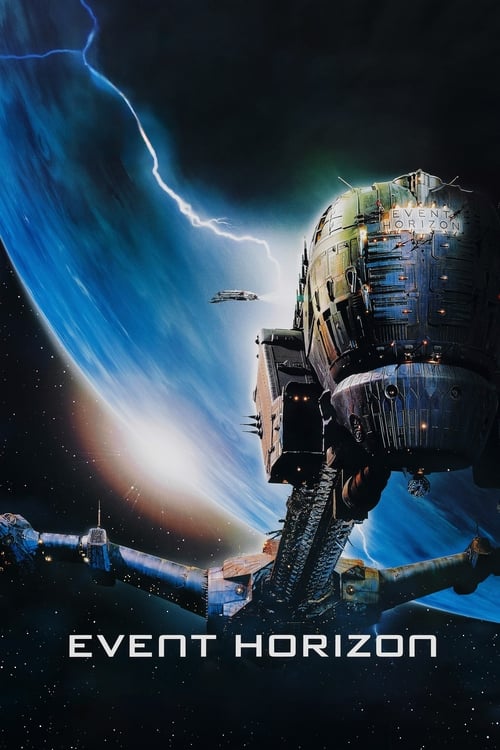
Event Horizon
1997 · Paul W. S. Anderson
For when you want a real scare with sci-fi hardware around it — a dark-room, lights-off watch that leaves you a little queasy. Firmly on the challenge end: this is horror that goes for the throat, not a comfort rewatch for the faint-hearted.
What it's about
In 2047, a rescue crew is sent to the far edge of the solar system to board the Event Horizon, an experimental starship that vanished on its maiden voyage seven years earlier and has suddenly reappeared. The ship's designer rides along to explain his creation, but the vessel they find is dark, empty, and wrong — and whatever it brought back with it starts working on the crew's minds. It's a haunted-house story where the house is a spaceship and there's nowhere to run but the corridors.
The experience
Dread-forward and increasingly nasty — it starts as a procedural salvage mission and curdles into nightmare logic, with flash-cut visions and gore that hits harder than you expect from a studio picture. The mood is claustrophobic and genuinely mean; it wants to rattle you, not just startle you.
Performances
Sam Neill gets to slide from clipped, rational engineer into something far more disturbing, and Laurence Fishburne anchors the ship as the captain — steady, skeptical, and the film's moral weight.
The craft
The production design is the star: a starship built like a gothic cathedral, all spiked corridors and industrial gloom, shot so the ship itself feels malevolent. The sound design and sudden subliminal imagery do a lot of the damage, and it absolutely rewards a big screen and good speakers — this is a film about darkness and noise pressing in on you.
Why it matters
A famous flop that became a durable cult object, now cited as the bridge between the industrial-grunge school of space horror and the wetter, more extreme horror that followed — and as the film whose rumored lost gorier cut fans still hunt for.
Snapshot
Event Horizon is a haunted-house film in a starship, and its enduring interest lies in the friction between those two halves. Paramount released it in August 1997 into a summer already crowded with science-fiction spectacle, and it failed commercially and critically — a rejection so decisive that Paul W. S. Anderson has described the experience in interviews over the years as the most painful of his career. The film then did what a certain class of studio horror does: it survived on home video, cable, and eventually streaming, accruing a reputation that has steadily inverted its original verdict. Today it is routinely cited as a cult object and as the aesthetic bridge between the clean, industrial-grunge science fiction of the Alien lineage and the wet, corporeal extremity that British and American horror would pursue in the following decade.
The premise is unusually direct for a film whose reputation rests on excess. A rescue crew aboard the Lewis and Clark is dispatched to Neptune orbit to recover the Event Horizon, an experimental vessel that vanished seven years earlier and has now returned, silent and intact, from wherever it went. The ship carried a gravity drive designed to fold space — to bypass the light-speed limit by creating an artificial singularity and joining two points in spacetime. It worked. The film's governing idea, and the reason it lodges in memory, is the answer it gives to the question of where the ship went: not another star system, but somewhere outside the physical universe, a dimension the film declines to name and characterizes only as pure chaos, hostile and alive. The ship comes back with something aboard, or perhaps comes back as something. The distinction is deliberately left unresolved.
What makes the film worth a dossier is not the plot but the collision of registers: production design of genuine sophistication, a sound and score strategy that was ahead of the curve, a compressed post-production that visibly damaged the third act, and a set of images — the Latin distress signal, the frozen ballroom of the Event Horizon's original crew, the eyeless captain — that outlived the film that contained them.
Industry & production
Event Horizon was produced by Lawrence Gordon and Lloyd Levin, with Jeremy Bolt, and released by Paramount Pictures. It was Anderson's third feature and his first with a substantial studio budget, following Shopping (1994), a low-budget British film, and Mortal Kombat (1995), the video-game adaptation that made him commercially viable in Hollywood. The screenplay is credited to Philip Eisner. Shooting took place primarily at Pinewood Studios in England, on the 007 Stage among others — a facility whose scale permitted the construction of the Event Horizon's corridors and the gravity drive chamber as substantially practical environments rather than as digital extensions.
The production's defining constraint was its schedule. The release date was fixed early and the post-production window was short, which meant that the film Anderson delivered was cut down under time pressure rather than shaped at leisure. Anderson has said in numerous interviews that a longer, considerably more graphic version existed and that studio previews and the compressed timetable drove substantial excisions, particularly from the sequence depicting what happened to the original crew — the film's central revelation, glimpsed in the finished version as a rapid, near-subliminal montage. He has also said, consistently and over many years, that the trimmed footage was not properly archived and that efforts to locate usable elements for a restored cut have repeatedly failed. Fan interest in a "director's cut" has persisted for nearly three decades; the honest position is that the surviving material has never been shown to be in a condition that would support one, and no such cut has been released.
This history matters critically, not just as trivia. The film's third act is widely and reasonably criticized for accelerating into incoherence — for resolving through action beats what the first hour builds as dread. Some of that is structural, attributable to the screenplay. But some is demonstrably the residue of cutting: the finished film gestures at material it no longer contains, and several performances play to information that was removed. Event Horizon is a rare case where the visible seams in a studio horror film can be traced to a documented production circumstance rather than inferred.
Technology
The film sits at a specific and now-legible moment in effects history: 1997, when digital compositing was mature enough to be routine but when practical construction was still the default for anything an actor had to touch. Event Horizon is overwhelmingly a practical film. The ships are miniatures and physical sets; the gore is prosthetic, latex, and blood rigs; the wire work and stunt gags are performed. Digital tools are present — in the gravity-drive effects, the space environments, and the compositing that stitches miniature photography to live action — but they serve a physically built world rather than replacing it.
The single most inventive technological conceit is the gravity drive itself, realized as a spherical chamber ringed by rotating armatures, with the singularity generated at its center. Production designer Joseph Bennett's solution was to make the machine legible as a device — you can see what it is meant to do — while keeping it visually alien, closer to a piece of Gothic architecture or a torture instrument than to the ergonomic paneling around it. The much-repeated observation that the Event Horizon's interiors resemble a cathedral crossed with a machine is accurate and is a designed effect: pointed arches, spikes, cruciform corridor junctions, and a claustrophobic density of surface detail. The design vocabulary owes a clear debt to Giger-adjacent biomechanics and to the Gothic revival, and the film uses it to argue that the ship is not merely infested but architecturally complicit.
Technique
Cinematography
Adrian Biddle shot the film. Biddle's credentials for the assignment were exact: he had been the cinematographer on Aliens (1986), and his instinct for reading industrial space through hard sources, atmospheric haze, and pooled darkness is the visual foundation of Event Horizon. The Lewis and Clark is lit warm and cramped, with practical sources dominating; the Event Horizon is colder, bluer, and lit in a way that leaves the geometry of its corridors ambiguous — you frequently cannot tell how far a passage extends. Beams cut through particulate haze constantly, which does double duty: it makes light itself visible as a physical object and it degrades depth perception.
Biddle and Anderson use wide-angle lenses aggressively in the ship's interiors, which stretches corridors and makes proximity feel invasive. The camera moves — Steadicam glides down passageways, slow pushes into blackness — but the movement is generally withholding rather than revealing. A signature figure is the shot that travels forward into a darkened space and stops before disclosing what is in it. Later, when the ship's influence takes hold, the grammar loosens deliberately: canted angles, harder contrast, strobing sources during the crew's hallucinations. The film's visual argument is that the ship's environment and the crew's psychology are the same system.
Editing
Martin Hunter cut the film. The first hour is patient by the standards of late-1990s studio horror: long approaches, sustained silence, a willingness to hold on a face while nothing happens. The turn comes with the Event Horizon's log playback — the montage revealing the fate of the original crew — which is edited as a barrage of fragments, some only a few frames long, deliberately faster than comprehension. This is the film's most-discussed formal choice and it works both ways: it is genuinely effective as a technique of suggestion, and it is also, per Anderson's own accounts, partly the shape that censorship and trimming left behind. What remains is a sequence that functions as a wound in the film's editorial fabric.
After that point the cutting speeds and never recovers its earlier composure. The final act moves in short, action-oriented units — decompression, fire, hull breach, sacrifice — and the tonal register shifts from dread to survival mechanics. Whether one reads this as a failure of nerve or as a casualty of the schedule, the discontinuity is real and is the most common critical objection to the film.
Mise-en-scène / staging
Joseph Bennett's production design is the film's most durable achievement and the element most frequently praised even in negative reviews. The two ships are opposed at every level. The Lewis and Clark is cluttered, human, and provisional: exposed conduits, taped-on labels, bunks, personal objects. The Event Horizon is monumental, symmetrical, and empty of human trace — corridors that meet at cruciform junctions, the vast cylindrical shaft of the gravity drive chamber, spikes and grilles that read as instruments of restraint. The film stages its horror in this contrast: characters carrying their small, warm, disorderly ship into a cold, ordered, enormous one.
Staging within the Event Horizon consistently subordinates the human figure to architecture. Actors are placed small in frame, at the bottom or edge, with the ship's geometry converging above them. The film's most-cited single image — the crew of the original Event Horizon suspended in a slow, silent tableau of mutilation — is composed as a frieze, a deliberate arrest of motion in a film otherwise defined by movement. Blood is used as a design element rather than only as gore: it appears as sheets, as writing, as a medium that fills corridors.
Sound
The sound design and score are, with the production design, the strongest technical elements. The score is credited to Michael Kamen with substantial electronic contributions from Orbital, the British electronic duo. This combination — orchestral writing braided with abrasive, textural electronica — was not yet standard practice for a studio horror film in 1997, and it gives Event Horizon a sonic identity that predates by several years the widespread adoption of electronic-orchestral hybrids in genre scoring. The result is a soundtrack that alternates between conventional dread cues and passages that behave less like music than like the ship's own noise.
Sound design proper is used structurally. The film's most efficient horror device is the recovered distress transmission — a garbled voice that the crew initially misreads and then translates. Its rendering, degraded and unplaceable, is a textbook use of poor audio fidelity as a source of terror: the listener's ear does the work of imagining. Elsewhere the ship is characterized almost entirely through sound: hull groans, drive hum, the absence of ambience in spaces where ambience should be. Silence is deployed as an event.
Performance
Laurence Fishburne plays Captain Miller and gives the film its center of gravity — a performance of controlled authority that treats the material entirely seriously and refuses to comment on it. Sam Neill plays Dr. William Weir, the gravity drive's designer, and his arc is the film's clearest structural line: from grief-stricken rationalist to the ship's instrument. Neill's late-film work, playing a man who has been unmade and reassembled by something else, is committed to a degree the surrounding film sometimes cannot support. The supporting crew — including Kathleen Quinlan, Joely Richardson, Richard T. Jones, Jason Isaacs, and Sean Pertwee — is populated by capable actors given comparatively thin material; several are defined chiefly by a single hallucination.
The ensemble's collective register is worth noting: everyone plays it straight. There is no winking, no genre self-awareness, which in 1997 — the year Scream's influence was at its height — was itself a choice.
Narrative & dramatic mode
Structurally the film is a rescue narrative that reveals itself as a haunting. The dramatic mode is investigative: a crew enters a sealed space, gathers evidence, and reconstructs a past event. This gives the first two acts the shape of a procedural, and the film's best sustained passage is the accumulation of physical clues aboard the Event Horizon before any supernatural agency is confirmed.
The pivot is the log playback, which converts the procedural into a possession narrative. From there the film adopts a structure familiar from haunted-house fiction: the house selects a susceptible occupant (Weir), works through him, and picks off the rest. The crucial narrative decision — and the one that most divides viewers — is the film's refusal to explain. The dimension the ship visited is never named, its logic never systematized. Miller's formulation that the ship went somewhere outside the known universe and brought something back is the whole of the ontology. For some this is the film's greatest strength: a genuine confrontation with the unexplained, closer to cosmic horror than to demonology. For others the absence of a system leaves the third act with nothing to resolve except physical survival, which is why it defaults to action.
Genre & cycle
Event Horizon belongs to the science-fiction/horror hybrid, and specifically to the haunted-ship subtype. Its most obvious ancestors are Alien (1979) — for the working-crew realism, the industrial interiors, and the ship-as-labyrinth — and the tradition of the haunted-house film from The Haunting (1963) through Kubrick's The Shining (1980), whose logic of a malign structure working on its inhabitants' psychology Event Horizon transposes wholesale into space. The film has been described, accurately and often, as The Shining in a spacecraft, and Anderson has acknowledged the haunted-house framework as the deliberate design.
The debt to Clive Barker's Hellraiser (1987) and to Barker's fiction generally is equally clear: the conception of another dimension as a site of ecstatic suffering, the machine that opens a door to it, the aesthetic of flesh as material. Event Horizon is in this sense a Barkerian premise executed with a studio science-fiction budget.
Its cycle position is precise. It arrived at the end of a mid-1990s run of high-concept space thrillers and just before the resurgence of extreme body horror in the 2000s. In 1997 it looked like an ugly outlier; in retrospect it looks like an early instance of a mode — bleak, corporeal, unresolved — that would become common.
Authorship & method
Anderson's directorial reputation rests on later franchise work (Resident Evil, Death Race, Monster Hunter), and Event Horizon is consistently identified — including by sympathetic critics — as the film in which his ambitions most exceeded his usual register. His method here is spatial: the film is organized around making an environment comprehensible and then making it hostile. That instinct for architecture as a storytelling system persists in his later work, generally in a more mechanical form.
The key collaborators are the story. Adrian Biddle's photography brings the Aliens lineage directly into the film. Joseph Bennett's production design supplies the cathedral-machine vocabulary that is the film's signature. Martin Hunter's editing establishes the deliberate first half and the fractured revelation sequence. Michael Kamen, a composer best known for large-scale orchestral action scoring, working alongside Orbital, produced a hybrid score whose approach was ahead of the studio norm. Philip Eisner's screenplay supplies the central conceit — a faster-than-light drive that reaches somewhere it should not have — which is the film's most durable single idea.
The record on the writing history is thinner than the record on the production. Accounts of how the script developed between Eisner's draft and the shooting version circulate widely but are not well documented in reliable sources, and I would not want to state a specific chain of revisions as fact.
Movement / national cinema
The film is a Hollywood studio production shot in Britain with a substantially British crew and cast, and it belongs to the long tradition of American genre films made at Pinewood and Shepperton using British craft labor. This matters aesthetically: the film's Gothic sensibility, its willingness to be genuinely grim, and its design vocabulary are recognizably closer to British horror — the Hammer inheritance, and Barker's 1980s work — than to the American studio horror of its moment. Anderson, Bolt, Bennett, Isaacs, Pertwee, and Richardson are all British. Event Horizon is best understood as a British horror film financed and released by an American studio.
Era / period
1997 is legible in the film in several ways. Its production sits at the practical-effects endpoint, before digital work became the default solution for physical horror. Its release falls in a moment of pre-millennial anxiety that produced a cluster of films about the collapse of physical or perceptual reality — Dark City and The Truman Show in 1998, The Matrix and eXistenZ in 1999 — and Event Horizon shares their preoccupation with a substrate beneath the visible world, though it locates that substrate in hell rather than in simulation.
It also arrives in a specific studio-horror climate. Post-Scream horror in 1996–97 was largely ironic, teen-oriented, and self-referential. Event Horizon is none of those things. Its total absence of irony was part of why it landed badly in 1997 and part of why it has aged better than most of its contemporaries.
Themes
The film's governing theme is grief as a vector for damnation. Weir is introduced as a widower; the ship's first and most effective move is to give him his wife back. Every crew member's hallucination is drawn from private guilt or loss, which makes the ship less a demon than a device for reading and weaponizing interiority. This is standard haunted-house grammar, but the science-fiction framing sharpens it: the gravity drive is a technology for connecting distant points, and what it connects is a person to their worst memory.
Second is the theme of knowledge as transgression. The drive is a genuine scientific achievement, and the film's horror follows directly from its success. This aligns Event Horizon with the Faustian tradition and with a specific strand of science fiction — the Solaris and Sphere strand — in which contact with the truly alien is destructive not because the alien is hostile but because human cognition cannot survive it.
Third, and most distinctive, is the theme of the body as architecture. The ship and the crew become progressively interchangeable: the ship bleeds, the bodies become fixtures, and Weir's final form is a human being rebuilt to the ship's specification. The Latin transmission's mistranslation — a message that seems to promise rescue and instead announces the opposite — is the film's compressed statement of its own method: everything here means something worse than it first appears.
Reception, canon & influence
Critical reception in 1997 was largely hostile. The dominant objections were consistent: derivative construction, a third act that abandons its own atmosphere for action, and gore judged gratuitous. The film underperformed commercially against its budget — I won't state figures, as the reported numbers vary across sources — and it was treated at the time as a failure. Praise, where it existed, went almost exclusively to the production design and the atmosphere of the first hour, and to Sam Neill.
The reversal came through home video and television, where the film found an audience that encountered it without the burden of summer-blockbuster expectation. Over the following two decades its standing rose substantially, and it is now a fixture of cult-canon lists and a common reference point in critical writing about science-fiction horror. Multiple attempts to develop a television series based on the film have been reported at various points; none has reached air, and the details of those efforts are not well enough documented to state with confidence.
Backward, its influences are traceable and largely acknowledged: Alien for the crew dynamic and industrial space; The Shining for the structure of a malign environment working through a susceptible man; Hellraiser and Barker's fiction for the conception of another dimension as a place of ecstatic suffering and for the machine that opens onto it; Solaris — Tarkovsky's 1972 film and Lem's novel behind it — for the idea of an encounter that manifests as the return of the dead; and The Black Hole (1979) for the specific premise of a ship at the edge of a singularity that has become something other than a ship.
Forward, its legacy is real and unusually concentrated in games. The influence on the Dead Space franchise (from 2008) is direct and has been widely noted: a derelict ship, a crew reduced to mutilated fixtures, a religious cosmology, an environment that assaults the mind. The film is also cited as an influence on the Warhammer 40,000 setting's popular reception, where the Event Horizon's transit "outside" maps closely onto the Warp — the resemblance is frequently discussed by fans, though the direction of influence is debatable given that Warhammer 40,000's Warp cosmology predates the film. In cinema, the film sits upstream of a run of grim, ship-bound science-fiction horror including Pandorum (2009) and, tonally, Sunshine (2007) and Life (2017).
Its final claim on the canon is simpler than any of this. Event Horizon supplied a small set of images and a single idea — that a machine built to shorten a journey might route it through hell — that have proved more durable than the film's own reputation. The dossier's honest summary is that this is a film with a masterpiece's design, atmosphere, and premise, and a compromised final third, which is precisely the combination that produces a cult.
Reception
Savaged by critics and a box-office flop in 1997, it clawed its way to cult-classic status on home video and is now routinely called one of the great sci-fi horrors of the '90s — the textbook 'the critics were wrong' rehabilitation.
How Event Horizon was received, from release to now →
How to watch Event Horizon: what to notice on a first viewing
- Notice the ship's warm light against the Event Horizon's cold blue. Biddle lights the Lewis and Clark with cramped practical warmth and the Event Horizon in cold blue haze that hides how far corridors go. The contrast marks whose ship is human and whose is something else entirely.
- Notice how small the actors look against the ship's corridors. Anderson and Bennett place the crew low in frame, at the edges, while cruciform junctions and vast shafts converge above them. The architecture keeps announcing that the humans are intruders, not owners, of this space.
- Watch shots that push into darkness, then stop before revealing anything. Biddle's camera glides forward down corridors and halts short of disclosure, again and again, a repeated gesture of withholding. The camera trains you to dread what it refuses to show, not what it shows.
- Listen for hull groans and long stretches with no ambient sound. The Event Horizon is built almost entirely from sound design; silence itself is used as a deliberate event. The ship gets its own presence through what you hear, not what you see.
- Notice that no actor ever winks or plays the horror for laughs. Fishburne, Neill, and the crew treat every escalating event with total seriousness, refusing genre self-awareness common in 1997 horror. That commitment makes the film's stranger images land as dread instead of camp.
The whole guide to watching Event Horizon, with the keys for a rewatch →
Influences: the films it descends from and the films it influenced
- The Haunting (1963) — Establishes the grammar the seed transposes to a hull — 30mm-and-wider distorted architecture, a camera that pans toward a threat and stops before revealing it, and an antagonist rendered only as sound (the pounding on the door) so that silence between assaults becomes the actual event.
- 2001: A Space Odyssey (1968) — Supplies the physical toolkit: motion-control miniature passes for hull flyovers, in-camera rotating-set staging for a habitable ring, and the hard cut from full orchestral score to vacuum silence that Event Horizon reuses for its exterior transitions.
- Solaris (1972) — The template for an environment that interrogates a crew by materializing its dead — visitors staged as ordinary physical presences in the ship's own rooms rather than as apparitions, with the long withholding take letting the audience register the impossibility before the character does.
- Alien (1979) — Donates the working-crew hierarchy and the industrial-vernacular interior — Vanlint's low-key sourcing off practicals, chains and dripping condensation used as foreground scrim, corridors dressed so the ship reads as a place of labor before it reads as a set.
- The Black Hole (1979) — The direct premise-and-design ancestor: a derelict parked at a singularity, its interior built as vaulted, glass-ribbed gothic nave rather than utilitarian tube, and a crew revealed to have been converted into fixtures of the vessel that houses them.
- The Shining (1980) — Source of both the wide-angle architecture that shrinks the figure inside a legible floor plan and the single-frame atrocity insert — the flash of the past cut in without diegetic motivation, which Event Horizon rebuilds as its subliminal ship's-log montage.
- The Keep (1983) — The precedent for scoring gothic dread with sustained electronics against orchestral texture (Tangerine Dream) while shooting haze-filled shafts through stone architecture — a structure that turns out to be an engineered container for an entity, not a shelter.
- Aliens (1986) — Adrian Biddle's own prior work is imported wholesale — atmospheric smoke to make hard beams visible in every corridor, and the cold blue-green key played against sodium-amber emergency and firelight that becomes the seed's warm/cold contrast scheme.
- Hellraiser (1987) — Provides the machine-as-portal device and the prosthetic vocabulary of ecstatic mutilation — flayed and hooked bodies posed as tableau rather than thrashing in action, which the gravity-drive log restages as a frieze.
- Jacob's Ladder (1990) — The step-printed, low-frame-rate distortion of a human figure — heads vibrating faster than a body can move — plus the subliminal insert of a horror too brief to parse, both formal devices Event Horizon lifts for its glimpses of the other place.
- Alien 3 (1992) — Turns the industrial ship interior into a cathedral: corridors lensed as nave and clerestory, backlit dust standing in for incense, and blocking that leaves actors as small dark shapes against vast rusted vaulting — the exact staging logic of the seed's Event Horizon sets.
- Altered States (1980) — The cosmic-dread strain: an experimental apparatus that breaches into metaphysical horror, inheriting the idea of scientific transgression opening onto annihilating otherness.
- Ghost Ship (2002) — Opens with a mass-mutilation set piece staged as a single sweeping wire-cut through a ballroom, then runs the seed's structure verbatim: salvage crew boards a vessel that is a reliquary of its own atrocity and reconstructs it through found footage.
- Resident Evil (2002) — Anderson's own follow-through on the spatial method — establish a facility's geometry as comprehensible, then weaponize it; the laser corridor is the gravity drive's mutilation frieze converted from relic into working machine.
- Sunshine (2007) — Boards a missing predecessor ship, plays its degraded crew video as the film's horror pivot, and renders the antagonist through blown-out, step-printed flash frames that refuse legible focus — the seed's subliminal montage adopted as a whole visual register.
- Pandorum (2009) — Builds its reveal out of the seed's parts: a corrupted transmission from a ship that should not be transmitting, reactor spaces dressed as cathedral machinery, and a crew whose degeneration is staged as fixtures embedded in the hull.
- The Void (2016) — Carries the practical-effects half of the inheritance forward — hand-built latex and cable-actuated flesh transformations, no digital assist — and stages transcendence-through-suffering as a Barkerian ascent into a hole in space held inside an ordinary building.
- Sphere (1998) — Same-decade parallel construction: a rescue team boards a derelict vessel, decodes the previous crew's recovered logs, and finds the environment manifesting the contents of their own minds — the discovery-then-manifestation structure worked out independently and released months later.
- Session 9 (2001) — Extends the architecture-as-antagonist method — deep-focus wide angles that subordinate workers to a derelict institution — and makes the degraded recovered recording (reel-to-reel tape here, distress transmission there) the sole engine of revelation.
- Prometheus (2012) — Shares the descent-structure into a hostile vessel as a journey toward forbidden metaphysical knowledge, where reaching past human limits is punished with literal bodily damnation.
- Memories (1995) — Runs Magnetic Rose's premise in live action — a rescue crew boards a derelict ship that weaponizes their own memories and dead into lethal illusion.
Similar films
- Alien (1979) — influence & lineage · same viewing thread
- Aliens (1986) — influence & lineage
- Solaris (1972) — influence & lineage
- 2001: A Space Odyssey (1968) — influence & lineage
- Alien: Romulus (2024) — same viewing thread
- Annihilation (2018) — same viewing thread
- The Abyss (1989) — same viewing thread
- Stalker (1979) — same viewing thread
All the films related to Event Horizon →
Watch it with: curated runs of related films
- Crossing Into the Zone — A run of crews and expeditions that step across a threshold into a hostile unknown — a derelict, a shimmer, a forbidden Zone — that rewrites biology, sanity, and who comes back; watch them in sequence to feel the same dread deepen from pulp to the sublime.