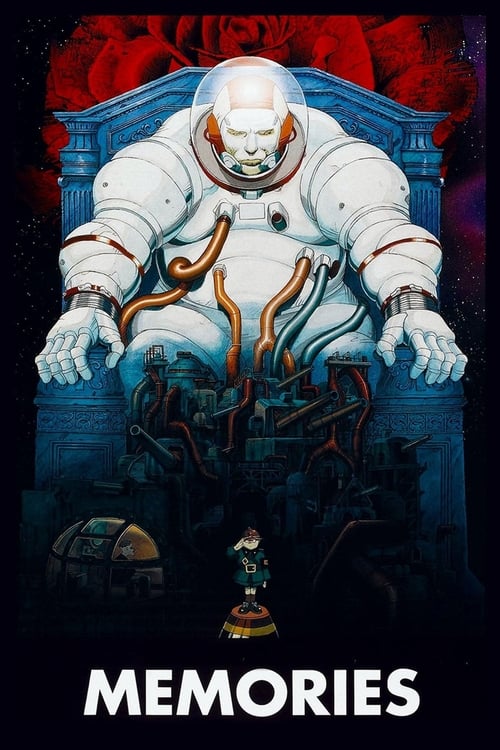
Memories
1995 · Katsuhiro Otomo
For when you want ambitious, idea-driven animation and don't need a single tidy story — an evening that plays like a great short-story collection. It rewards full attention and a willingness to shift gears between dread, absurdist comedy, and quiet sorrow.
What it's about
Three self-contained science-fiction stories from three directors, drawn from Katsuhiro Otomo's manga. Salvage workers in deep space answer a distress signal from a derelict station saturated with one woman's memories; a hapless lab technician becomes a walking catastrophe as the authorities scramble to stop him; and a child's day unfolds in a city whose entire existence is organized around firing an enormous cannon at an enemy no one ever sees.
The experience
Each segment feels like a different film — the first an operatic ghost story in space that slides from eerie to overwhelming, the second a deadpan escalating farce, the third a stately, melancholy piece of world-building. Together they leave you unsettled and a little haunted, in the best way.
The craft
One of the most stylistically ambitious anime features of the 1990s: three directors, three distinct visual idioms, each pushed to a lavish extreme, from cathedral-like derelict interiors to a city rendered as one continuous industrial machine. The first segment in particular is a feast of sound and score — this is a film to watch big and loud if you can.
Why it matters
A landmark of the anthology form in Japanese animation, it showcased a generation of major talents under Otomo's supervision and its opening segment is regularly cited among the finest animated science fiction ever made.
Snapshot
Memories (Japanese: Memorîzu) is a 1995 anthology feature assembling three self-contained science-fiction shorts, each adapted from a story in Katsuhiro Otomo's manga and each helmed by a different director under Otomo's overall supervision. The segments are "Magnetic Rose" (directed by Kōji Morimoto), "Stink Bomb" (directed by Tensai Okamura), and "Cannon Fodder" (directed by Otomo himself). The three films share no characters or continuity; what binds them is a common authorial sensibility — a fascination with technology run amok, with the residue of memory and history, and with ordinary people swallowed by systems too large to see. The result is one of the most stylistically ambitious Japanese animated features of the mid-1990s: a portmanteau that deliberately refuses a house style, letting each director push a distinct visual and tonal register. Produced principally through Studio 4°C, the boutique founded around the animator-directors who would define a certain art-house strain of anime, Memories is remembered less as a commercial event than as a showcase — above all for "Magnetic Rose," widely regarded as one of the finest short works the medium has produced.
Industry & production
Memories emerged from Otomo's stature after Akira (1988), the film that had made him the international face of adult-oriented Japanese animation. Rather than mount another single epic, Otomo functioned here as a producer-auteur, curating an anthology drawn from his own short manga and delegating direction to younger talents. The production is closely associated with Studio 4°C, co-founded by Kōji Morimoto and Eiko Tanaka, and the project served as an early, high-profile calling card for that studio's craft-forward ethos. The film reportedly took roughly three years to complete, a timeline consistent with the density of its animation, though the fine-grained budget and scheduling records are not something I can reconstruct with precision and I won't invent figures.
The anthology format itself was a shrewd industrial move: it let Otomo lend his marquee name and creative oversight while incubating directors — Morimoto and Okamura — who would go on to substantial careers, and it let the individual segments run at feature-caliber quality without any one of them needing to sustain a full runtime. Memories premiered in Japan in December 1995. Its commercial performance was modest relative to Akira, and precise box-office returns are not something I can cite reliably; its reputation has grown chiefly through critical esteem and home-video circulation, including belated Western releases.
Technology
The film sits at the hinge between traditional cel animation and the first incursions of digital tools into Japanese production. It is fundamentally a hand-drawn, cel-based work, but "Magnetic Rose" in particular is often noted for integrating computer-generated elements — its rendering of a derelict space station's architecture and the intricate, receding interiors leans on the kind of digital compositing and CG assistance that was becoming feasible in the mid-1990s. I'd flag that the exact division of labor between hand-drawn and digital work in that segment is described variously in different accounts, so the safest claim is that "Magnetic Rose" is an early, sophisticated example of blending CG spatial construction with cel character animation rather than a fully digital film. The other two segments are more conventionally cel-animated, with "Cannon Fodder" in particular pursuing a deliberately analog, drawn-and-painted texture. Across all three, the technological interest is as much thematic as it is procedural: each story is about machines, weapons, or engineered substances that overrun their makers.
Technique
Cinematography
Because the three segments were conceived independently, the "camera" language shifts sharply between them, and this is one of the film's signature pleasures. "Magnetic Rose" deploys an expansive, roving virtual camera: long drifts through cavernous space, elegant push-ins and reveals, and a sense of deep, ornate three-dimensional space that recalls the opera house and the salvaged mansion the derelict station imitates. "Stink Bomb" is comparatively grounded and kinetic, favoring the propulsive coverage of a chase — road-level tracking, aerial and military-surveillance vantages, wide shots that stage a lone figure against advancing hardware. "Cannon Fodder" is the most radical: Otomo stages the entire short to read as a single, unbroken flowing take, the "camera" gliding through a vertical industrial city without apparent cuts, so that framing becomes a continuous choreographic gesture rather than a series of discrete shots.
Editing
The segments' editorial rhythms are as differentiated as their photography. "Magnetic Rose" is patient and dilated, cutting to sustain mood and to blur the line between present reality and implanted memory, so that the audience shares the crew's disorientation about what is real. "Stink Bomb" accelerates: its comedy and horror come from escalation, and the cutting tightens as the catastrophe widens, intercutting the oblivious protagonist with the increasingly frantic command structure pursuing him. "Cannon Fodder" all but suppresses visible editing within its long-take conceit, folding transitions into camera movement so that the day-in-the-life structure feels continuous and inescapable — the formal choice enacts the story's totalizing militarism.
Mise-en-scène / staging
The production design is where Memories most clearly announces itself as a curated triptych. "Magnetic Rose" builds a decaying Gothic-Romantic environment in space — a station shaped and dressed like a European opera house and mansion, thick with chandeliers, roses, and holographic memory-theater — so that the setting itself is a psychological trap. "Stink Bomb" works in a bright, ordinary Japanese register — a pharmaceutical lab, highways, cities — precisely so the mundane can curdle into apocalypse. "Cannon Fodder" constructs a fully realized steampunk city organized entirely around the firing of enormous guns: every apartment, school lesson, and civic ritual bends toward artillery, with a muted, sepia-industrial palette and a design lineage that reads as indebted to European bande dessinée and propaganda-poster iconography.
Sound
Sound design and music are handled distinctly per segment, and the standout is "Magnetic Rose," scored by Yōko Kanno, whose orchestral writing — and the diegetic use of operatic material associated with Puccini's Madama Butterfly — is integral to the segment's theme of a diva enshrining her own lost love. Kanno's contribution is one of the film's most celebrated elements and helped cement her reputation as a leading anime composer. The other two segments carry their own scores and sound palettes suited to their tones — the anxious propulsion of "Stink Bomb" and the martial, mechanized soundscape of "Cannon Fodder." I want to be careful about attributing those two scores to specific composers from memory; the well-documented and confidently stated musical fact here is Kanno's work on "Magnetic Rose."
Performance
As drawn performances, the three shorts ask different things of their animators. "Magnetic Rose" demands nuanced, restrained acting — the salvage crew's dawning fear, the seductive melancholy of the memory-diva — carried through subtle facial and body work; the segment's reputation rests partly on animation of unusual delicacy. "Stink Bomb" is broader and more physical, its hapless protagonist a figure of oblivious comedy who never grasps that he has become the weapon everyone is fleeing. "Cannon Fodder" reduces its characters almost to civic types — a father, a boy, a mother, functionaries — deliberately flattening individual performance into ritual role, which is the point of its critique.
Narrative & dramatic mode
Memories moves across three dramatic modes in sequence, and part of its design is the tonal whiplash. "Magnetic Rose" is a psychological ghost story in a science-fiction shell — a haunted-house tale where the haunting is memory and illusion, resolving into tragedy. "Stink Bomb" is black satire, a comedy of errors escalating into disaster-movie horror, its humor deriving from the gulf between the protagonist's ignorance and the scale of the calamity he causes. "Cannon Fodder" is closest to fable or dystopian allegory: nearly plotless by design, it is a day-in-the-life whose meaning lies in the totality of its world rather than in event. Read together, the three enact a movement from the intimate and interior (one person's memories) outward to the social and systemic (a whole society organized around war).
Genre & cycle
The film is science fiction across all three panels, but each inflects the genre differently — haunted deep-space Gothic, techno-thriller satire, and militarist dystopia. As an anthology it belongs to a recognizable tradition of animated omnibus films that let auteur animators work at short length, and it stands in dialogue with the broader post-Akira cycle of ambitious, adult-oriented anime features in which Otomo was a central figure. Its thematic spine — technology and human systems turning against their makers — connects it to the cyberpunk and techno-anxiety currents running through Japanese animation of the late 1980s and 1990s.
Authorship & method
The organizing author is Katsuhiro Otomo, who supplies the source stories, oversees the whole, and directs "Cannon Fodder" outright — the segment that most directly bears his signature as a designer of dense, mechanized worlds. The anthology is equally a portrait of collaboration and delegation. "Magnetic Rose" is directed by Kōji Morimoto and is closely associated with the screenwriting of Satoshi Kon — an important detail, given Kon's later emergence as one of anime's great directors of memory, identity, and the porousness between reality and illusion; the segment reads in hindsight as a seedbed for his mature preoccupations. Its music, as noted, is by Yōko Kanno. "Stink Bomb" is directed by Tensai Okamura, working from Otomo's writing. This distributed authorship — a supervising auteur, a rising director-screenwriter pairing, and a composer of the first rank — is the method: Memories is less a unified statement than a curated convergence of distinct hands around shared concerns.
Movement / national cinema
Memories is a landmark of 1990s Japanese animation and specifically of the art-house, craft-forward wing represented by Studio 4°C. It belongs to the lineage that Akira opened internationally — Japanese animation taken seriously as a medium for sophisticated, adult, formally daring cinema. It also documents a generational handoff: Otomo, the established master, providing a platform for Morimoto, Okamura, and (through the writing) Kon, figures who would shape the following decades of anime. Within the national cinema, it exemplifies the anthology as an incubator, and it reflects a moment when the boundary between hand-drawn tradition and digital technique was actively being negotiated.
Era / period
Released at the end of 1995, the film sits in a pivotal year for Japanese animation and science fiction more broadly — the same period that produced other watershed works reckoning with technology, identity, and apocalypse. It is a late high point of the cel era, made just before digital production reshaped the industry's economics and look. Its anxieties — engineered weapons, runaway military bureaucracy, societies built around perpetual war, the technological preservation and falsification of memory — are legible as products of a fin-de-siècle moment, though their resonance has proven durable rather than dated.
Themes
The unifying theme is the way human creations — memories, weapons, institutions — escape and consume their creators. "Magnetic Rose" treats memory as both sanctuary and trap: a woman's refusal to relinquish the past becomes a machine that devours the living, dramatizing nostalgia as a lethal force and probing the unreliability of what we remember. "Stink Bomb" satirizes catastrophe and the failure of systems: an ordinary worker becomes an unwitting weapon, and the state's response only magnifies the harm, indicting bureaucratic and military escalation. "Cannon Fodder" is a compact allegory of militarism, showing a society so thoroughly organized around warfare that the war's purpose has vanished and only the ritual of firing remains — an image of ideology reproduced through daily life and education. Across all three runs a preoccupation with the individual dwarfed by technological and social machinery.
Reception, canon & influence
Critically, Memories has been received above all through its first segment: "Magnetic Rose" is frequently singled out as a masterpiece of short-form animation and one of the strongest things any of its makers produced, praised for its design, its Kanno score, and the emotional precision of its storytelling — and, in hindsight, for prefiguring Satoshi Kon's later cinema of memory and illusion. The anthology as a whole is esteemed among anime enthusiasts and critics as a high-craft showcase, even as its uneven, deliberately discontinuous structure means the segments are often ranked against one another rather than judged as a single work.
On the backward-looking side, the film's influences are legible: the operatic, European-Gothic imagination of "Magnetic Rose"; the bande dessinée and propaganda-art lineage behind "Cannon Fodder," whose dense mechanical cityscapes sit within Otomo's long-standing engagement with figures such as the European comics tradition; and the post-Akira techno-anxiety that Otomo himself had helped codify.
Looking forward, its most concrete legacy is as a launch pad. It helped establish Studio 4°C's identity, advanced the careers of Morimoto and Okamura, and stands as an early showcase of Satoshi Kon's writing before his directorial breakthrough — a lineage often cited when tracing the roots of Kon's Perfect Blue and after. "Magnetic Rose" in particular is regularly invoked as an influence on later science-fiction imagery of abandonment and memory in space, and observers have drawn comparisons between its derelict-station imagery and subsequent works, though I'd treat specific claims of direct homage cautiously rather than assert them as documented fact. What is not in doubt is the segment's canonical standing: three decades on, Memories endures principally as the vehicle that delivered one of animation's great short films.
A Deleuzian reading
A salvage crew in heavy suits answers a distress beacon and floats into a derelict space station.
The full Deleuzian reading of Memories →
Reception
Barely distributed in the West on release in 1995, it circulated for years as a cinephile hand-me-down among anime fans — now it's routinely reappraised as one of the great anthology films, with 'Magnetic Rose' regularly called one of the finest anime shorts ever made.
How Memories was received, from release to now →
How to watch Memories: what to notice on a first viewing
- Watch how the camera's movement changes with each of the three stories. Morimoto floats the camera through Magnetic Rose in long drifting takes, Okamura tracks the Stink Bomb chase from roads and the air, and Otomo turns Cannon Fodder into one unbroken glide with no visible cuts. The shifting camera style tells you before the story does which kind of trap you are watching, memory, panic, or system.
- Notice how quickly Stink Bomb starts cutting as the chase widens. Okamura's editing accelerates as the catastrophe grows, intercutting the oblivious protagonist with an increasingly frantic chain of command chasing him. The tightening cuts turn one man's ignorance into a widening disaster you feel speeding up.
- Look at how the city bends every building toward a gun. Otomo designs a steampunk world where every apartment, school lesson, and civic ritual bends toward the firing of enormous guns. The city's architecture is the argument, war has become the only shape daily life can take.
- Listen for Puccini's opera filling the Magnetic Rose station. Yoko Kanno's score and the diegetic Madama Butterfly recordings turn the station into a memory theater the crew cannot leave. The music is not just mood, it is the mechanism holding the diva's memory in place.
- Watch how flat and expressionless the faces stay in Cannon Fodder. Otomo reduces his characters, a father, a boy, a mother, to civic roles rather than individuals, so no one stands out from the ritual. The flattened performances show a society that has replaced people with function.
The whole guide to watching Memories, with the keys for a rewatch →
Influences: the films it descends from and the films it influenced
- Akira (1988) — Otomo's own grammar of hyper-detailed mechanical carnage — rivet-by-rivet cityscapes and the physics of debris in destruction — is the draughtsman's vocabulary Cannon Fodder and the whole anthology inherit.
- Robot Carnival (1987) — Its animator-showcase SF omnibus — a single studio letting distinct directors run wild across unconnected shorts, Otomo supplying the framing — is the portmanteau format Memories directly extends.
- 2001: A Space Odyssey (1968) — Magnetic Rose lifts the weightless roving camera drifting through a decaying, ornate space interior set to classical music, and the idea of the vessel/environment itself as the antagonist.
- Alien (1979) — Magnetic Rose reproduces the exact structural engine — a blue-collar salvage crew homes in on a distress beacon and boards a derelict that turns out to be a trap.
- Solaris (1972) — Supplies the device Magnetic Rose runs on: memory externalized as physical, walkable hallucination that reconstructs a lost love aboard a vessel, carried on deliberately dilated pacing.
- Metropolis (1927) — Cannon Fodder's vertically stratified machine-city — humans as interchangeable cogs feeding artillery — is Lang's expressionist industrial worker-as-cog design translated to cel.
- Dr. Strangelove (1964) — Stink Bomb is built on its deadpan escalation logic: a bureaucratic-military doomsday apparatus grinding, straight-faced, toward absurdist apocalypse nobody can halt.
- Royal Space Force: The Wings of Honnêamise (1987) — Its obsessively engineered retro-tech alt-world — every uniform, rivet and rocket designed from scratch to make a militarist society feel materially real — is the design ethic Cannon Fodder's artillery-city extends.
- Neo Tokyo (1989) — Built on this film's exact production template by Ōtomo as producer: three segments, three directors, deliberately divergent visual systems, with Ōtomo again taking the deadpan-satirical closing piece.
- Perfect Blue (1997) — Kon's directorial debut systematizes the technique his Magnetic Rose script prototyped: match-cut editing that collapses the seam between staged illusion/memory and reality until neither is trustworthy.
- Millennium Actress (2001) — The mature form of Magnetic Rose's memory-palace — a protagonist walks bodily through her own reconstructed past via seamless time-and-space match cuts.
- Steamboy (2004) — Otomo's feature-length elaboration of Cannon Fodder's steampunk artillery-city: the same dense Victorian-industrial machine design scaled up to a full film.
- The Animatrix (2003) — Adopts the Memories model wholesale — a multi-director SF short anthology under one banner — with Morimoto's 'Beyond' carrying forward his Magnetic Rose craft directly.
- Tekkonkinkreet (2006) — Embodies the Studio 4°C art-anime house style Memories helped found: painterly, warped cityscapes explored by a restless roving virtual camera.
- Cowboy Bebop: The Movie (2001) — Extends the Yōko Kanno method that scores Magnetic Rose — genre-fluid, quasi-operatic composition cut to picture so the music, not dialogue, drives the emotional beats.
- Tokyo Godfathers (2003) — Kon wrote its screenplay under mentor Otomo, absorbing the method of hyper-dense realist background detail and reality-dissolving montage that he later deploys across Tokyo's streetscapes.
- Ghost in the Shell (1995) — Shares the exact late-cel-era cel/CG-hybrid compositing pipeline and the wordless, score-driven 'dilated mood' city montage that suspends narrative for atmosphere.
- The Fifth Element (1997) — Twins Magnetic Rose's craft on two axes: a diegetic operatic aria staged as a bravura action set-piece, and production design drawn straight from the bande dessinée tradition (Mézières).
- Event Horizon (1997) — Runs Magnetic Rose's premise in live action — a rescue crew boards a derelict ship that weaponizes their own memories and dead into lethal illusion.
- Jin-Roh: The Wolf Brigade (1999) — Extends Cannon Fodder's militarism-allegory register — an alt-history security state rendered in meticulous retro-tech detail and muted, tragic cel realism.
Similar films
- Akira (1988) — influence & lineage · same viewing thread
- Ghost in the Shell (1995) — influence & lineage
- Cowboy Bebop: The Movie (2001) — influence & lineage
- Godzilla Minus One (2023) — same viewing thread
- Tekkonkinkreet (2006) — influence & lineage · often watched together
- Mind Game (2004) — often watched together
- Neo Tokyo (1989) — shared sensibility
- Millennium Actress (2002) — shared sensibility
All the films related to Memories →
Watch it with: curated runs of related films
- Bodies at the End of the World — A run of visionary, punishing films where flesh is scarred, melted, mechanized or sacrificed while the world tips into its last days — watch these back to back when you want cinema at its most extreme and transcendent.