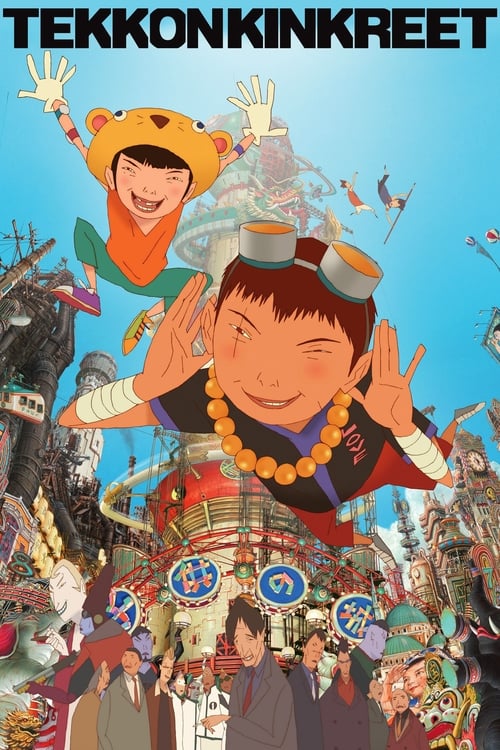
Tekkonkinkreet
2006 · Michael Arias
For when you want animation that's genuinely adult and genuinely beautiful — something to gape at and then chew on. More challenge than comfort, but the payoff is a film you won't confuse with anything else.
What it's about
Two orphan boys — brutal, street-smart Black and innocent, otherworldly White — rule the rooftops of Treasure Town, a sprawling, decaying metropolis that feels like every Asian city collaged into one. When yakuza and a corporate scheme move in to bulldoze their territory for an amusement park, the boys fight back, and the battle for the city becomes a battle for each other and for Black's own mind.
The experience
Visually intoxicating and emotionally raw — it swings from exhilarating rooftop flight to genuinely dark psychological territory, sometimes within a single scene. It's violent, strange, and tender, and the city itself feels alive around you.
The craft
Studio 4°C's fusion of loose, hand-drawn characters with dense, digitally built 3D cityscapes was groundbreaking, and Treasure Town — every signboard, alley, and rooftop — may be the real star. The camera swoops through the city in ways traditional animation couldn't manage, and the electronic score deepens the dream-logic atmosphere. See it big and loud if you can.
Why it matters
A landmark of 2000s adult-oriented anime, notable both for its technical ambition and for being one of the first theatrical anime features directed by a non-Japanese filmmaker.
Snapshot
Tekkonkinkreet is a feature-length animated film produced by Studio 4°C and adapted from Taiyō Matsumoto's early-1990s manga Tekkon Kinkreet (originally serialized under the title Black & White). It follows two orphaned boys — Black (Kuro) and White (Shiro), collectively "the Cats" — who rule the streets of a decaying, pan-cultural metropolis called Treasure Town, and whose feral autonomy is threatened when yakuza and a corporate redevelopment scheme move to reshape the city into an amusement park. The film is historically notable on two counts: it is among the most ambitious integrations of hand-drawn 2D character animation with digitally built 3D environments in mid-2000s anime, and it was directed by Michael Arias, an American, making it one of the first theatrical anime features helmed by a non-Japanese director. Beneath its action-adventure surface it is a dual-protagonist parable about the two halves — savage and tender — of a single psyche.
Industry & production
The film emerged from Studio 4°C, the Tokyo house co-founded by Eiko Tanaka and animator Koji Morimoto, a studio known through the 1990s and 2000s for formally adventurous, auteur-driven work (Memories, Mind Game, later Genius Party). Tekkonkinkreet was, by the account Arias and the studio have given in interviews, the product of a very long gestation: Arias had been attached to the material for roughly a decade, and an animated pilot/test based on the manga had been produced in the late 1990s with Morimoto's involvement before the full feature finally moved forward with Arias himself directing. That protracted development — unusually long for an anime feature — is one of the better-documented facts of the production; precise budget figures and detailed box-office returns are not something I can state reliably, and I will not invent them.
The English-language screenplay was written by Anthony Weintraub and then adapted into Japanese for production, an inversion of the usual localization flow that reflects the film's transnational authorship. The picture was released theatrically in Japan in December 2006 and distributed domestically by Aniplex, with subsequent international festival and home-video release carrying it to Western audiences.
Technology
Tekkonkinkreet sits at a pivotal moment in anime's digital transition, and technology is central to both its making and its look. Arias came to directing from a visual-effects and software-tools background rather than from traditional animation; earlier in his career he was involved in developing toon-shading / cel-rendering techniques that let 3D computer geometry be rendered to read as flat, hand-drawn line-and-cel imagery. That expertise is legible in the finished film's method: Treasure Town is substantially a constructed 3D digital environment — a modeled, navigable space — over and through which the 2D characters are composited. The production used digital compositing to marry drawn figures to rendered backgrounds and to move a "virtual camera" through the city in ways a purely cel-based pipeline could not easily achieve. Arias's parallel involvement in transnational digital-animation projects of the period (he was a producer on the omnibus The Animatrix) situates him squarely in the cohort that was, in these years, dissolving the old boundary between "CG anime" and "cel anime."
Technique
Cinematography
Because the environment is a 3D digital model, the film's "camera" is liberated from the fixed planes of traditional layout, and Tekkonkinkreet exploits that freedom aggressively. Its signature images are swooping, vertiginous moves — up, over, and through the rooftops, alleys, and telephone wires of Treasure Town — often with wide-angle, near-fisheye distortion that bows the horizon and exaggerates depth. The virtual camera behaves at times like a bird or like Black and White themselves, who traverse the city by leaping across rooftops; the mobility is diegetically motivated as well as spectacular. This is layout-as-worldbuilding: the camera's ability to keep discovering new corners of the city communicates the density and lived-in scale of the place.
Editing
The editing modulates between two registers. In the boys' free-running passages and the action set-pieces, cutting is kinetic and elliptical, matched to the camera's motion. In the film's more contemplative second movement — as Black's psyche fractures and White is taken out of the city — the rhythm slows and the picture leans into interiorized, associative imagery. Some viewers and critics have found this shift toward the psychological and allegorical to loosen the narrative's momentum; the tonal turn from street-level adventure to symbolic interior drama is one of the film's most-discussed structural choices.
Mise-en-scène / staging
Treasure Town is the film's true protagonist as much as either boy. Under art director Shinji Kimura, the city is rendered as a maximalist, retro-eclectic collage: Shōwa-era Japanese storefronts, hand-painted signage in multiple scripts, temple motifs, Southeast-Asian and vaguely mid-century-American textures, rust, laundry, wiring, and rot layered into every frame. The density is deliberate and thematic — a place with accreted history and human warmth, set against the antiseptic geometry of the proposed "Kiddie Kastle" amusement park that would replace it. Kimura's background art carries a lineage traceable to the detailed urban decay of earlier landmark anime, and here it is pushed to a near-hallucinatory saturation.
Sound
The score is by Plaid, the British electronic duo associated with Warp Records — an unusual choice that gives the film a cool, melancholic, non-orchestral texture at odds with conventional anime scoring. The electronic palette underlines the film's modernity and its emotional undertow, particularly in the quieter, dissociative passages. Sound design leans on the ambient life of the city, so that the environment's presence is aural as well as visual.
Performance
The vocal performances are notable for casting live-action actors rather than career voice actors: Black is voiced by Kazunari Ninomiya (of the pop group Arashi) and White by Yu Aoi, with a supporting cast that includes established screen performers. The casting choice yields a naturalistic, slightly rougher delivery than the trained-VA norm — White's fractured, childlike speech and Black's guarded hardness both benefit from the unpolished quality. An English dub was produced for international release; specifics of that cast I won't assert without confidence.
Narrative & dramatic mode
The film operates in a dual-protagonist structure that is finally revealed to be a single-psyche allegory. Black is aggression, cunning, and worldliness; White is innocence, intuition, and a kind of holy foolishness — "White has all the screws that Black is missing," as the film frames it. Their separation, engineered by the adult forces closing in on the town, precipitates the central crisis: Black, deprived of White, is consumed by a shadow-self (externalized as a menacing figure) and slides toward violence and madness. The dramatic mode thus moves from picaresque street adventure into psychomachia — a literalized battle between the halves of a soul — before resolving in reunion and a fragile redemption. It is a coming-of-age story told as a splitting and re-fusing of one identity.
Genre & cycle
Nominally an action-adventure, Tekkonkinkreet belongs more precisely to the cycle of adult-oriented, artistically ambitious anime features that Studio 4°C and its peers were producing in the 2000s — films pitched at cinephile and international-festival audiences rather than at children or franchise-television markets. It shares DNA with the urban-dystopian strain of anime (the crime-ridden, corruptly redeveloped city under threat) while subordinating genre spectacle to formal experiment and interior allegory. Its blend of yakuza intrigue, superpowered street kids, and metaphysical duality resists tidy generic placement, which is part of its identity.
Authorship & method
Michael Arias (director). Arias is the film's defining authorial figure precisely because of how atypical his path was: an American technologist-turned-filmmaker who championed Matsumoto's manga for years and brought a compositor's and tools-developer's sensibility to a traditional-animation house. His authorship is legible in the film's fusion of 2D and 3D and in its restless virtual camera.
Taiyō Matsumoto (original manga). The source author's idiosyncratic line — loose, elastic, European-influenced (his work is often discussed in relation to the French bande-dessinée tradition and to Moebius) — sets the visual DNA the film adapts, and his story supplies the Black/White duality and the Treasure Town setting wholesale.
Shinji Kimura (art director) governs the film's world, as described above.
Shojiro Nishimi (character design / animation direction) translates Matsumoto's angular, unconventional character forms into animate figures, preserving the manga's un-cute, spindly-limbed physiognomy rather than smoothing it into house style.
Anthony Weintraub (screenwriter) shaped the adaptation's structure.
Plaid (composer) provide the score. Together this is an unusually cross-cultural authorial team for a Japanese feature of the period.
Movement / national cinema
The film is a Japanese production and belongs to the national tradition of theatrical anime, but it is best understood within the specific mid-2000s movement of digitally hybridized, auteur art-anime associated with Studio 4°C and adjacent creators — a movement defined by treating the feature-length anime as a space for personal, formally radical filmmaking rather than commercial franchise extension. Its foreign director and English-first script also make it a genuinely transnational object, a bridge work between Japanese animation craft and a globalizing digital-animation industry.
Era / period
Tekkonkinkreet is a document of anime's early-digital maturity, roughly 2004–2008, when studios had absorbed digital compositing and CG environments deeply enough to attempt seamless 2D/3D integration at feature scale, but before such techniques became routine. Released at the end of 2006, it stands alongside the era's other markers of the medium's growing international art-house prestige. It captures a transitional moment: hand-drawn character animation still primary, but now inhabiting fully constructed digital worlds.
Themes
The governing theme is duality — Black and White as yin and yang, two inseparable halves of one whole, neither complete alone. Radiating from this are: the violence latent in childhood and the cost of a childhood lived without protection; the tension between organic, historically layered community (Treasure Town) and sanitized capitalist redevelopment (the amusement park); nostalgia and loss as a city is remade; and redemption through connection, as White's innocence is what finally recalls Black from his shadow. The film also broods on urban belonging — who a city is for, and what is erased when it is "improved."
Reception, canon & influence
Critically, Tekkonkinkreet was received as a visually extraordinary, formally ambitious work — routinely praised for its cityscape design, its camera, and its integration of 2D and 3D — with a recurring reservation that its second-half turn into psychological allegory made the story diffuse or hard to follow. It has since accrued a durable reputation as a cult landmark and as a touchstone for discussions of digital hybridization in anime and of Matsumoto adaptations. I believe the film received recognition within Japanese animation awards circles, but I am not confident of the exact prizes and ceremonies, so I will not assert specific citations rather than risk error.
Influences on the film (backward). The primary source is Matsumoto's manga, whose story, characters, and elastic art style the film adapts directly; through Matsumoto, the film inherits an affinity with European comics art (Moebius and the bande-dessinée tradition). The dense, decayed urban art direction stands in a lineage with the landmark cityscapes of earlier adult anime, a tradition Shinji Kimura's background work belongs to. The yin-yang/duality framework draws on a deep, non-cinematic cultural inheritance.
Legacy / what it shaped (forward). As one of the first anime features directed by a Westerner and a high-water mark of 2D/3D compositing, the film became a reference point for the subsequent normalization of digitally built environments in hand-drawn anime and for the broader internationalization of anime authorship. Its maximalist, fisheye-warped cityscapes and free-roaming virtual camera left a visible mark on the visual vocabulary of later animation and music-video work, and it helped cement Studio 4°C's identity as a home for director-driven experiment. Its central conceit — two externalized halves of one soul at war and in need of reunion — continues to resonate in later animated storytelling, and the film remains a staple recommendation in discussions of anime that pushed the medium's formal boundaries in the digital era.
Reception
A modest theatrical run and 'gorgeous but baffling' reviews in 2006-07 have given way to genuine cult devotion — it's now routinely name-dropped as one of the great overlooked anime features of the 2000s, and its Japan Academy Prize win looks more and more deserved in hindsight.
How Tekkonkinkreet was received, from release to now →
How to watch Tekkonkinkreet: what to notice on a first viewing
- Watch the camera swoop across rooftops as the boys run. The virtual camera moves like a bird or like Black and White themselves, discovering new corners of the city as it goes. The camera's freedom makes the city feel as alive and explorable as the two boys who live in it.
- Notice the hand-painted signs and clashing textures crowding every street. Kimura layers storefronts, multiple scripts, temple motifs, rust, and laundry into nearly every frame, building a city with visible, accreted history. The density of the background is doing as much storytelling as anything the characters say.
- Listen for the electronic score instead of a typical orchestral one. Plaid's cool, melancholic electronic music sits underneath the action, giving the film a modern texture unlike conventional anime scoring. The music keeps the film feeling contemporary even inside a city built from decades of accreted history.
- Watch for Black's guarded hardness against White's fractured, childlike speech. Live-action actors voice the two boys instead of career voice performers, giving both roles a rougher, less polished delivery. The unpolished voices make the two feel like real kids instead of anime archetypes.
- Watch the contrast between Treasure Town and the amusement park model. The film keeps setting the city's cluttered, lived-in texture against the clean, antiseptic geometry of the corporate redevelopment threatening to replace it. You can feel what's at stake just by comparing what the two places look like.
The whole guide to watching Tekkonkinkreet, with the keys for a rewatch →
Influences: the films it descends from and the films it influenced
- Akira (1988) — Established the template of the hand-painted, over-detailed decaying megacity as protagonist — the maximalist background-art tradition Shinji Kimura came up through and reworks in Treasure Town.
- Ghost in the Shell (1995) — Pioneered early digital compositing and the slow, prowling 'virtual camera' craning through multi-plane cityscapes that Tekkon accelerates into free-roaming flight.
- Metropolis (2001) — Landmark of setting flat 2D characters against volumetric 3D-CG architecture — the 2D/3D hybrid pipeline problem Tekkon inherits and solves more seamlessly.
- Les Maîtres du temps (Time Masters) (1982) — Brought Moebius's bande-dessinée line directly into animation, seeding the loose, elastic European draftsmanship that reaches Tekkon through Matsumoto's Moebius-inflected art.
- Princess Mononoke (1997) — Arias worked on its digital-effects/compositing crew, absorbing the CG-assisted ink-and-paint methods he later redeployed as a director's toolkit at Studio 4°C.
- Memories: Magnetic Rose (1995) — Founding Studio 4°C work whose ornate, physically impossible environments and abrupt shifts between psychological registers prefigure Tekkon's second-half allegorical turn.
- Memories (1995) — Embodies the Studio 4°C art-anime house style Memories helped found: painterly, warped cityscapes explored by a restless roving virtual camera.
- Swallowtail Butterfly (1996) — Treasure Town is drawn as an accreted retrofit city — layered signage in multiple scripts, hand-built junk architecture — with long-lens crowd depth and handheld instability translated into animated camera moves.
- Ping Pong the Animation (2014) — Later Taiyō Matsumoto adaptation that, like Tekkon, refuses to smooth his angular, spindly, un-cute physiognomy into house style and leans on comic-panel register shifts.
- Children of the Sea (2019) — Later Studio 4°C high-water mark of 2D-over-3D compositing and virtual-camera movement through hyper-detailed environments, directly building on the pipeline Tekkon proved at the studio.
- Spider-Man: Into the Spider-Verse (2018) — Weds toon-shaded 3D to a preserved 2D comic line and non-cute stylization, extending Tekkon's normalization of digitally built worlds that retain hand-drawn/BD character fidelity.
- Arcane (2021) — Painterly hand-textured surfaces composited over 3D geometry — the logical maturation of Tekkon's 2D/3D fusion aim of making digital environments read as illustrated.
- Berserk: The Golden Age Arc III - The Advent (2013) — Establishes Studio 4°C's willingness to fold heavy digital compositing and roving virtual-camera moves into hand-drawn work, the studio-culture precondition for the trilogy's hybrid production.
- Mind Game (2004) — Contemporary Studio 4°C director-driven experiment (with Nishimi in the art/animation core) that pushes radical register-shifts and live-photographic integration alongside elastic hand-drawn figures.
- Paprika (2006) — Same-year mastery of edit-driven 'register shift' — cutting between reality-strata with a mobile virtual camera — the technique Tekkon uses to slide from city-realism into psychomachia.
- Redline (2009) — Extends the maximalist, fisheye-warped, hand-drawn urban collage into pure kinetic spectacle, sharing Tekkon's density-over-legibility staging philosophy.
- The Animatrix (2003) — Arias produced it, modeling the cross-cultural authorship (Western technologists + Japanese studios) and CG/2D hybrid experimentation that defines his own directorial method.
- Genius Party (2007) — Studio 4°C anthology that continues the house identity Tekkon cemented — toon-shaded CG environments married to idiosyncratic character line as a vehicle for director-driven form.
Similar films
- Mind Game (2004) — influence & lineage · often watched together
- Akira (1988) — influence & lineage
- Paprika (2006) — influence & lineage
- Redline (2009) — influence & lineage
- Ghost in the Shell (1995) — influence & lineage
- Boy & the World (2014) — shared sensibility
- Teenage Mutant Ninja Turtles: Mutant Mayhem (2023) — shared sensibility
- Big Hero 6 (2014) — shared sensibility