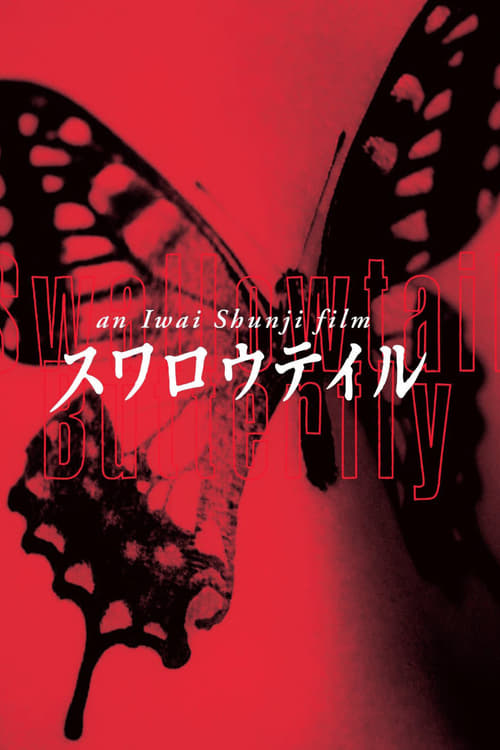
Swallowtail Butterfly
1996 · Shunji Iwai
For when you want to disappear into a whole world for a night — something ambitious, emotional, and unlike anything in your usual rotation. It rewards a viewer in the mood for a journey rather than a tidy story.
What it's about
In an alternate near-future where the yen is the strongest currency on earth, migrants from across Asia have flooded into a Japanese megacity they call Yentown, scraping out lives on its scrap-metal edge. An orphaned girl, taken in by a singer-prostitute named Glico and her found family of hustlers and dreamers, gets pulled into a counterfeit-money scheme, a nightclub gamble, and the making of a pop star — a street fable about money, belonging, and the people a boomtown uses up.
The experience
Sprawling, scrappy, and alive — it lurches from grimy crime story to tender hangout movie to full-blown pop musical, held together by restless handheld camerawork and a big beating heart. At nearly two and a half hours it's messy by design, and the mess is the charm.
Performances
Chara, a real-life pop star, is magnetic as Glico — raw and fragile in the dramatic scenes, electric when she sings — and the film's live-band sequences run on her voice.
The craft
Iwai shoots the migrant shantytowns and neon clubs with grainy, sun-flared handheld beauty, cutting to the rhythm of its songs, and the film's polyglot dialogue — Japanese, Mandarin, English colliding mid-sentence — builds its multicultural world from the sound up. The soundtrack is central, not decoration; good speakers earn their keep.
Why it matters
A generational touchstone in 1990s Japan, it captured post-bubble anxieties about money and immigration inside a pop package, cemented Iwai as the era's defining young stylist, and spun off a real band from its fictional one.
Snapshot
Swallowtail Butterfly is a 148-minute urban fable set in "Yentown," a Japanese megacity in a near-future where the yen has become the world's strongest currency and has pulled migrants from across Asia and beyond into a scrap-metal periphery. The locals call the newcomers "Yentowns" as a slur; the newcomers call the city Yentown as a promise. Out of that single pun the film builds everything else: an orphaned girl who is given the name Ageha (Japanese for swallowtail butterfly), a singer-prostitute called Glico, a counterfeiting scheme hidden in the magnetic tape of a cassette, a nightclub, a manufactured pop star, and a yakuza reprisal that closes the fable with startling brutality.
It was Shunji Iwai's second theatrical feature, arriving one year after Love Letter (1995) had made him the most closely watched young director in Japan, and it is deliberately its opposite: where Love Letter is snowbound, monolingual, and elegiac, Swallowtail is polyglot, filthy, sprawling, and loud. The film matters for three reasons. It is one of very few mainstream Japanese films of its decade to place non-Japanese migrant characters at the center of the frame and to let them speak their own languages at length. It consolidated an image-making style — handheld, available-light, blown-out, haloed — that spread through Japanese advertising, music video, and youth cinema for a decade. And its fictional band, Yen Town Band, crossed out of the film into the actual Japanese record charts, an early and unusually complete instance of a movie generating a real pop artifact.
Industry & production
The production sits at the junction of two industries that had become inseparable in 1990s Japan: television and music. The studio system that had produced the Japanese cinema of the 1950s and 60s was, by the mid-1990s, effectively gone as a talent pipeline; directors of Iwai's generation came instead from television, V-cinema (direct-to-video), commercials, and music promos, and their films were financed by "production committees" pooling broadcasters, record labels, publishers, and advertising agencies. Iwai himself came from Fuji Television, where his 1993 telefilm Fireworks, Should We See It from the Side or the Bottom? had won him serious critical attention and, unusually for a TV work, a theatrical afterlife.
Swallowtail is a big film by the standards of that ecology — a large multinational ensemble, extensive purpose-built exteriors, a 148-minute running time, and a soundtrack conceived as a commercial release in its own right rather than as a licensing afterthought. English-language documentation of the financing, budget, and box-office performance is thin, and I would not put numbers to any of it; what is clear from the film's shape is that music-industry capital and music-industry logic were structural to it, not decorative. The score and songs were produced by Takeshi Kobayashi, one of the most powerful pop producers in Japan at the time through his work with Mr. Children and My Little Lover, and the film's central band was staffed with a real recording artist, Chara, in the lead role. The song "Swallowtail Butterfly ~Ai no Uta~," credited to Yen Town Band, became a substantial hit; the accompanying album Montage followed. The film and the record were, functionally, one release.
Iwai's career trajectory from this point is one of steadily accumulated control — writing, directing, cutting, later composing, and eventually operating through his own production outfit. Swallowtail is the moment that ambition first gets a full-scale budget.
Technology
The film was shot photochemically, and its look depends on pushing film stock rather than lighting scenes conventionally: fast emulsion, available and practical light, deliberate overexposure of windows and sky, and an embrace of halation, flare, and grain that most cinematographers of the era were still working to suppress. Noboru Shinoda's images are legible as a technical position — that the artifacts of the medium are expressive rather than defective.
The more interesting technological argument is inside the story. The film's engine is a cassette tape: a dead yakuza swallows one, and the magnetic strip encodes data that lets the Yentowns counterfeit ¥10,000 notes. The same tape, played as audio, is a recording of "My Way." One physical object is simultaneously music, money, and evidence — a compact statement about analog media at the precise historical moment they were about to be superseded. Around it the film stages the whole apparatus of mid-90s music technology: the multitrack studio, the producer's console, the star-making machinery that can take a voice out of a brothel and press it onto a disc. Counterfeiting currency and manufacturing a pop star are shown as the same industrial process, and the film knows it.
Digital tools appear at the margins — in composited cityscape work that establishes Yentown's skyline — but the production design does the heavy lifting, and the future is built almost entirely from present-day junk. Iwai would become one of Japan's most committed early adopters of digital video within a few years, shooting All About Lily Chou-Chou (2001) largely on DV; Swallowtail's appetite for degraded, high-grain, low-light texture reads in hindsight as the aesthetic precondition for that move.
Technique
Cinematography
Noboru Shinoda's work here is the fullest statement of what became known in Japan as the "Iwai look." The camera is predominantly handheld and close, often on wide glass, moving with bodies through cramped interiors and scrapyard exteriors; light sources are allowed into frame and allowed to bloom; skin is rendered soft and milky against crushed, smoky backgrounds. Long-lens observation is used for crowds, compressing the shantytown into a churning mass. The palette runs to rust, oil, sodium vapor, and the acid neon of the club sequences, with the film's whites — a bare bulb, a doorway, a stage light — consistently overdriven past detail.
Crucially, this is not a uniform style applied evenly. Shinoda modulates: the fable passages have a soft, diffuse, almost devotional quality, while the violence is shot with jagged, hard-contrast immediacy. Shinoda shot every one of Iwai's features until his death in 2004, and the partnership is one of the defining director–cinematographer relationships in modern Japanese cinema.
Editing
The cutting is music-video cutting applied to a novel-length narrative — elliptical, willing to jump, organized in movements rather than scenes. Montage sequences set to Kobayashi's music carry substantial narrative freight, compressing months of the community's fortunes into minutes. Against that, Iwai lets performance sequences run long, holding on the band and the club until the sequence becomes an event rather than a transition. The result is a deliberately uneven tempo; the film's looseness and its 148 minutes are a choice, not an accident, and they are the choice that most divides its viewers.
Mise-en-scène / staging
Yentown is a retrofit future: nothing is new, everything is salvaged. Shacks are assembled from oil drums, corrugated iron, tarpaulin, car bodies, and signage in four alphabets. The nightclub is a repurposed hulk. Costume is thrift-store maximalism — mismatched, layered, historically incoherent — which does the same work as the architecture, insisting that this world was made by people with no capital and infinite improvisation. Staging favours density: frames crowded with bodies, hanging laundry, wires, and hand-painted text, so that the migrant community reads visually as a single organism before any individual is introduced.
Sound
The soundtrack is genuinely multilingual — Japanese, Mandarin, and English intercut and overlapped, frequently within a single exchange — and the film subtitles its own non-Japanese dialogue for its domestic audience, a formal admission that Japan contains speech Japan cannot understand. Music slips constantly between diegetic and non-diegetic registers: Glico's singing begins as something that happens in a room and ends as something that happens over the film. "My Way" recurs as the film's ironic anthem, a song about self-authorship deployed in a world where identity is purchased, forged, or assigned.
Performance
The casting is a statement. Chara, a working pop musician rather than a trained actor, plays Glico with an unpolished physicality that the film uses rather than smooths; her singing is the one thing in Yentown that is not counterfeit. Ayumi Ito, a newcomer, plays Ageha as a watchful near-silence for long stretches, so that the film's emotional accounting happens on a face that withholds. Hiroshi Mikami, an established star, anchors Feihong as the community's charismatic center. The Cantopop singer Andy Hui performs across languages he does not fully command, and this is true of much of the ensemble — the accented, halting, code-switched delivery produces a documentary friction that no polished bilingual cast would have given. Imperfect language is part of the performance design.
Narrative & dramatic mode
The film opens in the register of a fairy tale, with narration establishing Yentown as a "once upon a time" — a fable frame that licenses everything improbable that follows. Inside it, three modes braid: a picaresque about a scavenging community, a crime plot organized around the MacGuffin of the tape, and a backstage rise-and-fall about the manufacture of a star. Threading them is a bildungsroman — Ageha's passage from an unnamed orphan beside her mother's corpse to a young woman with a name, a tattoo, and a history.
Iwai refuses tonal consistency on principle. Slapstick, tenderness, sexual squalor, and extreme violence sit in adjacent scenes, and the last act turns abruptly into revenge melodrama of real cruelty. Some viewers read this as structural incoherence; the more persuasive reading is that the fable frame is being tested to destruction — that the film is showing what happens when a fairy tale is asked to hold an actual underclass. The episodic, novelistic sprawl is consistent with Iwai's habit of working across prose and film; he has repeatedly moved material between the two forms, most famously with All About Lily Chou-Chou, which began life as an online serial before becoming a film.
Genre & cycle
The science-fiction tag is nominal. There is no technological novum; Yentown is an alternate present with the volume raised, and the film belongs far more to the crime picture, the musical, and the urban fable than to SF proper. It sits inside a mid-1990s Japanese cycle preoccupied with drifting, precarious youth and with a Tokyo emptied of postwar certainty, alongside the emergent work of Takeshi Kitano, Kiyoshi Kurosawa, Hirokazu Kore-eda, Shinji Aoyama, and Takashi Miike — a cohort often described as a new Japanese wave, unified less by style than by their common independence from the collapsed studio order. It also joins an international cycle of "world city" films of the same decade, in which the multilingual megacity itself is the subject.
Authorship & method
Iwai has generally described himself less as a film director than as a maker of moving images across formats — television, promos, prose, features — and Swallowtail is what that self-definition looks like at scale. He wrote it, directed it, and shaped its cut, and the finished film has the texture of something authored end to end rather than assembled by departments.
The key collaborators are two. Noboru Shinoda, the cinematographer, is effectively co-author of the visual grammar described above; his death in 2004 marked a genuine break in Iwai's work. Takeshi Kobayashi, as composer and music producer, supplied not just a score but the film's commercial and conceptual center of gravity — and the Iwai–Kobayashi partnership produced its most remarkable trick five years later on All About Lily Chou-Chou, where the fictional singer at the film's heart was voiced by Salyu and released as a real recording artist. Yen Town Band is the prototype for that maneuver: a band invented for a story that then goes and has a chart career.
Movement / national cinema
The film's national-cinema significance rests on its subject as much as its style. Japan's 1990 immigration reform had opened specific legal channels while leaving large undocumented populations working the construction sites, factories, and sex trades of the bubble and post-bubble economy — Chinese, Korean, Iranian, Filipino, Brazilian-Japanese. Mainstream Japanese cinema largely declined to look at them. Swallowtail looks, and it does so in their languages, which is why it remains a reference point in discussions of Japanese cinema and ethnic difference, whatever one concludes about its romanticism.
Stylistically, Iwai's influence radiated outward with unusual speed. The blown-highlight, handheld, backlit look became a default idiom in Japanese commercials, promo videos, and youth-oriented features; and Iwai's standing across East Asia — particularly in South Korea, where Love Letter's 1999 release became a cultural phenomenon — made him one of the region's most imitated directors. His later work directing Chinese-language production closed that circuit in the other direction.
Era / period
1996 is a precise position: five years after the asset bubble burst, one year after the Kobe earthquake and the Aum Shinrikyo sarin attack, one year before the Asian financial crisis and the Hong Kong handover. The premise — the yen as the world's most powerful currency, drawing the desperate toward it — is already a period fiction in 1996, an image of Japanese economic supremacy that the decade was actively dismantling. That gives the film its melancholy: Yentown's migrants are chasing a boom that has ended. The Hong Kong casting and the Mandarin dialogue register the other regional anxiety of the moment, the imminent reordering of Chinese-language Asia.
Themes
Money and identity are the same problem. The counterfeit ¥10,000 note is the film's master image: value that works because everyone agrees to treat it as real — which is also how names, nationalities, and pop stars work here. Characters take names from products (Glico), from insects (Ageha), from convenience; nobody's papers are real; the community is held together by nothing but consent. Against that, the film sets a small number of things it treats as unforgeable — a voice, a tattoo, a body, grief.
Related strands: the found family as the only functioning social unit; the migrant body as a site of extraction, sexual and economic; the perpetually deferred elsewhere (Shanghai, home, escape) that organizes everyone's desire; and the swallowtail butterfly itself, a figure of metamorphosis and of a lifespan too short for the transformation to matter.
Reception, canon & influence
Domestically the film landed hard and stayed. It is remembered as a defining artifact of 1990s Japanese youth culture, and the Yen Town Band single carried it far beyond its cinema audience. Western reception was another matter: it received no wide theatrical release in the English-speaking world, circulated for years mainly through festivals, imports, and word of mouth, and accumulated a devoted cult rather than a critical consensus. English-language scholarship on the film remains comparatively thin, and where it exists it tends to divide along the same line as popular opinion — admiration for the ambition, the images, and the sheer nerve of the premise, set against objections to the length, the tonal whiplash, and the romanticizing of poverty.
Looking backward, the lineages are legible. The polyglot dystopian megacity built from retrofitted junk invites obvious comparison with Blade Runner (1982), a comparison critics have made routinely. The handheld neon urbanism and transient lovers connect it to Hong Kong cinema of the immediate moment — Wong Kar-wai's Chungking Express (1994) and Fallen Angels (1995) — an axis the Cantopop casting makes explicit. Domestically it inherits from two older traditions: Shohei Imamura's films of the postwar underclass and its black markets, and the "stateless" mukokuseki action cinema of 1960s Nikkatsu, in which Japan was staged as nowhere in particular. Its scrapyard-metal Tokyo also shares air with the industrial body-horror imagery Shinya Tsukamoto had brought to Japanese screens with Tetsuo (1989).
Looking forward, three legacies stand out. The Shinoda–Iwai image style became a widely copied house look across Japanese screen media. The Yen Town Band model — a fictional band made commercially real — recurred in Iwai's own All About Lily Chou-Chou and prefigured a now-standard transmedia practice. And the film's insistence that a Japanese city could be filmed as a multilingual, migrant place gave later filmmakers a precedent that had not previously existed at this scale. Its canonical position is unusual: minor in most Western surveys of Japanese cinema, major in the memory of the audiences and filmmakers who actually grew up with it.
A Deleuzian reading
A dead man on a floor, and someone pulling a cassette out of his stomach.
The full Deleuzian reading of Swallowtail Butterfly →
Reception
Divisive in Japan on release in 1996 — critics were split on its sprawling, polyglot vision of a mongrel Tokyo even as young audiences embraced it — it's since been reappraised abroad as a cult classic of 90s Japanese cinema, rediscovered by cinephiles working through Shunji Iwai after Love Letter and All About Lily Chou-Chou.
How Swallowtail Butterfly was received, from release to now →
How to watch Swallowtail Butterfly: what to notice on a first viewing
- Notice bulbs and doorways blown out to pure white. Shinoda lets light sources bloom past detail throughout Yentown, bare bulbs and doorways overexposed into halation instead of being corrected down to a normal exposure. The overexposure gives a scrapyard slum an almost holy glow it has no business having.
- Look at what Yentown's shacks are actually built from. Every structure is assembled from oil drums, corrugated iron, tarpaulin, car bodies, and signage in four alphabets, nothing new, everything scavenged and repurposed. The architecture itself tells you this world was made by people with no capital and endless improvisation.
- Listen for Japanese, Mandarin, and English inside one conversation. The film intercuts three languages, often within a single exchange, and subtitles its own non-Japanese dialogue for its domestic audience rather than smoothing it into one tongue. The soundtrack admits that this city contains speech its own country cannot fully understand.
- Watch the crowd compress into one moving mass. Long lenses flatten the shantytown into a churning crowd, and Iwai crowds his frames with bodies, laundry, wires, and hand-painted signs before introducing a single named character. The community reads as one organism on screen before it reads as a group of individuals.
- Watch Glico sing like a real performer, not an actor. Chara, a working musician rather than a trained actor, plays Glico with an unpolished physicality the film uses instead of smoothing over, so her singing feels unmistakably real. In a story built almost entirely out of fakes, her voice is one of the only things not counterfeit.
The whole guide to watching Swallowtail Butterfly, with the keys for a rewatch →
Influences: the films it descends from and the films it influenced
- Blade Runner (1982) — The retrofit-future method — a megacity made by accreting junk, signage and rain onto existing structures instead of designing clean futurism — paired with 'cityspeak,' dialogue deliberately blended from several languages so the viewer is kept partly outside it; Yen Town is that grammar rebuilt out of Tokyo landfill.
- Chungking Express (1994) — Christopher Doyle's handheld available-light shooting at wide apertures, exposure pushed until highlights clip, plus the single pop song looped until it stops being a jukebox cue and becomes score — the diegetic/non-diegetic hinge Iwai runs on 'My Way'.
- Fallen Angels (1995) — Wide-angle handheld pressed inches from faces in cramped interiors, and the casting of Cantopop performers whose recording persona is part of the character — the axis Iwai makes explicit by casting Hong Kong singer Andy Hui and musician Chara as leads.
- Pigs and Battleships (1961) — Imamura's staging of the black-market underclass as a jostling economy — long-lens crowd shots in which the protagonist is one body among many, hustling and sex work filmed as labor rather than as crime melodrama.
- Tokyo Drifter (1966) — Nikkatsu mukokuseki staging — Japan denatured into 'nowhere in particular' — with the hero's theme sung on-screen and then returning as orchestrated score, the recurring-anthem device Swallowtail rebuilds around 'My Way'.
- Tetsuo: The Iron Man (1989) — Scrap-metal surface as production design and sound at once — welded corrugated iron, oil, industrial clatter — plus the body inscribed with metal, which Swallowtail domesticates into junkyard shanties and the butterfly tattoo.
- Love Letter (1995) — Where Iwai and Noboru Shinoda fix the exposure grammar: backlit faces, windows blown to featureless white, available light held well past clipping, and performance carried in long takes — the identical toolkit turned on slums a year later.
- The Harder They Come (1972) — A non-professional singer cast as lead whose songs were pressed as a real chart record released alongside the film, so the fiction's music acquired commercial life outside the fiction — the Yen Town Band maneuver in prototype.
- A City of Sadness (1989) — Multilingual sound as social map — Taiwanese, Mandarin, Japanese and Shanghainese colliding inside one national cinema — held in long takes that let untrained cadence survive without being smoothed by cutting.
- Ley Lines (1999) — Chinese immigrants and sex workers in a Japan filmed entirely as a country of foreigners, dialogue moving between Mandarin and Japanese as an economic fact of the scene rather than a plot device.
- All About Lily Chou-Chou (2001) — Iwai and Takeshi Kobayashi perfect the Yen Town trick — the film's fictional singer is voiced by Salyu and released as a genuine recording artist — while porting the blown-highlight, available-light handheld grammar onto early DV.
- Linda Linda Linda (2005) — An invented band whose soundtrack became a real record, fronted by a Korean exchange student whose halting code-switched Japanese is the performance, culminating in a set played out in sustained long takes rather than montage.
- Memories of Matsuko (2006) — Tonal collision as governing method: music-video musical numbers cut hard against destitution and beatings, wrapped in a retrospective fable frame narrated by a survivor — Swallowtail's refusal to hold one register, industrialized.
- Tekkonkinkreet (2006) — Treasure Town is drawn as an accreted retrofit city — layered signage in multiple scripts, hand-built junk architecture — with long-lens crowd depth and handheld instability translated into animated camera moves.
- Tokyo Tribe (2014) — A stateless, multilingual Tokyo staged in continuous crane and Steadicam takes through crowded junk-built sets, with the score rapped by the characters themselves so diegetic and non-diegetic music become indistinguishable.
- Ritual (2000) — Establishes Iwai's diffuse-light, handheld intimacy and drifting-outsider figures; in Ritual Iwai himself steps in front of the lens as the director-protagonist.
- Shinjuku Triad Society (1995) — Arrives a year earlier with the same claim — that Shinjuku is a migrant, polyglot city — shot handheld in available light with Taiwanese-Japanese characters code-switching mid-sentence, unsubtitled reassurance withheld.
- Comrades: Almost a Love Story (1996) — Mainland migrants hustling in a city that won't have them, structured around one pop standard (Teresa Teng) that keeps crossing from radio-in-the-scene into score — the exact motif architecture Iwai builds for 'My Way'.
- Made in Hong Kong (1997) — Street-cast non-professionals shot handheld on donated short-end stock in real housing estates, with poverty rendered as kinetic pop energy rather than social-realist observation.
Similar films
- All About Lily Chou-Chou (2001) — influence & lineage · same viewing thread
- Memories of Matsuko (2006) — influence & lineage · same viewing thread
- Moving (1993) — same viewing thread · often watched together
- Chungking Express (1994) — influence & lineage · often watched together
- Cosmic Princess Kaguya! (2026) — shared sensibility
- Spirited Away (2001) — shared sensibility
- Your Name. (2016) — shared sensibility
- Weathering with You (2019) — shared sensibility
All the films related to Swallowtail Butterfly →
Watch it with: curated runs of related films
- Unmoored in Modern Japan — Watch these when you want Japanese cinema at its most restless — lives knocked off their axis by divorce, disaster, migration, or heartbreak, and the strange grace of piecing them back together.