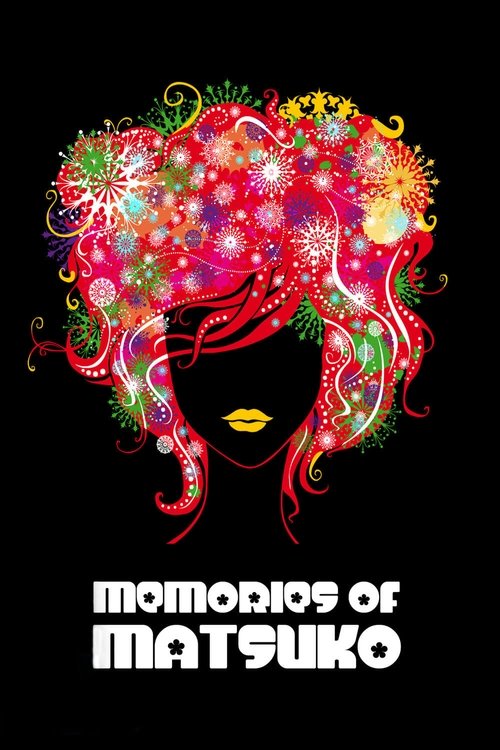
Memories of Matsuko
2006 · Tetsuya Nakashima
For when you want a big, strange, maximalist emotional workout — something that makes you laugh and wrecks you in the same scene. This is a challenge film dressed as comfort food; save it for a night when you can handle a full-body cry with glitter on it.
What it's about
A young slacker is sent to clean out the apartment of an aunt he never knew, and starts piecing together how her life fell apart. What he uncovers is Matsuko's story: a schoolteacher whose one misstep sends her tumbling through decades of bad luck and worse men — lounge hostess, lover, dreamer — always giving everything to people who give nothing back. The film tells her decline the strangest way possible: as a candy-colored musical, with songs and digital flowers blooming right through the heartbreak.
The experience
Whiplash by design — one minute you're grinning at a bubblegum production number, the next you're gutted, and the gap between the two is where it gets you. It's exhausting, dazzling, and by the end quietly devastating; the sugar-rush style makes the sadness hit harder, not softer.
Performances
Miki Nakatani carries the whole film, playing Matsuko across roughly thirty years — from bright young teacher through every degradation — without ever letting her hope look stupid. It's a fearless, physically transformative performance that keeps a cartoonish film painfully human.
The craft
Tetsuya Nakashima came out of advertising and it shows: hyper-saturated digital color, musical numbers that erupt mid-tragedy, CGI bluebirds attending scenes of real devastation. The frosting-thick style isn't decoration — it's Matsuko's own forced cheerfulness made visible. Loud, gorgeous, and absolutely built for a big screen with the sound up.
Why it matters
It cemented Nakashima as Japan's great pop-maximalist after Kamikaze Girls and became a cult touchstone for viewers who want melodrama played at full volume; few films have pushed the sad-story-told-happily contradiction this far.
Tetsuya Nakashima tells the story of a woman's catastrophic life as if it were a candy commercial: musical numbers erupt mid-tragedy, flowers bloom in digital hyper-color, and CGI bluebirds attend scenes of genuine devastation. A young slacker sorts through his dead aunt's squalid apartment and reconstructs her decades — schoolteacher, lounge hostess, lover of the wrong men, over and over — in flashbacks staged like production numbers. The dissonance is the point. Nakashima, who arrived from advertising via the pop confection Kamikaze Girls, understands that Matsuko performs happiness because she cannot secure it, and the film's frosting-thick style becomes her own coping mechanism made visible. Miki Nakatani gives a fearless performance across thirty years of aging, degradation and undimmed hope, and the film's refrain — a childhood funny-face she pulls to win her father's attention — accrues almost unbearable weight through repetition. A touchstone of 2000s Japanese cinema's maximalist wing, it plays like Dancer in the Dark rescored by a karaoke machine, and its final movement earns every gaudy petal that came before.
A Deleuzian reading
A CGI bluebird settles beside a woman on the worst day of her life, and the flowers behind her come up the color of a candy wrapper.
The full Deleuzian reading of Memories of Matsuko →
Reception
A domestic hit and awards magnet in Japan (it swept Miki Nakatani a shelf of Best Actress prizes), it barely registered in the West on release — then Letterboxd word-of-mouth turned it into one of the 2000s' most passed-around 'how have you not seen this' discoveries.
How Memories of Matsuko was received, from release to now →
Influences: the films it descends from and the films it influenced
- Kamikaze Girls (2004) — Nakashima's own immediately prior pop-collage film: freeze-frame captions, comic-book inserts, saturated Lolita fashion and a fizzy advertising-aesthetic editing rhythm that Matsuko intensifies into tragedy.
- Swallowtail Butterfly (1996) — Tonal collision as governing method: music-video musical numbers cut hard against destitution and beatings, wrapped in a retrospective fable frame narrated by a survivor — Swallowtail's refusal to hold one register, industrialized.
- The World of Kanako (2014) — Establishes Nakashima's commercial-trained, post-production-intensive collage method — musical-number montage, hyper-saturated color, and dense on-screen graphics — later inverted from candy-bright melodrama to predatory grime in Kanako.
- Dancer in the Dark (2000) — The film's explicit template: musical production numbers that erupt out of a doomed woman's degradation, so that fantasy song-and-dance becomes the psychic defense mechanism against unbearable suffering — Matsuko literally quotes this structure of misery-into-musical.
- The Umbrellas of Cherbourg (1964) — The candy-saturated melodrama palette — walls and costumes color-coordinated into pastel unreality — that lets a sentimental tragedy of serial doomed love play out inside a deliberately artificial storybook world.
- The Young Girls of Rochefort (1967) — Sunlit ensemble street choreography where whole town squares break into coordinated primary-colored production numbers, the sourcebook for Matsuko's fields-of-flowers dance interludes.
- Amélie (2001) — Digital hyper-color grading plus whimsical CGI embellishment and a briskly narrated reconstruction of one woman's life from anecdotal fragments — the advertising-slick storybook-biography mode Nakashima adopts wholesale.
- Moulin Rouge! (2001) — Hyperkinetic montage married to karaoke-style pop scoring — recycling familiar hit songs as emotional shorthand — inside a maximalist doomed-love tragedy that never lets its cutting rest.
- All That Jazz (1979) — A self-destructive life reconstructed as a series of increasingly delirious musical fantasy numbers, culminating in death staged as a show-stopping production — the biography-as-song-cycle blueprint.
- The Red Shoes (1948) — Three-strip Technicolor pushed past realism and a woman destroyed by her own performed devotion, where the fantasy ballet sequence externalizes her doom as pure stylized spectacle.
- House (Hausu) (1977) — Japanese ad-director collage maximalism — matte-painted skies, gleeful in-camera and optical trickery, tonal whiplash between whimsy and horror — the native lineage for Nakashima's toy-box digital surrealism.
- Confessions (2010) — The same authorial tonal dissonance — slow-motion beauty scoring the ugliest acts — and reconstructed multi-perspective narrative, showing the Matsuko craft turned cold and monochrome.
- Paco and the Magical Book (2008) — Direct sibling in CGI candy-color embellishment: a hyper-artificial storybook set where digital painterly effects and production-number staging carry a sentimental fable of doomed devotion.
- Love Exposure (2008) — J-cinema maximalism sharing Matsuko's tonal dissonance and motif-repetition structure — comedy, faith, and violence collided at operatic length, with recurring musical cues used ironically against catastrophe.
- Zatoichi (2003) — A period drama that resolves into a full tap-dance production number, the same device of letting a choreographed musical set-piece burst incongruously out of a non-musical tragedy.
Similar films
- Confessions (2010) — influence & lineage
- Kamikaze Girls (2004) — influence & lineage
- Dancer in the Dark (2000) — influence & lineage · often watched together
- Tokyo Story (1953) — often watched together
- Dolls (2002) — often watched together
- Drive My Car (2021) — often watched together
- The Last 10 Years (2022) — shared sensibility
- Your Name. (2016) — shared sensibility
All the films related to Memories of Matsuko →
Watch it with: curated runs of related films
- Unmoored in Modern Japan — Watch these when you want Japanese cinema at its most restless — lives knocked off their axis by divorce, disaster, migration, or heartbreak, and the strange grace of piecing them back together.