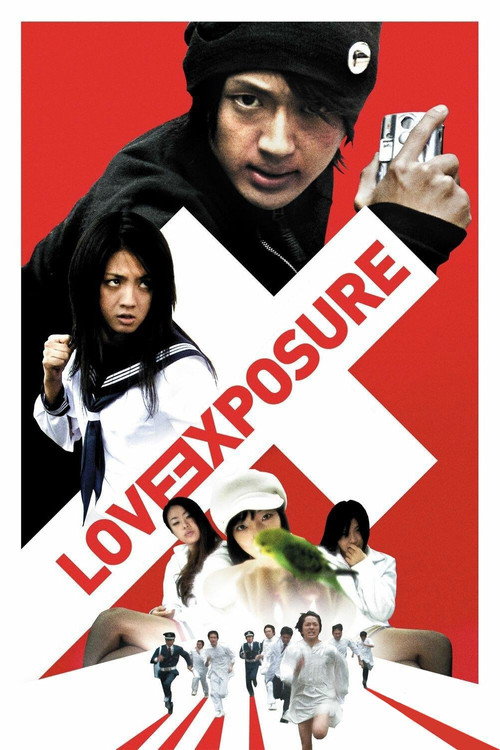
Love Exposure
2008 · Sion Sono
For when you want to be swallowed whole — a full-evening event movie for the adventurous, best with friends who'll commit. Absolutely not a casual background watch.
What it's about
Yu is a devout Catholic teenager so starved for a sin worth confessing that he apprentices himself to the underworld art of upskirt photography — and while out in disguise as a woman, he meets Yoko, the girl he instantly, catastrophically loves. She thinks she's fallen for a mysterious woman; he's tangled in guilt, kung-fu, petty crime, and the orbit of a sinister sect called the Zero Church. It's a four-hour epic about faith, perversion, and first love, played completely straight.
The experience
Nearly four hours that move like ninety minutes — delirious, hilarious, lurid, and then suddenly, unaccountably sincere. It swings from slapstick to scripture-quoting rapture and somehow earns both; you come out wired.
The craft
Sion Sono's structure is its own dare: backstories nest inside backstories for a full hour before the title card finally crashes onscreen. The film runs on propulsive pop-and-classical needle drops and go-for-broke set pieces, with First Corinthians recited like a love song — maximalist filmmaking where excess is the method, not the flaw.
Why it matters
An instant cult monument of 2000s Japanese independent cinema and the film that made Sono an international name, passed hand-to-hand by viewers daring each other into its runtime.
A nearly four-hour epic of Catholic guilt, martial-arts upskirt photography, cults, and transcendent first love — and somehow one of the most propulsive films of its decade. Sion Sono, poet-provocateur of the Japanese indie fringe (Suicide Club, Cold Fish), spins the story of Yu, a devout boy whose hunger for a sin worth confessing leads him into the netherworld of 'peek shots,' and toward Yoko, the girl he meets while disguised as a woman. From this lurid premise Sono builds something unaccountably sincere: a treatise on faith, perversion, and purity in which Corinthians is recited like a love song and a brainwashing sect called the Zero Church plays villain. The film's structure is its own dare — backstories nest inside backstories for a full hour before the title card finally crashes onscreen, a flourish that announces Sono's total confidence in his sprawl. Trimmed from a rumored six-hour cut, it became a midnight-circuit legend at Berlin in 2009 and has only grown: proof that excess, wielded by a believer, can be a form of devotion.
A Deleuzian reading
A boy kneels in a confessional and has nothing to say.
The full Deleuzian reading of Love Exposure →
Reception
It premiered in the Berlinale Forum in 2009, where it won the Caligari and FIPRESCI prizes, and spent years as a word-of-mouth secret handshake among cinephiles; today it's one of the highest-rated cult titles on Letterboxd and routinely tops 'best films of the 2000s you haven't seen' lists.
How Love Exposure was received, from release to now →
Influences: the films it descends from and the films it influenced
- Branded to Kill (1967) — Nikkatsu-programmer excess rebuilt as pop-art delirium — absurd set-pieces, tonal whiplash and eroticized violence staged with cartoon flatness, the studio-genre deconstruction Sono weaponizes.
- Funeral Parade of Roses (1969) — Japanese underground's cross-dressing/gender-disguise identity play and self-reflexive editing that Sono channels through Yoko's 'Sasori' drag and Yu's female alter-ego.
- The Holy Mountain (1973) — Blasphemous Catholic iconography staged as maximalist spectacle — sacrilege as provocation, the sacred and the obscene forced into the same frame.
- Battles Without Honor and Humanity (1973) — Frenetic handheld energy and a chaptered, multi-part narrated structure with freeze-frame title-cards that Sono scales up into his nested-backstory epic architecture.
- In the Realm of the Senses (1976) — Explicit desire pushed past pornography into spiritual crisis — the transgressive fusion of eros and the sacred/obscene threshold Love Exposure lives on.
- Suicide Club (2001) — Sono's own template: cult-and-media apocalypse, shock cutting and J-pop maximalism, establishing the escalating-provocation register he later expands.
- Enter the Void (2009) — Endurance-length formal assault where transgression becomes immersive duration — provocation sustained past comfort as its own aesthetic, like Sono's four-hour build.
- Climax (2018) — Escalating collective descent driven by relentless energy and moral vertigo, extending the transgressive-cinema stamina Love Exposure demanded of audiences.
- Cold Fish (2010) — Opens Sono's 'hate' trilogy — an ordinary man dragged into escalating depravity, tightening the same faith/perversion and violence machinery.
- Guilty of Romance (2011) — Closes the trilogy with split female identity, sexual degradation and Catholic-tinged guilt — the Yoko/Kaori material pursued to its bleakest end.
- Why Don't You Play in Hell? (2013) — Gonzo meta-cinema of pure film-love and maximalist excess, extending the delirious, self-aware momentum of Love Exposure's action climaxes.
- Antiporno (2016) — Explicitly reclaims the Nikkatsu roman-porno tradition behind Love Exposure's upskirt 'tosatsu' motif, turning pink-film form into confrontational art.
- Visitor Q (2001) — Same-era Japanese taboo cinema of the escalating family transgression — deadpan depravity mounting toward absurd catharsis.
- Ichi the Killer (2001) — Extreme-cinema shock aesthetics fusing sadomasochistic eros and gore into gleeful spectacle, the 'midnight circuit' provocation Sono shares.
- Oldboy (2003) — Operatic revenge built on a delayed nested-backstory reveal and taboo love, sustaining melodrama at pulp-maximalist pitch.
- Magnolia (1999) — The sprawling multi-hour ensemble where private guilt and paternal trauma erupt operatically — 'everything at once' epic maximalism as structural principle.
- The World of Kanako (2014) — Maximalist four-hour collision of perversion, faith, and pop energy whose restless camera and ironic scoring over transgression exemplify the same provocateur-auteur sensibility.
- Kamikaze Girls (2004) — Matches the maximalist genre-blender energy and freeze-frame/chapter-title punctuation in service of a young protagonist's outsized self-invention, the same tonal whiplash between comedy and melodrama.
- Memories of Matsuko (2006) — J-cinema maximalism sharing Matsuko's tonal dissonance and motif-repetition structure — comedy, faith, and violence collided at operatic length, with recurring musical cues used ironically against catastrophe.
Similar films
- In the Realm of the Senses (1976) — influence & lineage
- Ichi the Killer (2001) — influence & lineage
- Magnolia (1999) — influence & lineage · often watched together
- Funeral Parade of Roses (1969) — influence & lineage · often watched together
- The Holy Mountain (1973) — influence & lineage · often watched together
- The Passion of the Christ (2004) — often watched together
- Kokuho (2025) — shared sensibility
- Mind Game (2004) — shared sensibility