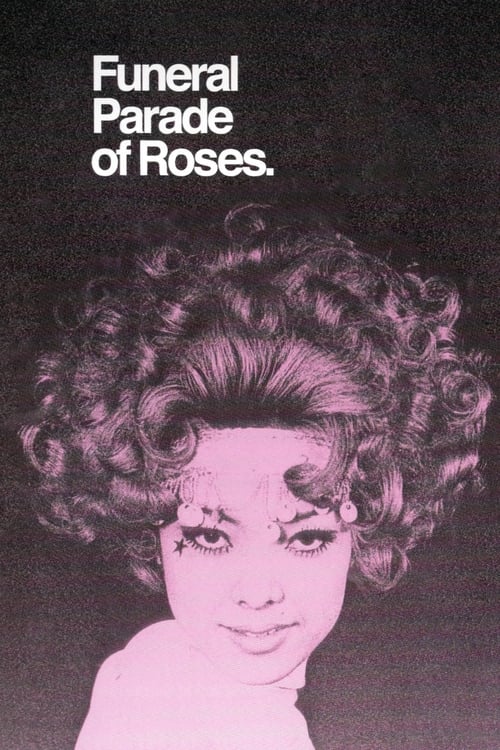
Funeral Parade of Roses
1969 · Toshio Matsumoto
For when you want a film to chew on for days — a challenging, form-breaking watch for an adventurous night, not a comfort one. Reach for it when you're ready to see cinema's rulebook cheerfully shredded.
What it's about
In the gay bars and back streets of late-1960s Shinjuku, young Eddie — the most beautiful of the cross-dressing hostesses at Bar Genet — begins an affair with the bar's owner, Gonda, setting off a rivalry with Leda, the reigning madam and Gonda's longtime lover. Woven through the love triangle is something no one in it can see coming: a buried family history pulling the story toward the shape of Greek tragedy. Between the drama, the film keeps stopping to interview its real-life performers about their actual lives.
The experience
Electric and disorienting in the best way — it swerves from tender melodrama to documentary interview to sped-up slapstick to genuine horror, sometimes within minutes. It's playful, then it's devastating; you come out rattled and exhilarated.
Performances
Peter, a real fixture of the Shinjuku scene making a film debut, is magnetic as Eddie — glamorous, wounded, and unnervingly modern — surrounded by actual denizens of the subculture playing versions of themselves.
The craft
Toshio Matsumoto shoots in high-contrast black and white and throws the whole avant-garde toolkit at the story — jump cuts, freeze-frames, direct address, the crew visible on camera — yet the collage never loses emotional focus. It looks startlingly fresh today and rewards the biggest, sharpest screen you can find.
Why it matters
A landmark of the Japanese avant-garde and of queer cinema — a rare, humane document of Tokyo's trans and gay underground at the moment it happened — and a film whose visual audacity was famously absorbed by later dystopian filmmaking.
Snapshot
Funeral Parade of Roses (薔薇の葬列, Bara no Sōretsu) is Toshio Matsumoto's first feature, a black-and-white plunge into the gay and transgender demimonde of late-1960s Shinjuku, structured as a loose and deliberately fractured retelling of the Oedipus myth. Its ostensible plot — the young "gay boy" Eddie displaces the older madam Leda in the affections of the bar owner Gonda, only for a buried familial history to detonate the arrangement — is less the film's subject than its scaffolding. What Matsumoto actually delivers is a hybrid organism: part scripted melodrama, part cinéma-vérité documentary in which the performers, several of them genuine denizens of the subculture, are interviewed on camera about their lives; part avant-garde essay bristling with jump cuts, freeze-frames, sped-up slapstick, direct address, and film-within-the-film self-exposure. Produced through the Art Theatre Guild, it stars the androgynous cabaret performer Peter (Pîtâ) in his screen debut. Long difficult to see outside Japan, it accrued a formidable underground reputation and is now widely regarded as a landmark of the Japanese New Wave and of queer cinema. It is a film about faces, masks, and the impossibility of telling one from the other.
Industry & production
The film was made under the aegis of the Art Theatre Guild (ATG), the Tokyo company that from the mid-1960s became the essential enabler of Japan's independent and experimental cinema. ATG's model — modest budgets, frequently a cost-sharing arrangement with directors, and distribution through its own art houses — freed filmmakers from the commercial imperatives of the majors (Toho, Shochiku, Nikkatsu, Daiei) at precisely the moment those studios were contracting. That context is decisive: a feature centered on Tokyo's transvestite bar culture, mixing documentary interviews with a mythic-melodramatic plot and radical formal disruption, was inconceivable within the studio system and characteristic of what ATG existed to permit.
Matsumoto arrived at the feature not from the industry but from the avant-garde. Through the 1950s and 1960s he was a leading figure in Japanese experimental film and a prominent theorist, associated with documentary and with the intermedia and expanded-cinema currents of the period. Funeral Parade of Roses was thus a first feature made by an artist already established in another register, and it carries that lineage in its structure. Precise budget and box-office figures for the production are not something I can state with confidence, and I will not invent them; the salient economic fact is simply that ATG's low-cost independent framework made the film possible.
Technology
The film was shot on 35mm black-and-white stock, a choice that in 1969 was already an aesthetic rather than merely economic decision — color was by then standard for commercial features, and monochrome signaled art-cinema seriousness and a documentary lineage. The technological interest of the film lies less in any single tool than in the range of in-camera and optical effects Matsumoto marshals: high-speed (fast-motion) photography for comic interludes, freeze-frames, negative or high-contrast imagery, and superimposition. The interview sequences depend on relatively mobile, available-light-inclined shooting appropriate to vérité practice of the era. The score, meanwhile, draws on the electronic and musique concrète sensibility that Japanese avant-garde composers had been developing since the 1950s, so that the film's sonic technology is as forward-leaning as its editing. It is a film that treats the cinematic apparatus itself as visible material.
Technique
Cinematography
Photographed by Tatsuo Suzuki, the film's monochrome images oscillate between two registers that mirror its documentary/fiction split. The vérité interviews are handled with a plainer, observational directness — faces filling the frame, the camera acknowledged. The staged scenes, by contrast, are highly composed and often stylized: stark contrasts, graphic use of shadow, mirrors and reflective surfaces that double and fracture the figures, and compositions that isolate Eddie's face as an object of contemplation. The recurring motif of the mirror is both a compositional device and a thematic one, insisting on the constructed, performed nature of the identities on screen. The camera is frequently mobile and unsettled, refusing the stability that would let the viewer settle into a single mode of looking.
Editing
Editing is the film's most conspicuous and celebrated technique. Matsumoto — working with editor Toshie Iwasa — deploys a full arsenal of disjunctive cutting: abrupt jump cuts, freeze-frames that arrest the action, flash inserts, and non-chronological ordering that scrambles past and present. The montage repeatedly breaks the fiction to insert documentary footage, on-set interviews with the actors, or images of the crew and equipment, so that the seam between representation and reality is not hidden but exhibited. Sequences accelerate into fast-motion farce and then halt. This editing is not decoration; it is the film's argument, enacting a refusal of the seamless illusion that classical narrative cinema depends on and aligning the film with the international modernist currents of the late 1960s.
Mise-en-scène / staging
The dominant world of the film is the interior of the bar and the apartments and streets of Shinjuku's nightlife, dressed with the makeup, wigs, costume, and ritual of the subculture it documents. Staging repeatedly foregrounds the act of self-fashioning — dressing, applying makeup before mirrors — so that the mise-en-scène itself thematizes performance and disguise. Against these naturalistic milieus Matsumoto sets stylized, theatrical, or overtly artificial tableaux, and interpolated materials (graphic design, text cards, art images) that pull the film toward the essayistic. The result is a staging philosophy in which no environment is allowed to read as simply "given."
Sound
The score is credited to the avant-garde composer Jōji Yuasa, whose background in electronic and experimental music suits the film's dislocations; the soundtrack tends toward the atonal, the electronic, and the unsettling rather than conventional dramatic underscoring. Sound and image are frequently held in tension rather than synchronized for emotional reinforcement, and the shifts between diegetic bar sound, interview speech directly addressed to the camera, and composed score reinforce the film's layered relationship to reality. The documentary interviews give the soundtrack an unusual weight of unscripted, first-person voice.
Performance
The casting is inseparable from the film's method. Peter (Pîtâ, the stage name of Shinnosuke Ikehata), a young cabaret performer, plays Eddie in a debut of remarkable poise, his androgynous presence functioning as both character and icon. Around him Matsumoto cast performers drawn in part from the actual subculture, and the vérité interviews ask them to speak as themselves — collapsing the distance between actor and role that the fiction otherwise maintains. Performance in the film is therefore doubled: it is both the dramatic playing of the Oedipal plot and the documented self-presentation of real lives, and the film deliberately keeps the viewer uncertain which is which at any given moment.
Narrative & dramatic mode
The narrative mode is hybrid and self-reflexive rather than classical. Beneath the surface melodrama runs the armature of Sophocles' Oedipus — a fated, incestuous, self-blinding trajectory that the film reveals only gradually and reorganizes out of sequence, so that the mythic pattern surfaces as a shock of recognition rather than a linear inevitability. Matsumoto braids this fiction with documentary interruption: the story stops for interviews, for glimpses of the production, for essayistic digression. The effect is a modernist, distanciated dramaturgy in which the audience is denied absorption and repeatedly reminded that it is watching a made object. The tragic ending, when it arrives, lands with a violent literalness that retroactively clarifies the myth — but the film has spent its length teaching us not to trust the seamlessness of any story it tells.
Genre & cycle
The film resists single-genre placement, which is part of its point. It is at once a queer melodrama, an avant-garde art film, and a documentary of a subculture, and it belongs most securely to the cycle of ATG-produced Japanese New Wave features that pushed political and formal transgression in the years around 1968–1971. Within that cycle it sits alongside the more overtly political experimentation of contemporaries as an instance of cinema turned reflexively on its own means. As queer cinema it is an unusually early feature-length work to center transgender and gay life not as pathology or spectacle-for-outsiders but as a documented, self-articulating world, however stylized the frame around it.
Authorship & method
The controlling intelligence is Toshio Matsumoto, who directed and wrote the film and who came to it as an established experimental filmmaker and theorist rather than a studio craftsman. His method here is the practical application of ideas he had developed about the relationship between documentary and the avant-garde: rather than treating observation and abstraction as opposites, he fuses them, using documentary material as one more disruptive element within a constructed, self-exposing form. The film is unmistakably an auteur's essay on cinema, identity, and artifice.
He worked with key collaborators whose contributions shape the film's identity: cinematographer Tatsuo Suzuki, whose monochrome imagery gives the film its graphic and mirrored surfaces; editor Toshie Iwasa, essential to the disjunctive montage that is the film's signature; and composer Jōji Yuasa, whose avant-garde score supplies its unsettling sonic register. Above all the film depends on Peter, whose casting is itself an authorial decision, the performer's real androgyny made the pivot of the film's meditation on face and mask. Matsumoto continued in features afterward — his 1971 Demons (Shura) is the most cited of his subsequent work — while remaining rooted in experimental and theoretical practice.
Movement / national cinema
Funeral Parade of Roses is a central document of the Japanese New Wave (Nūberu Bāgu) in its late, ATG-enabled, formally radical phase. Where the earlier New Wave of the studios had channeled political dissent through relatively conventional narrative, the ATG period pushed toward outright modernist rupture, and Matsumoto's film is among the most extreme instances. It also belongs to the broader Japanese avant-garde and intermedia scene of the 1960s, connecting cinema to experimental music, graphic design, and the reflexive documentary tradition Matsumoto theorized. Nationally, it registers the ferment of a Tokyo counterculture on the eve of the political disillusionments of the early 1970s, giving cinematic form to a specifically Japanese urban underground.
Era / period
The film is saturated in 1960s Tokyo and specifically the nightlife of Shinjuku, a district that was the era's crucible of countercultural, artistic, and sexual dissent. It arrives at the tail end of a decade of protest and experimentation, and its formal aggression is of a piece with the international 1968 moment — a cinema of rupture answering a wider sense that inherited forms, social and artistic alike, had lost their authority. Its documentary passages preserve a real subcultural world at a specific historical instant, which lends the film, beyond its formal daring, the value of a record.
Themes
The film's governing theme is identity as performance — the mask that does not conceal a stable face beneath but constitutes the self. Gender is its most direct vehicle: cross-dressing, transition, and androgyny are presented not as deviation but as the visible edge of a truth about all identity, that it is made and worn. Around this cluster artifice and reality, the film's insistence that cinema, like the self, is constructed, and its refusal to let the viewer forget it. The Oedipal substructure introduces fate, blindness, and the return of the repressed, binding the personal drama to myth. Mirrors, makeup, and doubling recur as figures for self-division. And running throughout is a reflexive meditation on cinema itself — on looking, on the camera's complicity, on the porous border between the documented and the staged.
Reception, canon & influence
On release the film was recognized within Japan's art-cinema circles as a significant and provocative work, though as an ATG production it belonged to a specialized rather than mass audience; I would rather flag that its detailed contemporary critical and commercial record is not something I can reconstruct precisely than invent figures for it. Internationally its reputation grew slowly and largely through cinephile and festival channels, hampered for decades by limited availability; its restoration and reissue in the 2010s brought it to a far wider audience and consolidated its standing as a canonical work of both the Japanese New Wave and queer cinema.
Looking backward, the film draws on Sophoclean tragedy for its mythic armature; on the international modernism of the 1960s — the jump cuts and reflexivity associated with the French New Wave and the broader distanciation of the period — for its formal vocabulary; on the vérité documentary tradition Matsumoto himself had theorized; and on the Japanese avant-garde's fusion of film, experimental music, and graphic design.
Looking forward, its most frequently cited legacy is its reputed influence on Stanley Kubrick's A Clockwork Orange (1971) — particularly in fast-motion and stylized sequences; this connection is widely repeated in the film's reception, though it rests on anecdotal attribution rather than firm documentation, and I note it as such rather than as established fact. More securely, the film became a touchstone for later queer and avant-garde cinema and a rediscovered classic whose formal audacity and empathetic documentation of a marginalized world feel strikingly contemporary. Its lead, Peter, went on to a notable career, including a memorable role as the fool Kyoami in Akira Kurosawa's Ran (1985). Half a century on, Funeral Parade of Roses endures less as a period curiosity than as a living demonstration that a film can interrogate its own means and still break the viewer's heart.
Reception
A radical underground object in 1969 Japan, it was barely seen in the West for decades until a 4K restoration and 2017 re-release turned it into a rediscovered classic — now widely hailed as a landmark of queer cinema and the Japanese avant-garde.
How Funeral Parade of Roses was received, from release to now →
How to watch Funeral Parade of Roses: what to notice on a first viewing
- Notice abrupt jump cuts breaking scenes apart. Matsumoto cuts scenes into jagged fragments, freeze-frames, and flash inserts instead of smooth continuity, refusing the illusion that classical narrative cinema depends on. The rough cutting keeps reminding you that you're watching something made, not something simply happening.
- Watch the film stop for interviews with the real performers. The scripted melodrama repeatedly breaks to show cast members answering questions as themselves, so fiction and documentary keep trading places without warning. You can never fully settle whether you're watching a performance or a person's actual life.
- Notice mirrors doubling and fracturing faces throughout. Reflective surfaces recur constantly in the bar and apartments, splitting Eddie's face into pieces and insisting that identity here is built rather than simply revealed. The mirrors keep telling you that a face here is something made, not something you were simply born with.
- Watch Eddie apply makeup before a mirror. Peter plays Eddie's self-fashioning, the dressing and the makeup, as its own kind of scene, foregrounding the labor of becoming an image rather than hiding it. You watch a self get constructed in real time instead of just appearing fully formed on screen.
The whole guide to watching Funeral Parade of Roses, with the keys for a rewatch →
Influences: the films it descends from and the films it influenced
- Breathless (1960) — Codified the jump cut within a single continuous action as an expressive rupture rather than an error — the discontinuous cutting grammar Iwasa's montage adopts throughout.
- Masculin Féminin (1966) — Interpolates direct-to-camera vérité interviews and on-screen intertitle chapter cards into a fiction, the exact documentary-interrupts-drama device Matsumoto uses when he cuts to real interviews with his drag cast.
- Chronicle of a Summer (1961) — Cinéma-vérité that films real subjects and then films them watching their own footage — the reflexive documentary method Matsumoto had theorized and here folds into the film's self-exposing structure.
- Hiroshima mon amour (1959) — Pioneered the subliminal flash-cut that splices remembered past into present action, the associative memory montage behind the film's abrupt intrusions of Eddie's childhood trauma.
- Last Year at Marienbad (1961) — Built a nonlinear architecture of repeated, contradicted events staged amid mirrors and labyrinthine framing — the ambiguous, mirror-motif temporality Matsumoto echoes.
- Scorpio Rising (1963) — Cut documentary footage of a queer subculture to a pop-song soundtrack with homoerotic iconography, establishing the montage-driven queer avant-garde essay form.
- Flaming Creatures (1963) — Foregrounded androgynous drag performers in improvised tableaux, the underground-queer casting-as-meaning that Matsumoto formalizes around Peter's real androgyny.
- Chelsea Girls (1966) — Documented non-professional drag 'superstars' playing versions of themselves, the casting of a marginalized milieu as its own performers that anchors Funeral Parade's non-professional cast.
- Cruel Story of Youth (1960) — Cuts documentary interviews and street footage directly into the fiction, so the newsreel-insertion device Ōshima used as punctuation becomes the film's whole anti-continuity architecture.
- A Clockwork Orange (1971) — Its fast-motion and stylized set-pieces are the technique most often traced back to Funeral Parade of Roses' undercranked comic sequences (an anecdotal but widely cited debt).
- Paris Is Burning (1990) — Empathetic vérité documentation of a queer/trans ballroom underground whose subjects perform identity directly to camera, extending Matsumoto's respectful observation of a marginalized world.
- Velvet Goldmine (1998) — Uses a reflexive, fragmented nonlinear structure around an androgynous glam icon to stage identity-as-performance — the face/mask meditation rebuilt with New Wave editing devices.
- Tangerine (2015) — Casts trans non-professional leads drawn from the very milieu it depicts and immerses in it with vérité mobility, reviving the documentary-fiction empathy toward a queer underground.
- Love Exposure (2008) — Japanese underground's cross-dressing/gender-disguise identity play and self-reflexive editing that Sono channels through Yoko's 'Sasori' drag and Yu's female alter-ego.
- Demons (1971) — Matsumoto's own preceding feature, whose fractured nonlinear montage, repeated/reenacted actions, and jarring subjective inserts are transplanted from Shinjuku demimonde documentary into Shura's kabuki-revenge frame.
- Castration Movie Anthology i. Traps (2024) — Underground trans/queer portraiture that blends documentary interview and staged fiction with self-reflexive breaks, an early model for talk-driven trans cinema outside respectable form.
- Tokyo Fist (1995) — Japanese avant-garde antecedent for the aggressive jump-cut/flash montage and the transgressive, self-mutilating urban body staged as formal assault.
- Belladonna of Sadness (1973) — Matsumoto interrupts narrative with freeze-frames, graphic title cards and documentary inserts scored to avant-garde jazz, establishing the ATG-era license for formal rupture and non-diegetic sung/spoken commentary that Belladonna assumes as its baseline.
- Female Prisoner #701: Scorpion (1972) — Codifies the shock insert as a syntactic unit — single-frame stabs, freeze-frames, documentary interviews rupturing fiction — and draws its cast from the Shinjuku angura troupes, the same underground-theater body Ito recruits for his massed-prisoner geometry.
- Bullet Ballet (1998) — ATG-underground practice of casting non-professionals out of an actual Shinjuku subculture and shooting them in their own spaces, then rupturing the fiction with documentary-grain inserts — the casting and location economy Tsukamoto inherits for his street gang.
- The Man Who Stole the Sun (1979) — Cinematographer Tatsuo Suzuki's method arrives intact: handheld 35mm shot into unpermitted Shinjuku crowds, long lenses flattening real pedestrian traffic into a moving wall, and abrupt cutting that ruptures tone mid-scene rather than modulating it.
- Death by Hanging (1968) — An ATG Japanese New Wave feature deploying Brechtian distanciation and a documentary-fiction hybrid frame to interrogate its own means, the same reflexive strategy from the same production house.
- Woman in the Dunes (1964) — Japanese avant-garde fusion of graphic monochrome abstraction (skin, sand in extreme close-up) with Tōru Takemitsu's musique-concrète score — the film/experimental-music/design synthesis Matsumoto shares.
- Shura (1971) — Matsumoto's own follow-up extending his monochrome, temporally fractured experimental formalism into jidaigeki, the clearest continuation of the same authorial method.
- Performance (1970) — Dissolves stable identity through fragmented, mirror-laden montage and gender-fluid casting, pursuing the face/mask theme via the same disjunctive editing register.
- Pale Flower (1964) — Matsumoto's extreme high-contrast monochrome cinematography, elliptical editing across narrative time, and direct-to-camera breaks that rupture diegetic space extend Japanese New Wave's formal radicalism across an urban counter-cultural milieu, sharing Pale Flower's strategy of using genre-adjacent material as formal experiment.
- In the Realm of the Senses (1976) — Shares the JNW project of yoking transgressive sexuality to radical formal device and a confrontational address of the body.
- Throw Away Your Books, Rally in the Streets (1971) — An ATG-financed Japanese underground collage that interrupts its fiction with documentary direct-to-camera interviews, mixing performance and reality with the same anti-naturalistic rupture Terayama deploys.
- Pastoral: To Die in the Country (1974) — Contemporary Japanese post-studio avant-garde that interleaves documentary self-reflexivity, jump-cut associative montage, and staged artifice — the sibling experiment in exposing the film's own making.
Similar films
- Woman in the Dunes (1964) — influence & lineage · often watched together
- Harakiri (1962) — often watched together
- Drive My Car (2021) — often watched together
- House (1977) — often watched together
- Throw Away Your Books, Rally in the Streets (1971) — often watched together
- Bullet Ballet (1998) — often watched together
- Tetsuo: The Iron Man (1989) — often watched together
- Enter the Void (2010) — often watched together