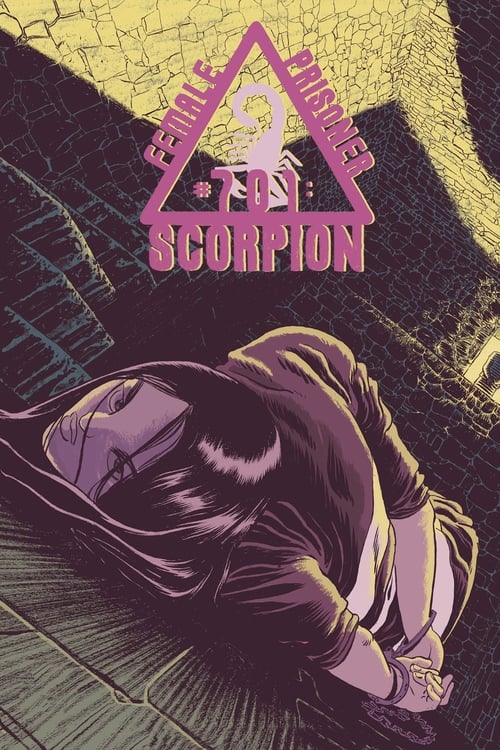
Female Prisoner #701: Scorpion
1972 · Shunya Ito
For when you're craving something wild and transgressive — a stylish, cathartic revenge trip well outside polite cinema. Definitely a challenge, not a comfort watch: expect cruelty and exploitation-movie flesh alongside the artistry.
What it's about
Nami Matsushima loved a narcotics detective completely — and he used her as bait, betrayed her to the mob, and put her behind bars. Now, in a brutal women's prison run by sadistic guards, she endures torture and treachery while nursing a single, unbending purpose: revenge. The other inmates call her Scorpion, and the institution has no idea what it's holding.
The experience
Ferocious and hypnotic at once — a grindhouse revenge picture that keeps erupting into pure, theatrical style, with walls dropping away and color flooding the frame at its most violent moments. It's harsh, lurid, and frequently jaw-dropping; you watch it half in shock, half in awe.
Performances
Meiko Kaji is iconic as Matsu — a performance built almost entirely of silence and a stare that could cut steel, turning near-wordless endurance into one of cult cinema's great screen presences.
The craft
First-time director Shunya Ito smuggles avant-garde theater into a studio exploitation programmer: revolving sets, expressionist lighting, and sudden washes of unmotivated color transform prison-movie sleaze into something closer to a fever dream. On a good screen the stylized sequences are genuinely stunning.
Why it matters
It launched a legendary Japanese cult series, made Meiko Kaji an enduring icon of the avenging woman, and its imagery and attitude echo through decades of revenge cinema and its Western admirers.
Snapshot
A women's-prison programmer released by Toei in the summer of 1972, adapted from Tōru Shinohara's manga Sasori, and the directorial debut of a thirty-something studio assistant director named Shunya Ito. On paper it is a disreputable object: an under-ninety-minute exploitation picture built for a double bill, trading in nudity, torture and revenge. In practice it is one of the strangest formal experiments the Japanese studio system produced in its decline — a genre picture that repeatedly abandons realist space altogether, dropping its walls, revolving its floors and flooding its frame with unmotivated color at the moments of greatest violence.
Its center is Meiko Kaji as Nami Matsushima, "Matsu the Scorpion," a woman imprisoned after knifing the narcotics detective, Sugimi, who seduced her, used her as bait against a yakuza drug operation, and let her be raped to protect his own career. Kaji plays her almost wordlessly: a fixed, upward glare from beneath a fall of black hair, a body that absorbs punishment without confessing to it. The film's power comes from the collision between that austere, near-immobile performance and a mise-en-scène of continuous stylistic assault. Three sequels followed within eighteen months, two of them Ito's, and the character became one of the most durable icons in Japanese pop cinema.
Industry & production
The film belongs to a specific and short-lived industrial moment. By 1972 the Japanese studio system was in open collapse: Daiei had gone bankrupt in 1971, Nikkatsu had converted to softcore roman porno production in November of that year, and theatrical attendance had been falling for a decade and a half against television. Toei's response, engineered under Shigeru Okada, was to abandon the chivalrous ninkyō yakuza formula that had sustained it through the 1960s and chase two new lines simultaneously: the brutal documentary-styled gangster film — Kinji Fukasaku's Battles Without Honor and Humanity arrived in January 1973, six months after Scorpion — and a cycle of violent, sexualized films with female leads that English-language criticism later labeled "pinky violence." The Girl Boss (Sukeban) and Terrifying Girls' High School series ran in parallel with the Scorpion films on Toei's programs.
These were program pictures in the strict sense: made fast, on short schedules and modest budgets, cut to a length that fit a double bill, and expected to earn out within weeks. That economy is the precondition for the film's formal risk-taking rather than an obstacle to it. Nobody was watching closely enough to stop a first-time director from tilting the set. Ito had come up through Toei's assistant-director system during the 1960s, the same apprenticeship structure that produced Fukasaku and that placed young directors alongside Teruo Ishii's ero-guro torture pictures, and he was handed a pre-sold property with a built-in audience.
Meiko Kaji's presence is itself an artifact of the industry's disintegration. She had been a Nikkatsu contract star, leading the Stray Cat Rock films and appearing in Teruo Ishii's Blind Woman's Curse (1970); when Nikkatsu pivoted to roman porno she left rather than take that work, and moved to Toei. She arrived, in other words, as a performer with an established refusal at the core of her professional identity — a fact the Scorpion films exploit almost literally.
Technology
Nothing in the film is technologically novel; what is notable is how its effects are achieved. It was shot on 35mm color stock in anamorphic widescreen, the roughly 2.35:1 format Toei had branded Toeiscope, and the scope frame is used aggressively — Ito repeatedly isolates Kaji at one edge of an otherwise emptied or symmetrically massed composition, so that the width of the image registers as pressure rather than spectacle.
The stylistic set pieces are stage machinery, not optical work. Optical printing was expensive and slow; a revolving floor, wild walls that can be flown or dropped, gelled lamps, mirrors and smoke are all available in-camera on a studio stage for the cost of a setup. So when the film's most cited sequence — the flashback in which Nami is assaulted in a tatami room — abandons realism, it does so by physically rotating the set beneath the actors while the walls fall away and the lighting shifts to a saturated red. The audience is watching theater technology, filmed. Eastmancolor's response to heavily gelled key light, which a more prestigious production would have treated as a flaw to be avoided, is here treated as an expressive resource: color that detaches from any plausible source.
Zoom lenses, ubiquitous in early-1970s Japanese program pictures, are used for sudden punctuation rather than for smooth reframing, and handheld coverage is reserved for the riot and escape material, where the shift in camera support does the work that coverage volume would otherwise require.
One later technological point matters for the film's reputation: for two decades it circulated internationally, when it circulated at all, on pan-and-scanned analog video, which destroyed precisely the compositional logic that makes it distinctive. Its critical re-evaluation in the West is inseparable from DVD editions in the early 2000s and subsequent restored, correctly framed releases.
Technique
Cinematography
Hanjirō Nakazawa's photography operates in two incompatible registers and refuses to reconcile them. The prison material is largely hard, high-contrast and gray-green, with the drab institutional palette of a documentary; against it, the film inserts passages of pure chromatic abstraction — a face lit red against black, a corridor washed in blue — with no diegetic justification offered or wanted.
The camera's default relationship to Matsu is the low angle. She is repeatedly framed from below her own eyeline, or from ground level looking up, and the film's signature image is the extreme close-up of Kaji's eyes glaring upward through her hair. This is not simply an iconic flourish. The prison's entire architecture of power is organized around looking — inspection, surveillance, the humiliation of forced exposure — and Ito's camera systematically returns the look from underneath. When Matsu is buried in the yard as punishment, the film puts the camera where she is, in the dirt, and the guards become the objects of a gaze from below ground.
Editing
The cutting is built on shock and rupture rather than continuity. Ito favors the hard insert — a flash of the past, a stab of color, a face out of nowhere — dropped into an otherwise conventional scene, and he will cut from extreme stillness to chaos without transition. The film's flashback structure is deliberately unstable: the past does not arrive as an orderly narrative block but as intrusion. Credit records for Toei program pictures of this period are inconsistent in English-language sources, and the editor's contribution here is not well documented; what is legible on screen is a rhythmic strategy of withholding and then overwhelming.
Mise-en-scène / staging
This is where the film is genuinely radical. Ito stages substantial portions of the picture as theater rather than cinema, and the debt is specifically to the Japanese stage: the revolving floor is the kabuki mawari-butai; the walls that drop to leave actors stranded in a void of colored light belong to the late-1960s angura underground theater of Shūji Terayama and Jūrō Kara, whose anti-realist, folk-grotesque idiom was the dominant avant-garde language in Tokyo when Ito was coming up.
The consequence is that the prison is never merely a location. It is a machine for arranging bodies — inmates massed in ranks, forced into synchronized labor, arrayed for inspection — and the geometry of those arrangements does the film's political argument without dialogue. Set against the mass, Matsu is almost always a single vertical figure, motionless.
Sound
Shunsuke Kikuchi's score works the same seam as his contemporaries at Toei and Nikkatsu: brass stabs, wah-wah guitar, a jazz-funk propulsion imported from American crime scoring. Against it sits the film's real sonic signature, the theme "Urami Bushi" ("Grudge Song"), sung by Kaji herself in an enka-inflected register, with music by Kikuchi. The song functions less as underscore than as chorus — a external moral voice supplying the grief and rage the character will not speak. Its use is structural: because Matsu is silent, the ballad carries her interiority, exactly as a narrating ballad would in a traditional dramatic form.
Ito also uses hard silence and isolated diegetic sound — scraping metal, dripping water, the rhythm of digging — as a counterweight to the score's excess, and drops the music entirely at several moments of violence.
Performance
Kaji's is a subtractive performance, and it is the film's organizing decision. She barely speaks; a widely circulated account, which Kaji has supported in interviews, holds that she pushed for the character's near-total silence herself. What remains is posture, stillness and the eyes. The character does not develop psychologically — she is a constant, and the drama is what the institution fails to do to her.
Around that constant, the ensemble plays broad and loud: the inmates are pitched near hysteria, and the guards, led by Fumio Watanabe as the prison chief, are played as grotesques — bureaucratic sadism rendered as caricature. Watanabe, familiar from Nagisa Ōshima's films, brings a specifically institutional smugness to the role. Isao Natsuyagi's Sugimi is deliberately unremarkable, a man of ordinary careerist calculation, which is the point: the film's villain is not monstrous but professional.
Narrative & dramatic mode
The structure is revenge tragedy grafted onto serialized manga. The film opens in medias res with an escape and recapture staged against an official ceremony — the state honoring itself while its prisoners run — then reaches back to the betrayal that produced Matsu, then returns to the prison for a sustained account of punishment, informing, and the slow accumulation of a weapon and an opportunity, before releasing her toward Sugimi.
Its dramatic mode is not realist. Characters are emblems; motivation is single and fixed; the moral arithmetic is absolute. Matsu's defining act, dramatically, is a refusal — the authorities want an apology, a confession, a submission, and she never supplies it. Because she gives nothing away, the film cannot generate suspense from her psychology and instead generates it from the question of how much the institution can do to a body before something breaks. Nothing does. The ending consummates the revenge but declines resolution: she is at large, not free, which is both a genre convention of the serial and an accurate statement of the film's politics.
Genre & cycle
Scorpion sits at the intersection of three cycles. The first is the international women-in-prison film, which was in a global boom around 1970–72 — Jess Franco's 99 Women (1969), and Roger Corman's New World productions shot in the Philippines, The Big Doll House (1971) and The Big Bird Cage (1972). The Toei cycle is contemporaneous rather than derivative; the shared taxonomy (the sadistic warden, the shower, the informer, the riot) reflects convergent exploitation economics as much as direct borrowing.
The second is Japanese: Toei's own tradition of the female avenger, established commercially by the Red Peony Gambler films with Junko Fuji, and the ero-guro torture pictures Teruo Ishii made for the studio in the late 1960s. Scorpion inherits Fuji's iconography of the implacable woman and Ishii's appetite for spectacle of the punished body, and fuses them.
The third is the pinky violence cycle proper, of which this is generally regarded as the artistic high point. What separates it from its shelf-mates is that its stylization is not decorative. The genre's obligations — nudity, degradation, sadism — are met, but Ito keeps rerouting them through anti-realist devices that make the viewer's own position uncomfortable rather than comfortable.
Authorship & method
Ito's method, on the evidence of his first three films, was to accept the assignment's content wholesale and rebuild its form. He directed the first three entries — Scorpion (1972), Jailhouse 41 (1972) and Beast Stable (1973) — before Yasuharu Hasebe took over for the fourth, and across those three the theatrical devices intensify. His later career diverged sharply; he moved to social-issue drama with Hana Ichimonme (1985), on dementia and family, and to the historically contentious Pride (1998).
The key collaborators: Kaji, whose refusal of dialogue set the film's entire register; Nakazawa on camera, supplying both the documentary gray of the prison and the chromatic abstraction that punctures it; Kikuchi on score, plus "Urami Bushi" as the film's external conscience; and screenwriters Fumio Kōnami and Hirō Matsuda, adapting Shinohara's manga (Ito took co-writing credit on the sequels he directed). Toei's crew credits from this period are inconsistently recorded in English-language sources, and the art direction and editing contributions — visible and substantial on screen — are not well documented.
Movement / national cinema
The film belongs to no movement, and that is analytically important. By 1972 the Japanese New Wave directors — Ōshima, Imamura, Yoshida — had left the studios for independent production and the ATG. The pink film and roman porno had claimed low-budget sexual content. What remained inside the majors was the program picture, and the surprising fact of the early 1970s is that the most formally aggressive Japanese studio cinema of the moment was being made there rather than in the art sector: Fukasaku's fractured, handheld gangster films and Ito's theatricalized prison films are both cases of avant-garde technique smuggled in under a commercial license.
Its aesthetic lineage runs through Japanese theater rather than through international art cinema. The revolve, the flown walls, the ballad-chorus, the emblematic rather than psychological characterization — these connect Scorpion to kabuki convention as reprocessed by the angura stage of the post-1968 counterculture.
Era / period
1972 in Japan was a year of political exhaustion. The mass student movement had been defeated; in February the United Red Army siege at Asama-Sansō played out on live television, followed by revelations of the group's internal purge and murders, an event that effectively discredited the radical left in mainstream opinion. Okinawa reverted to Japanese administration in May. The country was consolidating into high-growth consumer prosperity under a state that had absorbed and outlasted its opposition.
Against that backdrop, a film in which a woman is disciplined by an institution that speaks the language of rehabilitation while practicing humiliation, and whose only available response is silence and violence, is not an apolitical entertainment. The corrupt-detective premise also connects it to the era's most persistent domestic theme, the interpenetration of police, politics and organized crime, which Fukasaku would anatomize at length starting the following January. The film does not argue a position; it supplies an image of the state as a machine that grinds and of resistance as pure, unassimilable negation — which is close to what the political defeat of 1972 actually left available.
Themes
Institutional power and the body. The prison is a disciplinary apparatus whose operations are visual and corporeal: inspection, exposure, forced labor, confinement. The film anticipates, without knowing it, the vocabulary Foucault would publish in 1975, and reads well through it.
Silence as refusal. The institution's real demand is not obedience but speech — confession, apology, admission. Matsu's muteness is her weapon, and the film treats it as a more complete negation than violence.
The returned gaze. Exploitation cinema's default is to look at the female body. Ito builds a counter-system of low angles and direct address in which the object looks back. This is the film's most-debated feature and the basis of both its feminist reclamation and the objection to it.
Betrayal as the ground of the world. Sugimi's betrayal is instrumental and unromantic; among the inmates, solidarity is fragile and informing is routine. The film declines the consoling fiction of a sisterhood of the oppressed.
Abjection. Blood, dirt, bodily fluids and burial recur as the medium the heroine passes through and survives — degradation as a kind of transfiguration, staged with the frankness the genre licensed.
The critical difficulty is real and worth stating plainly: the film indicts sexual violence in sequences that are also constructed as spectacle for a male audience, and no reading fully dissolves that tension. The most defensible account is that Ito's anti-realist devices continually break the spectator's comfortable position without ever fully renouncing the genre's economy.
Reception, canon & influence
Contemporaneously, the film was a commercial product evaluated as one. Three sequels within eighteen months indicate it worked. Japan's critical establishment — Kinema Junpo's year-end polls and the prestige press — paid the exploitation program pictures little serious attention at the time, and detailed contemporaneous Japanese critical response to this specific title is thin in the English-language record; claims about its initial reception should be treated cautiously.
Backward. The film draws on Shinohara's manga for character and premise; on Toei's ninkyō female-avenger tradition and Ishii's ero-guro films for iconography; on the international WIP cycle for narrative furniture; and, most consequentially, on kabuki staging and the angura theater of Terayama and Kara for its formal vocabulary. Kaji brought her own accumulated star text from the Nikkatsu delinquent films.
Forward. Within Japan, the Scorpion films are the benchmark of the pinky violence cycle and fed directly into the sukeban strain that persisted in film, manga and V-cinema; Kaji's Matsu, together with her Yuki in Toshiya Fujita's Lady Snowblood (1973), established the template of the silent, monochrome-costumed female avenger that later Japanese and Korean revenge cinema repeatedly reworked. The property has been remade, including a Japanese-produced version in 2008, and revived in direct-to-video entries.
Internationally, the films had little theatrical circulation and reached most Western viewers only through home video from the 1990s onward — Media Blasters' DVD editions in the early 2000s and later restored box-set releases were decisive in their canonization. Quentin Tarantino's advocacy accelerated this: Kill Bill used two Kaji recordings, including "Urami Bushi," and its heroine's fusion of stillness, iconography and absolute revenge is a public acknowledgment of the debt. English-language scholarship and criticism — Chris D.'s work on Japanese outlaw cinema, and the Midnight Eye writing of Tom Mes and Jasper Sharp — did the work of establishing the films as more than curiosities.
The settled position today is that Female Prisoner #701: Scorpion is a canonical example of a specific kind of achievement: a director working inside the most constrained and least respected corner of a dying studio system, using the license that disreputability grants, to make something formally more adventurous than most of what the respectable sector produced that year.
Reception
Cranked out as a Toei exploitation programmer in 1972, it was a hit in Japan and then spent decades as grindhouse arcana in the West — until restorations and the Arrow box set got it reappraised as avant-garde filmmaking smuggled inside a women-in-prison picture.
How Female Prisoner #701: Scorpion was received, from release to now →
How to watch Female Prisoner #701: Scorpion: what to notice on a first viewing
- Watch how often Matsu is framed from below, looking up. The camera defaults to a low angle on her, often at ground level, building to extreme close-ups of her eyes glaring upward through her hair. The prison runs on looking down at people, and the camera keeps handing the look back to her.
- Notice a face or corridor suddenly wash into pure color. Against the prison's hard, documentary gray-green, the film drops in passages of red or blue light with no realistic source, unexplained and unapologized for. The color breaks are the film announcing it has stopped pretending to be a document.
- Watch the inmates massed in ranks against Matsu standing alone. Prisoners are repeatedly arranged in synchronized rows for labor and inspection, while Matsu is staged as a single, motionless vertical figure set apart from the mass. The geometry alone makes the film's argument about the institution without needing a line of dialogue.
- Watch how rarely Matsu speaks throughout the entire film. Kaji plays her almost entirely through posture, stillness, and her eyes, refusing the confession or apology the institution keeps demanding from her. Her silence is not absence of character. It is the one thing the prison cannot take from her.
- Listen for a ballad sung by Kaji herself entering the film. The theme 'Urami Bushi' works like a chorus in a traditional drama, voicing the grief and rage the silent Matsu never speaks aloud herself. The song is doing the job of an interior monologue for a character who refuses to give you one.
The whole guide to watching Female Prisoner #701: Scorpion, with the keys for a rewatch →
Influences: the films it descends from and the films it influenced
- An Actor's Revenge (1963) — Stages a widescreen revenge tragedy in explicitly kabuki terms — actors isolated in black anamorphic voids, stage-convention lighting cues replacing naturalistic sources, an onnagata avenger whose face is a mask — the exact grammar Ito imports when he drops the prison walls and lets Matsu stand in unlit space.
- Kwaidan (1964) — Establishes the studio-built painted sky and hand-mixed chromatic wash as a legitimate substitute for location realism, licensing Nakazawa's unmotivated reds and blues that puncture the film's documentary prison gray without any diegetic light source.
- Tokyo Drifter (1966) — The founding case of a contract director accepting a program-picture assignment's content and rebuilding its form — sets stripped mid-scene to monochrome voids, color changing between cuts on no motivation — which is precisely Ito's method inside Toei six years later.
- Shogun's Joy of Torture (1968) — Ishii, whom Ito assisted at Toei, fixes the ero-guro tableau: frontal, proscenium-flat torture compositions held in long takes with the victim's body arranged as graphic design, the iconographic vocabulary Ito inherits and then abstracts.
- Red Peony Gambler (1968) — Toei's ninkyō template for the female avenger as a fixed icon — a single unvarying costume, frontal address to camera, minimal dialogue, the blade withheld until a formally announced final sequence — the structural skeleton beneath Matsu's black coat and terminal knife.
- Funeral Parade of Roses (1969) — Codifies the shock insert as a syntactic unit — single-frame stabs, freeze-frames, documentary interviews rupturing fiction — and draws its cast from the Shinjuku angura troupes, the same underground-theater body Ito recruits for his massed-prisoner geometry.
- Blind Woman's Curse (1970) — Ishii's direction of Kaji discovers the register Ito will build a film on: the actress withholding all reaction while the frame does the emoting around her, plus kaidan color and tattoo iconography grafted onto yakuza plotting.
- Stray Cat Rock: Sex Hunter (1970) — Builds Kaji's Nikkatsu star text — flat affect, scope-wide gang tableaux arranged as friezes, and her own on-screen singing functioning as commentary on the action — the accumulated persona and the sung-conscience device Ito takes over intact with 'Urami Bushi.'
- The Big Doll House (1971) — Supplies the international WIP cycle's narrative furniture — matron, strip search, cell-block hierarchy, the shower and the hole, escape through jungle — which Ito accepts wholesale as content precisely so he can spend his invention on form.
- Throw Away Your Books, Rally in the Streets (1971) — Terayama's angura cinema puts dropped walls, direct address, and abrupt tonal/color rupture on film as a working method, the theatrical vocabulary Ito translates into the mawari-butai rotation that swings the interrogation set open mid-scene.
- Lady Snowblood (1973) — Kaji again, refined: the monochrome-costumed silent avenger, the chaptered revenge-tragedy structure with title cards, and Kaji's own recorded theme placed over the image as external conscience — the direct continuation of the Matsu template into jidaigeki.
- Zero Woman: Red Handcuffs (1974) — Transplants the formula to the police film — a near-wordless woman in a fixed red coat, low-angle glare framing, and the same withheld-then-total violence — confirming Scorpion's costume-as-identity and refusal-as-action as a reusable Toei-adjacent grammar.
- Kill Bill: Vol. 1 (2003) — Openly reworks the machinery: Kaji's own recordings ('Urami Bushi,' 'Shura no Hana') deployed as commentary track, the single unvarying costume as identity, and the held eye-line close-up of a still face doing the work that dialogue would elsewhere do.
- Sympathy for Lady Vengeance (2005) — Rebuilds the prison-forged avenger with the same tools — a chaptered tragedy structure, a single iconographic facial mark (the red eyeshadow) standing in for characterization, and frontal tableau compositions in scope where the collective of women arranges into geometry.
- Sasori (2008) — The authorized remake preserves exactly the elements that were Ito's rather than the manga's — the upward-glare eyeline, the black coat and hat silhouette, the withheld voice — demonstrating that what the property now consists of is the 1972 film's formal signature.
- Female Prisoner Scorpion: Jailhouse 41 (1972) — Ito's own immediate escalation of the same devices: the hag's sung ballad literalizes the external-conscience function of 'Urami Bushi,' and the ochre-and-red landscape sequences push the unmotivated color from punctuation into a sustained register.
- Sex and Fury (1973) — The parallel Toei pinky-violence line, working the same anamorphic tableau instinct — the snow swordfight staged as a series of held frontal compositions with arterial spray used as graphic accent against white — but with Ike's exhibitionist body where Kaji offers subtraction.
- Thriller: A Cruel Picture (1973) — Arrives independently at the same discovery — that a mute avenger's refusal to speak converts every close-up into an accusation — and pairs it with the eyepatch-and-black-coat monochrome costume that fixes the character as a single reproducible silhouette.
Similar films
- Lady Snowblood (1973) — influence & lineage
- Kill Bill: Vol. 1 (2003) — influence & lineage
- Demons (1971) — shared sensibility
- Ninja Scroll (1993) — shared sensibility
- Ichi the Killer (2001) — shared sensibility
- In the Realm of the Senses (1976) — shared sensibility
- Belladonna of Sadness (1973) — shared sensibility
- Audition (2000) — shared sensibility