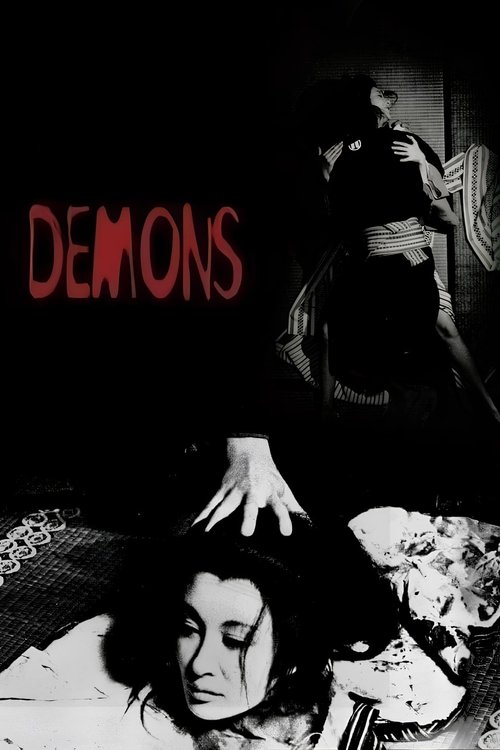
Demons
1971 · Toshio Matsumoto
For when you want to stare into the abyss — a demanding, punishing watch for a night when comfort is the last thing you're after and you want a film that leaves a bruise.
What it's about
A disgraced samurai in feudal Japan has scraped together the money to buy back his honor and join a famous vendetta — then a geisha he loves and her husband swindle him out of everything. What starts as a story of debt and devotion curdles into an obsessive, spiraling revenge, following one man as loss strips him down past honor, past reason, past humanity itself.
The experience
Pitch-black in every sense: slow-burning dread that tightens into genuinely harrowing cruelty, with dream logic that makes you doubt what you just saw. It replays moments and imagined outcomes until you feel trapped inside the man's fevered head — bleak, hypnotic, and hard to shake.
The craft
Matsumoto came from experimental film, and it shows: stark, inky black-and-white where night swallows the frame, scenes replayed and rehearsed as fantasy before they happen, kabuki-derived staging whose theatrical cruelty gets stripped of theatrical safety. The darkness of the images is a statement in itself — this rewards a dark room and full attention.
Why it matters
A cult landmark of the Art Theatre Guild era, Japan's home for radical independent cinema, and proof that its director's avant-garde instincts could detonate a classical genre from the inside. It stands among the blackest revisions of the samurai film ever made.
After the delirious drag-world pop art of Funeral Parade of Roses, Toshio Matsumoto swerved into period drama and emerged with one of Japanese cinema's blackest visions. Shura — released in English as Demons or Pandemonium — follows Gengobe, a disgraced samurai saving to buy his way back into the famous vendetta of the forty-seven ronin, until a geisha and a swindle strip him of money, honor, and finally humanity. Adapted from a nineteenth-century kabuki play by Tsuruya Nanboku, the film keeps the theater's cruelty while dismantling its distance: Matsumoto, a pioneering experimental filmmaker working under the Art Theatre Guild's radical umbrella, splinters the revenge plot with fantasy inserts, replayed scenes, and imagined outcomes, so that Gengobe's fevered mind keeps rehearsing violence before committing it. Made the same year as Kurosawa's humanist ebb, it plays like the genre's exorcism — a samurai film with no code left to betray. Most striking is the darkness itself: shot almost entirely at night, its blacks are so total that faces and blades surface like apparitions, the frame a void that swallows whatever honor was left.
A Deleuzian reading
A face comes up out of the black with nothing behind it.
The full Deleuzian reading of Demons →
Reception
An independent, avant-garde samurai film that screened at Cannes' Directors' Fortnight and Rotterdam in 1972 and then all but vanished from circulation for decades; the post-2017 rediscovery of Matsumoto (via the Funeral Parade of Roses restoration) turned it into one of Letterboxd's favorite deep cuts.
How Demons was received, from release to now →
Influences: the films it descends from and the films it influenced
- Funeral Parade of Roses (1969) — Matsumoto's own preceding feature, whose fractured nonlinear montage, repeated/reenacted actions, and jarring subjective inserts are transplanted from Shinjuku demimonde documentary into Shura's kabuki-revenge frame.
- Harakiri (1962) — Established the flashback-structured revenge tragedy that weaponizes samurai honor against itself, with austere low-key compositions and a nihilistic view of the bushido code that Shura pushes to abstraction.
- Kwaidan (1964) — Model for painterly, overtly theatrical set-bound chiaroscuro in a supernatural jidaigeki, treating darkness as designed pictorial space rather than location.
- Onibaba (1964) — Inky high-contrast night photography where black voids and reeds swallow the frame, staging dehumanization through figures dissolving into surrounding darkness—Shura's chiaroscuro-void aesthetic.
- Kuroneko (1968) — Vengeful-ghost jidaigeki staged against pure black backgrounds with isolating pools of light, blurring the boundary between the corporeal and the phantasmal.
- Ugetsu (1953) — Pioneered the seamless fantasy/ghost insert that slides into and out of realistic diegesis without a cut-marker—the perceptual ambiguity Shura exploits between real and imagined killings.
- Throne of Blood (1957) — Imported Noh-derived stylized performance, mask-like faces, and fog/emptiness staging into jidaigeki, legitimizing extreme theatrical abstraction of a period setting.
- Kamikakete Sango Taisetsu (Tsuruya Nanboku IV) (1825) — The kabuki source play Matsumoto adapts—its structure as the sordid underside/parody of the Chushingura supplies the ironic Forty-Seven Ronin backdrop the film corrodes.
- The Sword of Doom (1966) — Centers a morally void swordsman driven by pure nihilism through expressionist night duels, prefiguring Shura's protagonist as an agent of meaningless slaughter.
- Lady Snowblood (1973) — Extends the nonlinear, chaptered revenge-tragedy jidaigeki with stylized flashback interpolation and punctuating bursts of aestheticized, near-abstract violence.
- Taboo (Gohatto) (1999) — Late deconstruction of bushido using candlelit low-key chiaroscuro and near-void staging, treating the samurai milieu as a claustrophobic theatrical chamber of desire and death.
- Gemini (1999) — Revives kabuki-inflected expressionist staging—doubling, garish theatrical artifice, and blackened interiors—to render a period tale as a psychological hall of mirrors.
- Hara-Kiri: Death of a Samurai (2011) — Restages the anti-honor revenge tragedy with deliberate slow-burn austerity and desaturated low-key interiors, inheriting the flashback indictment of the samurai code.
- Double Suicide (1969) — Companion ATG bunraku/kabuki adaptation that foregrounds theatrical artifice—black-clad kurogo stagehands, painted flats—as an anti-illusionist device in stark monochrome.
- Woman in the Dunes (1964) — Defining ATG avant-garde monochrome: abstracted high-contrast textures and existential entrapment that dehumanize the body into pattern, the movement's formal vocabulary Shura shares.
- Death by Hanging (1968) — ATG anti-genre Brechtian deconstruction built on repetition and reenactment, breaking narrative naturalism to interrogate the genre's premises rather than fulfill them.
- Blind Woman's Curse (1970) — Contemporary stylized supernatural revenge jidaigeki using theatrical color-and-shadow tableaux and tattoo/ghost motifs to push period melodrama toward the phantasmagoric.
Similar films
- Harakiri (1962) — influence & lineage · same viewing thread
- The Sword of Doom (1966) — influence & lineage · same viewing thread
- Throne of Blood (1957) — influence & lineage
- Kuroneko (1968) — influence & lineage
- Funeral Parade of Roses (1969) — influence & lineage
- Onibaba (1964) — influence & lineage
- Lady Snowblood (1973) — influence & lineage
- Ugetsu (1953) — influence & lineage
All the films related to Demons →
Watch it with: curated runs of related films
- The Samurai Code on Trial — A run of chanbara films that draw the sword only to turn it against the myth of honor itself — watch them together and the bushido ideal keeps curdling into cruelty, nihilism, and doubt.