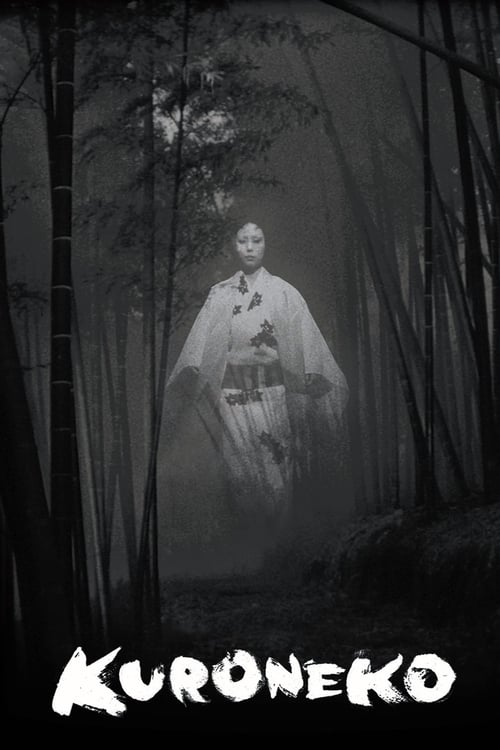
Kuroneko
1968 · Kaneto Shindō
For when you're craving an elegant, atmospheric scare — moonlight and menace instead of gore. Best late at night, lights off, no distractions.
What it's about
In civil-war Japan, a mother and daughter are raped and murdered by marauding soldiers — and afterward, samurai passing through a bamboo grove begin turning up dead, throats torn out. The governor dispatches a fierce young warrior to destroy whatever spirit is hunting them, and the film becomes a ghost story where the real horror is what the living did first.
The experience
Eerie, hypnotic, and coldly beautiful — dread builds through repetition and ritual rather than shocks, like a nightmare that keeps circling back. It's a slow spell, not a jump-scare machine, and it lingers.
Performances
Nobuko Otowa, director Kaneto Shindō's lifelong collaborator, anchors the film with a stillness that reads as both grief and threat.
The craft
High-contrast black-and-white widescreen photography, Noh-inflected staging, wirework leaps in eerie slow motion, and a spectral house that seems built from mist — every frame is composed like a woodblock print. Shindō, fiercely independent of the studio system, sharpens the ghost story into class warfare: the samurai here are predators of peasants, not heroes.
Why it matters
A classic of the Japanese ghost-story tradition whose imagery — vengeful women in white, supernatural stillness, horror born of injustice — echoes through decades of horror cinema since.
Kaneto Shindō's companion piece to Onibaba transposes a kaidan folk tale into something colder and more political: two women, brutalized and killed by soldiers in civil-war Japan, return as spirits who lure samurai into a bamboo grove and tear out their throats. Shindō, a fiercely independent figure who ran his own production company outside the studio system, frames the ghost story as class warfare — the samurai here are not noble warriors but the armed men who prey on peasants, and the horror flows from what was done to the living before anyone became a ghost. The craft is ravishing: high-contrast black-and-white photography in the widescreen frame, Noh-inflected staging, wirework leaps rendered in eerie slow motion, and a spectral house that seems assembled from moonlight and mist. Nobuko Otowa, Shindō's lifelong collaborator, anchors it with a performance poised between grief and vengeance. Alongside Kwaidan and Ugetsu it defines the Japanese ghost film, and its imagery — a white-clad figure gliding through black bamboo — has haunted horror cinema ever since. The title translates simply as 'black cat.'
Reception
Long overshadowed by Shindō's own Onibaba and barely seen in the West for decades, Kuroneko was rediscovered after a 2010 US theatrical re-release and a 2011 Criterion edition, and is now ranked alongside Onibaba as a peak of Japanese gothic horror.
How Kuroneko was received, from release to now →
Influences: the films it descends from and the films it influenced
- Ugetsu (1953) — Established the spectral-seductress kaidan built on gliding long-take camera moves and near-invisible in-camera dissolves that let a ghost materialize inside a continuous shot — the seamless-transition grammar Shindō stylizes into Kuroneko's floating, wire-assisted apparitions.
- Bōrei Kaibyō Yashiki (Black Cat Mansion) (1958) — Codified the bakeneko/ghost-cat vengeance template — a murdered woman's spirit channeled through a black cat that returns to slaughter the samurai class that wronged her — the exact genre engine Kuroneko inherits and refines.
- Tōkaidō Yotsuya Kaidan (1959) — Fixed the vengeful female yūrei's visual iconography (pallid disfigurement, floating approach, targeted haunting of the men who betrayed her) that Kuroneko restages as the cat-mothers stalking their samurai killers one by one.
- Throne of Blood (1957) — Imported literal Noh — the fixed mask-face, glacial gliding gait, and stylized hand gestures of the forest spirit — into samurai cinema, the Noh-staging vocabulary Shindō applies to the ghosts' ritualized bows and seductions.
- Kwaidan (1964) — Its 'Black Hair' episode — a wronged woman whose spectral return decays into vengeance — plus its openly theatrical, painted-set artifice model the anti-realist spectral set design and studio-bound abstraction of Kuroneko's ghost house.
- Onibaba (1964) — Its explicit companion piece: same director, same star Nobuko Otowa, same high-contrast monochrome widescreen and wind-raked susuki-grass expressionism, same thesis of war-brutalized peasant women turned monstrous by samurai violence.
- Rashomon (1950) — Pioneered aiming the camera into the sun through forest canopy and razor high-contrast dappled light in a woodland assault scene — the chiaroscuro-in-nature cinematography Kuroneko pushes to abstraction in its bamboo-grove murders.
- A Page of Madness (1926) — Japan's foundational experiment in expressionist superimposition, distorted montage, and dream-logic dissolves to externalize a haunted mind — the avant-garde toolkit Shindō draws on for Kuroneko's ghost transformations.
- Pitfall (1962) — Extends the living-dead-shared-space staging into stark high-contrast black-and-white, its vengeful ghosts occupying the same tangible physical frame as the living exactly as Pitfall's dead loiter among the workers.
- A Touch of Zen (1971) — Extends the same craft cross-culturally: a wronged woman's spirit avenging her slaughtered family from within a haunted grove, staged with trampoline/wire-assisted leaps and bamboo-forest chiaroscuro that echo Kuroneko's slow-motion aerial combat.
- House (Hausu) (1977) — Carries forward the vengeful cat-spirit devouring intruders, but detonates Kuroneko's studio-bound anti-realism into gleeful in-camera trick effects, painted backdrops, and openly artificial spectral space.
- Empire of Passion (1978) — Reworks the murdered-returns-as-ghost structure into a rural class tragedy where a slain man's spirit haunts his killers — Oshima's monochrome-tinged, misty apparitions descend directly from Shindō's peasant-vengeance kaidan.
- Kuroneko's Ringu (1998) — Modernizes Kuroneko's long-haired, gliding female yūrei who methodically hunts down each person implicated in her wrongful death — the vengeful-woman-ghost silhouette and unnatural locomotion are lifted almost whole.
- Ju-on: The Grudge (2002) — Builds its franchise on Kuroneko's core mechanism — a curse born of domestic/gendered violence that clings to a house and destroys anyone who enters — retaining the murdered-woman-and-child spirit pairing.
- Ring (1998) — Codified the long-haired female onryo gliding through negative space with unnatural floating/reverse motion — the precise staging vocabulary Nakata reuses for Sadako's exit from the well and the television.
- Demons (1971) — Vengeful-ghost jidaigeki staged against pure black backgrounds with isolating pools of light, blurring the boundary between the corporeal and the phantasmal.
- Jigoku (1960) — Rendered otherworldly punishment through stylized, non-naturalistic staging and stark theatrical lighting on near-empty stages — the same theater-of-damnation abstraction Kuroneko uses for its liminal spirit-world thresholds.
- The Snow Woman (Kaidan Yukijorō) (1968) — Released the same year, it too fuses a supernatural woman bound by an oath she cannot break with Noh-inflected stillness and high-contrast monochrome, a parallel late-1960s studio kaidan working Kuroneko's exact register.