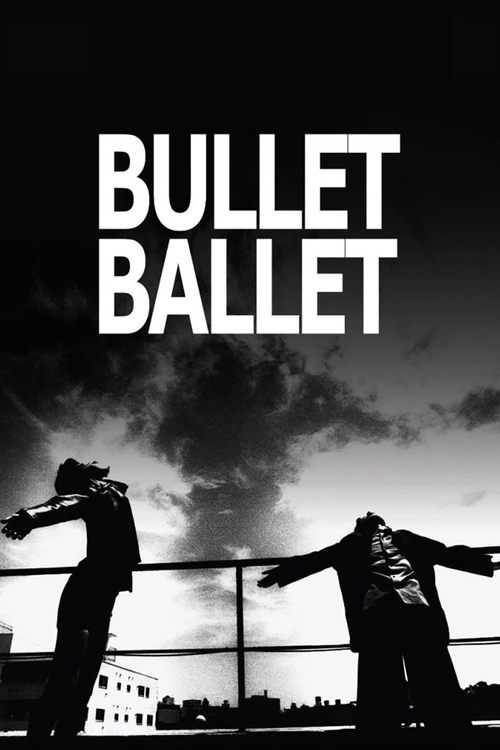
Bullet Ballet
1998 · Shinya Tsukamoto
For when you want cinema that hits like loud music — raw, confrontational, midnight-movie energy with real despair at its core. Absolutely a challenge pick; reach for it when polished films feel too tame.
What it's about
A Tokyo commercial director comes home to find his girlfriend has shot herself with a handgun he never knew she owned — and becomes obsessed with getting the same gun for himself. His search drags him through the city's black market, a swindle, a doomed attempt to build a weapon from scrap, and into the orbit of a gang of young nihilists who haunt the underpasses and train platforms of nighttime Tokyo.
The experience
Jagged, feverish, and relentless — handheld black-and-white camerawork that slams through the city like a fist, punctuated by moments of eerie stillness. It's punk-rock filmmaking: abrasive, kinetic, and strangely mournful underneath all the violence.
The craft
Shinya Tsukamoto does nearly everything himself — directing, shooting, editing, and starring — and the result feels handmade in the best way: high-contrast black and white that turns Tokyo into a maze of steel and shadow, machine-gun editing, and an industrial soundscape that gets under your skin. Loud speakers recommended; the film is as much assault as story.
Why it matters
A key work of Japanese independent cinema and the bridge in Tsukamoto's career between his cyberpunk body-horror beginnings and his later, more human dramas — proof that one-man-band filmmaking could produce something this ferocious.
Snapshot
Bullet Ballet is Shinya Tsukamoto's black-and-white film about a man who cannot get hold of a gun. Goda, a Tokyo television-commercial director in his thirties, comes home to find that his girlfriend has shot herself with a handgun he never knew she owned. The discovery does not produce grief so much as a fixation on the instrument: he wants the same weapon, a Smith & Wesson Chief's Special, and he wants it with the literalism of a man trying to reverse-engineer another person's interior life from a piece of hardware. What follows is a descent through the black market, a swindle, an attempt to machine a firearm out of scrap, and a collision with a gang of young nihilists who haunt the underpasses and station platforms of an unnamed Tokyo district.
The film sits at the hinge of Tsukamoto's career. It is the third of the Tokyo films that begin with Tokyo Fist (1995) and culminate in A Snake of June (2002) — works in which the city's professional class is not mutated into metal, as in Tetsuo (1989), but instead broken open by contact with violence, desire, or death. Where the Tetsuo films made the body-machine fusion literal and hallucinatory, Bullet Ballet relocates the same obsession into something closer to social observation: the gun is the foreign object that wants to become part of the body, and Japan — a country with among the most restrictive firearms laws in the developed world — is the setting where that fusion is hardest to achieve and therefore most charged. Roughly 87 minutes, shot in 16mm monochrome, made by a crew small enough that Tsukamoto himself directed, wrote, produced, photographed, edited, designed, and played the lead.
Industry & production
Bullet Ballet was produced through Kaijyu Theater, the production banner Tsukamoto carried forward from the theater troupe he founded in the mid-1980s after leaving a career in advertising. That biographical detail is not incidental: Tsukamoto studied at Nihon University's College of Art, worked several years making television commercials, and quit to make Tetsuo: The Iron Man on 16mm with friends and weekends. Goda's job in Bullet Ballet — a commercial director, glimpsed on set amid the fatuous choreography of an ad shoot — is the closest thing to a self-portrait in Tsukamoto's filmography, and it is Tsukamoto's own face in the role.
The production model is the defining fact about the film's texture. Tsukamoto works with a crew that can be counted on two hands, shoots for extended and interrupted periods rather than a conventional block schedule, and takes on the craft roles himself rather than delegating them. This is not merely economy; it is a method, and it produces a specific kind of image — one made by a person holding the camera who also knows exactly where the cut will fall. Precise budget figures for Bullet Ballet are not reliably documented in English-language sources, and I will not invent one; what can be said is that the film belongs to the low-budget, self-generated end of Japanese independent production rather than to the studio or television-financed mainstream.
Its distribution context was the late-1990s Japanese mini-theater circuit — the small urban art houses that sustained independent and foreign film in Japan through the 1980s and 1990s — supplemented by the international festival and genre-programming networks that had adopted Tsukamoto after Tetsuo became a cult object abroad. The precise details of its festival premiere and awards are thinly recorded in accessible English sources, and I would rather flag that gap than fill it. What is clear is the shape of the reception economy: Tsukamoto's films of this period reached most of their audience outside Japan through festivals, then through home video, and Bullet Ballet was among the titles later restored and reissued in Arrow Video's Solid Metal Nightmares box set (2020), which did more than any theatrical run to consolidate its availability.
Technology
The film was shot on black-and-white 16mm and blown up for 35mm exhibition, and almost every distinctive quality of the image follows from that decision. The blowup coarsens the grain into an active, boiling surface; blacks clot, highlights bloom, and the image acquires a documentary illegitimacy that a clean 35mm negative would have refused. The effects vocabulary is photochemical and in-camera rather than digital: undercranking and step-printing to produce the stuttering, strobed motion of the fight and chase sequences; whip-pans that smear the frame into abstraction; frame-rate manipulation used as a percussive device rather than as slow-motion lyricism.
This is, in an important sense, the last film in which Tsukamoto works purely in the 16mm idiom that produced Tetsuo and Tokyo Fist. His subsequent features move to 35mm (Gemini, 1999; A Snake of June, 2002) and, in the following decade, to digital acquisition (Haze, 2005; Kotoko, 2011). Bullet Ballet therefore catches an artisanal photochemical practice at the moment just before the DV revolution made that kind of self-shot, self-cut independence cheap and general.
There is a further technological irony embedded in the production itself. Japan's firearms regulation — the postwar Firearms and Swords Control Law — makes real handguns effectively unavailable to civilians, and model and prop guns are themselves tightly restricted. A Japanese film crew depicting a handgun is working with a non-firing simulation, which is precisely the condition the film dramatizes: everyone involved, on both sides of the camera, is handling an object whose meaning is entirely cinematic and whose function is entirely imagined.
Technique
Cinematography
Tsukamoto photographs the film himself, handheld, close, and predominantly on wide lenses. The wide angle at short distance is the signature: faces distend at the edges of frame, corridors and alleys stretch into tunnels, and the camera can be inside a fight without losing spatial legibility. The lighting is high-contrast and often practical — sodium underpasses, fluorescent convenience-store wash, headlights, the strobe of a passing train. Compositions favour verticals and enclosures: stairwells, station platforms, the rectangular mouths of tunnels. Tokyo is filmed not as a skyline but as a set of pressurized interiors that happen to be outdoors.
Editing
The cutting is Tsukamoto's own and it is the film's most aggressive instrument. Violence arrives as a burst of frames rather than as staged action; a beating may be assembled from fragments too brief to parse, so that the viewer registers impact without ever obtaining a coherent view of the event. Between these bursts the film can go very still — long, held shots of Goda alone with the gun or with video images of the dead woman. The rhythm is deliberately arrhythmic, alternating catatonia and seizure, which is also a fair description of the protagonist's psychology.
Mise-en-scène / staging
Tsukamoto serves as his own art director, and the production design is essentially curatorial: the film finds its spaces rather than building them. Underpasses, back streets, love-hotel districts, station platforms, apartment blocks, the artificial brightness of a commercial shoot. The gang occupies transitional non-places — the spaces you pass through — which suits a group defined by having nowhere to arrive. Staging repeatedly puts bodies at thresholds: the platform edge, the tunnel mouth, the muzzle. The recurring image of a young woman standing in the path of an oncoming train is the film's mise-en-scène thesis in a single shot.
Sound
Chū Ishikawa, Tsukamoto's composer from Tetsuo onward and his most important collaborator, scores the film with the industrial vocabulary he developed with his ensemble Der Eisenrost — metallic percussion, machine pulse, distorted guitar — but the application here is sparer and more punctuational than in the Tetsuo films. Much of the film's soundtrack is the city itself: train brakes, rail hum, traffic, the enormous amplified report of a gunshot in rooms not built to contain it. Ishikawa's death in 2017 ended one of the most consistent director–composer partnerships in modern Japanese cinema, and Bullet Ballet is one of its more restrained achievements.
Performance
Tsukamoto's Goda is played with a flat, clenched blankness that only occasionally cracks into spasm — a performance built from posture and reaction rather than expression. Kirina Mano, a model-turned-actress, plays Chisato, the young woman in the gang, with a hard, affectless stillness that reads as both provocation and exhaustion; the film's most interesting relationship is the mutual recognition between two people courting death by different routes. Tatsuya Nakamura — a rock drummer by trade — brings a musician's physical unpredictability to the gang leader. The ensemble's non-professional and adjacent-professional casting is characteristic of Tsukamoto's method and contributes to the film's documentary abrasiveness.
Narrative & dramatic mode
The structure is a quest narrative emptied of its object. Goda wants a gun; the film is largely the record of him failing to obtain one, being cheated, being beaten, and finally fabricating a crude approximation himself. Because the goal is fetishistic rather than instrumental — he does not know what he will do with it — the plot cannot supply the usual satisfactions of escalation. Motivation is withheld rather than explained: the girlfriend is present mostly as fragments, video images, and absence, and the film declines to psychologise her death.
The dramatic mode is closer to trance narrative than to thriller. Causality is loose; scenes are linked by obsession rather than by consequence. When the film does deliver the confrontation its genre promises, it is chaotic, ugly, and brief — the "ballet" of the title arrives as a stumble. The ending turns, ambiguously, from the death drive toward something like a reluctant will to continue, a movement Tsukamoto would repeat in later work.
Genre & cycle
The film cross-cuts three Japanese genre traditions and satisfies none of them. It borrows the yakuza film's underworld economy, the delinquent-youth film's disaffected gang, and the international noir's doomed protagonist, then strips out the codes of honor, the subcultural glamour, and the fatalistic elegance respectively. Its title invokes the "bullet ballet" of Hong Kong heroic bloodshed — John Woo's choreographed gunplay, then at the height of its global influence — as an explicit object of refusal. There is no grace in this film's gunfire.
Within Tsukamoto's own cycle, Bullet Ballet completes a movement away from the cyberpunk body-horror that made his name toward an urban realism inflected by delirium. The metal is still there; it has simply been machined into a handgun.
Authorship & method
Tsukamoto's authorship is total in a way that has few parallels: on this film he is director, writer, producer, cinematographer, editor, production designer, and lead actor. The method is closer to a painter's than a producer's — the film is worked on rather than executed, and the credits describe a single sensibility rather than a division of labor.
The exceptions matter. Chū Ishikawa's score is the one voice in the film that Tsukamoto did not generate himself, and it functions as a genuine second author, supplying the industrial substrate against which the imagery is legible. The Kaijyu Theater company provided a repertory of collaborators carried over from Tsukamoto's stage work. Beyond that, the collaboration is with the city and with the actors' bodies.
Tsukamoto has also worked extensively as an actor for other directors, which sharpens his sense of performance as physical labor — he appears in Takashi Miike's Ichi the Killer (2001) and, later, in Martin Scorsese's Silence (2016).
Movement / national cinema
Bullet Ballet belongs to the Japanese independent surge of the 1990s, the generation that reached international visibility alongside Takeshi Kitano, Kiyoshi Kurosawa, Takashi Miike, and Shinji Aoyama — filmmakers working outside a studio system in long decline, sustained by mini-theaters, video markets, and foreign festivals. Tsukamoto's specific lineage runs back through Sōgō Ishii's punk films (Crazy Thunder Road, 1980; Burst City, 1982) to the ATG-era underground of the late 1960s: self-financed, handheld, urban, hostile to the professional image.
The film is also unimaginable outside its national context. Its entire premise depends on the fact that in Japan a handgun is not a consumer object but a rumor — something known almost exclusively through American movies. Goda's obsession is, at bottom, an obsession with an imported image.
Era / period
1998 is deep in the post-bubble "lost decade": stagnation, corporate insecurity, and a widespread sense that the salaryman contract had stopped paying. The mid-1990s had also delivered the Kobe earthquake and the Aum Shinrikyō sarin attack of 1995 — twin shocks to Japanese assumptions about safety and social cohesion — followed by an intense public anxiety about youth violence. The gang in Bullet Ballet, drifting and lethal and bored, is legible against that moral panic without being reducible to it. The film's affect — numbness punctuated by spasm — is period-accurate.
Themes
The gun as prosthesis. The film's governing idea is continuous with Tetsuo: an object wants to enter the body and complete it. Here the object is a machined tool of American manufacture, and the fusion is desired rather than inflicted.
Suicide as an unreadable act. The film refuses to explain the girlfriend's death and thereby makes the survivor's project — reconstructing her through her instrument — visibly absurd and visibly necessary.
Numbness and the need for sensation. Like Tokyo Fist, the film treats violence as an attempt to feel something in a life anaesthetised by work and city. Chisato's train game is the same experiment conducted at higher stakes.
The image as source of the real. Goda is a man who makes commercials; his knowledge of guns is cinematic; the film he is in is black-and-white in emulation of the noir tradition he has absorbed. Bullet Ballet is quietly a film about how media supplies the templates for despair.
Reception, canon & influence
Contemporary reception was modest and largely confined to festival and specialist coverage; the film arrived in the shadow of Tetsuo, which had fixed Tsukamoto's international reputation as a body-horror cyberpunk and made his more austere work harder to see clearly. Its reputation has grown steadily through home-video circulation and through serious critical attention in English — principally Tom Mes's monograph Iron Man: The Cinema of Shinya Tsukamoto (FAB Press, 2005) and the broader mapping work of Mes and Jasper Sharp's The Midnight Eye Guide to New Japanese Film (2004), which did much to establish the vocabulary in which Tsukamoto is now discussed. The Arrow restoration and box set (2020) completed the film's passage from obscure title to recognized part of the corpus.
Backward, the film's inheritances are legible. Seijun Suzuki's Branded to Kill (1967) is the Japanese precedent for a monochrome film about a gunman's disintegrating psyche. Scorsese's Taxi Driver (1976) is the unavoidable reference for a lone urban man arming himself against an unnameable condition. The French New Wave's handheld street practice, the ATG underground, and Sōgō Ishii's punk cinema supply the shooting method. And Tsukamoto's own Tetsuo supplies the metaphysics of metal in flesh.
Forward, the clearest influence is on Tsukamoto himself: the restraint and moral seriousness that Bullet Ballet introduces to his work runs directly into A Snake of June (2002), Kotoko (2011), Fires on the Plain (2014), and Killing (2018) — the last of which extends Bullet Ballet's central move, refusing a genre's promised violence, into the samurai film. More broadly, Tsukamoto's do-everything-yourself model became a template for a generation of independent filmmakers who saw in his credits a proof that a feature could be made by one person and a few friends; his stylistic fingerprints are widely acknowledged by directors working in stroboscopic, grain-heavy urban modes, and his standing was formalized when Scorsese cast him in Silence. Among Tsukamoto's films, Bullet Ballet is the one most often recovered by later critics as underrated — the moment his cinema stopped being about transformation and started being about the far harder problem of remaining alive.
A Deleuzian reading
He comes home and his girlfriend is dead on the floor, and what the film fixes on is not her face.
The full Deleuzian reading of Bullet Ballet →
Reception
Premiered at Venice in 1998 but spent years as the hard-to-see middle child of Tsukamoto's filmography, overshadowed by Tetsuo; Third Window's director-supervised restoration from the original negatives turned it into the connoisseur's pick, with many fans now calling it one of his very best.
How Bullet Ballet was received, from release to now →
How to watch Bullet Ballet: what to notice on a first viewing
- Watch faces stretch and bulge near the edge of frame. Tsukamoto shoots handheld on wide lenses held close, so faces distend at the edges and ordinary corridors stretch into tunnels. The distortion makes even a hallway feel like it is pressing in on the people inside it.
- Notice violence arrive as fragments too fast to follow. A fight gets assembled from bursts of frames you cannot fully parse, and then the film drops into long, still shots of Goda sitting alone. The film keeps alternating between seizure and stillness, which is also a portrait of the man having it happen to him.
- Listen for the city's own noise standing in for music. Train brakes, rail hum, and traffic carry long stretches of the film, with Ishikawa's metallic score entering only sparingly and punctually rather than continuously. The city itself is doing most of the scoring, so the music lands harder on the rare occasions it appears.
- Notice how often characters stand at edges or thresholds. Underpasses, platform edges, and tunnel mouths recur as the gang's home ground, places built for passing through rather than arriving anywhere. These are people who live in transit, and the settings never let you forget it.
- Watch how often Goda's hands return to the gun. The pistol keeps reappearing in his hands, held, turned over, studied, treated less like a weapon than like an object he is trying to read. He is trying to reverse-engineer a dead woman's inner life out of a piece of hardware.
The whole guide to watching Bullet Ballet, with the keys for a rewatch →
Influences: the films it descends from and the films it influenced
- Breathless (1960) — Raoul Coutard's shoulder-carried, available-light shooting in live streets — with jump cuts made *inside* a continuous action rather than between scenes — is the working method Tsukamoto reruns on 16mm in Tokyo, leaving real passersby in frame instead of clearing the location.
- Pale Flower (1964) — Tōru Takemitsu built the score from amplified ambient sound — dice clatter, footsteps, traffic — establishing city noise itself as the musical bed for a monochrome yakuza film, the exact premise of Bullet Ballet's traffic-and-machinery track running under Chū Ishikawa's percussion.
- Branded to Kill (1967) — Abstracts the pistol into a graphic object in high-contrast black-and-white, withholds the killer's motivation entirely, and repeatedly cuts away from the beat the genre has promised — the structural template for a protagonist who acquires a gun and cannot make it signify.
- Funeral Parade of Roses (1969) — ATG-underground practice of casting non-professionals out of an actual Shinjuku subculture and shooting them in their own spaces, then rupturing the fiction with documentary-grain inserts — the casting and location economy Tsukamoto inherits for his street gang.
- Taxi Driver (1976) — Makes the procedural ritual of the illegal handgun purchase and the solitary rehearsal with the weapon the film's actual dramatic engine; Tsukamoto transposes that sequence structure to a salaryman assembling a gun he can barely fire.
- Eraserhead (1977) — Alan Splet's continuous industrial roar is mixed at the level of a score rather than an effect, so monochrome urban interiors become legible through sound — the same substitution Ishikawa's metal-percussion bed performs, and the same years-long one-man production model.
- Burst City (1982) — Punk shooting kit: undercranked and step-printed running bodies, the handheld camera physically inside the brawl rather than observing it, and a cast recruited from bands instead of agencies — Tsukamoto's whole delinquent-street methodology.
- Tetsuo: The Iron Man (1989) — Supplies the literal apparatus: 16mm blown up to 35mm for grain, single-frame burst cutting, Chū Ishikawa's scrap-metal score, and the total-authorship credit block (direct/shoot/cut/design/act) that Bullet Ballet reuses at deliberately lower amplitude.
- Tokyo Fist (1995) — Perfects the wide-angle lens held inches from a face and whipped with the impact, plus the director putting his own untrained body through the punishment on camera — the performance-as-physical-labor method carried directly into the gun film.
- Ichi the Killer (2001) — Casts Tsukamoto himself and uses his body-as-instrument approach to performance, while extending the anti-heroic bloodshed premise by making the gore anticlimactic and nauseating rather than cathartic.
- A Snake of June (2002) — Keeps the total-authorship model and the monochrome (here blue-toned) rain-drenched Tokyo, but applies the restraint and moral seriousness Bullet Ballet introduced — long held frames replacing the seizure cutting.
- Killing (2018) — Extends Bullet Ballet's central move — refusing the genre the act of violence it exists to deliver — into the samurai film, retaining the handheld wide-angle proximity and the Ishikawa-lineage percussive sound design.
- Kotoko (2011) — Grainy monochrome handheld urban vertigo plus Tsukamoto casting himself as a man coming apart establishes the director-cameo-in-crisis method he reprises inside Kotoko.
- Sonatine (1993) — Structures violence as long flat stillness punctured by a single unheralded burst with no build-up and no aftermath coverage, performed by the director himself as an affectless lead — the arrhythmic stillness-and-seizure grammar Tsukamoto works in.
- Rubber's Lover (1996) — Takes over the same production kit — high-contrast 16mm monochrome blown up, strobe and step-printed cutting, an industrial noise score — proving the Tetsuo apparatus was a transferable craft rather than one director's tic.
- Cure (1997) — Stages its violence in found urban non-places — vacant lots, drained buildings, service corridors — using flat frontal compositions that park figures in doorways and thresholds, and withholds motive as a formal principle rather than a late reveal.
- Pi (1998) — Reversal-stock black-and-white 16mm blown up to 35mm, rapid-fire montage of a repeated ritual action, and Clint Mansell's industrial-electronic score tracking a man's psychic collapse in a city — the identical low-budget monochrome-plus-noise solution arrived at the same year.
- I Stand Alone (1998) — Punctuates cuts with gunshot-loud sound stabs and hard title cards around a mute, unemployed man carrying a pistol toward no articulable object — the same withheld-motivation trance quest scored to percussive editing.
- Electric Dragon 80.000V (2001) — A 55-minute monochrome blast of stroboscopic step-printing over a score of amplified guitar noise generated by the cast themselves — the Tokyo-noise-plus-black-and-white grammar pushed to its limit case.
Similar films
- Tokyo Fist (1995) — influence & lineage · often watched together
- Pale Flower (1964) — influence & lineage · often watched together
- Tetsuo: The Iron Man (1989) — influence & lineage
- Ichi the Killer (2001) — influence & lineage
- Sonatine (1993) — influence & lineage
- Branded to Kill (1967) — influence & lineage
- Funeral Parade of Roses (1969) — influence & lineage · often watched together
- Run Lola Run (1998) — often watched together