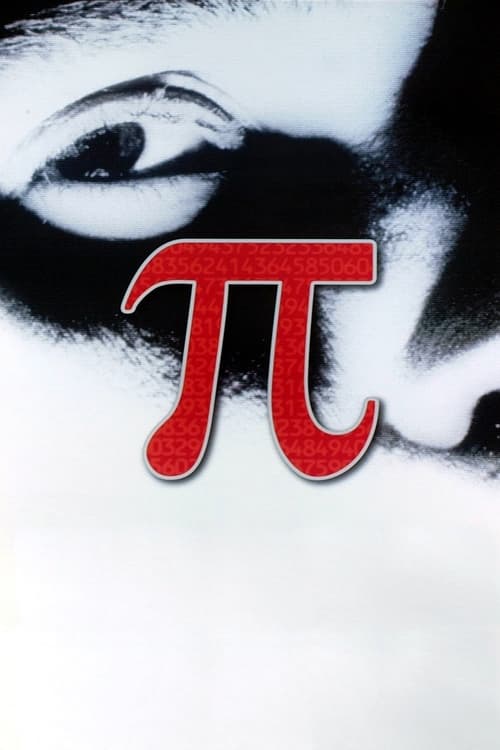
Pi
1998 · Darren Aronofsky
For a late night alone when you want something raw, obsessive, and midnight-movie strange — a film that gets under your skin rather than one that relaxes you. Challenge, not comfort, and it leaves you buzzing.
What it's about
A reclusive number theorist lives alone in a cramped Chinatown apartment with a homemade supercomputer, convinced that a pattern underlies everything — the stock market, nature, maybe reality itself. When a 216-digit number starts surfacing at the edge of his calculations, a Wall Street firm and a sect of Kabbalist mystics both come looking for him, and his crippling migraines get worse.
The experience
Relentless and paranoid — the grainy black-and-white, the pounding electronic score, and the camera locked to the hero's skull make the whole film feel like being inside a migraine. It winds tighter and tighter and never lets you settle.
Performances
Sean Gullette is in nearly every frame, twitchy and sweat-soaked, and makes mathematical obsession feel physically painful to watch.
The craft
Shot for almost nothing on harsh, high-contrast black-and-white, with jackhammer montage editing and a driving Clint Mansell electronic score that does half the storytelling. The style isn't decoration — every technical choice puts you inside one man's deteriorating head. Watch it with good speakers or headphones; the sound is the experience.
Why it matters
A sensation out of Sundance that announced Darren Aronofsky overnight and became a blueprint for how a no-budget indie could feel overwhelming through sheer style and conviction.
Snapshot
Pi (stylized as π, and sometimes rendered Pi: Faith in Chaos) is Darren Aronofsky's first feature, a black-and-white psychological thriller about mathematics, obsession, and the seductive, ruinous belief that the universe can be decoded. Its protagonist, Maximillian Cohen, is a reclusive number theorist who has retreated into a cramped Chinatown apartment crammed with a homemade supercomputer; convinced that nature is written in numbers and that patterns underlie everything from the stock market to the spiral of a seashell, he becomes fixated on a 216-digit number that seems to recur at the threshold of every system he probes. As his theory closes on something that looks like a key to reality, two forces converge on him — a Wall Street firm hungry to predict the markets, and a sect of Hasidic Kabbalists who believe the number is the unspeakable true name of God — while Max himself is consumed by debilitating migraines, hallucinations, and a paranoia that may be madness or revelation. Shot for a famously minuscule sum on high-contrast reversal film stock, propelled by a pounding electronic score and a frenetic, percussive editing style, Pi announced Aronofsky as a major new voice when it won the Directing Award at the 1998 Sundance Film Festival. It remains a defining artifact of late-1990s American independent cinema and the seed from which an entire authorial career grew.
Industry & production
Pi is a paradigmatic no-budget American independent feature, and the story of its making is inseparable from its meaning. Aronofsky, a Brooklyn-born, Harvard-educated filmmaker who had made the short Protozoa and the unfinished/short work No Time in the years prior, developed the project with his producing partner Eric Watson and his lead actor and collaborator Sean Gullette. The screenplay is credited to Aronofsky, from a story developed with Gullette and Watson — a genuinely collective authorship rooted in a tight circle of friends. The production is widely reported to have been financed for around sixty thousand dollars, raised in significant part through small contributions — the often-repeated account is of one-hundred-dollar donations solicited from friends and family — with the filmmakers promising to repay backers if the film found distribution. (The precise financing should be treated with the caution any oft-retold origin story deserves, but the order of magnitude — tens of thousands of dollars — is well established.)
The film was shot in and around New York City, drawing on the textures of Chinatown and the Lower East Side, and was completed and brought to the 1998 Sundance Film Festival, where it won the Directing Award and ignited the kind of bidding interest that such festivals exist to generate. It was acquired and released by Artisan Entertainment, the distributor then building a reputation for handling edgy independent product (and which would, the following year, ride The Blair Witch Project to enormous returns). Pi opened in the summer of 1998 to strong reviews and, on its tiny cost base, was a clear commercial success, grossing many times its budget in theatrical release — the exact figures are reported variously and are best left unquantified here beyond noting that it returned its investment many times over. Aronofsky's production banner, Protozoa Pictures, took its name from his early short and would go on to produce his subsequent work.
Technology
Pi's technological identity is bound up in two deliberate, low-cost choices that became central to its look and, later, to Aronofsky's signature. The first is its film stock: the picture was shot on high-contrast black-and-white reversal stock, a choice both economical and expressive. Reversal stock, pushed and printed for maximum contrast, yields the film's stark, grainy, near-monochrome-without-grey-scale appearance — blooming whites, crushed blacks, and a granular surface that reads as both documentary-raw and hallucinatory. The result is a visual world that mirrors Max's binary, pattern-seeking mind and feels physically abrasive, like a headache rendered as an image.
The second is the body-mounted camera rig that Pi helped make famous: the so-called SnorriCam (named for the rig's developers), a harness that fixes the camera to the actor's body so that the performer remains locked and stable in the frame while the entire world behind him swims and lurches. Deployed as Max strides through the streets in states of agitation, the device externalizes his dissociation and dread — the protagonist eerily still at the center while reality reels around him. Though not invented for this film, the SnorriCam became strongly associated with Aronofsky through Pi and his subsequent work. Beyond these, the film's technology is resolutely handmade: practical locations, available and rigged light exploited for high contrast, and a production-design supercomputer ("Euclid") assembled as a tangible, wired, junk-shop organism rather than a sleek effect.
Technique
Cinematography
The cinematography is by Matthew Libatique, here at the start of a career-long partnership with Aronofsky. Libatique's images marry the harsh contrast of the reversal stock to a restless, subjective camera. The visual strategy is relentlessly point-of-view-bound: we are locked into Max's perception, whether through the destabilizing SnorriCam walk-and-talks, extreme close-ups of pills, eyes, and machinery, or the queasy handheld coverage of his attacks. Light is used as an assault — glare, overexposure, and pulsing brightness stand in for the migraines and visions that overtake him. The photography refuses prettiness; its beauty is the beauty of stark graphic design, of black and white pushed to abstraction, well suited to a film about the search for pure pattern beneath messy appearance.
Editing
Pi is, above all, an edited film, and its cutting introduced what Aronofsky and his collaborators would later popularize as the "hip-hop montage": rapid-fire sequences of extreme close-ups — a pill bottle opening, a swallow, an eye dilating, a switch thrown — strung together with percussive sound to compress a repeated ritual into a few seconds of kinetic shorthand. The editing renders Max's compulsive routines and his physiological crises as bursts of staccato rhythm, making the cutting itself a vehicle for obsession and addiction. Across the feature the editing alternates between this aggressive compression and longer, dread-soaked stretches, building a mounting sense of acceleration toward breakdown. The technique is so distinctive that it became one of Aronofsky's identifying tools, refined and amplified in his next film.
Mise-en-scène / staging
The film's staging is claustrophobic by design. Max's apartment — a sealed, paper-strewn, machine-clogged warren guarded by locks and dominated by the sprawling mass of Euclid — is the film's central space and a literalization of a mind closing in on itself. The production design accumulates the detritus of monomania: printouts, circuit boards, scribbled notation, the bottles of medication. Against this interior stand the streets of New York, shot to feel both real and menacing, and the contrasting domestic warmth of Sol Robeson's apartment, where Max's former mentor sits over a Go board. The recurring iconography — the spiral, the Go stones, the brain, the number itself — is staged as a web of correspondences, so that the mise-en-scène constantly invites the viewer, like Max, to read pattern into everything.
Sound
Sound is one of Pi's most powerful and least discussed weapons. The film is wrapped in a dense, oppressive sound design — the hum and clatter of the computer, the throb of headaches, amplified bodily noise — that keeps the viewer inside Max's overstimulated nervous system. Over and through this runs the score and song selection by Clint Mansell, the former frontman of the band Pop Will Eat Itself, in his first major film collaboration with Aronofsky. The music draws on contemporary electronic idioms — techno, drum-and-bass, and ambient textures — and the soundtrack incorporated tracks from prominent electronic artists of the era, giving the film a propulsive, club-adjacent pulse that was novel for an art-house thriller. The marriage of pounding electronica to the percussive montage is fundamental to the film's velocity and to its sense of a mind being driven, mechanically, toward collapse.
Performance
Sean Gullette's performance as Max Cohen anchors the film. It is a portrait of intelligence under siege: twitchy, internalized, physically wracked, swinging between the cold precision of the theorist and the terror of the sufferer. Gullette carries nearly every frame, and the film's intensity depends on his commitment to Max's deterioration — the nosebleeds, the seizures, the dwindling grip on reality. Mark Margolis, as Sol, the older mathematician who once chased the same numerical white whale and was broken by it, supplies the film's gravity and its cautionary conscience; the scenes between Gullette and Margolis over the Go board are its quiet center. Ben Shenkman, as Lenny Meyer, the genial Hasid who draws Max toward Kabbalah and the sect's interest in the number, provides a crucial thread connecting mathematics to mysticism. The supporting playing is small-scale and grounded, in keeping with the film's intimate means.
Narrative & dramatic mode
Pi's dramatic mode is the paranoid thriller turned inward — a conspiracy film in which the central uncertainty is whether the conspiracy is real, the protagonist's delusion, or a genuine glimpse of an order too large for the human mind to hold. The structure follows Max's escalating investigation: each breakthrough draws pursuers closer and pushes him further into physical and mental crisis, so that the engine of revelation is also the engine of destruction. The film is organized around Max's stated assumptions — that mathematics is the language of nature, that there are patterns everywhere, that the patterns can be found — and it dramatizes both the exhilaration and the catastrophe of that creed. The mode is subjective and unreliable throughout: because we are sealed inside Max's perception, we cannot finally distinguish the supernatural, the conspiratorial, and the pathological, and the film declines to resolve the ambiguity. Its climax — an act of self-directed violence that is at once horrifying and, in the film's logic, a kind of release from the unbearable burden of knowing — completes a tragic arc in which the protagonist's gift is indistinguishable from his curse.
Genre & cycle
Pi sits at the intersection of several genres: the psychological thriller, the paranoid conspiracy film, the body-horror-adjacent descent narrative, and the cerebral "science-fiction without spaceships" of ideas. It belongs to a small but resonant cycle of films about mathematical or scientific genius shading into madness — a lineage the late 1990s and early 2000s would extend in very different registers with Good Will Hunting (1997) and A Beautiful Mind (2001), though Pi is far closer in spirit to art-horror than to those mainstream dramas. It also participates in the tradition of urban-alienation cinema, the lone obsessive in the indifferent metropolis. Most importantly, it is a flagship of the 1990s American independent feature: the high-concept, low-budget, festival-launched calling-card film, kin to the no-budget breakthroughs of its decade in its scrappy means even as its dense intellectual ambition set it apart.
Authorship & method
Pi is the foundational text of Darren Aronofsky's authorship, and almost every preoccupation and technique that would define his subsequent career is present here in embryo: the protagonist consumed by an idea, addiction, or fixation; the physical body as the site where obsession is paid for; the percussive "hip-hop montage"; the SnorriCam; the fusion of intellectual and visceral extremity. Aronofsky's method on Pi was one of necessity-as-aesthetic — converting the constraints of a tiny budget into a coherent and aggressive style, where high-contrast stock, body-mounted cameras, and rapid montage are at once economical and expressive choices.
The film also establishes the creative partnerships that would sustain that career. Cinematographer Matthew Libatique would shoot much of Aronofsky's later work, carrying forward the subjective, virtuosic camera seen here. Composer Clint Mansell would become Aronofsky's regular musical collaborator, the electronic propulsion of Pi evolving into the more orchestral-electronic hybrids of later films. Lead actor and co-story author Sean Gullette was part of the founding circle, and producer Eric Watson and the Protozoa banner anchored the production. The screenplay's collaborative origin — a story built among friends — reflects a method of close-knit, low-resource collective filmmaking. It is fair to call Pi an auteur's debut precisely because so much of the mature author is already legible in it, while crediting the genuinely collaborative circumstances of its making.
Movement / national cinema
Pi is a product of the American independent film movement at its late-1990s high-water mark — the post-Sundance ecosystem in which a distinctive, personal first feature made for very little money could be launched at a festival, acquired by a specialist distributor, and pushed into theatrical release on the strength of critical enthusiasm and word of mouth. It belongs specifically to a New York lineage of scrappy, intellectually ambitious, often abrasive independent filmmaking. Within that movement, Pi stands out for marrying the no-budget aesthetic to genuinely heady subject matter — number theory, Kabbalah, the philosophy of pattern — rather than to the relationship comedy or crime picture more typical of the calling-card film. As national cinema, it captures a particular American independent moment of confidence, when the festival-to-distributor pipeline made room for genuinely strange and uncompromising work.
Era / period
The film is a precise artifact of the late 1990s, and its concerns register the anxieties of that fin-de-siècle moment. Its preoccupation with the stock market as a system that might be cracked by pattern-recognition speaks directly to the era's mounting financial speculation and the dawning sense that markets were becoming computational phenomena. Its vision of a homemade supercomputer, of code and computation as the substrate of reality, belongs to the years just before the dot-com peak, when the cultural imagination was newly saturated with the idea that everything might be reducible to information. Its fusion of ancient mysticism (Kabbalah, the names of God, numerology) with cutting-edge computation reflects a characteristically 1990s collision of the technological and the spiritual. And its dread-soaked, paranoid texture is of a piece with the conspiratorial and millennial moods that ran through American culture as the century turned.
Themes
Pi's governing theme is the peril of the search for total knowledge — the ancient hubris of seeking to read the mind of God, recast as mathematics. Max's faith that nature is numerical, that patterns govern all things, is presented as both intoxicating and annihilating: the closer he comes to the pattern, the more his body and mind disintegrate, as though the human organism is simply not built to hold such knowledge. Around this orbit several interlocking concerns. There is obsession and its physical cost — a theme Aronofsky would pursue throughout his career — in which intellectual fixation is indistinguishable from addiction and is paid for in pain. There is the tension between order and chaos, embodied in the contrast between Max and his mentor Sol, who warns that the search itself is the disease. There is the convergence of the sacred and the computational — the same number sought by financiers as a market key and by mystics as the name of God — which stages the film's deepest question about whether the patterns we find are real or projected. And there is the theme of isolation: the genius sealed away from human connection, his retreat into pure abstraction figured as a kind of living death from which only catastrophe, or surrender, can release him.
Reception, canon & influence
Pi was a critical success on its 1998 release, widely praised for the audacity of its style, the intensity of Gullette's performance, and the rare achievement of making abstract mathematics into genuine suspense. Its central honor was the Directing Award at the 1998 Sundance Film Festival, the prize that effectively launched Aronofsky's career; it went on to further recognition in the independent-film world, including honors for its screenplay among the season's awards for first-time filmmaking. (Specific award citations beyond the Sundance directing prize are best confirmed against the record rather than asserted from memory.) Commercially, on its negligible budget, it was a conspicuous success and became a touchstone of how a microbudget intellectual thriller could break out.
Influences on the film run backward most clearly to David Lynch's Eraserhead (1977), with which Pi shares its stark black-and-white photography, its oppressive industrial sound design, its urban dread, and its flirtation with body horror — a debt Aronofsky has acknowledged in spirit. The frenetic, high-contrast monochrome and the cyberpunk-adjacent fusion of flesh and machine also recall Shinya Tsukamoto's Tetsuo: The Iron Man (1989), and the film draws on the broader traditions of the paranoid conspiracy thriller, German Expressionist visual stylization, and the tortured-genius narrative. Its intellectual scaffolding — the golden ratio, the Fibonacci sequence, the game of Go, Kabbalistic numerology — supplies a web of real and pseudo-mathematical reference unusual in genre cinema.
Its influence forward is profound, beginning with Aronofsky's own next feature, Requiem for a Dream (2000), which took Pi's hip-hop montage, SnorriCam, addiction theme, and the Libatique–Mansell collaboration and amplified them into one of the defining American films of its moment; the entire shape of Aronofsky's subsequent career — its formal signatures and its fixation on obsession and bodily ruin — is foreshadowed here. More broadly, Pi became a model for the high-concept microbudget feature, demonstrating that severe formal ambition and difficult ideas could find an audience on minimal means, an example later cerebral low-budget films (the time-travel puzzle Primer among them) would echo. It helped cement an aesthetic of aggressive, music-driven montage that rippled through subsequent independent and music-video-influenced filmmaking, and it secured a lasting place in the canon as one of the most distinctive debut features of the American independent 1990s.
A Deleuzian reading
Max Cohen walks down a Chinatown street and the street will not hold still.
The full Deleuzian reading of Pi →
Reception
Pi arrived at Sundance 1998 as the scrappy $60k debut that won Aronofsky Best Director and got snapped up by Artisan — and while it was briefly overshadowed by Requiem for a Dream, it's since settled in as the ur-text of his whole career, the raw sketch cinephiles keep returning to.
How Pi was received, from release to now →
Influences: the films it descends from and the films it influenced
- Eraserhead (1977) — High-contrast monochrome industrial nightmare and oppressive, droning sound design as a continuous bed of dread — Pi lifts Lynch's mode of urban anxiety rendered through grainy black-and-white texture and machine-noise atmosphere.
- Tetsuo: The Iron Man (1989) — Frenetic stop-motion-adjacent montage and harsh high-contrast B&W fused with body-horror flesh-meets-machine imagery, the percussive cutting rhythm Pi adopts for its drill/migraine sequences.
- The Conversation (1974) — Paranoid-conspiracy thriller built from a lone obsessive's subjective surveillance, where the protagonist's deteriorating reliability becomes the film's structuring device rather than plot mechanics.
- Repulsion (1965) — Claustrophobic single-apartment staging as a psychic pressure-cooker, the camera locking us inside a mind unspooling so the architecture itself reads as mental collapse.
- The Cabinet of Dr. Caligari (1920) — German Expressionist visual stylization — distorted geometry and externalized madness — whose tradition of rendering a disordered psyche through warped graphic design Pi channels into its Kabbalist/Fibonacci hallucinations.
- Jacob's Ladder (1990) — Unreliable-subjectivity horror that visualizes paranoid hallucination through smeared faces and seizure-fast head-shake effects, a precedent for Pi's subway and subway-platform hallucinatory POV.
- Rumble Fish (1983) — High-contrast black-and-white cinematography as psychological externalization of a disturbed male protagonist's perception, paired with a percussive electronic score used as neurological pressure rather than emotional illustration — inheriting Rumble Fish's dual strategy of image-distortion and industrial sound.
- Requiem for a Dream (2000) — Directly amplifies Pi's signature toolkit — hip-hop montage, SnorriCam, the Libatique camera and Mansell score — scaling the addiction-as-obsession template into a full formal system.
- Black Swan (2010) — Extends the Pi authorship of the body as the site where obsession is physically paid for, with subjective handheld camera and unreliable hallucination tracking a genius's descent into madness.
- Primer (2004) — The high-concept microbudget cerebral thriller Pi made viable — severe intellectual difficulty (here time-travel logic, there number theory) sustained on negligible means and deliberately abrasive texture.
- Enter the Void (2009) — Pushes Pi's subjective-POV principle to a literal first-person camera bound to the protagonist's perception, extending the body-mounted/subjective device into a whole-film formal commitment.
- A Beautiful Mind (2001) — Mainstreams Pi's genius-into-madness narrative of a mathematician seeing patterns/numbers everywhere, where the apprehension of hidden numerical order is staged as both gift and psychosis.
- The Fountain (2006) — Continues the Libatique–Mansell partnership seeded on Pi, evolving the film's driving electronic propulsion into the orchestral-electronic hybrid score that becomes an Aronofsky signature.
- Mother! (2017) — Carries forward Pi's claustrophobic single-location entrapment and relentless subjective camera locked to a protagonist's panicking face as the world's hostility closes in.
- Iron Man (2008) — Source of cinematographer Matthew Libatique's handheld, close-quarters indie craft for shooting obsessive work inside a cramped lab.
- Intacto (2001) — Pioneers the desaturated high-contrast, paranoid metaphysical-thriller look for a story about a hidden quasi-mathematical system secretly governing reality.
- Tigerland (2000) — Launches Matthew Libatique's signature high-contrast, grainy, reactive handheld 16mm style — the same DP method, two years before he brings it to Tigerland.
- Begotten (1989) — Microbudget experimental cinema that converts extreme grain and degraded high-contrast B&W stock into an aesthetic of bodily torment — the same necessity-as-style economy Aronofsky weaponizes.
- Requiem-era music-video montage cinema / Run Lola Run (1998) — Contemporary embrace of aggressive, music-driven percussive editing and propulsive electronic scoring as narrative engine, the MTV-generation montage grammar Pi helped legitimize in indie features.
- Following (1998) — Same-year microbudget B&W debut deploying severe formal constraint and an obsessive, unreliable male protagonist drawn into paranoid conspiracy — a parallel proof that style could substitute for budget.
- Naked (1993) — A motormouthed obsessive's apocalyptic theorizing rendered through deteriorating performance and nocturnal urban dread — kin to Gullette's verbal, physically degrading portrait of a mind eating itself.
- Cube (1997) — Microbudget genre filmmaking that turns mathematics (prime numbers, coordinates) into literal life-or-death suspense, the rare contemporaneous attempt to make abstract math genuinely thrilling onscreen.
- Twelve Monkeys (1995) — Aronofsky deploys extreme wide-angle and near-fisheye lenses as deliberate paranoid visual grammar — a world seen through distorting optics that may be the camera's or the protagonist's diseased perception — extending directly the visual language Gilliam and Pratt developed for Cole's psychotic point of view.
- Iron Man 2 (2010) — Libatique's high-contrast, push-processed cinematographic signature — clinical cool tones against hot practical sources — is the same authorial visual fingerprint he carries into the Stark world.
- Uncut Gems (2019) — Shares the obsessive-protagonist-cornered-by-his-own-compulsion structure with relentless subjective sound and escalating dread, an adjacent New York anxiety-cinema strain.
- The Machinist (2004) — High-contrast, drained cinematography and abrasive industrial sound design over an insomniac paranoiac prefigure the Machinist's cold sensory world.
- Perfect Blue (1998) — A contemporaneous paranoid subjective thriller built on percussive, hip-hop-cut montage of a fraying mind — the same year, arriving at a parallel editing grammar for psychological dissolution.
- Bullet Ballet (1998) — Reversal-stock black-and-white 16mm blown up to 35mm, rapid-fire montage of a repeated ritual action, and Clint Mansell's industrial-electronic score tracking a man's psychic collapse in a city — the identical low-budget monochrome-plus-noise solution arrived at the same year.
Similar films
- Requiem for a Dream (2000) — influence & lineage
- A Beautiful Mind (2001) — influence & lineage
- Black Swan (2010) — influence & lineage
- Eraserhead (1977) — influence & lineage
- The Conversation (1974) — influence & lineage · same viewing thread
- Life of Pi (2012) — shared sensibility
- Memento (2000) — shared sensibility
- The Pianist (2002) — shared sensibility
Watch it with: curated runs of related films
- The Paranoid and the Obsessed — A run of stylish thrillers about lone men consumed by a hidden pattern, a betrayal, or a truth they can't stop chasing — each staged with more virtuosity than the plot strictly needs.