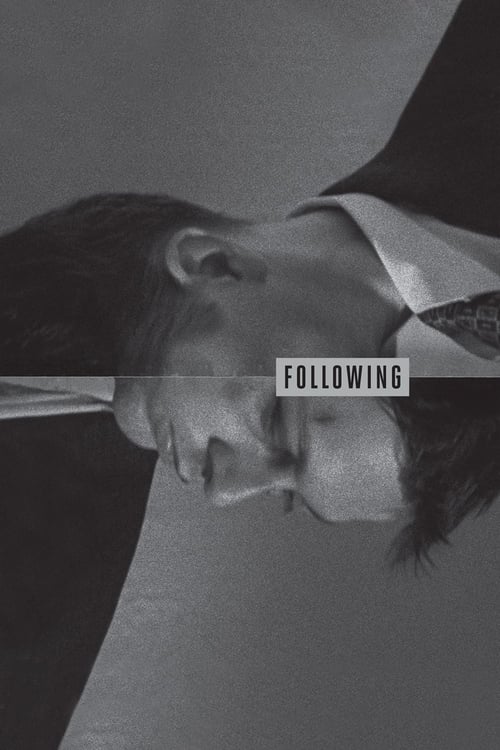
Following
1999 · Christopher Nolan
For a late night when you want something short, sharp, and clever — a film to actively solve rather than passively watch. It's a challenge, not a comfort, best when your brain wants a workout.
What it's about
Bill, a lonely, unemployed would-be writer in London, starts following strangers through the streets — harmless curiosity, he tells himself, research for his fiction. Then one of his targets turns the tables: Cobb, a charismatic burglar who breaks into flats to pry open other people's lives, takes Bill on as a pupil. What begins as a game becomes a trap that closes with terrible precision.
The experience
Cold, compact, and puzzle-like — the story is told out of order, so you're piecing together what happened even as it happens, and the dread builds from how neatly everything clicks into place. At barely seventy minutes it's over fast but lingers like a con you didn't see coming.
The craft
Christopher Nolan shot this on grainy black-and-white 16mm over a year of weekends with a crew of friends and almost no money, and the constraint becomes style: shadowy, stripped-down, noir to the bone. The fractured chronology isn't a gimmick — it's the trap itself, engineered so each revelation rewrites what you thought you knew. Proof of how much film you can make with how little.
Why it matters
The calling card that launched Nolan's career, and a touchstone for no-budget filmmaking — nearly every obsession of his later work is already here in miniature.
Snapshot
Following is Christopher Nolan's debut feature: a 70-minute black-and-white neo-noir shot on 16mm in London, on weekends, over the better part of a year, by a crew of friends with day jobs and almost no money. Its premise is a moral trap disguised as a hobby. A solitary, unemployed would-be writer who calls himself Bill begins shadowing strangers through the city as a cure for his own emptiness, telling himself it is research, a way of touching lives he cannot otherwise reach. The habit draws the attention of Cobb, a soft-spoken burglar who breaks into flats less for profit than to rearrange the lives of their owners — and who proceeds to recruit, school, and ultimately frame his eager pupil. Compact, cold, and ruthlessly engineered, the film is both a calling card and a thesis statement: nearly every preoccupation of Nolan's later career — fractured chronology, the unreliability of what we are shown, the con as narrative architecture, identity as a thing that can be assembled and stolen — is already present here in miniature.
Industry & production
Following is one of the canonical examples of no-budget independent filmmaking succeeding as a career launch. The production constraints were severe and they shaped the film at every level. Nolan and his collaborators had ordinary jobs, so shooting took place on Saturdays across roughly a year, in real flats and on real London streets, with available locations standing in for the script's interiors — Nolan has often described using friends' homes and his own. The budget is frequently cited at around £3,000 (a few thousand pounds), though exact figures vary between tellings and should be treated as approximate rather than audited; the essential point is that the money was negligible by any professional standard.
To survive that economy, Nolan inverted the normal relationship between rehearsal and shooting. Because film stock and processing were the real costs, scenes were rehearsed exhaustively in advance so that each setup could be captured in only two or three takes, with lighting kept to what was practical and portable. The discipline this imposed — knowing precisely what each shot needed to accomplish before the camera rolled — is visible in the film's economy.
The film premiered on the festival circuit in 1998 (its early high-profile screening was at the San Francisco International Film Festival), with wider release following into 1999; in the United States it was eventually distributed by Zeitgeist Films. It did not make money in any conventional sense, but it did what a debut of this kind is meant to do: it demonstrated, on screen, a controlling intelligence capable of building a watertight narrative machine. On that evidence Nolan secured the financing for Memento (2000), and the rest of the trajectory is well documented.
Technology
The film was shot on 16mm black-and-white stock, the most economical professional format available, with the grain and contrast that implies. The decision was as much aesthetic as financial: monochrome flattered the limited lighting, hid the seams of guerrilla production, and aligned the film with the noir tradition it was consciously inheriting. Image capture was largely handheld and naturalistic, leaning on available and practical light rather than elaborate rigs. In the conditions of late-1990s independent production — before consumer digital cinematography had matured — 16mm was the natural choice for a filmmaker who wanted a "real film" look without studio resources. The technological story of Following is therefore one of constraint converted into identity: the format is inseparable from the movie's texture.
Technique
Cinematography
Nolan served as his own cinematographer, and the camerawork reflects both necessity and instinct. The handheld 16mm photography keeps the camera close to bodies and faces in cramped interiors, and out among genuine London crowds in the following sequences, lending the surveillance scenes a documentary furtiveness — we watch the watcher at the watcher's own distance. The black-and-white palette is high-contrast and unglamorous, full of gray daylight and pooled shadow, situating the film in the visual grammar of classic noir while remaining recognizably contemporary and low-rent. Compositions favour confinement: doorways, windows, the interiors of strangers' flats that Cobb violates with proprietary calm. The look is not showy, but it is purposeful, and it disguises the absence of money rather than advertising it.
Editing
Editing is where Following announces the Nolan to come. The film is built on a deliberately fractured chronology, intercutting at least three distinct time strands so that the audience must continually reassemble cause and effect. Crucially, the disordering is not decorative: it is the film's engine of suspense and its instrument of misdirection, withholding the logic of the con until the structure itself springs the trap. Nolan gives the viewer visual anchors to navigate the timelines — most famously the changing state of the protagonist, who at different points is scruffy and unkempt or clean-cut and battered, so that grooming and injury become a clock. This braided construction prefigures the reverse-and-forward architecture of Memento directly, and establishes editing-as-storytelling as the central Nolan signature. (The cutting is credited to Nolan with a collaborator; he was the decisive shaping hand.)
Mise-en-scène / staging
The film's world is one of borrowed and invaded spaces. Cobb's burglaries turn other people's flats into stages on which he performs a perverse pedagogy, handling intimate objects — photographs, underwear, correspondence — to read the absent owners like texts. Production design was effectively whatever the real locations provided, but Nolan stages within them with control, using the clutter of lived-in rooms as evidence and the bareness of the protagonist's own existence as contrast. The most cited deliberate detail is a Batman logo affixed to a door in the film — a knowing wink, in retrospect almost uncanny, from a director who would later define the modern Batman. Staging throughout privileges watching, handling, and intrusion: the choreography of people moving through spaces that are not theirs.
Sound
David Julyan composed the score — the beginning of a long working relationship that continued through Memento, Insomnia, and The Prestige. The music is spare and tense, suited to the film's miniaturist scale, supplying unease without underlining it. Sound design is correspondingly modest and naturalistic, foregrounding the ambient noise of the city during the following sequences and the small domestic sounds of break-ins. The aural world matches the visual one: stripped down, close, and slightly clinical.
Performance
The cast were largely non-professional or near-professional collaborators, and the performances are pitched to the film's chilly register. Jeremy Theobald plays the protagonist — the credited "Young Man," who gives his name as Bill — as a passive, faintly pathetic figure whose loneliness reads as both sympathetic and culpable; his very pliability is the hook the plot hangs on. Alex Haw is the film's standout as Cobb, all reasonable menace and seductive articulacy, a manipulator who explains himself so plausibly that we, like the protagonist, are slow to see the manipulation. Lucy Russell plays the Blonde, the noir woman whose role in the design is part of the film's late revelations. John Nolan, the director's uncle, appears as a police detective. The acting is functional rather than virtuosic, but it is well-judged for material that depends on withholding rather than display.
Narrative & dramatic mode
Following is a noir of entrapment told as a puzzle. Its dramatic mode is retrospective and ironic: the fractured timeline means we are frequently watching consequences before causes, so that the pleasure and the dread come from assembling the shape of a scheme we sense but cannot yet see. The protagonist narrates and rationalizes — he is a writer, after all, forever framing his own behavior as material — and the film quietly indicts that self-justifying voice. The mode is confessional and unreliable at once: a story told by a man who has been authored by someone else and does not realize it until too late. Where the film could have rested on shock, it instead derives its force from structure, making the act of understanding the plot indistinguishable from the experience of being conned.
Genre & cycle
The film sits squarely in neo-noir, drawing on the cycle's perennial furniture: the drifting, weak-willed man; the burglary; the femme fatale; the frame-up; the city as moral labyrinth. It belongs to a late-1990s wave of low-budget, structurally ambitious independent thrillers that used non-linear storytelling as both an artistic and a marketing distinction — films that competed on cleverness because they could not compete on spectacle. Within Nolan's own filmography it inaugurates a recurring genre, the heist/con narrative whose real subject is its own construction, later elaborated in Memento, The Prestige, and Inception. Following is the lean, monochrome ancestor of all of them.
Authorship & method
Following is an unusually pure case of single authorship: Nolan wrote, directed, photographed, edited, and produced it, financing it himself and working with a tiny, loyal company of collaborators. The method — total rehearsal, minimal takes, weekend-by-weekend accumulation over a year — was dictated by poverty but reveals the temperament. This is a filmmaker who plans on paper, controls structure obsessively, and treats narrative order as the primary creative variable. The key collaborators who would recur are visible here in embryo: composer David Julyan, and the actor Jeremy Theobald, who would reappear in a small role in Batman Begins. Behind the camera and at the editing bench, though, the film is overwhelmingly one person's: a debut that functions as a controlled experiment in everything its maker would later do at scale. The continuity of concerns from this £-few-thousand short feature to nine-figure studio productions is among the clearest authorial throughlines in contemporary cinema.
Movement / national cinema
The film is a product of British independent cinema at the close of the 1990s, but it is only loosely a "British film" in the social-realist sense that dominated the country's output. It uses London as anonymous urban texture rather than as a subject, and its affinities are more with international noir and puzzle-narrative cinema than with any home-grown movement. It belongs to the broader late-1990s international independent moment — the era of Pi, The Usual Suspects' afterlife, and Tarantino-influenced chronological play — in which formally daring, low-budget thrillers found festival and arthouse audiences. Nolan's subsequent move to American studio production means Following reads now as the British prologue to a transatlantic career rather than as a contribution to a national school.
Era / period
Made and released at the very end of the 1990s, Following is a film of the threshold between analog and digital independent production, and of a cultural moment fascinated by unreliable narration and reordered time. It arrives just before the puzzle film became a mainstream commercial mode — a shift that Memento, Fight Club, and Mulholland Drive would consolidate at the turn of the millennium. Its monochrome 16mm aesthetic places it in a still-photochemical era, while its narrative ambitions point toward the structurally complex cinema that would define the 2000s. It is, in period terms, a hinge.
Themes
The film's central theme is voyeurism and the hunger for connection that curdles into intrusion. Bill follows strangers to feel proximate to lives, and Cobb burgles homes to know and to manipulate their owners; both are forms of looking that refuse the reciprocity of actually being known. Surveillance and anonymity in the modern city are figured as conditions that make such predation possible. Closely related is the theme of authorship and control: Bill imagines himself the author of his observations, only to discover he is a character in someone else's plot — a metaphor for narrative itself, and for the way the film authors its own audience's understanding. Identity emerges as something performed and stealable: Cobb teaches that breaking into a home is a way of trying on a self, and the plot's mechanics turn on the transfer and falsification of identity. Manipulation, complicity, and the seductiveness of a persuasive explanation run beneath it all — the film implicates the viewer's own willingness to be led. These are the themes Nolan would return to repeatedly, but they are stated here with unusual nakedness.
Reception, canon & influence
On release Following was a small film that earned respect rather than wide attention; with limited distribution it was reviewed positively in the independent and critical press, which singled out its structural ingenuity and its remarkable economy of means. Its reputation has grown substantially in retrospect, almost entirely through the lens of what its director did next: it is now routinely studied and revisited as the seed of Nolan's cinema, the place where his methods and obsessions first appear whole. The Criterion Collection's later release of the film canonized that status, presenting it as a significant debut rather than a curio.
Looking backward, the film's influences are legible and consciously worn. It draws on the classical film-noir tradition — the patsy, the fatale, the frame — and on the Hitchcockian thriller of ordinary men drawn into criminal designs, with the voyeurism of Rear Window an obvious antecedent for its watching protagonist. Its appetite for reordered, puzzle-box storytelling situates it alongside the broader 1990s vogue for non-linear narrative. The literary cast of its concerns — identity, doubling, the reader implicated in the text — has invited comparison with that tradition, though such affinities are atmospheric rather than documented borrowings, and are best stated as resonance rather than source.
Looking forward, the film's influence is concentrated and decisive. Most immediately it shaped Nolan's own work: Following is the direct rehearsal for Memento, sharing its fractured chronology, its unreliable male protagonist, its con-as-structure, and its composer, and through Memento it altered the commercial prospects of non-linear storytelling in the 2000s. More broadly it became a textbook example for aspiring filmmakers of how a structurally sophisticated feature could be made for almost nothing — an argument, repeated in countless retrospectives and film-school discussions, that ambition of construction can outrun budget. Its largest legacy is therefore double: as the origin point of one of the era's defining directorial careers, and as a durable proof of concept for resourceful independent cinema.
A Deleuzian reading
A man stands in a London crowd and picks a back to follow.
The full Deleuzian reading of Following →
Reception
A blip on the late-90s festival circuit that almost nobody saw on release, it's since been retro-canonised as the ultimate 'before they were famous' debut — every Nolan blockbuster sends a new wave of viewers back to it.
How Following was received, from release to now →
Influences: the films it descends from and the films it influenced
- Rear Window (1954) — Builds suspense entirely from a protagonist who watches others' lives through windows, the voyeur-as-investigator structure Nolan transplants into the Young Man's compulsive shadowing of strangers.
- Strangers on a Train (1951) — The template of an ordinary man maneuvered into a criminal's design through a charming double who scripts his actions — the Cobb/Bill manipulation reproduces this seductive-accomplice dynamic.
- Double Indemnity (1944) — Establishes the noir patsy narrated in retrospect through a confessional frame whose ordering the audience trusts and is betrayed by — the unreliable backward-told account Following weaponizes structurally.
- Detour (1945) — Proves a fatalist noir can be shot in days for pocket change with a doomed narrator whose telling can't be trusted — the poverty-row economy-of-means model Following revives at feature scale.
- Pickpocket (1959) — Renders theft as a tactile, near-documentary procedural performed by non-professional actors, the hands-on burglary craft and flat amateur playing Following echoes in Cobb's tutorials.
- Breathless (1960) — Demonstrates a noir homage shot handheld on the street with available light and elliptical cutting, the low-fi guerrilla aesthetic and jump-cut discontinuity Nolan adopts in monochrome.
- The Killing (1956) — Pioneers shattering a crime's chronology into reordered overlapping fragments so the audience reassembles the heist — the fractured-timeline architecture Following and Memento inherit.
- Peeping Tom (1960) — Makes the act of watching itself the crime and implicates the spectator in the voyeur's gaze, the moral entrapment of looking that underwrites Following's surveillance premise.
- Blood Simple (1985) — Nolan's £6,000 debut inherits Blood Simple's proof that budget restriction converted into formal constraint becomes style: the systematic information-withholding across a fractured chronology, the structural revelation that reframes everything the audience believed it understood, and the low-budget-as-aesthetic-choice all descend directly from the Coens' independent financing model and editing grammar.
- Memento (2000) — The direct sequel-in-method: same fractured chronology, same unreliable male protagonist conned by structure, same composer David Julyan — Following's experiment scaled into a feature-length puzzle.
- The Prestige (2006) — Extends Following's con-as-structure into the magician's pledge-turn-prestige, building the film's form around misdirection and doubling so the narrative itself performs the trick on the viewer.
- Primer (2004) — Carries forward Following's proof-of-concept argument — a structurally dense puzzle feature written, shot, edited and scored by one person for almost nothing.
- Brick (2005) — A debut that transplants classical noir's patsy, fatale and frame into a new setting through an outsider auteur, extending Following's self-conscious genre-archaeology approach to neo-noir.
- The Usual Suspects (1995) — Constructs an entire plot as a con narrated by an unreliable witness whose retrospective account is revealed as a fabricated frame — the same patsy-built-from-fragments reveal Following deploys.
- Pi (1998) — A contemporaneous micro-budget debut shot high-contrast black-and-white and handheld by a single controlling auteur, sharing the grainy 16mm paranoia and DIY puzzle-film ethos.
- Lost Highway (1997) — Fractures chronology around identity-doubling and a protagonist who slips into another's life, the splintered-time-plus-unstable-self construction Following renders in miniature.
- El Mariachi (1992) — The canonical near-zero-budget genre debut made by one resourceful filmmaker, the proof that ambition of construction outruns budget that Following became the British art-house counterpart to.
Similar films
- Peeping Tom (1960) — influence & lineage · same viewing thread
- Memento (2000) — influence & lineage
- Pickpocket (1959) — influence & lineage
- The Killing (1956) — influence & lineage
- The Usual Suspects (1995) — influence & lineage
- Pi (1998) — influence & lineage · often watched together
- Batman Begins (2005) — shared sensibility
- Insomnia (1997) — shared sensibility
All the films related to Following →
Watch it with: curated runs of related films
- The Long Shadow of M — A run from Lang's Weimar crime films through their noir and neo-noir children — killers, con men, masterminds, and manhunts — where you can watch expressionist menace mutate step by step into the modern thriller.