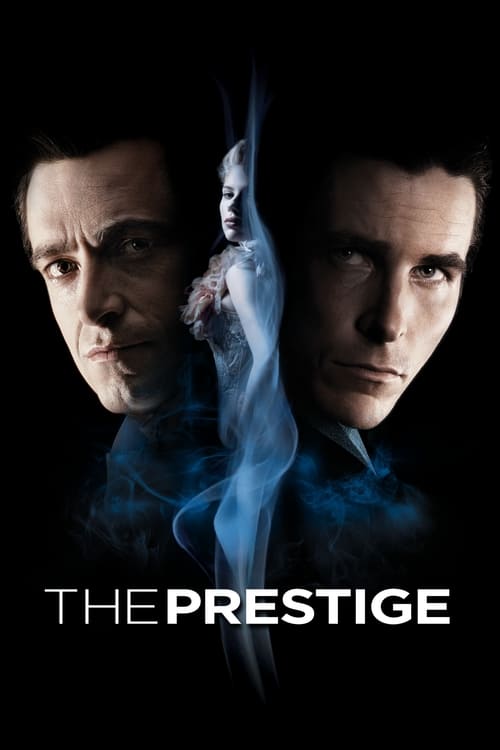
The Prestige
2006 · Christopher Nolan
For when you want to be outsmarted — a night where you lean forward, trade theories at the pause button, and argue about it on the walk afterward. Engaging rather than heavy, but it lingers.
What it's about
In late-Victorian London, two stage magicians — Angier, the polished showman, and Borden, the instinctive craftsman — turn a professional rivalry into a lifelong war of sabotage, stolen secrets, and one-upmanship. Each becomes obsessed with the other's greatest trick, and each is willing to give up far more than he should to win. The story unfolds through their diaries, each man reading the other's, so you're never quite sure who's fooling whom.
The experience
A puzzle box that plays completely fair and still gets you — twisty, propulsive, and darker than you expect, with an obsessive streak that turns from fun to genuinely chilling. It practically demands an immediate second viewing.
Performances
Christian Bale and Hugh Jackman are perfectly matched opposites — Bale all coiled, working-class cunning, Jackman all wounded showmanship — with Michael Caine as the steady voice explaining the rules of the game, and David Bowie in an inspired turn as the inventor Nikola Tesla.
The craft
Nolan structures the whole film like a magic trick, with the editing itself doing the misdirection: three interlocking timelines that only click into place at the end. The period detail is rich without being fussy, and the mechanics of stagecraft — trapdoors, doubles, machinery — are shot with real fascination.
Why it matters
Made between Nolan's Batman films, it has steadily climbed in reputation to become many people's favorite of his career, and it set the modern standard for the rewatchable puzzle film whose twist is also its theme.
Snapshot
A nested-diary psychological thriller set in the competitive world of late-Victorian stage magic, The Prestige follows two rival illusionists — the showman Robert Angier (Hugh Jackman) and the instinctive craftsman Alfred Borden (Christian Bale) — whose mutual obsession escalates from professional antagonism to violence, sacrifice, and, finally, a science-fictional abyss. Adapted from Christopher Priest's 1995 World Fantasy Award-winning novel, the film is structured as a layered act of misdirection: its narrative architecture mirrors the three stages of a stage illusion described in its own opening monologue. One of Christopher Nolan's most formally controlled works, it sits at the intersection of period melodrama, puzzle-film, and Gothic horror — and has grown substantially in critical standing in the two decades since its release.
Industry & production
The Prestige was produced by Christopher Nolan and Emma Thomas through their Syncopy banner in partnership with Touchstone Pictures (a Disney label), with Warner Bros. handling international distribution — a bifurcated arrangement that reflected Nolan's newly elevated standing after Batman Begins (2005). That film's commercial success granted Nolan unusual creative latitude for what was, by blockbuster standards, a relatively modestly budgeted project (reported figures place it around $40 million). The film's mid-tier commercial performance — worldwide receipts in the region of $109 million — was considered respectable given its period setting, non-linear complexity, and adult subject matter, though it did not approach the commercial heights of Nolan's franchise work.
Nolan chose The Prestige as his palate-cleanser between the first and second entries in the Dark Knight trilogy precisely because it allowed him to pursue structural obsessions — unreliable narration, nested temporality, the epistemology of perspective — outside the demands of franchise continuity. The casting reflects the same transatlantic star ecosystem Nolan was consolidating: Jackman and Bale, both emerging A-list figures; Michael Caine, by now a fixture in Nolan's company; Scarlett Johansson in a supporting role; Rebecca Hall in her notable film debut; and the conceptually audacious casting of David Bowie as Nikola Tesla, a choice that blurred the boundaries between icon and historical figure in ways that proved unexpectedly resonant.
Jonathan Nolan, Christopher's brother and long-time collaborator, co-wrote the screenplay. The two Nolans departed meaningfully from Priest's source novel, which frames the narrative through the contemporary descendants of the two magicians — a gothic-genealogical device the film excises entirely, collapsing the story into a purely Victorian register and allowing the trick-within-a-trick structure to work more efficiently.
Technology
The Prestige was shot on 35mm photochemical film at a time when digital acquisition was rapidly encroaching on mainstream production. Nolan and cinematographer Wally Pfister were committed film partisans, and their choice here was both aesthetic and philosophical — film grain and optical fallibility suited the visual world of Victorian London and reinforced a thematic preoccupation with the limits of what the eye can verify.
Tesla's "teleportation machine," the film's science-fictional hinge, required minimal special-effects intervention; the cloning conceit is revealed almost entirely through editing and performance rather than visual effects spectacle. This restraint was deliberate, pushing the film toward classical illusionism in both its subject matter and its methods. The lightning sequences at Tesla's Colorado laboratory — produced practically with arc-discharge equipment — were among the more technically demanding sequences and underscore the film's interest in electricity as both Victorian spectacle and actual scientific force. Colorado Springs is correctly identified in the film as the site of Tesla's experimental station (active 1899–1900), which lends the science-fiction substrate a genuine historical anchor.
Technique
Cinematography
Wally Pfister shot The Prestige in 2.39:1 anamorphic widescreen, a format whose horizontal expanse suits both the theatrical spaces of the stage and the compositional logic of concealment — wide frames that contain information the audience is trained not to notice. Pfister's palette for the Victorian London sequences is predominantly cool and desaturated: a world of slate, soot, and gaslight that evokes period illustration and distances the film from the warmer romanticism of conventional costume drama. The Colorado sequences shift register subtly, introducing an eerie, phosphorescent quality around Tesla's electrical apparatus — a visual syntax borrowed from Expressionist horror that signals the film's entry into uncanny territory.
Pfister received Academy Award nominations for cinematography on several Nolan films during this period; The Prestige itself received Oscar nominations for Cinematography and Art Direction, recognizing the visual coherence of its period construction. High-contrast lighting within the theater sequences mimics the raking, dramatic illumination of actual late-Victorian stage magic, rooting performance spectacle in documentary plausibility.
Editing
Lee Smith, Nolan's editor from Batman Begins onward, had to manage one of the more architecturally demanding cuts in the director's filmography. The film operates across at least three temporal layers simultaneously: Angier reading Borden's notebook, Borden reading Angier's notebook, and the dramatized "present" of their rivalry — all of which fold into one another as the narrative progresses and each reader's knowledge changes the meaning of what we see. Smith's approach is lapidary rather than aggressive: the film's editing tempo is generally unhurried, trusting the cognitive load of following competing unreliable narrators without bombarding the viewer with rapid cuts. The intercutting accelerates only at specific revelatory moments, using pace as an emotional register rather than a default mode. The structural device of labeling the film's three movements ("The Pledge," "The Turn," "The Prestige") is rendered visually and editorially, organizing viewer expectations around a known dramatic grammar — then exploiting that grammar's false comfort.
Mise-en-scène / staging
Nathan Crowley's production design achieves a Victorian London that functions as both period reconstruction and psychological landscape: the theaters are cramped, velvet-draped spaces in which illusion is manufactured under conditions of intimacy, making deception a fundamentally social act. Angier's more opulent stagings, as his wealth and desperation increase, are contrasted with Borden's sparer, more technically rigorous performances — a spatial argument about showmanship versus craft that the film never has to make explicitly. Tesla's Colorado compound, rendered as a semi-ruined, snow-blanched laboratory on a high mesa, carries Gothic-Romantic overtones: the scientist-as-sorcerer working at the edge of civilization. Crowley's sets consistently code space as moral condition.
The staging of the magic acts themselves required genuine consultation with professional illusionists and historians of conjuring. The acts are presented with enough procedural specificity that their internal logic holds, which is essential for the film's climax to function — the audience must believe that what Borden performs is physically possible by human means, not supernatural ones.
Sound
David Julyan's score for The Prestige — his last major collaboration with Nolan before Hans Zimmer assumed the role from The Dark Knight — is characterized by restraint and industrial texture. Julyan, who had scored Memento (2000), Insomnia (2002), and Batman Begins (2005) for the director, works here in a predominantly minimalist register: low drones, mechanical rhythmic patterns, and sparse piano lines that evoke mechanism and ritual without announcing their emotional intentions. The sound design in the Tesla sequences uses electrical hum and static discharge as both realistic atmosphere and heightened dramatic punctuation. The theatrical performances are rendered with the ambient acoustics of period auditoriums — the rustle and murmur of crowds, the hollow resonance of large enclosed spaces — grounding spectacle in communal experience.
Performance
The film's central performances are calibrated as mirror inversions. Jackman plays Angier with a performer's extroversion — charisma as a form of concealment, charm as controlled self-erasure — while Bale embeds Borden's laconic opacity in a physical stillness that retrospectively reconstitutes its meaning entirely. Both performances are required to sustain deliberate audience misdirection; both are also required to make that misdirection feel, in retrospect, entirely fair. Michael Caine's Cutter functions as the audience's surrogate — his exposition-heavy opening monologue is the film's boldest risk and its most functional narrative mechanism. Bowie's Tesla is played with a formal, slightly inhuman dignity that aligns the historical figure with his mythological status, and the casting implicitly connects two kinds of stage performance — concert rock spectacle and Victorian magic — in ways that resonate beyond mere stunt.
Narrative & dramatic mode
The Prestige belongs to the tradition of the epistemically aggressive puzzle narrative: films that withhold, distort, or fragment information not for mere suspense but to interrogate the reliability of first-person perspective itself. The dual-diary structure positions both protagonists as narrators who understand themselves as deceived but are simultaneously, and without acknowledgment, deceiving the reader — a condition the film maps onto its central argument about performance. The magic trick becomes a meta-commentary on cinematic narration: cinema, like conjuring, is predicated on managing the audience's attention, directing it toward what is meant to be seen and away from what is meant to be hidden.
The science-fictional revelation — that Angier has been using a Tesla machine to generate duplicate selves — activates a retrospective re-reading of the entire film, but crucially the film has prepared for this re-reading without cheating: all the information is present in the text. This narrative fairness distinguishes it from the pure "twist" film and aligns it with the detective story tradition, in which the solution must be derivable from available evidence. Priest's novel handles these revelations differently and less cleanly; the Nolans' compression and restructuring arguably improves on the source in this specific respect.
Genre & cycle
The Prestige arrived in 2006 alongside The Illusionist (dir. Neil Burger), a coincidence of production timing that generated considerable press comparison. The two films share a period magic-show setting and a mystery structure but diverge sharply in tone and ambition: Burger's film is relatively conventionally romantic, while Nolan's is Gothic, obsessional, and structurally radical. The near-simultaneous release belongs to no coordinated cycle but reflects a period interest in Victorian and Edwardian stagecraft as a setting for narratives about illusion and identity.
More meaningfully, The Prestige sits within the puzzle-film cycle that defined much of prestige American cinema in the decade following The Sixth Sense (1999) and Memento (2000): films including Mulholland Drive (2001), The Others (2001), Eternal Sunshine of the Spotless Mind (2004), and Caché (2005) that trained a generation of cinephile audiences in active, suspicious viewership. The Prestige both participates in and self-consciously theorizes this mode — its opening monologue about the three acts of a magic trick doubles as a description of how such films work.
It also engages with a longer Gothic tradition: the Faustian bargain narrative in which the pursuit of mastery destroys the self (Bale's Borden sacrifices his domestic life and, effectively, his identity; Jackman's Angier sacrifices his very selfhood to the machine). Shelley, Stevenson, and Wilde are informing presences — the doubling motifs connect to The Strange Case of Dr Jekyll and Mr Hyde and The Picture of Dorian Gray — though Nolan does not dwell on these connections explicitly.
Authorship & method
By 2006, Christopher Nolan had established a coherent directorial signature: structurally fractured narratives, characters whose cognition or memory is compromised in ways that generate dramatic irony, a visual rhetoric that favors practical production over digital elaboration, and a consistent thematic focus on self-deception and its costs. The Prestige consolidates rather than expands these tendencies, applying the lessons of Memento — competing subjective accounts, information withheld as a narrative device — to a more conventionally accessible period story.
His collaboration with Wally Pfister, spanning Memento through Inception (2010), was one of the defining director-cinematographer partnerships of the era: photochemical, widescreen, with a strong preference for natural and practical light sources that lend even fantastical sequences an empirical weight. Lee Smith's editing complements Nolan's structural ambitions without subjugating to them; the films breathe more than their complex architecture might suggest. Jonathan Nolan's contribution as co-writer is frequently underestimated: his facility with puzzle structure and his comfort with science-fictional conceits (later extended through his work on Westworld) are visible throughout.
David Julyan's minimalist scoring gave Nolan's first five films a consistent sonic texture; the shift to Zimmer and Howard for Batman Begins (in the end Julyan also scored that film) and then fully to Zimmer from The Dark Knight represents a meaningful inflection toward a more maximalist, emotionally directive musical language that The Prestige does not employ.
Movement / national cinema
Nolan occupies a distinctive position as a British-born director who has worked primarily within the American studio system while maintaining creative and production autonomy unusual for his budget tier. The Prestige is a British-American co-production set in Britain and the American West, filmed partly in England and partly on American locations standing in for period Colorado. In this sense it is neither straightforwardly a British film nor a straightforwardly Hollywood product — it engages with British cultural material (Victorian stagecraft, the London theater world, Priest's British novel) while operating within American commercial infrastructure.
There is a lineage traceable to British literary adaptation and the Merchant Ivory tradition of the prestige period film, but Nolan's structural radicalism and genre restlessness place him at considerable distance from that tradition. He might more usefully be contextualized within a generation of British directors — including Ridley Scott, Paul Greengrass, Sam Mendes — who have worked primarily in the American mainstream while inflecting it with sensibilities formed elsewhere.
Era / period
The Prestige is a product of the mid-2000s moment in Hollywood in which the "smart blockbuster" was an identifiable commercial category: films that made significant structural or thematic demands on their audiences while retaining the production values and star power of mainstream entertainment. This category — which includes Eternal Sunshine of the Spotless Mind, Babel, Children of Men, and Nolan's own Batman Begins and subsequent work — was predicated on the emergence of an audience formed by DVD culture, internet criticism, and the decade's renovation of the prestige film concept.
The film is also a product of a specific stage in Nolan's career: the window of absolute creative freedom that followed a commercial success (Batman Begins) and preceded a franchise commitment (The Dark Knight). That interstitial positioning explains some of its formal ambition — it is a film made by a director who knows his next project will be watched by tens of millions of people and is working, temporarily, without that constraint.
Themes
The film's governing theme is the cost of total commitment to a performance. Both Angier and Borden sacrifice their authentic selves — their names, their bodies, their domestic relationships — to the maintenance of an illusion; the film argues, ultimately, that the perfect magic trick requires the permanent disappearance of the self who performs it. Borden's secret (he is, in fact, twin brothers Alfred and Fallon who have shared one identity across their entire careers) figures this as a condition of absolute discipline: the illusion consumes the man. Angier's solution (duplicating himself via Tesla's machine and drowning one copy per performance) is its grotesque mirror: the illusion consumes the body.
Obsession, rivalry, and the mirror-logic of antagonism are central: Angier and Borden are less opponents than doubles, each constituted by the other's existence, each unable to exist without the enmity that defines them. This doubling extends to the film's formal structure — two competing narrators, two versions of events, two conclusions that must be read against each other. The question the film finally poses is whether the audience, too, is complicit in demanding the kind of spectacle that requires this level of sacrifice — a question it poses with its final image of the drowned duplicate Angiers floating in glass tanks, a warehouse of discarded selves.
Reception, canon & influence
Critical reception. The Prestige was received positively on release, with substantial praise for its performances, structural ingenuity, and period design. Roger Ebert awarded it three and a half stars. The science-fiction dimension of the third act generated some resistance among critics who found the genre shift destabilizing, though defenders argued — convincingly, in the longer critical record — that the film had prepared for this turn from its opening frames. In the years since, the film has moved into the upper tier of Nolan's canon and is widely taught as an exemplary instance of unreliable-narrator cinema.
Influences on the film (backward). The primary literary source is Priest's novel, which itself draws on Victorian sensation fiction and the documented competitive world of late-nineteenth-century stage magicians. Narratologically, Citizen Kane (Welles, 1941) underwrites the competing-perspectives structure; Vertigo (Hitchcock, 1958) informs the film's treatment of obsession and constructed female identity. Nolan's own Memento is the immediate formal predecessor in the use of competing subjective accounts and information management. The Faustian-bargain tradition of British Gothic literature — Shelley's Frankenstein is the Tesla scenes' most obvious literary correlative — is a consistent background presence.
Legacy and forward influence. The Prestige contributed to the consolidation of the puzzle-film as a mainstream viable form, and its structural approach to magic-trick plotting — using the three-act trick as a meta-commentary on narrative itself — has been widely imitated. Nolan's subsequent films (Inception, Interstellar, Tenet, Oppenheimer) all extend the film's structural and thematic preoccupations in different directions, and The Prestige reads retrospectively as the clearest statement of his mature aesthetic: the film as mechanism, the audience as deceived participant who consents to and desires that deception. Jonathan Nolan's subsequent television work, particularly Westworld (2016–), extends the twin themes of duplicate identity and the ethics of performance into a new medium. The film's influence on the "neo-Victorian" strand of prestige genre fiction — fiction and film interested in late-Victorian spectacle, technology, and epistemological crisis — is diffuse but traceable.
A Deleuzian reading
Start with the image everyone keeps: a field of black top hats in the Colorado snow, each one identical, each one true.
The full Deleuzian reading of The Prestige →
Reception
In 2006 it was received as a solid mid-tier Nolan — respectable reviews, modest box office, and endless lazy comparisons to The Illusionist, which opened the same year. Two decades on it's routinely called his most rewatchable and, by a vocal contingent, his outright best.
How The Prestige was received, from release to now →
Influences: the films it descends from and the films it influenced
- The Cabinet of Dr. Caligari (1920) — Wiene invents the unreliable-narrator twist ending — the entire narrative revealed as a madman's delusion — establishing the formal mechanism of retrospective reframing that The Prestige's nested-diary structure inherits; the carnival showman as Gothic agent of horror is the template for both Angier and Borden.
- Citizen Kane (1941) — Welles and Toland's nested testimonial architecture — incompatible witnesses reconstructing a single figure through documents and flashbacks — is the direct structural template for Nolan's diary-within-diary conceit, including the Expressionist high-contrast chiaroscuro Pfister channels for the Victorian theater sequences.
- Les Diaboliques (1955) — Clouzot's twist finale — apparent antagonists revealed as secret collaborators who staged the entire plot — is the precise narrative mechanism The Prestige inherits; the Gothic domestic horror and the shock of rereading all prior events as concealed conspiracy are structurally identical.
- Vertigo (1958) — Hitchcock and editor George Tomasini's technique of withholding visual information the camera ostensibly showed, then retroactively restructuring meaning through a mid-film reveal, is the exact editorial logic of The Prestige's twist; Kim Novak's dual Madeleine/Judy role is the direct template for mirror-inversion performance.
- Sleuth (1972) — Mankiewicz's two-hander chamber film stages identity deception as theatrical combat — costume, disguise, and performance as moral weapons between antagonists in a closed space — and its twist that an apparent stranger was a concealed figure all along directly anticipates The Prestige's dramatic architecture.
- Barry Lyndon (1975) — Kubrick and John Alcott's radically desaturated, candlelit period palette — achieved through modified Zeiss lenses and flashed negatives — establishes the anti-romantic period cinematography that Pfister refined for Victorian London; both films treat period photography as forensic observation rather than nostalgic illustration.
- McCabe & Mrs. Miller (1971) — Vilmos Zsigmond's gauze-diffused, flashed-negative period photography — deliberately desaturated and grained to approximate nineteenth-century photographic memory — is the direct technical forerunner of Pfister's Prestige palette; both films consciously refuse the warm romanticism of conventional costume drama.
- Dead Ringers (1988) — Cronenberg solved the formal problem of staging one actor as psychologically mirrored identical twins — through split-screen compositing, body doubles, and choreographed blocking — confronting precisely the camera-physics problem Nolan faces with Bale's hidden twin; the horror of doubled identity as mutual self-annihilation is the conceptual template.
- The Usual Suspects (1995) — Singer's retrospective unreliable narrator — whose testimony is revealed as constructed fiction, forcing the audience to reread all prior imagery as fabrication — is the specific mechanism The Prestige inherits; the device of a character narrating documents while dramatized events unfold that may be entirely false is structurally identical.
- Memento (2000) — The immediately preceding Nolan/Pfister/Julyan collaboration uses backward chronology as an epistemic device and David Julyan's sparse industrial score to model an unreliable narrator who cannot trust his own records — the formal laboratory from which The Prestige's nested-diary architecture and perceptual unreliability directly emerge.
- Insomnia (2002) — Nolan and Pfister carry the inversion-thriller structure — in which the protagonist's investigation of an antagonist reveals his own culpability — into a period magic-act setting; the flash-cut intrusion editing and the morally compromised unreliable narrator are both direct extensions of the Insomnia template.
- House of Games (1987) — Stages magic-as-misdirection as its very narrative structure, with Ricky-Jay-grade craft authenticity and the trick deliberately played on the viewer.
- Inception (2010) — Lee Smith and Pfister expand The Prestige's diary-within-diary nested temporal structure into dream-within-dream nested spatial architecture, the same editorial problem of cutting coherently between simultaneous time-streams at different ontological levels solved by the same team using the formal grammar first developed here.
- Black Swan (2010) — Aronofsky and Libatique stage the doubling of a performer's identity — White Swan vs. Black Swan — as psychological horror through mirror imagery and backstage surveillance, directly paralleling The Prestige's obsessive-craftsman vs. spectacular-showman opposition and its horror that the double may have been the protagonist all along.
- Shutter Island (2010) — Scorsese's Gothic institutional puzzle film deploys an unreliable narrator whose perception cannot be trusted and constructs a retrospective reveal that forces total rereading of prior events, sharing The Prestige's cold-desaturated forensic period palette and its staging of an enclosed moral theater in which identity is systematically dismantled.
- Maharaja (2024) — Uses parallel crosscutting to make the audience assume two strands are simultaneous when they are not, the precise editing deception behind Maharaja's concealed time-gap between the two robberies.
- Mulholland Drive (2001) — Lynch deploys identity doubling where two women may be fragments of the same consciousness, embedding a retroactive narrative restructuring — a second half that forces rereading of the first — within a story explicitly about performance and manufactured selfhood, the same structural logic The Prestige uses for its magician-twin reveal.
- Oldboy (2003) — Park's Gothic revenge architecture builds to a revelation that retroactively reconstitutes the protagonist's identity; the antagonist as concealed puppeteer whose entire plot was a staged trap — a mechanism of total narrative entrapment — is structurally analogous to The Prestige's Angier/Borden relationship.
- The Illusionist (2006) — Released the same year and occupying identical narrative territory — Victorian stage magic, a theatrical reveal that answers whether the supernatural is real or staged — The Illusionist is The Prestige's closest formal sibling, both films treating magic performance as a moral system and constructing third-act reveals through the same mechanics of audience misdirection.
- The Invisible Guest (2017) — Sibling in nested-retelling structure built on interlocking diaries and a substitution-of-identity twist, the same misdirection-as-architecture that Paulo's script treats like a magic trick.
Similar films
- The Illusionist (2006) — influence & lineage
- Inception (2010) — influence & lineage
- Memento (2000) — influence & lineage
- Sleuth (1972) — influence & lineage
- Vertigo (1958) — influence & lineage
- Barry Lyndon (1975) — influence & lineage
- Tenet (2020) — shared sensibility
- Birdman or (The Unexpected Virtue of Ignorance) (2014) — shared sensibility
All the films related to The Prestige →