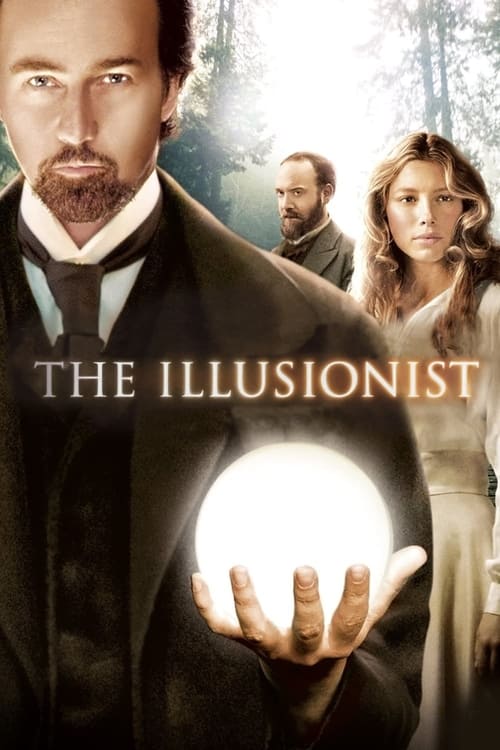
The Illusionist
2006 · Neil Burger
For a wintry night in when you want old-world romance with a puzzle inside it — comfort viewing that still keeps your brain switched on, and pays off if you like guessing.
What it's about
In turn-of-the-century Vienna, a stage magician named Eisenheim has become the talk of the city with illusions nobody can explain. When a command performance reunites him with Sophie, the aristocrat he loved as a boy before class pulled them apart, he sets out to win her back from her betrothed — the ambitious, dangerous Crown Prince Leopold. A shrewd police inspector, caught between serving the prince and his own fascination with the magician, starts pulling at the threads.
The experience
It plays like a slow, candlelit card trick — romantic and hushed, with a current of menace underneath. You spend the whole film trying to work out what's real and what's staged, and the pleasure is in not quite being able to.
Performances
Edward Norton plays Eisenheim with a stillness that makes you believe crowds would fall silent for him, while Paul Giamatti steals scenes as the inspector — a decent, curious man visibly torn between ambition and conscience. Rufus Sewell gives the crown prince real bite.
The craft
The film is built as an act of misdirection: the storytelling itself keeps its cards face-down, so form and subject rhyme. The burnished, sepia-toned photography makes Vienna look like an antique photograph come to life, and the stage illusions are shot to preserve their mystery rather than explain it. It's a handsome, atmospheric watch that rewards dim lights and full attention.
Why it matters
It arrived in a moment when period magician stories briefly captured the culture, and became a word-of-mouth hit that proved a modestly scaled adult mystery-romance could still find an audience.
Snapshot
The Illusionist is a turn-of-the-century romance and mystery built, fittingly, as an act of misdirection — a film whose form rhymes with its subject, dressing a tightly constructed deception in the burnished surfaces of fin-de-siècle Vienna. Adapted from Steven Millhauser's short story "Eisenheim the Illusionist," it follows a stage magician of obscure, possibly peasant origins (Edward Norton) whose reunion with the aristocratic Sophie (Jessica Biel), the childhood love from whom class had once separated him, places him on a collision course with her betrothed, the ambitious and brutal Crown Prince Leopold (Rufus Sewell). Caught between them is Chief Inspector Walter Uhl (Paul Giamatti), a policeman of bourgeois aspiration and genuine curiosity who serves the prince but cannot suppress his fascination with the magician's seemingly impossible feats. Released in 2006 — the same year as Christopher Nolan's The Prestige, with which it is perpetually paired — Neil Burger's second feature became an unexpected commercial success, buoyed by Dick Pope's Academy Award-nominated cinematography, a Philip Glass score, and a structure that withholds its true nature until a closing revelation recasts everything that preceded it. It is a film about the seductions of illusion that is itself, in the end, a confidence trick played on the audience as much as on the prince.
Industry & production
The Illusionist was an American independent production, made outside the major studio system and financed through Bull's Eye Entertainment and associated partners, with Edward Norton attached not only as star but as a producer — a degree of creative investment that shaped the project's development. The screenplay and direction were by Neil Burger, whose debut, the faux-documentary Interview with the Assassin (2002), had marked him as a filmmaker interested in the manipulation of evidence and the unreliability of the recorded image — preoccupations that find a period costume in this second feature. Burger adapted the script himself from Millhauser's story, expanding a spare literary conceit into a full romance-and-detection plot.
Production took place largely in the Czech Republic, with Prague and surrounding locations — including the town of Tábor and various Bohemian palaces and interiors — standing in for imperial Vienna and the Austro-Hungarian countryside. The choice was both economic and aesthetic: the Czech Republic offered a deep infrastructure for period filmmaking and a wealth of unspoiled Habsburg-era architecture, allowing a modestly budgeted film to command a convincing late-imperial grandeur. The film was distributed in the United States by Yari Film Group and opened in the late summer of 2006, expanding from a limited platform release on the strength of positive notices and word of mouth. By the standards of its budget it performed strongly at the box office, becoming one of the more profitable specialty releases of its year; precise figures are widely reported but I will refrain from citing exact totals here, noting only that its commercial outcome substantially exceeded expectations for a film of its scale and pedigree.
Technology
Made in the mid-2000s, The Illusionist sits at a transitional moment in motion-picture technology, and it negotiates that moment in a manner consistent with its themes. The film was photographed on 35mm, and its imagery is heavily inflected by photochemical and in-camera techniques that deliberately evoke the look of early photography and proto-cinema. Yet its central spectacle — Eisenheim's most celebrated illusions, above all the spectral apparitions of his late stage act — depends on digital visual effects, used to render manifestations that no nineteenth-century conjuror could have achieved and that the film withholds explanation for. The technological interest of the picture lies precisely in this layering: practical stage magic of the period (the orange tree that grows and fruits before the audience, the disappearing handkerchiefs) is supplemented by modern CGI, and the seam between the two is intentionally obscured, so that the viewer, like Uhl, cannot finally distinguish the mechanically possible from the apparently supernatural. The film thus uses contemporary effects technology not to display spectacle for its own sake but to reproduce, for a modern audience, the epistemological vertigo that Eisenheim's audiences are meant to feel.
Technique
Cinematography
The film's most lauded element is the cinematography of Dick Pope, the British director of photography long associated with Mike Leigh, whose work here earned an Academy Award nomination for Best Cinematography. Pope constructs a palette of deep ambers, sepias, and candlelit golds, with shadows that swallow the edges of the frame — a register drawn equally from the chiaroscuro of old master painting and from the warm, degraded tonality of early color and hand-tinted photographs. Most distinctively, the film makes recurrent use of the iris — the circular masking of the frame, irising in and out of scenes — together with soft vignetting and a slightly flickering, antiqued image quality that consciously imitates the silent cinema and the magic-lantern shows contemporaneous with the story's setting. This is a film about an illusionist set at the dawn of the cinema, and Pope's photography insists on that historical rhyme: the apparatus of early film is folded into the visual grammar, so that the medium itself becomes one more form of period magic. The camera is generally elegant and unhurried, favoring composed, painterly framings over restless movement, in keeping with the film's measured, fable-like tone.
Editing
The editing, credited to Naomi Geraghty, serves a narrative that is structured as a withheld revelation, and its strategy is one of controlled concealment. The film is framed and partly narrated through Inspector Uhl's reconstruction of events, and the cutting organizes the story so that the audience's knowledge is bounded by what Uhl is able to perceive and infer. This point-of-view discipline is essential to the film's final effect: the climactic sequence depends on a rapid, retrospective montage that re-edits and re-contextualizes earlier images, exposing the mechanism of the deception that the preceding narration has carefully hidden. The pacing is deliberate, allowing the romance and the stage performances to unfold at length, and then accelerating into the recognition that reframes the whole. The film belongs to that class of mystery in which the editing's primary task is the management of information — what is shown, what is implied, and what is reserved for the turn.
Mise-en-scène / staging
The film's staging is governed by the proscenium. Eisenheim's theatrical performances are presented as set pieces, and the production design — opulent imperial interiors, gaslit theaters, the heavy fabrics and dark woods of Habsburg officialdom — establishes a world of rigid hierarchy against which the magician's transgressive ascent is measured. Ngila Dickson's costume design and the art direction map the social order with precision: the prince's military finery and the gilt of court counterpose the magician's austere black, the showman who commands attention through restraint rather than display. Burger stages the illusions with an eye to the audience-within-the-film, frequently cutting to the rapt or unnerved faces of Eisenheim's spectators, so that the spectacle is always doubled by its reception — we watch people watching magic, and their belief becomes part of the apparatus. The recurring imagery of mirrors, theatrical curtains, and thresholds reinforces the film's concern with surfaces and what lies behind them.
Sound
The soundscape is dominated by Philip Glass's score, and the choice of Glass — the foremost American minimalist composer — gives the film much of its hypnotic, incantatory quality. Glass's characteristic arpeggiated figures and slow harmonic cycles lend the romance an aura of fated inevitability and the illusions a trance-like solemnity, the repetitive structures functioning almost as a form of enchantment in their own right. The music is not incidental decoration but a central expressive instrument, binding the film's disparate registers — romance, mystery, period reconstruction — into a single mood. Beyond the score, the sound design favors the hush of theaters and the resonance of grand interiors, with the gasps and murmurs of the on-screen audience used to register the impact of each illusion.
Performance
The performances are pitched in a controlled, interiorized key. Edward Norton plays Eisenheim with a deliberate opacity, a quiet watchfulness that makes the character legible as a man perpetually performing — never fully available even to the audience, his stillness a kind of mask. The choice is strategic: the film cannot finally let us know Eisenheim, and Norton's reserve protects the secret at the story's center. Paul Giamatti, as Inspector Uhl, supplies the film's emotional and intellectual access point, a man of intelligence and thwarted social ambition whose divided loyalties and reluctant admiration give the drama its moral texture; it is arguably the richest performance in the film, and Uhl, not Eisenheim, is its true protagonist. Rufus Sewell makes Crown Prince Leopold a study in entitled menace, brittle and dangerous. Jessica Biel's Sophie occupies the more thinly written role of the beloved, the object over whom the men contend, and her performance works within those constraints. The ensemble is uniformly committed to the film's grave, fairy-tale register.
Narrative & dramatic mode
The Illusionist operates in the mode of the romantic mystery, or more precisely the constructed deception — a narrative whose dramatic engine is the gap between what the characters (and the audience) are shown and what is actually the case. It adopts the structure of a detective story, with Uhl as the investigator piecing together a sequence of seemingly inexplicable events, but its true affinity is with the long tradition of the framed, unreliable tale. The story is mediated through Uhl's retrospective account, and this framing is itself part of the trick. The film advances through Eisenheim's escalating illusions toward an apparent tragedy, and then, in its final movement, performs a reversal that exposes the entire preceding narrative as an elaborately staged misdirection — the illusionist's greatest trick played not on a theater audience but on the apparatus of the state and, simultaneously, on us. The dramatic satisfaction is double-edged and has divided viewers: some find the closing revelation an elegant fulfillment of the film's premise, in which form and content perfectly cohere; others find it a contrivance that retroactively drains the romance of stakes. Either way, the film's mode is fundamentally that of the magic trick rendered as narrative — the pledge, the turn, and the prestige translated into dramatic structure.
Genre & cycle
The film belongs most obviously to the cycle of mid-2000s period magician films, and it is impossible to discuss it apart from Christopher Nolan's The Prestige, released in the same year and likewise concerning rival illusionists in a turn-of-the-century setting where stage magic shades into the uncanny. The coincidence was much remarked upon, and the two films make an instructive contrast: where Nolan's is a cold, structurally intricate meditation on obsession and sacrifice, Burger's is warmer, more romantic, and more frankly a fairy tale. (Woody Allen's Scoop, also 2006, made minor use of stage magic as well, underscoring a brief cultural moment of fascination with the conjuror.) More broadly, The Illusionist draws on the period costume romance, the literary mystery, and the gothic-tinged tale of the supernatural-that-may-be-explicable — the ambiguity between genuine magic and clever fraud being its central generic tension. Its lineage runs back through a long tradition of stories about magicians, mesmerists, and mountebanks in fin-de-siècle Europe, a milieu that has recurrently attracted filmmakers for its conjunction of scientific rationalism and lingering occult belief.
Authorship & method
The Illusionist is the work of Neil Burger as writer-director, and it extends the concern with constructed and falsified reality that ran through his debut, Interview with the Assassin — both films are, at bottom, about deception and the unreliability of what we are shown. Burger's method here is one of immersive period reconstruction harnessed to a single structural conceit, the withheld revelation, around which the entire film is organized. Yet the film is unusually legible as a collaboration. Edward Norton's involvement as producer-star reflects a substantial creative stake, and the performance is central to the film's design. Above all, the picture's identity is the product of three signature contributions from key collaborators: Dick Pope's antiqued, iris-framed, Oscar-nominated cinematography, which supplies the visual idea of cinema-as-magic; Philip Glass's hypnotic minimalist score, which supplies the film's emotional and temporal atmosphere; and the source material of Steven Millhauser, whose Pulitzer Prize-winning literary sensibility — fascinated by automatons, illusions, and the obsessive perfection of artifice — furnishes the conceptual ground. Geraghty's editing realizes the structural sleight of hand on which the whole depends. The film is thus best understood as an auteur's adaptation in which several distinct artistic signatures are made to serve a unified illusionist's premise.
Movement / national cinema
The Illusionist is an American independent film, a product of the specialty-distribution ecosystem of the 2000s in which mid-budget, literary, adult-oriented pictures could still find theatrical success outside the major studios. It does not belong to a movement in any programmatic sense; rather, it exemplifies a strain of intelligent, handsomely mounted independent period filmmaking aimed at an arthouse-crossover audience. Its production geography, however, locates it within the broader phenomenon of "runaway" period production in Central and Eastern Europe — the use of Prague and the Czech Republic as a cost-effective backlot for Habsburg- and Mitteleuropa-set films, a practice that supported a substantial local film economy in the period. Culturally the film is steeped in Austro-Hungarian subject matter, but as a piece of national cinema it is firmly American in origin and financing.
Era / period
The film is set in Vienna at the turn of the twentieth century, in the late Habsburg Empire — a fin-de-siècle world poised between imperial tradition and the modern forces that would shortly destroy it. This setting is integral to the film's meaning. It is the Vienna of rigid aristocratic hierarchy and a restive, ambitious bourgeoisie; of advancing science and rationalism coexisting with a popular hunger for the spiritualist and the occult; and of dynastic politics straining under the pressure of nationalist and democratic agitation. The film gestures, through the figure of Crown Prince Leopold and the intrigues around the succession, at the instability of the Austro-Hungarian monarchy in its twilight — though it treats this history loosely, as romantic backdrop rather than as documented chronicle, and viewers should read its court politics as fiction inspired by, rather than faithful to, the historical record. The period of the magic-lantern show, the séance, and the dawning cinema is exactly the moment when the boundary between illusion and reality was a live cultural preoccupation, and the film mines that historical condition for its central themes.
Themes
At its core the film concerns the nature and power of illusion — the human appetite to believe in what cannot be, and the capacity of the skilled deceiver to exploit that appetite for ends both romantic and political. Around this run several braided themes. There is class and the impossibility of love across social barriers: Eisenheim and Sophie are divided in childhood by the gulf between commoner and aristocrat, and the magician's entire enterprise can be read as a war waged by artifice against the accident of birth. There is the opposition of rationalism and belief, embodied in Inspector Uhl, the modern investigator who insists every effect has a mechanical cause yet finds his certainty eroded. There is power and its theatricality — the recognition that the authority of princes is itself a kind of performance, vulnerable to a superior showman. And there is the romantic notion of love as a force that justifies and animates the most elaborate deceptions, with the film finally suggesting that the grandest illusion may be assembled not for an audience's wonder but for love's sake. Beneath all of these lies the self-reflexive theme that the film shares with all stories about magicians and, indeed, with cinema itself: that we go willingly to be deceived, and that the pleasure of the trick survives the knowledge that it is one.
Reception, canon & influence
The Illusionist was generally well received critically and proved a notable commercial success for an independent period piece, expanding from a limited release into a wide and profitable run on the strength of favorable reviews and audience word of mouth. Critics singled out Dick Pope's cinematography — recognized with an Academy Award nomination — along with Philip Glass's score and the performances of Norton and especially Giamatti; reservations tended to cluster around the climactic twist, which some reviewers found over-determined or emotionally deflating, and around the relative thinness of the central romance. The persistent comparison with The Prestige shaped its reception and has continued to define its place in memory, the two films functioning as a matched pair in discussions of the magician genre.
Influences on the film run backward to Steven Millhauser's source story and his broader literary fascination with artifice and automata; to the long tradition of fin-de-siècle tales of mesmerism, spiritualism, and the uncanny; and, formally, to the iconography and visual technique of early cinema and the magic-lantern show, which Pope's photography deliberately reanimates. The Vienna setting draws on a rich cultural archive of Habsburg twilight that has long attracted writers and filmmakers.
Its influence forward is most concretely felt in the career of Neil Burger, who built on its success to direct higher-profile projects including Limitless (2011) and the young-adult franchise opener Divergent (2014), and whose preoccupation with perception and deception persisted across that work. The film helped sustain, in the mid-2000s, the commercial viability of the intelligent, mid-budget period romance and confirmed the bankability of a certain kind of literary adult drama at a moment when such films were beginning to be squeezed from studio slates. Within the small canon of magician films it holds a secure, if frequently second-billed, place beside The Prestige, and it endures as a well-crafted example of a film whose form and subject are one — a movie about illusion that is, in its final accounting, an illusion about a movie. The longer-term critical estimation of the film remains modest rather than canonical, and the record offers little evidence of a substantial direct influence on subsequent filmmakers beyond its own director's trajectory.
A Deleuzian reading
Watch how the picture closes.
The full Deleuzian reading of The Illusionist →
Reception
A genuine sleeper hit in 2006 — it opened small, rode word of mouth, and got warm reviews — but time has been complicated: it's now mostly remembered as 'the other magician movie' from the year The Prestige came out, with a loyal minority insisting it's unfairly overshadowed.
How The Illusionist was received, from release to now →
Influences: the films it descends from and the films it influenced
- A Trip to the Moon (1902) — Originated the in-camera substitution splice and iris-framed conjuring trick that Dick Pope's photography deliberately reanimates to equate the cinema apparatus with the magician's apparatus.
- Sunrise: A Song of Two Humans (1927) — Established the expressionist chiaroscuro and softly conjured studio-built old-world atmosphere that Pope's antiqued, gaslit Vienna directly echoes.
- Topsy-Turvy (1999) — Dick Pope's own prior exercise in immersive antiqued period reconstruction of proscenium theatrical spectacle, lit warm and footlight-low, is the proximate template for his Illusionist lighting.
- Koyaanisqatsi (1982) — Defined Philip Glass's hypnotic arpeggiated minimalism as a cinematic device for shaping temporal and emotional atmosphere, the exact register Glass supplies here.
- The Sting (1973) — Period con-narrative whose true mechanism is concealed from the audience and sprung as a retrospective reveal, the structural sleight-of-hand the Illusionist's plot inherits.
- The Usual Suspects (1995) — Frames its story as testimony to an investigator and detonates a climactic retrospective montage that re-reads every prior scene as staged—the Inspector Uhl framing device's blueprint.
- Vertigo (1958) — Built obsessive romance atop a deliberately staged illusion sustained by doubling and mirror motifs, the deception-as-love-plot architecture the film borrows.
- Citizen Kane (1941) — Modeled the restricted-POV investigative frame in which a withheld truth is reconstructed piecemeal from others' accounts, organizing access to the protagonist's interior.
- Now You See Me (2013) — Reworks stage magic as heist with a retrospective reveal of each trick's hidden mechanics, augmenting practical illusion with CGI exactly as the Illusionist's ghost-apparition effects did.
- Hugo (2011) — Explicitly canonizes Méliès's stage-magic cinema and dramatizes the cinema-as-magic thesis the Illusionist advances through Pope's early-cinema iconography.
- Limitless (2011) — Burger carries forward his signature preoccupation with altered perception and deception, here rendered through subjective optical distortion rather than period stagecraft.
- Divergent (2014) — Extends Burger's deception motif into staged simulation environments—illusory test spaces the protagonist must read as constructed, a sci-fi transposition of the magician's frame.
- The Prestige (2006) — The matched-pair magician film, sharing restricted POV that hides the trick's method and a twist sprung via retrospective re-cut, released the same year on the same fin-de-siècle stage-magic premise.
- Interview with the Assassin (2002) — Burger's mock-documentary debut about falsified reality and unreliable testimony establishes the constructed-deception conceit he refines into the Illusionist's withheld revelation.
- The Imaginarium of Doctor Parnassus (2009) — A fin-de-siècle proscenium showman whose illusions blur stage spectacle and reality, extending the same period-magician staging where the trick exceeds its apparatus.
- The Prestige's source-mate Houdini-era cycle entry—The Great Buster aside, Death Defying Acts (2007) — Part of the same mid-2000s period-magician cycle, pairing a staged-illusion performer with a deception romance and Edwardian proscenium spectacle.
Similar films
- The Prestige (2006) — influence & lineage
- The Sting (1973) — influence & lineage
- The Magician (1958) — shared sensibility
- Last Year at Marienbad (1961) — shared sensibility
- The Thomas Crown Affair (1968) — shared sensibility
- The Double Life of Véronique (1991) — shared sensibility
- The Cabinet of Dr. Caligari (1920) — shared sensibility
- Faust (1926) — shared sensibility