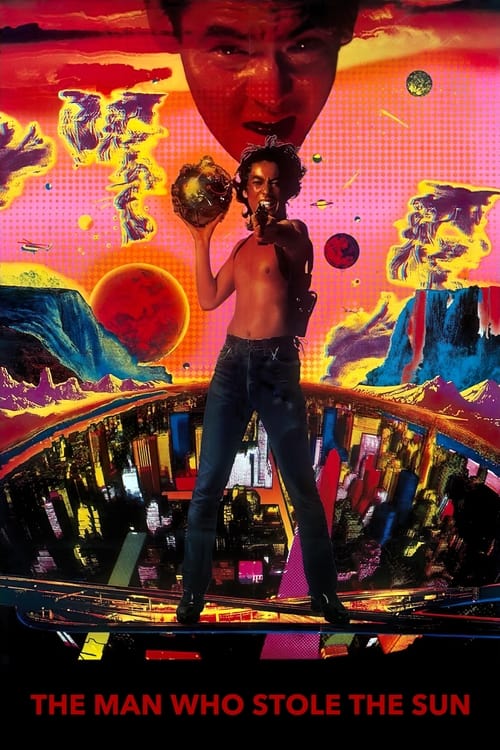
The Man Who Stole the Sun
1979 · Kazuhiko Hasegawa
For when you want a big, audacious cult thriller with ideas rattling around inside it — something to be entertained by and chew on afterward. Energetic enough for a weekend night, odd enough to reward a curious one.
What it's about
A shabby Tokyo junior-high science teacher, mocked by his students, steals plutonium and builds a working atomic bomb in his cluttered apartment. Then comes the strange part: with the ultimate weapon in hand, he can't think of anything to demand — and his cat-and-mouse game with a bulldog police inspector becomes a search for a desire big enough to match the bomb.
The experience
A wild ride that keeps changing shape — deadpan comedy, procedural thriller, action spectacle, and an undertow of real melancholy about a man with absolute power and no purpose. Long, propulsive, and stranger than its logline suggests.
Performances
Pop idol Kenji Sawada is perfectly cast as the teacher — glamorous emptiness turned into a whole performance — opposite Bunta Sugawara's granite-hard detective, and the collision of their two acting styles is half the movie's charge.
The craft
Kazuhiko Hasegawa stages the bomb-building with tactile, nerve-jangling detail and mounts chases and set pieces with reckless late-70s energy, all scored to a rock-and-roll pulse. It's a big, loud picture that earns a big screen and good speakers.
Why it matters
A commercial disappointment that became one of Japanese cinema's great cult objects — a daring treatment of the bomb from the only country to suffer it, and hugely influential on later Japanese filmmakers.
Snapshot
A junior-high science teacher in Tokyo — Makoto Kido, played by the pop idol Kenji Sawada — steals plutonium from a nuclear facility, builds a working atomic bomb in his cluttered apartment, and then discovers he has nothing to demand. That vacuum is the film's subject. The Man Who Stole the Sun (太陽を盗んだ男, Taiyō o Nusunda Otoko) spends roughly two and a half hours constructing a terrorist and then watching him fail to become one, because late-1970s Japan has left him with no desire large enough to match the weapon in his hands. What he eventually asks for — that televised baseball games be broadcast to their conclusion rather than cut off for the schedule; that the Rolling Stones, then barred from performing in Japan, be allowed to play; finally, ¥500 million — arrives partly crowd-sourced from listeners phoning a radio request show. Kazuhiko Hasegawa's second and last completed feature is a genre-scrambling object: heist picture, procedural, slapstick comedy, body-horror chronicle of radiation sickness, and civic apocalypse, often within the same reel. It failed to become the popular event its scale implied, was rapidly canonized by Japanese critics, and has since hardened into one of the essential cult texts of post-studio Japanese cinema — a film that domesticated the atomic bomb by putting it in a rented room.
Industry & production
The film was produced by Kitty Films and released through Toho. Kitty is the crucial detail: it grew out of Kitty Music, a record and artist-management company, and its move into film production is a textbook instance of the late-1970s Japanese "media mix," in which music, television, publishing and cinema were increasingly financed as a single promotional organism. Kadokawa Haruki's book-to-film event pictures had been operating on the same logic since 1976. Casting Kenji Sawada — "Julie," one of the biggest pop stars in the country, formerly of the Group Sounds band The Tigers — was therefore not merely a creative choice but the financing structure made visible. Kitty would apply comparable logic two years later with Shinji Sōmai's Sailor Suit and Machine Gun (1981), another film built around a young pop star placed inside a genre machine.
The original story is credited to Leonard Schrader, the American screenwriter who had lived and taught in Japan in the late 1960s and whose immersion in Japanese genre cinema fed his brother Paul Schrader's The Yakuza (1974); Leonard would later write Kiss of the Spider Woman (1985) and co-write Mishima (1985). It is widely reported that Hasegawa substantially rewrote the material, and Hasegawa shares screenplay credit. The precise division of labor between the two, and the extent of any friction, is not well documented in accessible sources; accounts are anecdotal and should be treated as such.
Production was largely on location in Tokyo, and the film's most-discussed passages — a helicopter money-drop that scatters banknotes over the city, street chases and a car crash staged in live traffic — are frequently described as having been shot in or against real, uncontrolled crowds. These accounts are consistent with what is on screen, where bystanders repeatedly look like bystanders rather than extras, but the specifics of how much was stolen versus permitted belong to production legend more than to documented record.
Technology
Two technological registers run in parallel. The first is diegetic and is the film's actual argument: Japan's civil nuclear fuel cycle, operating at Tōkai in Ibaraki since the 1960s, had put weapons-usable material inside the ordinary logistics of a country constitutionally and rhetorically committed to non-nuclear status. The film's premise is that the gap between "civil" and "military" is a matter of a locked door, a lead container, and enough patience. Kido's laboratory is a domestic kitchen; the bomb is assembled with rubber gloves, household containers and hardware-store improvisation, and the film lingers on the sheer manual banality of it. Set against this is the second network: mass media and telephony — the radio request show, the traced call, the recorded and distorted voice, the television bulletin, the police switchboard. Kido has a weapon but no public existence; broadcasting is the only apparatus through which a private citizen can address the state, and the film treats the airwaves as the true infrastructure of power.
On the production side, the technology of note is lightweight location shooting: handheld 35mm work in real streets, long-lens compression in crowds, aerial photography from helicopters, and a willingness to run camera in conditions that a studio-era Japanese production would have built on a soundstage. The film belongs to the moment when Japanese commercial cinema, having lost the studio floors, learned to use the city itself as a set.
Technique
Cinematography
Tatsuo Suzuki shot the film, and the choice carries a lineage: Suzuki's credits include work for Nagisa Ōshima and Toshio Matsumoto's Funeral Parade of Roses (1969), which is to say a cinematographer trained in the reportage-inflected, formally aggressive image-making of the Japanese avant-garde and New Wave. The film alternates two visual modes. The apartment sequences are close, hot, cluttered and unstable, framing Kido against an accumulating mess of tools, shielding and takeout; the city sequences are wide, gray and documentary, with telephoto lenses flattening Kido into anonymous crowds and aerials that turn Tokyo into a target diagram. The palette is deliberately unglamorous — overcast concrete, fluorescent interiors — which makes the isolated eruptions of color (banknotes in the air, blood) function as shocks rather than decoration. Suzuki's camera also stays notably close to physical process: hands, containers, tape, wire. The bomb is photographed as labor.
Editing
The film runs about two and a half hours and uses its length structurally rather than incidentally. The central bomb-building movement is an extended, near-wordless procedural montage cut against music — a set-piece of assembly that borrows the rhythm of a heist film's preparation sequence and stretches it past comfort, so that admiration curdles into dread as Kido's body degrades. Elsewhere the cutting is the film's chief instrument of tonal violence: sequences pivot from farce to horror on a single cut, and the film repeatedly sets up a genre expectation (the siege, the ransom drop, the chase) only to derail it. The record on the editing credit and the cutting-room process is thin in English-language sources, and I will not guess at attributions.
Mise-en-scène / staging
The apartment is the film's thesis in production design: a bomb assembled among instant noodles and laundry, the sublime object of the twentieth century reduced to a domestic appliance. Against it, the film stages Tokyo's official spaces — police headquarters, the highway system, the skyline — as bureaucratic and legible, which is exactly why Kido cannot be found in them. Staging in the action sequences favours real geography over coverage: chases move through recognizable streets, and the money-drop uses vertical space (helicopter, rooftop, street) to literalise the film's social schema, with the state above, the crowd below, and Kido oscillating between.
Sound
Takayuki Inoue composed the score. Inoue was a central figure in the Group Sounds and post-GS Japanese rock scene — a bandmate of Sawada's in PYG and a prolific composer for 1970s Japanese screen work — and the score is accordingly rock-based: electric guitar, blues-funk propulsion, riffs that push the bomb-building montage toward euphoria. The effect is deliberately misaligned with the content, giving suicide-by-plutonium the drive of a caper. Diegetic sound carries equal weight: the radio show's voices, phone lines, crowd noise, the tick of the timer, the clicking of radiation detection. The Rolling Stones are invoked as an object of desire rather than heard, which is itself the joke — the demand is for access to a culture, not for a song.
Performance
Sawada's casting is the film's most audacious move. A glam-era pop idol at the height of his fame is systematically dismantled: hair falls out, teeth loosen, nosebleeds arrive, the star body decays across the running time. Sawada plays Kido with a flat, almost cheerful vacancy that refuses the usual psychological anchoring — no trauma, no manifesto, no origin. Opposite him, Bunta Sugawara plays Detective Yamashita as granite: Sugawara had been the face of Kinji Fukasaku's jitsuroku yakuza cycle, and his presence imports an entire genre's worth of stubborn physical persistence, which the film then pushes to absurdity as Yamashita absorbs punishment no body should survive. Kimiko Ikegami — best known then for Nobuhiko Ōbayashi's House (1977) — plays Zero, the radio DJ through whom Kido's demands reach the public, and gives the film its one register of drifting, disaffected youth culture. Sawada took best-actor honors in the domestic year-end awards.
Narrative & dramatic mode
The film's engine is an inversion of the thriller's basic contract. Conventionally, a terrorist has a demand and the plot is the negotiation; here the weapon precedes the want. The opening — a school bus hijacked by an old man demanding an audience with the Emperor — establishes the pattern: a demand that is grandiose, unmeetable, and rooted in a history the country has agreed not to discuss. Kido, having achieved something no individual should be able to achieve, styles himself "Number 9," on the reckoning that a lone man with a working device makes Japan the world's ninth nuclear power. Then he stalls. He asks for uninterrupted baseball broadcasts. He asks, on suggestion, for a rock concert. He asks for money and does not know what to do with it. The dramatic mode is picaresque and tonally unstable by design — comedy, procedural, body horror, action spectacle — and the instability is the argument, since no single genre can hold a man whose motive is absence. The ending refuses closure: Kido, visibly dying, adrift in a crowd with the device, and the film declining to settle whether the bomb goes off. The withholding is the point; detonation would supply a meaning the film has spent its length denying.
Genre & cycle
It belongs to the international 1970s paranoid-thriller cycle — Dog Day Afternoon (1975) in particular, with its hostage-taker who becomes a media event, and the American conspiracy pictures' distrust of state apparatus — while remaining unmistakably a Japanese production of the post-studio moment, cross-bred with jitsuroku yakuza energy (via Sugawara), with the youth-drift film, and with the nuclear-allegory tradition that runs from Godzilla (1954) forward. Its distinctive move is to strip the atomic bomb of both the kaijū's metaphor and the war film's memory and hand it, unmediated, to a salaried nobody. Domestically it sits alongside the era's terrorism-haunted crime cinema; internationally it is the rare film that treats nuclear proliferation as farce without the Cold War abstraction of Dr. Strangelove (1964).
Authorship & method
Kazuhiko Hasegawa came up through the studio system's collapse — an assistant director and screenwriter in the Nikkatsu orbit as it turned toward roman porno in the early 1970s — and directed exactly two features. The first, The Youth Killer (1976), a low-budget parricide drama made in the independent milieu around Art Theatre Guild, was highly honored in the Japanese critics' polls and marked Hasegawa immediately as a major talent. The Man Who Stole the Sun was the follow-up, on a far larger canvas, and then nothing: Hasegawa never completed another feature, remaining active around the industry and in film education without returning to direction. The reasons have been discussed for decades and are not reliably documented; the two-film career is simply one of the strange facts of modern Japanese cinema.
The key collaborators map the film's contradictions precisely. Leonard Schrader's original story brings the American lone-man-in-the-city template of his brother's Taxi Driver (1976) — the rented room as armoury, violence as the only available self-expression — which Hasegawa's rewrite empties of moral fever and refills with Japanese specifics. Tatsuo Suzuki brings New Wave documentary aggression to a Toho-distributed star vehicle. Takayuki Inoue brings the rock idiom of Sawada's own musical world, closing the loop between star persona and score. The synthesis is a genuinely hybrid authorship: avant-garde technique, studio-era craft, and pop-industrial packaging in the same object.
Movement / national cinema
The film is a document of Japanese cinema between systems. The studio order had broken — Daiei's bankruptcy in 1971, Nikkatsu's pivot to soft-core the same year — and what replaced it was a patchwork of independent art production (ATG), television money, and media-mix conglomerates like Kadokawa and Kitty. Hasegawa's generation inherited the political seriousness of Ōshima and Imamura without the movement that had sustained it, and stood immediately before the 1980s independent surge of Sōmai, Sōgo Ishii and the punk-inflected filmmakers. The Man Who Stole the Sun reads as the hinge: it retains the 1960s New Wave's fury at the state and its formal restlessness, but the fury now has no politics to attach to, only appetite and boredom.
Era / period
1979 in Japan is the end of the postwar growth story: after the oil shocks, an affluent, television-saturated consumer society with a shrinking sense of collective project. The film's nuclear premise landed in a year that also brought the Three Mile Island accident, and against a domestic backdrop in which the Three Non-Nuclear Principles coexisted uneasily with a rapidly expanding civil nuclear program. Its terrorism premise landed after a decade of real domestic political violence — the Japanese Red Army's hijackings, the 1974 bombing of Mitsubishi Heavy Industries in Tokyo, and a government that in 1977 had paid ransom and released prisoners to end a hijacking. And the opening hijacker's demand to meet the Emperor is legible only in a period when Hirohito was still living and the war's central question remained publicly unresolvable. The film's genius is to treat all of this not as tragedy but as ambient noise in a country too comfortable to notice it.
Reception, canon & influence
Critically, the film was recognized at once: it placed high on Kinema Junpo's 1979 Best Ten — commonly reported as second, behind Shōhei Imamura's Vengeance Is Mine — and Sawada's performance was singled out in the domestic awards. Commercially it is generally described as having underperformed relative to its ambition and star; I have seen no reliable figures and will not supply any. Internationally it circulated for decades chiefly through festival retrospectives, imports and cult reputation before restoration brought it to wider audiences, which is why its influence has been felt more strongly inside Japan than outside it.
Backward, its debts are legible: the Schrader-brothers lineage of Taxi Driver; the American siege-and-media thriller of Dog Day Afternoon; the nuclear absurdism of Dr. Strangelove; the Fukasaku jitsuroku film's brute physicality; and, structurally, the entire postwar Japanese habit of processing the bomb through genre, which the film simultaneously honors and detonates by refusing metaphor.
Forward, its afterlife has been steady rather than spectacular. It is a standing reference point for Japanese filmmakers working on the lone catastrophist and the paralyzed state — an affinity readily visible in later work from Mamoru Oshii's Patlabor 2 (1993) to the bureaucratic-crisis mode of recent Japanese disaster cinema — though direct causal influence is more often asserted than documented, and I flag it here as resemblance rather than established lineage. What is documented is the arc of its reputation: a film that was admired in 1979, treated as cult curiosity for two decades, and then read as uncomfortably prophetic after the 1999 criticality accident at Tōkai and, above all, after Fukushima in 2011, when a comedy about plutonium in a Tokyo apartment stopped being funny in the way it had been. Its most durable legacy may be tonal — the license it granted to treat national catastrophe with irreverence, velocity and a pop score, without ever letting the audience off the hook.
A Deleuzian reading
Rubber gloves.
The full Deleuzian reading of The Man Who Stole the Sun →
Reception
A box-office disappointment in 1979 that critics adored from day one — it took #2 in that year's Kinema Junpo poll — and its stature has only grown: by 2009 the same magazine ranked it the seventh-greatest Japanese film ever made, a placement that still startles people who've never had the chance to see it.
How The Man Who Stole the Sun was received, from release to now →
How to watch The Man Who Stole the Sun: what to notice on a first viewing
- Watch Kido's body change over the course of the film. Sawada, a glam-era pop idol, is dismantled on screen: hair falls out, teeth loosen, nosebleeds arrive as the film goes on. A famous, glamorous body decaying on screen is its own kind of evidence, without a word of dialogue.
- Listen for Kido's voice arriving with no visible body. Once Kido starts speaking through a radio request show, his voice reaches the public as a disembodied signal, routed through Zero the DJ rather than shown as a face on screen. Power here travels down a phone line, not a face, which is the only way a private man reaches a whole city.
- Notice a scene tip from comedy into horror on one cut. Hasegawa repeatedly lets a single cut swing the tone from farce to dread, refusing to settle the film into one genre for long. The instability of tone is not sloppiness; it is the film refusing you a comfortable genre to hide in.
- Look at the mess around Kido as he builds the bomb. The apartment fills with tools, shielding, and takeout containers, staging the century's most feared weapon as something assembled amid instant noodles and laundry. Putting the bomb in a cluttered rented room is what makes the whole film feel domestic instead of grand.
- Watch telephoto shots flatten Kido into an anonymous crowd. City sequences use long lenses and aerials that press Kido into gray, documentary-style crowds, turning Tokyo itself into something closer to a target diagram. The camera keeps reminding you that the man with the bomb is otherwise completely invisible.
The whole guide to watching The Man Who Stole the Sun, with the keys for a rewatch →
Influences: the films it descends from and the films it influenced
- Taxi Driver (1976) — Leonard Schrader's story transplants his brother's template of the rented room as armoury — the autodidact's private preparation filmed as a patient instructional sequence, weaponry laid out and rehearsed against the mirror — which Hasegawa rewrites as bomb-lab procedure stripped of moral fever.
- Dog Day Afternoon (1975) — Establishes the siege-thriller feedback loop the seed runs on: the criminal negotiates through live broadcast and becomes a media performer, opposite an exhausted, humane cop-negotiator whose weary bulk Bunta Sugawara's Inspector Yamashita directly inherits.
- The Taking of Pelham One Two Three (1974) — Models the extortion plot as radio-diegesis procedural — the whole drama carried on a hijacked audio channel while municipal agencies stall in cross-cut, played in a dry comic register that treats civic paralysis as bureaucratic farce.
- Dr. Strangelove (1964) — Licenses comedy as the correct register for atomic annihilation: the deadpan procedural treatment of nuclear hardware and the gag of a state apparatus that cannot act on its own weapon, which Hasegawa relocates from war room to a Tokyo apartment.
- Battles Without Honor and Humanity (1973) — Supplies the jitsuroku physical grammar — handheld camera shoved into real locations, canted frames, bodies colliding without heroic staging — and Bunta Sugawara's battered, thick-jawed presence, imported here to give the pop fable its documentary weight.
- Funeral Parade of Roses (1969) — Cinematographer Tatsuo Suzuki's method arrives intact: handheld 35mm shot into unpermitted Shinjuku crowds, long lenses flattening real pedestrian traffic into a moving wall, and abrupt cutting that ruptures tone mid-scene rather than modulating it.
- The Youth Killer (1976) — Hasegawa's own first feature sets the domestic interior as the site of unspeakable act and its dull aftermath — the ordinary apartment turned crime scene, filmed with ATG-scale intimacy — which the seed scales up to a plutonium workbench beside the kitchen sink.
- The Battle of Algiers (1966) — The canonical bomb-workshop assembly montage: hands, timers, and components cut in patient close-up as pure technical process, giving the seed its editing model for making improvised weapons legible and absorbing without a word of explanation.
- Black Sunday (1977) — Pairs aerial helicopter coverage of a packed stadium with cutaways to the device below, building suspense from the arithmetic of crowd density — the same crowd-versus-payload cutting scheme the seed uses over the Tokyo grid.
- Godzilla (1954) — Founds the Japanese habit of routing the bomb through genre and through official diegesis — Geiger counters, emergency broadcasts, the scientist who alone holds the annihilating material — a lineage the seed honors procedurally while refusing its metaphor.
- Kagerō-za (1981) — Takes up the seed's use of Kenji Sawada as a body rather than an action lead, extending the idol-decay method — the star's glamour photographed as something dissolving and passive — into art-cinema abstraction.
- Patlabor 2: The Movie (1993) — Reprises the lone catastrophist holding a paralyzed capital, staged in long-lens compositions of emptied infrastructure and committee rooms, with tension generated by procedural inaction rather than by confrontation.
- Cure (1997) — Carries forward the motiveless perpetrator and the withheld ending as formal commitments — the film systematically declines the explanatory scene and closes on an unresolved gesture, leaving causation outside the frame.
- Shin Godzilla (2016) — Rebuilds the crisis as bureaucratic procedural — captioned ministries, dose readings and hard rhythmic cutting between meeting rooms — the seed's gag of a state that cannot move against a nuclear object turned into an entire structural method.
- Vengeance Is Mine (1979) — Its exact contemporary at the top of the 1979 polls, built on the same refusal: crime observed as flat behavioral procedure, the camera withholding the psychological cause the genre trains audiences to expect.
- House (1977) — The other Toho-distributed experiment in commercial velocity — pop-idol casting, advertising-trained cutting rhythms, and tonal whiplash that flips comedy to horror between shots rather than across acts.
- Fight Club (1999) — Independently arrives at the same device: home explosives manufacture edited as a sardonic domestic how-to, the apartment kitchen as lab, the instructional montage played for comedy against the scale of what it produces.
- Four Lions (2010) — Extends the seed's hardest formal bet — sustained farce staged inside an amateur bomb-maker's flat, with slapstick timing applied to fabrication scenes while never converting the payload into a joke.
Similar films
- Godzilla (1954) — influence & lineage
- Stray Dog (1949) — shared sensibility
- Shoplifters (2018) — shared sensibility
- Seven Samurai (1954) — shared sensibility
- Sonatine (1993) — shared sensibility
- Ikiru (1952) — shared sensibility
- Cruel Story of Youth (1960) — shared sensibility
- In the Realm of the Senses (1976) — shared sensibility