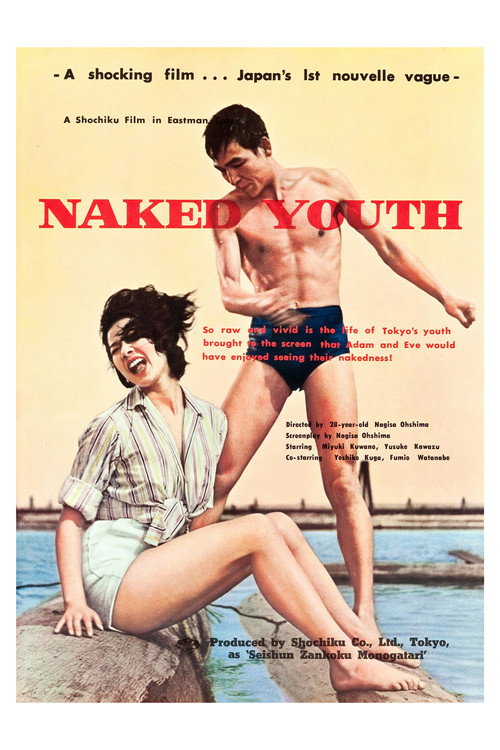
Cruel Story of Youth
1960 · Nagisa Ōshima
For when you want cinema with its teeth bared — a challenging, bracing watch for a night of serious film-going, not a comfort watch. Reach for it when you're curious what a national cinema sounds like when it turns against itself.
What it's about
In restless postwar Tokyo, Makoto, a high-school girl who hitchhikes rides from older men, falls in with Kiyoshi, a hard, opportunistic student who treats the world as something to be taken. Their romance curdles fast into a racket: she lures middle-class men, he shakes them down. Around them, a generation's political hopes are burning out in the streets.
The experience
Harsh, sensual, and confrontational — it has the surface heat of a lovers-on-the-margins picture but keeps refusing you the comfort of romance. It's a young director's fury put directly on screen, and it stings.
The craft
Ōshima shoots in blazing widescreen color, filling the frame with bodies, neon, and water, and cutting with a jagged energy that made the studio's usual youth pictures look embalmed. It's fast, physical filmmaking that turns commercial gloss into an attack.
Why it matters
Made when Ōshima was twenty-eight and released amid the 1960 protests against the U.S.–Japan security treaty, it announced the Japanese New Wave almost single-handedly — a studio youth movie turned inside out into a statement of generational revolt.
Snapshot
Cruel Story of Youth (Seishun zankoku monogatari, sometimes rendered in English as Naked Youth or A Story of the Cruelties of Youth) was Ōshima Nagisa's second feature and the film that made him, at twenty-eight, the most visible young director in Japan. Shot in Shōchiku's widescreen GrandScope and released in June 1960 — in the middle of the mass protests against renewal of the U.S.–Japan Security Treaty (Anpo) — it took the studio's most reliable commercial commodity, the youth picture, and turned it inside out.
The plot is spare and brutal: Makoto, a high-school girl who hitchhikes for rides with older men, is rescued from a groping salaryman by Kiyoshi, a hard, opportunistic university student. He rapes her at the lumberyard by the water; she attaches herself to him anyway. Together they industrialize her hitchhiking into a shakedown racket — she solicits, he arrives with fists and threats, the middle-aged man pays to keep it quiet. Around them hover the exhausted figures of an older generation: Makoto's sister Yuki, a former student activist of the immediate postwar, and her ex-lover Akimoto, now a doctor who performs Makoto's abortion. The younger couple's course runs to its end with no redemptive turn.
What makes the film canonical is not the story but the temperature. Ōshima refused the sentimentality of the taiyōzoku ("sun tribe") teen films of the mid-1950s and the humanist consolations of the older Shōchiku house style. The result is usually treated as the opening statement of the Japanese New Wave — a movement partly manufactured by Shōchiku's publicity department, but real enough in what it produced.
Industry & production
The context is a studio in demographic panic. Shōchiku, the most genteel of the majors, had built its identity on the Ōfuna style — domestic melodrama, family feeling, Ozu and Kinoshita — and by the late 1950s its audience was aging while the theatrical audience overall was about to fall off a cliff. Japanese cinema attendance peaked in 1958 at roughly 1.1 billion admissions and declined steeply through the 1960s as television spread. Nikkatsu had captured the youth market with its taiyōzoku films, adapted from Ishihara Shintarō's fiction, and with the Ishihara Yūjirō star vehicles that followed. Shōchiku's response, under production head Kido Shirō and with the encouragement of executives looking for new blood, was to promote very young assistant directors to the chair.
Ōshima was one of them. A graduate of Kyoto University in political science and law, a student activist, he had joined Shōchiku's Ōfuna studio in 1954 as an assistant director and made himself conspicuous as a polemicist in the company union's magazine and in the film journals — he was writing criticism before he was directing. His first feature, A Town of Love and Hope (Ai to kibō no machi, 1959), about a poor boy who repeatedly sells the same homing pigeon, ended without uplift and irritated the studio; the title itself was imposed over Ōshima's preferred, bleaker one. That friction set the pattern for everything that followed.
Cruel Story of Youth was made fast and cheap, on the model Shōchiku wanted: a youth picture with a marketable subject. What the studio got was a commercial success — the film performed well enough that Ōshima was immediately allowed to shoot again — with a politics the company had not asked for. Shōchiku's marketing department coined the "Shōchiku Nūberu Bāgu" (Shōchiku New Wave) label to sell Ōshima, Yoshida Yoshishige, and Shinoda Masahiro as a generational movement, borrowing the prestige of the French nouvelle vague. All three directors publicly disliked the label. Ōshima in particular insisted his cinema was not an aesthetic movement but a political one.
The arrangement lasted roughly a year and a half. Later in 1960 Ōshima made The Sun's Burial and then Night and Fog in Japan, an explicitly Anpo-focused film about the recriminations dividing the student left. Shōchiku pulled Night and Fog in Japan from theaters after a handful of days — the withdrawal followed the assassination of Socialist Party chairman Asanuma Inejirō in October 1960, and the company cited the political climate. Ōshima treated it as censorship, quit the studio, and founded his own production company, Sōzōsha, with collaborators including his wife, the actress Koyama Akiko. He never worked inside a major studio's system again on those terms. Cruel Story of Youth is thus the beginning and, in retrospect, the last moment of an accommodation.
Technology
The technology is worth noting precisely because Ōshima used the studio's prestige format against the studio. The film was shot in Shōchiku GrandScope — the company's anamorphic widescreen process, its equivalent of CinemaScope, adopted in the mid-1950s as part of the industry-wide response to television — and in color, on a low budget. Widescreen color was the language of the very entertainment cinema Ōshima was attacking; he took the tools and detuned them.
The anamorphic frame in Japanese cinema of the period was typically used for spectacle, for period films, and for the composed, balanced tableaux of studio craft. Ōshima's use is closer to a trap. The wide frame becomes a horizontal space in which a figure can be pushed to one edge and abandoned there, or in which two people can be held at a distance the shot refuses to close. The color is similarly unglamorous: harsh reds and greens, flat industrial surfaces, the gray-brown of reclaimed waterfront land.
Location shooting was central and was enabled by the practical fact that faster stocks and lighter equipment made it feasible to work in the actual streets of a Tokyo mid-reconstruction — the same enabling condition behind the French New Wave's street work, though Ōshima's crews remained studio-trained professionals rather than improvisers. The city being filmed was itself in violent transformation, four years before the Tokyo Olympics remade it again.
Technique
Cinematography
The cinematography is by Kawamata Takashi, who would shoot several of Ōshima's early films and become one of the defining camera stylists of the period. The strategies are consistent and legible.
First, decentring. Figures are placed hard against the edges of the GrandScope frame with large volumes of dead space beside them — space that is not compositionally "balanced" but simply empty, and which reads as pressure rather than air. Where classical Japanese studio composition of the era organizes the frame around the body, Ōshima and Kawamata organize it against the body.
Second, the long take and the moving camera used for duration rather than fluency. Scenes are held past the point where conventional coverage would have cut, which converts ordinary aggression into something the viewer must sit inside. The famous lumberyard sequence — Kiyoshi's assault on Makoto among floating logs — depends on this: the water, the logs, the unbroken attention.
Third, color as harshness. The film does not use color for beauty. Reds arrive as bruises and neon; the palette of the couple's world is that of cheap bars, hospital corridors, and construction sites.
Fourth, the camera's refusal of subjective identification. Ōshima rarely gives point-of-view structures that would let us occupy a character's perception comfortably. We watch from outside, at an angle, from a position that is not anyone's.
Editing
The editing is not the rupture-driven montage of Ōshima's later 1960s work — Death by Hanging and Diary of a Shinjuku Thief go much further — but it already declines the smoothness of studio continuity. Scenes begin late and end abruptly. Transitions are sometimes jarring in a way that reads as deliberate refusal rather than incompetence. The film's structure is episodic: a chain of encounters and beatings and negotiations rather than a rising dramatic arc, which is why the ending can be simultaneous and parallel rather than climactic.
Mise-en-scène / staging
The staging is where the film's argument lives. Ōshima's Tokyo is a landscape of margins: reclaimed land, lumberyards, docks, construction sites, cheap apartments, hospital rooms, bars. Very little of it is domestic in the Ōfuna sense; the family home, the load-bearing space of Shōchiku melodrama, is present mainly as something the characters have vacated.
Bodies are staged as objects in transactions. The hitchhiking racket is filmed as a mechanism — approach, ride, stop, ambush, payment — repeated until its structure is visible. Ōshima stages sex and violence in the same spaces and often in the same shots, refusing to separate desire from coercion. The film also stages the political present directly: newsreel footage of the Anpo demonstrations and of the contemporaneous South Korean student uprising against Syngman Rhee appears within the film, and the young couple watch or pass through such events without engagement. That indifference is the point.
Sound
The sound design is unromantic. Traffic, machinery, water, the city's ambient noise are allowed to intrude on dialogue. Dialogue itself is flat and often ugly — negotiations, insults, propositions — with almost none of the tonal warmth that the Ōfuna style cultivated.
The score is by Manabe Riichirō, a prolific composer whose work ranges across the period's genres. It is used sparingly and pointedly, and the film's most famous musical gesture is not scoring at all but the use of a popular song — the diegetic pop of the moment, deployed with irony against the characters' circumstances. Ōshima's later films would make the collision of pop music and political violence a signature; the technique starts here.
Performance
Kawazu Yūsuke plays Kiyoshi and Kuwano Miyuki plays Makoto. Both were young studio contract players, and Ōshima directs them away from the expressive conventions of the Shōchiku juvenile lead. Kawazu's Kiyoshi is not a brooding rebel with a wounded interior; he is opaque, transactional, and frequently repellent, and the film declines to supply the psychological backstory that would explain him. Kuwano's Makoto is the harder performance: she must make legible a girl who attaches herself to her rapist without the film ever framing that attachment as romance or as pathology. What comes through is not masochism so much as a total absence of alternatives.
The older generation is played with a different register. Kuwano's sister Yuki (Kuga Yoshiko) and Akimoto (Watanabe Fumio) carry the exhaustion of the defeated 1950s left; Watanabe would become one of Ōshima's recurring actors. The generational contrast is built into the acting styles, not merely the dialogue.
Narrative & dramatic mode
The dramatic mode is anti-melodramatic in a very specific sense: the film systematically withholds the moral machinery that melodrama exists to operate. No character is redeemed. No sacrifice is legible as sacrifice. There is no moment at which the film asks us to feel that the young couple's love, whatever it is, might have saved them.
The structure is a downward episodic spiral. Each episode is a variation on the same transaction, and the escalation is quantitative rather than dramatic — more money, more violence, more risk — until the mechanism destroys both operators. The ending stages the two deaths in parallel, separately, neither witnessing the other, which denies even the consolation of a shared fate.
Two generations are held in counterpoint throughout. Yuki and Akimoto had politics and lost; their conversations carry the memory of the postwar student movement and its dissolution into professional respectability and private disappointment. Makoto and Kiyoshi have no politics at all and are, in the film's diagnosis, what the older generation's failure produced. The film gives neither generation the last word — Yuki's warning to her sister is unheeded, but the film doesn't validate the warning as wisdom either.
Genre & cycle
The film belongs to, and detonates, the taiyōzoku cycle. Ishihara Shintarō's 1955 novel Season of the Sun and Nikkatsu's 1956 adaptations of it (Season of the Sun, Crazed Fruit) launched a wave of films about affluent, amoral, sexually frank youth that provoked a moral panic and contributed to the establishment of the industry's Eirin self-regulation body in its reformed form. By 1960 the cycle had been substantially defanged and absorbed into star vehicles.
Ōshima's intervention is to strip out the class. The taiyōzoku were rich kids on yachts; Makoto and Kiyoshi are poor, and their transgression is not leisure but work. What was glamorous nihilism becomes labor. The film also draws on the seishun eiga (youth film) tradition more broadly and on crime-film material — the shakedown racket gives the plot its engine — without settling into either.
Internationally, the natural comparison is to the delinquency cycle running from Rebel Without a Cause (1955) through the French New Wave's À bout de souffle (1960, released in France months before Ōshima's film and generally without direct influence on it, given production timelines). The resemblance is real but the temperament differs sharply: Godard's criminality is playful and cinephilic, Ōshima's is neither.
Authorship & method
Ōshima wrote the screenplay himself, as he would for most of his career. This is central to his self-definition: he came to directing from criticism and polemic, and he understood filmmaking as argument. His stated hostility to the "Japanese cinema" that Western critics had canonized — the Mizoguchi/Ozu tradition of formal beauty and resigned humanism — was programmatic. He wanted a cinema of the present tense, of political subjects, of ugliness where ugliness was accurate.
Kawamata Takashi's camerawork is the film's most legible collaborative signature, and the Ōshima–Kawamata partnership through the early Shōchiku and Sōzōsha years produced the visual grammar the New Wave is now identified with. Manabe Riichirō's score is a lesser but consistent element; Manabe worked widely in the industry, including on later Gojira entries, and his contribution here is a functional, unsentimental one.
The method was speed. Ōshima's output between 1959 and 1961 — four features in roughly two years — was possible because the studio system still supplied crews, equipment, and contract actors, and because Ōshima wrote fast and shot on location. When he left for Sōzōsha, the speed persisted but the scale contracted, and his work moved toward the more radical formal experiment of the mid-to-late 1960s.
Koyama Akiko, whom Ōshima married and who appeared in many of his films, is part of the Sōzōsha story more than this one. The production records of the film in English-language scholarship are relatively thin on day-to-day detail — much of what circulates comes from Ōshima's own later writings, collected in English as Cinema, Censorship, and the State, which are polemical documents rather than neutral production accounts.
Movement / national cinema
The Japanese New Wave (Nūberu Bāgu) is a contested category. It was partly a marketing invention, and its directors resisted it; it was also not unified aesthetically — Ōshima, Yoshida, Shinoda, Imamura Shōhei (at Nikkatsu), Hani Susumu (from documentary), and later Wakamatsu Kōji and Terayama Shūji pursued very different projects. What they shared was a refusal: of the humanist consolation of the previous generation, of studio decorum, and of the idea that Japanese cinema's business was national self-representation for export.
Cruel Story of Youth is conventionally the movement's starting gun because it arrived first and loudest, and because its politics were legible in its release moment. The Anpo protests of May–June 1960 were the largest mass demonstrations in Japan's postwar history; the treaty passed anyway, Prime Minister Kishi Nobusuke resigned, and the movement's failure defined the decade's left. The film's newsreel inserts and its portrait of a generation that has already stopped believing in politics landed inside that event, not after it.
The comparison to the French New Wave is genuine but limited. Both movements were made possible by young men who had written criticism first, by lighter equipment, and by studios in crisis. But the nouvelle vague was cinephilic, oriented toward Hollywood genre and toward the pleasures of film history; Ōshima's project was sociological and political, oriented toward what Japan had become. He was explicit about the difference.
Era / period
1960 is the hinge year of postwar Japan. The Occupation had ended in 1952; the economy was entering the high-growth period that would produce the "income doubling" plan announced under Ikeda Hayato at the end of that year; the country was, materially, beginning to become rich. The Anpo crisis was the political counter-current: the perception that Japan's alignment with the United States had been imposed rather than chosen, and that the postwar democratic settlement was procedurally hollow.
The film's characters live in the material gap. They are not the beneficiaries of high growth; they are its detritus, working the edges of a city being rebuilt around them. Ōshima's insistence on this margin — poor young people in an economy about to boom — is the film's most durable sociological observation, and it distinguishes the film from both the affluent nihilism of the taiyōzoku and the Ōfuna melodrama's stable, if straitened, family economy.
The generational structure maps onto the political one exactly. The older pair belong to the 1948–52 student left, defeated; the younger pair belong to a moment in which the demonstrations are literally passing outside the window and are not their business.
Reception, canon & influence
The film was a commercial success in Japan and made Ōshima immediately famous. Contemporary Japanese critical reaction split along predictable lines: the film journals recognized a new voice; more conservative commentary treated it as an escalation of the delinquency problem the taiyōzoku panic had already named. Ōshima's own critical writing kept the argument going, and his subsequent break with Shōchiku over Night and Fog in Japan made him a figure of principle for the left.
International recognition came later and unevenly. Ōshima's global reputation was built chiefly on In the Realm of the Senses (1976) and Merry Christmas, Mr. Lawrence (1983), with the 1960s films reaching Western audiences substantially in retrospect, through festival retrospectives and, much later, home-video restorations — notably the Criterion Collection's Eclipse series set of Ōshima's early Shōchiku films, which is how most English-speaking viewers now encounter it. Anglophone scholarship on Ōshima was shaped early by Noël Burch's To the Distant Observer (1979) and by David Desser's Eros Plus Massacre: An Introduction to the Japanese New Wave Cinema (1988), which treats Cruel Story of Youth as foundational. Maureen Turim's The Films of Oshima Nagisa (1998) is the standard English monograph.
Backward — what shaped it. The taiyōzoku films of 1956, as target and template. The postwar left's own history, which Ōshima had lived. Italian neorealism's location practice, filtered through the Japanese industry's own postwar realist strain. The critical culture of Kinema Junpō and the film journals in which Ōshima had made himself a public voice. And, negatively but decisively, the Ōfuna house style he had spent five years as an assistant director inside — the film is unintelligible without the thing it is refusing.
Forward — what it shaped. Most immediately, it authorized a cohort: Shinoda, Yoshida, and the wider New Wave worked in the space Ōshima's commercial success opened at Shōchiku, and the movement's subsequent migration into independent production (Sōzōsha, the Art Theatre Guild's financing of independent work through the 1960s and 70s) follows the path Ōshima cut when he left. Its portrait of youth as economically produced rather than psychologically deviant became a standard position in Japanese cinema of the decade, visible in Imamura's work and in the harsher end of the delinquency film.
Its longer influence is stylistic and attitudinal: the widescreen frame used to isolate rather than compose; pop music set against violence; the refusal of redemptive endings in youth narratives. Directors who have named Ōshima's early work as formative range across generations — the film sits in the background of a great deal of subsequent cinema about young people with no future and no politics, from later Japanese work through the international art-house lineage that treats delinquency as an economic condition. It should be said plainly that specific, documented influence claims of this kind are harder to substantiate than the general canonical position; what is not in doubt is the film's status as the moment the Japanese New Wave became visible, and as the demonstration that a studio's own commercial machinery could be turned to produce its critique.
A Deleuzian reading
Logs on black water.
The full Deleuzian reading of Cruel Story of Youth →
Reception
A genuine box-office hit for Shochiku in 1960 — successful enough that the studio let more twenty-something directors loose, birthing what got branded the 'Shochiku Nouvelle Vague.' Today it's canonized less as a hit teen picture than as the founding shot of the Japanese New Wave.
How Cruel Story of Youth was received, from release to now →
How to watch Cruel Story of Youth: what to notice on a first viewing
- Notice how often a figure is pushed to the frame's edge. Oshima and Kawamata shove figures hard against the sides of the widescreen frame, leaving a large volume of empty space that reads as pressure rather than open air. That emptiness beside a character is never neutral; it is weight bearing down on them.
- Notice you're rarely given a character's own point of view. Oshima almost never lets you occupy a character's perception the way classical Japanese cinema does, instead watching Kiyoshi and Makoto from outside, at an angle that belongs to no one. The refusal to take sides visually is what keeps the film from asking you to root for anyone.
- Notice red appearing as neon and bruises, never as beauty. The film's palette runs to cheap bars, hospital corridors, and construction sites, and red arrives specifically as harm rather than as anything glamorous or romantic. Color here tells you where danger is before the plot catches up to it.
- Watch the reclaimed land, lumberyards, and docks around the couple. Oshima shoots almost entirely on Tokyo's margins, construction sites and waterfront fill, a city still being poured, with barely a domestic interior in sight. The couple live on ground that isn't finished being ground, which tells you everything about their prospects.
The whole guide to watching Cruel Story of Youth, with the keys for a rewatch →
Influences: the films it descends from and the films it influenced
- Crazed Fruit (1956) — Supplies the taiyōzoku grammar Ōshima works against — Shōnan-coast location shooting of youth as leisured bodies, with elliptical cutting that jumps past consequence to the motorboat kill — which Ōshima re-stages in Tokyo's industrial margins with the glamour stripped out.
- Season of the Sun (1956) — Established the transactional-seduction plot engine (Ishihara's honey-trap as scandalous incident) that Ōshima promotes from incident to the film's entire structuring device — Makoto and Kiyoshi's badger game becomes the narrative's repeating unit rather than its shock.
- Kisses (1957) — The film Ōshima's own Kinema Junpō criticism named as the birth of a new Japanese cinema: dialogue rushed at speed over ambient location noise, psychology refused in favor of physical velocity, the motorbike ride carrying the whole of a relationship without interior explanation.
- Giants and Toys (1958) — DaieiScope plus deliberately garish commercial color used to make consumer capitalism a visual assault rather than a backdrop — the model for Ōshima's harsh Fujicolor palette and for treating a young woman's body as a manufactured commodity in the frame's own logic.
- Black River (1957) — Shōchiku's own harsh realist strain from inside Ōfuna — apartment-block staging shot on location in the base-town economy, with Nakadai's unredeemed pimp-antihero establishing that the studio's machinery could carry a protagonist the house style would normally punish.
- Tokyo Story (1953) — The negative ancestor: Ōshima's refused-POV and off-center GrandScope framing are a point-by-point negation of Ozu's low frontal address and eyeline-matched shot/reverse-shot, which grant every character a sightline the New Wave frame deliberately withholds.
- The 400 Blows (1959) — Location shooting of a city's margins around a non-professional-feeling adolescent lead, closing on an ending that withholds resolution — the freeze on Doinel is the structural precedent for Ōshima's refusal of a redemptive last beat.
- Rebel Without a Cause (1955) — First systematic use of the anamorphic frame to strand adolescents in negative space and push them to the edges of the composition — the widescreen-as-isolation device Ōshima and Kawamata extend by decentering the figure rather than balancing it.
- Bicycle Thieves (1948) — Neorealism's practice of staging the economic transaction on the actual street, letting real traffic, crowds and weather exert pressure on the performance — the location method that reached Ōshima through the Japanese industry's postwar realist filter.
- Pigs and Battleships (1961) — NikkatsuScope location work in Yokosuka's base economy, with the young couple's fate calculated in yen rather than character — the fullest extension of Ōshima's proposition that youth is economically produced, not psychologically deviant.
- Pale Flower (1964) — Kosugi Masao's high-contrast night-Tokyo widescreen paired with Takemitsu's musique-concrète sound design placed over dialogue rather than under it — ambient noise and card-slap rhythm displacing score exactly as Ōshima displaced melodramatic underscoring.
- Tokyo Drifter (1966) — Anti-naturalist saturated color and abrupt spatial discontinuity within the Nikkatsu scope frame, with the title song surfacing diegetically as ironic commentary on the violence it accompanies — Ōshima's ironic pop cue taken to a full formal system.
- Funeral Parade of Roses (1969) — Cuts documentary interviews and street footage directly into the fiction, so the newsreel-insertion device Ōshima used as punctuation becomes the film's whole anti-continuity architecture.
- Kids Return (1996) — Flat frontal staging and hard ellipses across the boys' failures — the crisis always cut away from — sustaining Ōshima's anti-melodrama contract of youth rendered without interiority and an ending that declines uplift.
- Happyend (2024) — Japanese New Wave template of disaffected teenagers whose personal drift becomes political indictment of the postwar order, the movement Happyend consciously revives.
- Breathless (1960) — Independent convergence in the same year: anti-continuity cutting inside a scene, a couple whose intimacy is a chain of petty transactions, pop-cultural surface used flatly rather than expressively, and a death staged without pathos or reaction shot.
- The Warped Ones (1960) — Handheld scope shooting on live streets with a jazz score run flat against sexual violence — music as ironic counterweight rather than emotional underline, the same year and the same refusal to let the soundtrack judge the act.
- Good-for-Nothing (1960) — The other Shōchiku New Wave debut: off-center widescreen compositions and a drifting episodic structure with no crisis-and-resolution arc, applied to bourgeois students whose delinquency is boredom rather than deviance.
- Night and Fog in Japan (1960) — Pushes Cruel Story's long-take tendency to its limit — roughly 43 shots for the whole film, with flashbacks staged in place by relighting within the take instead of cutting — turning the Anpo politics that sat at the earlier film's edges into its entire subject.
- Pitfall (1962) — A defining Japanese New Wave work that likewise hijacks commercial genre machinery to deliver an angry political critique, sharing Pitfall's project of turning entertainment forms into vehicles of dissent.
Similar films
- Pale Flower (1964) — influence & lineage
- Tokyo Story (1953) — influence & lineage
- Tokyo Drifter (1966) — influence & lineage
- Kamikaze Girls (2004) — shared sensibility
- In the Realm of the Senses (1976) — shared sensibility
- Confessions (2010) — shared sensibility
- Mind Game (2004) — shared sensibility
- The Life of Oharu (1952) — shared sensibility