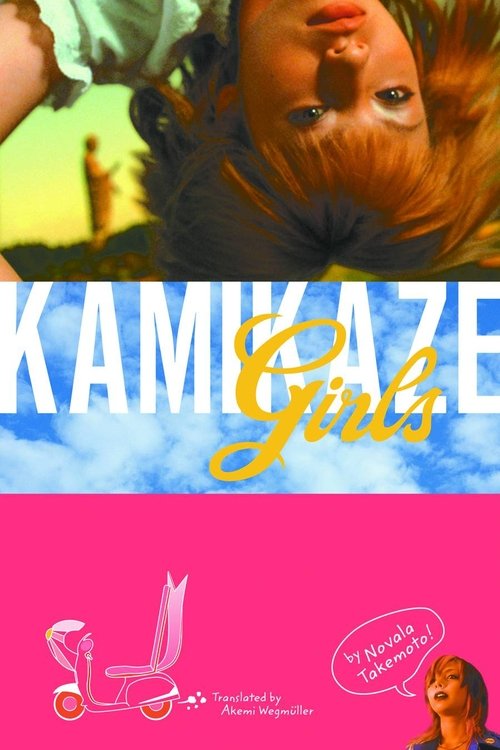
Kamikaze Girls
2004 · Tetsuya Nakashima
For when you want something loud, weird, and joyful — a candy-colored pick-me-up that celebrates being defiantly yourself. Great for a night when regular movies feel too beige.
What it's about
In the cabbage fields of rural Shimotsuma, Momoko — a deadpan girl who dresses in elaborate Rococo frills and dreams of eighteenth-century France — collides with Ichigo, a spitting, head-butting biker-gang delinquent. Two completely opposed philosophies of girlhood, ornamental self-invention versus loyalty and fists, get tangled into an unlikely friendship neither will admit she needs.
The experience
A sugar-rush: anime cutaways, freeze frames, colors cranked past legal limits, jokes fired straight at the camera — and underneath all the noise, a real, sturdy heart. It's laugh-out-loud strange and then suddenly, sneakily touching.
Performances
Kyoko Fukada and Anna Tsuchiya play the odd couple with deadpan grace — Tsuchiya's snarling biker girl especially became an instant cult favorite.
The craft
Tetsuya Nakashima came from advertising with every visual trick in the kit, and he uses all of them — yet the maximalism keeps landing on genuine feeling, because the film understands that style is the armor its heroines wear. The saturated look is a treat on a good screen.
Why it matters
A defining cult object of 2000s Japanese pop cinema and a touchstone for Lolita fashion and DIY girl subcultures far beyond Japan.
A sugar-rush of a friendship film from Tetsuya Nakashima, who arrived from Japan's advertising world with every trick in the kit — anime cutaways, freeze frames, direct address, colors saturated past legality — and a surprisingly sturdy heart underneath. In the cabbage fields of Shimotsuma, a girl devoted to Rococo frills and eighteenth-century French frivolity collides with a spitting, head-butting biker delinquent; the film watches two opposed philosophies of girlhood — ornamental self-invention versus loyalty-and-fists — discover they need each other. Kyoko Fukada and Anna Tsuchiya play it with deadpan grace, and Nakashima's maximalism, which could easily curdle into noise, keeps landing on real feeling: the style is the armor his heroines wear, and the film knows it. It became a defining cult object of 2000s Japanese pop cinema abroad and announced the director who would go on to the darker, equally baroque Memories of Matsuko and Confessions. Few films have taken frivolity this seriously, or argued so sweetly that choosing your own aesthetic is a form of courage.
A Deleuzian reading
A girl in a Rococo dress stands in a cabbage field.
The full Deleuzian reading of Kamikaze Girls →
Reception
A modest hit in Japan and a festival curio abroad in 2004, it has quietly climbed into cult-classic status — rediscovered by a new generation on Letterboxd, where its candy-coloured maximalism now reads as ahead of its time rather than garish.
How Kamikaze Girls was received, from release to now →
Influences: the films it descends from and the films it influenced
- Amélie (2001) — Establishes the template of a candy-hued, over-graded storybook palette married to omniscient voiceover that pauses the film to catalog each character's private likes and dislikes — the exact digressive character-inventory device Nakashima uses for Momoko and Ichigo.
- Trainspotting (1996) — Pioneers the freeze-frame-plus-on-screen-caption character introduction and wall-to-wall pop-needle-drop montage that Nakashima lifts wholesale for his roster of small-town grotesques.
- Run Lola Run (1998) — Its whip-fast animated cutaways and rapid-fire snapshot 'and-then-her-whole-life-happened' biographies of bit players model Kamikaze Girls' anime inserts and sped-up backstory gags.
- Natural Born Killers (1994) — The kitchen-sink collage grammar — switching film stocks, cartoon interludes, and back-projection mid-scene — legitimizes Nakashima's maximalist mixing of live action with drawn animation and format shifts.
- House (Hausu) (1977) — Obayashi, like Nakashima, migrated from TV-commercial directing and brought the same pop-art collage of naive optical effects and hyper-girlish surrealism into Japanese feature filmmaking, the native precedent for this advertising-bred maximalism.
- Tampopo (1985) — Itami's deadpan tonal juggling and freewheeling comic digressions that abandon the plot to follow a minor character establish the Japanese comedy register of straight-faced absurdity Momoko performs.
- Pierrot le Fou (1965) — Godard's primary-color pop-art frames and characters who break the fourth wall to address the audience directly are the art-cinema root of Momoko's to-camera narration and comic-book color blocking.
- Memories of Matsuko (2006) — Nakashima escalates his own method, turning the saturated-color and freeze-frame vocabulary into full CG-flower musical numbers, proving the candy palette can carry tragedy as well as farce.
- Confessions (2010) — He inverts the same advertising-honed image control — now cold desaturation and hyper-slow-motion — showing the freeze-frame/insert toolkit weaponized for dread rather than whimsy.
- Paco and the Magical Book (2008) — Extends the storybook-diorama staging and pop-up-book art direction of Kamikaze Girls into an explicitly fairy-tale, hand-crafted-set aesthetic.
- Marie Antoinette (2006) — Deploys rococo pastel excess and anachronistic pop scoring as a girl's armor of self-fashioning — the same 'frivolity and fashion as identity-building courage' thesis Momoko lives out in Baby-the-Stars-Shine-Bright frills.
- Scott Pilgrim vs. the World (2010) — Fuses live action with manga/anime cutaways, on-screen graphic sound-effect text, and video-game inserts, the Western twin of Nakashima's live-action-meets-anime editing grammar.
- Speed Racer (2008) — Translates anime into live action through hyper-saturated candy-color compositing and layered wipe transitions, sharing Kamikaze Girls' project of rendering cartoon flatness in photographed space.
- Love Exposure (2008) — Matches the maximalist genre-blender energy and freeze-frame/chapter-title punctuation in service of a young protagonist's outsized self-invention, the same tonal whiplash between comedy and melodrama.
- Kung Fu Hustle (2004) — Contemporaneously blends live action with cartoon-physics CG gags and Looney-Tunes speed-lines, a parallel Asian pop-cinema strain of comic-book editing and deadpan absurdist violence.
- Kill Bill: Vol. 1 (2003) — Cuts abruptly into a full anime sequence and stylized flashback chapters within a live-action film, endorsing the same anime-cutaway-as-backstory device Nakashima uses for Momoko's Rococo-era reveries.
- Survive Style 5+ (2004) — Fellow ex-CM director deploying candy-colored maximalism, on-screen graphic captions and pop-art artifice as the primary storytelling surface, released the same year.
- Linda Linda Linda (2005) — Part of the same mid-2000s cycle centering female adolescent friendship and subculture; a maximalist stylistic foil that shares the girl-duo-bonding premise while inverting Yamashita's naturalistic, static-camera reticence.
Similar films
- Memories of Matsuko (2006) — influence & lineage
- Confessions (2010) — influence & lineage
- Linda Linda Linda (2005) — same viewing thread
- Swing Girls (2004) — same viewing thread
- One Million Yen Girl (2008) — same viewing thread
- Cruel Story of Youth (1960) — shared sensibility
- K-ON! The Movie (2011) — shared sensibility
- The Girl Who Leapt Through Time (2006) — shared sensibility
All the films related to Kamikaze Girls →
Watch it with: curated runs of related films
- Learning to Play — Watch these together for the same tender charge — kids and drifters teaching themselves a song, a band, or a whole life from absolute zero, one clumsy try at a time.