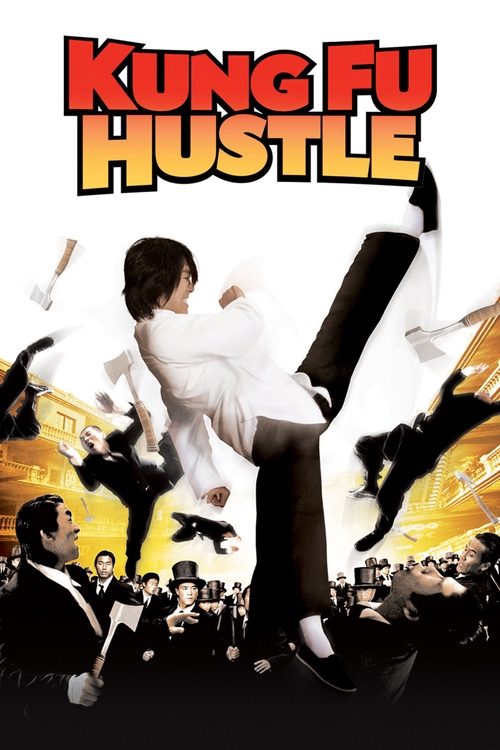
Kung Fu Hustle
2004 · Stephen Chow
For when you want to grin for ninety straight minutes — a crowd-pleaser to put on with friends, or the exact cure for taking movies too seriously. Zero homework required, all comfort.
What it's about
In a stylized 1940s China, the top-hatted Axe Gang runs everything worth running, and a small-time loser named Sing wants in — badly enough to start trouble he can't finish. His scheming brings the gang down on Pig Sty Alley, a ramshackle slum whose grumpy landlady, chain-smoking tenants, and put-upon laborers turn out to be hiding staggering martial-arts talent. Showdowns escalate from there, each one bigger and stranger than the last.
The experience
Pure joy at full velocity — a live-action cartoon where gags snap into jaw-dropping fight scenes without warning. It's silly, then suddenly beautiful, then silly again, and it never stops moving.
Performances
Stephen Chow gleefully plays the fool at the center of his own spectacle, but the film belongs to its veterans — especially Yuen Qiu as the curler-wearing, cigarette-dangling landlady, one of the great scene-stealing turns in action comedy.
The craft
Chow fuses old-school kung fu choreography with Looney Tunes physics and Hollywood-scale digital effects, so bodies stretch, blur, and crater the pavement in ways that still look inventive. The fights are staged as musical numbers of escalating absurdity — the bigger your screen and speakers, the better it plays.
Why it matters
It became the Hong Kong comedy that broke through to Western audiences, the film that introduced a global generation to Stephen Chow and proved slapstick and wuxia could share one frame at blockbuster scale.
Snapshot
Kung Fu Hustle (Gong Fu) is Stephen Chow's maximalist synthesis of Cantonese slapstick, Shaw Brothers wuxia, and Hollywood-scale digital effects — a film that treats the martial-arts movie as both love letter and cartoon. Set in a stylized 1940s China, it follows Sing (Chow), a small-time nobody who talks his way into trouble with the top-hatted Axe Gang, only to stumble onto a slum tenement, Pig Sty Alley, whose bickering working-class tenants turn out to be retired kung fu masters. Building on the international breakout of his Shaolin Soccer (2001), Chow scaled up his sensibility here: bigger stunts, denser effects, and a plot engineered as a series of escalating showdowns. The result was a critical and commercial success that traveled far beyond the usual reach of Hong Kong comedy, becoming for many Western viewers their primary encounter with Chow's signature mo lei tau nonsense humor.
Industry & production
The film was a co-production anchored by Columbia Pictures Film Production Asia — the arm through which Sony/Columbia pursued Chinese-language productions in the wake of Crouching Tiger, Hidden Dragon — together with Chow's own Star Overseas and mainland partners including China Film Group and the Beijing Film Studio, with Huayi Brothers involved in distribution channels. This financing structure is itself significant: it placed a Hong Kong comedian's passion project inside a pan-Chinese, studio-backed apparatus with resources for extensive visual effects and mainland shooting.
Chow served as director, co-writer, producer, and star — the total-authorship model he had been consolidating across his career. Production drew on a deep bench of Hong Kong veterans, several of them coaxed out of relative obscurity or retirement to play the tenement masters, a casting logic that doubles as the film's theme: hidden greatness in unglamorous bodies.
One well-documented production fact concerns the action department. Sammo Hung, one of the towering figures of Hong Kong action choreography, was initially attached as action director but departed the production; Yuen Woo-ping — by then internationally famous for The Matrix and Crouching Tiger — took over as the credited action choreographer. Beyond that transition, granular accounts of the shoot in English-language scholarship are comparatively thin, and specific budget and schedule figures should be treated cautiously.
Technology
Technologically, Kung Fu Hustle is a landmark for Hong Kong cinema's embrace of computer-generated imagery at scale. Visual effects were handled largely by Centro Digital Pictures, the Hong Kong house that had already collaborated with Chow on Shaolin Soccer. The film integrates CGI not as invisible enhancement but as an overtly expressive tool: the shockwaves of the Lion's Roar rendered as visible sound blasts, the Beast's toad-style qi, the physically impossible "Buddhist Palm" descending from the sky, and the Road Runner–style chase in which Sing's legs blur into cartoon motion. This is digital effects deployed in the register of animation rather than realism, and it marks a moment when Hong Kong production could marshal effects density comparable to Hollywood tentpoles while bending it toward a distinctly local comic idiom. Wirework and practical stunt craft remain the foundation — the digital layer sits atop, and in dialogue with, traditional Peking-opera-derived body technique.
Technique
Cinematography
Cinematography is by Poon Hang-sang, a seasoned Hong Kong veteran. The visual scheme leans on saturated, storybook color and a slightly heightened, theatrical framing that suits the film's cartoon logic. Pig Sty Alley is shot as a dense vertical warren, its balconies and courtyards staged for both crowd choreography and vertiginous verticality. Wide, deep-focus compositions let Chow pack the frame with gag business and background action, while the fight sequences shift to a cleaner, legible coverage that keeps the choreography readable — a deliberate contrast to the fragmented editing common in contemporaneous Hollywood action.
Editing
Angie Lam edited the film. The cutting is central to the comedy: Chow's mo lei tau depends on abrupt tonal reversals and deadpan timing, and the editing repeatedly sets up an expectation only to puncture it a beat later. The action, by contrast, is cut to preserve spatial clarity and the impact of individual blows, honoring the Hong Kong tradition of letting the audience see the body do the work. The film also uses rhythmic set pieces — most famously the Axe Gang's synchronized top-hatted dance — that fuse editing, music, and movement into a single showstopping unit.
Mise-en-scène / staging
The staging is the film's richest achievement. Pig Sty Alley is a complete comic ecosystem, populated by vivid character types whose costumes and props announce their function before they fight — the Coolie with his pole, the Tailor in his hoop earrings, the Baker (Donut). The Landlady's curlers, cigarette dangling from her lips, and floral housecoat are a direct nod to a recognizable Hong Kong comic-caricature lineage. Chow's blocking treats the tenement as a stage on which class comedy and martial spectacle share space, and the period Shanghai/Canton milieu is rendered as a deliberately artificial, memory-tinted world rather than a historical reconstruction.
Sound
The score by Raymond Wong (Wong Ying-wah) is a knowing pastiche of classical Chinese instrumental music and the orchestral idiom of vintage Shaw Brothers wuxia. Traditional pieces performed on Chinese instruments punctuate the fights, and the film weaponizes music literally in the sequence where the two Harpist assassins summon spectral swords from a guzheng. The sound design amplifies the cartoon physics — the whip-cracks, the sonic booms of the Lion's Roar, the exaggerated impacts — so that the aural track is as heightened and stylized as the image.
Performance
Performance operates in a broad, presentational key. Chow underplays as Sing, letting the world around him supply the mania. The ensemble is the engine: Yuen Wah and Yuen Qiu as the Landlord and Landlady are the film's comic and dramatic center, Yuen Qiu in particular delivering a now-iconic turn as the chain-smoking termagant who is secretly a master. Danny Chan (Brother Sum) supplies suave villainy, and Bruce Leung, as the harp-playing assassin turned unleashed Beast, embodies the film's reverence for an older generation of screen fighters. Casting long-inactive martial-arts performers is itself a performative statement about the persistence of skill in aging bodies.
Narrative & dramatic mode
The narrative mode is comic-heroic with a sincere sentimental undertow. Structurally the film is a series of escalating combats — thug, then masters, then assassins, then the Beast, then final transcendence — organized as a classic hero's-journey ascent from cowardice to enlightenment. Chow braces the slapstick with genuine pathos: Sing's childhood memory of failing to protect a mute girl, and the lollipop that recurs as a token of innocence, give the cartoon a beating heart. This willingness to hold sincere melodrama and absurdist gag in the same frame is characteristic of Chow, and it is the film's tonal signature.
Genre & cycle
Kung Fu Hustle is a kung fu comedy that self-consciously anthologizes the wuxia and martial-arts tradition. It belongs to the lineage of Hong Kong kung fu comedy that Jackie Chan and Sammo Hung popularized in the late 1970s, while its explicit homages reach back to Shaw Brothers swordplay and to the mythic "secret manual / hidden master" conventions of wuxia fiction. It arrived within, and helped extend, the early-2000s cycle of internationally distributed Chinese-language martial-arts films that Crouching Tiger, Hidden Dragon and Zhang Yimou's Hero had opened to Western audiences — though Chow's contribution is distinguished by its comic register and its cartoon sensibility rather than the wuxia epic's lyric seriousness.
Authorship & method
The film is fundamentally an auteur work in the Chow model of comprehensive control — writing, directing, producing, and starring. His method fuses two traditions: the Cantonese mo lei tau nonsense comedy he had refined across the 1990s, and a deep cinephile reverence for the martial-arts canon. Key collaborators shape the execution: action choreographer Yuen Woo-ping (following Sammo Hung's early involvement) brings the wire-fu vocabulary he had exported to Hollywood; cinematographer Poon Hang-sang supplies the storybook look; editor Angie Lam controls the comic and combat rhythm; composer Raymond Wong grounds the film in an affectionate musical pastiche; and the VFX team at Centro Digital Pictures realizes the impossible. Chow's writing credit is shared with collaborators including Tsang Kan-cheung and others, consistent with the workshop-style scripting common to his productions. The through-line across authorship is a sensibility that treats homage, parody, and sincere feeling as compatible rather than contradictory.
Movement / national cinema
The film sits at a hinge in Hong Kong cinema. Made after the industry's 1990s peak and during a period of contraction, it represents the strategy of survival through co-production and mainland integration, while asserting a defiantly local comic voice. It is Hong Kong filmmaking reaching for a global market on Hong Kong's own terms — the mo lei tau tradition, the Peking-opera stunt lineage, and the Shaw Brothers memory palace, all repackaged with international-grade effects. In this sense it is both a product of post-1997 pan-Chinese consolidation and a monument to a specifically Hong Kong entertainment culture.
Era / period
The film's diegetic period — a stylized 1940s of top-hatted gangsters and teeming slums — is less a historical setting than a nostalgic dreamscape, evoking the world of the old kung fu movies Chow grew up on. Its production era, the mid-2000s, is the moment when digital effects became affordable and expressive enough to let a comedian stage genuinely superhuman spectacle. The film is thus double-dated: a loving reconstruction of cinema's past executed with the newest tools of its present.
Themes
Its central themes are the hidden potential within ordinary people, the redemptive path from selfishness to heroism, and the persistence of tradition and skill beneath modern (or criminal) surfaces. Class runs throughout: the true power resides not with the wealthy Axe Gang but with the poor tenants of Pig Sty Alley, a populist inversion in which the slum is the reservoir of virtue and mastery. There is also a metafictional theme — the film is about kung fu movies, about the myth of the master and the dream of transcendence, and Sing's final ascent to enlightenment reads as a meditation on the genre's own aspirations toward the sublime.
Reception, canon & influence
Critically, Kung Fu Hustle was warmly received internationally, widely praised for its inventive fusion of slapstick, martial-arts craft, and cartoon-logic effects, and it drew frequent comparison to the anarchic spirit of Tex Avery and Looney Tunes cartoons. It performed strongly at home, and is commonly cited as having become the highest-grossing Hong Kong–produced film in the domestic market at the time of its release; exact figures vary by source and should be verified rather than quoted from memory. It was a major awards presence in the Chinese-language sphere, including recognition at the Hong Kong Film Awards and Golden Horse Awards — the specific categories are best confirmed against the record.
Its influences run backward into a dense web of citation. The film draws on Shaw Brothers wuxia and the "secret martial manual" conventions of the genre; the Landlady's Lion's Roar and the general iconography nod to wuxia lore, and the Harpist assassins evoke the supernatural-weapon tradition seen in films like The Bride with White Hair. Beyond Chinese sources, Chow openly quotes American cinema — the Road Runner cartoons in Sing's chase, imagery reminiscent of The Shining in a pursuit gag, and a knife-throwing beat often linked to Gangs of New York's milieu — alongside the wire-fu grammar that Yuen Woo-ping had globalized through The Matrix.
Forward, its legacy is chiefly as the film that carried Stephen Chow's sensibility to its widest audience and demonstrated that Hong Kong could produce effects-driven action comedy at international scale. It consolidated a template — martial-arts spectacle rendered with unabashed cartoon physics and sincere sentiment — that has echoed in subsequent Chinese blockbuster comedy and in the broader global appetite for genre-blending action. Within Chow's own filmography it stands as the peak pairing with Shaolin Soccer and a bridge to his later, effects-heavy directorial work. Its most durable cultural residue may be its images: the Landlady in curlers mid-scream, the Axe Gang's dance, and the Buddhist Palm falling from the heavens have become shorthand references in film culture well beyond the martial-arts audience.
Reception
A smash on arrival — it broke Hong Kong box-office records and became the highest-grossing foreign-language film in the US in 2005, with Roger Ebert comparing it to 'Jackie Chan and Buster Keaton meet Quentin Tarantino and Bugs Bunny.' Two decades on it's less a curio than a comfort classic: for many Western millennials it was the gateway drug to Hong Kong cinema.
How Kung Fu Hustle was received, from release to now →
How to watch Kung Fu Hustle: what to notice on a first viewing
- Notice how each tenant's costume announces their function before they fight. The Coolie's pole, the Tailor's hoop earrings, the Baker's dough all mark a fighter before any punch is thrown. Chow costumes Pig Sty Alley like a comic-book roster. Costume sorts the whole tenement for you at a glance, before anyone speaks.
- Watch how a joke's setup gets punctured a beat later. Angie Lam's editing keeps building an expectation, then cutting it off a moment past comfort. The rhythm trains you to distrust every setup. This is the engine of Chow's mo lei tau nonsense comedy: timing over logic.
- Listen for traditional Chinese instruments underscoring each fight. Raymond Wong's score threads classical instrumental music through the Shaw Brothers orchestral style, tying every showdown back to old wuxia cinema. The music itself is an homage, making the film's love of its genre audible, not just visible.
- Look at how saturated, storybook color fills every wide shot. Poon Hang-sang keeps the palette bright and heightened, closer to a picture book than a period document. The color tells you this 1940s Shanghai is a remembered dream, not a history lesson.
- Watch Chow stay flat and calm while chaos erupts around him. Sing barely reacts to the mounting absurdity; the tenants, gangsters, and effects around him carry all the mania instead. Chow's underplaying is the still point that lets everything around him go cartoonish.
The whole guide to watching Kung Fu Hustle, with the keys for a rewatch →
Influences: the films it descends from and the films it influenced
- Shaolin Soccer (2001) — Chow's own prior collaboration with Centro Digital Pictures established the template of treating human bodies as cartoon projectiles via CGI-augmented wire-fu, which Kung Fu Hustle scales up wholesale.
- Come Drink with Me (1966) — King Hu's musically-timed, balletic swordplay cutting and his lethal female martial hero underwrite the Landlady's whole rhythm and iconography.
- The 36th Chamber of Shaolin (1978) — Codified the 'secret manual → hidden training → mastery ascent' narrative and the wide, legible full-body hand-to-hand coverage that Sing's hero's-journey structure and fight framing inherit.
- The Bride with White Hair (1993) — Its supernatural-weapon assassin aesthetic is directly cited by the Harpist killers, who murder via a deadly musical instrument in the weaponized-music tradition.
- Crouching Tiger, Hidden Dragon (2000) — Yuen Woo-ping's prestige wire-fu here created the international 'crouching-tiger cycle' whose gravity-defying grammar Kung Fu Hustle both extends and affectionately parodies.
- The Matrix (1999) — Yuen Woo-ping's Hollywood-exported wire-fu vocabulary and speed-ramped setpiece grammar are the direct choreographic language remixed in the Axe Gang and Beast sequences.
- Fast and Furry-ous (Road Runner shorts) (1949) — The literal Road Runner desert-chase gag and the impact-cartoon physics (bodies flattened, then unharmed) are quoted directly in Sing's pursuit.
- The Legend of Drunken Master (1994) — Jackie Chan's comic-timing-reversal in choreography — a beat of clumsiness snapping into precision — and its legible, uncut action coverage feed Chow's editing rhythm.
- The Shining (1980) — Kung Fu Hustle's pursuit gag lifts Kubrick's imagery outright as a cinephile homage embedded in the chase framing.
- Gangs of New York (2002) — A specific knife-throwing beat is patterned on Scorsese's staging, absorbed into KFH's magpie citation method.
- The Matrix Reloaded (2003) — Fuses Yuen Woo-ping wire-fu with overt CG augmentation to push bodies past physical limits, exactly the digital-enhancement-of-martial-craft logic Reloaded mainstreamed.
- CJ7 (2008) — Chow pushes the Centro CGI-plus-sincere-sentiment formula further, building an entire creature-comedy on the reconciliation of cartoon effects and genuine pathos KFH perfected.
- Journey to the West: Conquering the Demons (2013) — Scales KFH's cartoon-physics spectacle and heaven-descending Buddhist-Palm iconography into full-CGI wuxia fantasy.
- Kung Fu Panda (2008) — DreamWorks translates KFH's affectionate wuxia-trope pastiche and hidden-master casting logic into animation, treating homage and parody as compatible with earnest feeling.
- Scott Pilgrim vs. the World (2010) — Extends KFH's weaponized-sound and cartoon-impact grammar with onscreen comic-book SFX text and video-game physics governing an action comedy.
- Everything Everywhere All at Once (2022) — Marries cartoon-logic martial-arts absurdism to sincere sentiment — KFH's core move of making parody and genuine emotion coexist within the same fight.
- The Mermaid (2016) — Continues KFH's populist class-inversion satire wedded to CGI spectacle, using cartoon set-pieces to stage the little guy toppling the powerful.
- Kamikaze Girls (2004) — Contemporaneously blends live action with cartoon-physics CG gags and Looney-Tunes speed-lines, a parallel Asian pop-cinema strain of comic-book editing and deadpan absurdist violence.
- Hundreds of Beavers (2024) — Subjects real bodies to Road Runner physics with direct, quoted Looney Tunes homage (the running-legs blur, the anvil logic), fusing wuxia staging with cartoon gags.
- Riki-Oh: The Story of Ricky (1991) — Hong Kong action that renders manga/cartoon impact logic — body-shaped craters, superhuman blows drawn straight from graphic-panel physics — with the same literal-comic-book staging Riki-Oh applies to violence.
Similar films
- Crouching Tiger, Hidden Dragon (2000) — influence & lineage · same viewing thread
- Kung Fu Panda (2008) — influence & lineage
- Come Drink with Me (1966) — influence & lineage
- The 36th Chamber of Shaolin (1978) — influence & lineage
- Everything Everywhere All at Once (2022) — influence & lineage
- Once Upon a Time in China (1991) — same viewing thread
- Dragon Inn (1967) — same viewing thread
- Kill Bill: Vol. 1 (2003) — same viewing thread
All the films related to Kung Fu Hustle →
Watch it with: curated runs of related films
- Wuxia and Its Heirs — Watch these as a bloodline — King Hu's weightless swordplay flowering into Zhang Yimou's painted epics and finally Tarantino's homage, all built on choreography as dance.