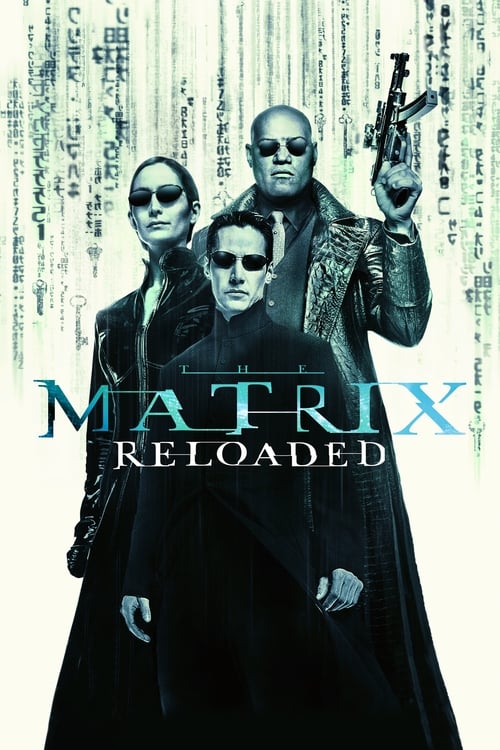
The Matrix Reloaded
2003 · Lilly Wachowski
For when you're deep in a saga and want the world to open up — best watched close on the heels of the original, with an appetite for both fight scenes and ideas.
What it's about
The war widens. Humanity's last city, Zion, swells with freed minds while machine sentinels tunnel toward it — seventy-two hours until breach. Neo, now fully awake to his powers inside the simulation, joins Morpheus and Trinity on a quest for the Keymaker, whose doors lead to the Source of the Matrix itself and to unsettling answers about what 'the One' really means.
The experience
Bigger, denser, and more overtly philosophical than the first film — long stretches of debate punctuated by some of the most ambitious action sequences ever staged. It asks more patience and gives more spectacle.
Performances
Hugo Weaving, multiplied into a small army of Agent Smiths, turns his sneering menace into something like a running dark joke — and the film's most magnetic presence.
The craft
The freeway chase alone — a fourteen-minute collision of cars, motorcycles, and fists staged on a road built for the film — justifies the ticket, and the effects work throughout pushed digital filmmaking to its era's limit. Loud, kinetic, and made for a big screen.
Why it matters
One of the biggest sequels of its decade, it set the template for the modern franchise middle chapter — expanding mythology, deferring resolution — and its set pieces became benchmarks action films are still measured against.
Snapshot
The Matrix Reloaded is the middle panel of the trilogy that began with The Matrix (1999), and it carries the structural burden of all middle films: to widen the world established by its predecessor and to defer resolution to a third. The Resistance grows as more humans are freed and gathered in the subterranean city of Zion; Neo, now fully aware of his powers within the simulation, learns that machine sentinels are tunneling toward Zion and will breach it within seventy-two hours. The narrative spine — a quest to find the Keymaker and, through him, the Source — is in part a pretext for a sequence of set pieces of unprecedented technical ambition, and in part the scaffold for the film's central conceptual reversal: the Architect's revelation that "the One" is not a messianic accident but a designed feature of the system's control architecture, the sixth iteration of a managed cycle. Reloaded is thus a film at war with itself in productive ways — a populist spectacle that interrupts its own momentum with dense philosophical exposition, a sequel that both expands and undermines the heroic myth its predecessor sold. It was, by any measure, one of the major commercial events of 2003 and a landmark in the development of digital cinematography, even as it divided the audience and critics that the first film had unified.
Industry & production
The Matrix Reloaded was co-directed by Lana and Lilly Wachowski (then credited as "The Wachowski Brothers"), produced by Joel Silver for Silver Pictures, and distributed by Warner Bros. Its defining production fact is that it was shot back-to-back with The Matrix Revolutions (2003) as a single extended production — an industrial gamble of the kind more associated with Peter Jackson's contemporaneous Lord of the Rings trilogy than with American studio action filmmaking. Principal photography returned to Fox Studios Australia in Sydney, the base of the first film, but the sequels' scale required infrastructure the original had not. The most conspicuous example was the freeway chase: rather than commandeer existing roads, the production built a purpose-made multi-lane freeway, roughly a mile and a half long, on the decommissioned Alameda Naval Air Station in California, a construction undertaken specifically because no real highway could be closed for the duration and choreography the sequence demanded.
The combined budget for the two sequels has been widely reported in the region of three hundred million dollars, though the precise allocation between the two films is not reliably broken out in public records, and figures attributed specifically to Reloaded should be treated with caution. The transmedia strategy surrounding the release was itself an industrial innovation: The Animatrix, a collection of animated shorts, and Enter the Matrix, a video game whose footage was shot during the main production and whose plot interlocked with the films, were released in coordination with Reloaded, an early and ambitious instance of a coordinated cross-platform franchise rollout. The production was also marked by the death of Gloria Foster, who played the Oracle; she died after completing her work on Reloaded, and the role was recast with Mary Alice for Revolutions — a circumstance the third film folds, with some ingenuity, into its narrative of systemic change.
Technology
If the first film's technical signature was "bullet time," Reloaded's was a more fundamental and less immediately legible advance: what John Gaeta and his collaborators termed "virtual cinematography" and "Universal Capture" (UCap). The Burly Brawl — Neo's fight against scores of replicating Agent Smiths in a Zion courtyard — could not be staged or photographed conventionally, because the density of bodies, the duration of unbroken action, and the impossible camera moves exceeded what live photography and wire work could deliver. The solution was to capture the actors' faces and performances photorealistically using arrays of cameras and high-resolution data, build digital doubles from that capture, and then "shoot" the resulting all-digital environment with a virtual camera unconstrained by physical space. The result is among the first sustained sequences in a mainstream film in which the line between photographed human and synthetic human is deliberately, and largely successfully, effaced. The achievement is uneven — certain shots betray the digital doubles' artificiality, a limitation honestly acknowledged in subsequent technical literature — but the methodology pointed directly toward the photoreal digital humans that would become central to visual effects over the following two decades.
The film leaned heavily on Yuen Woo-ping's wire-assisted choreography for its practical action — the Merovingian's chateau fight, Neo's confrontation with the Twins, the Trinity-and-Morpheus freeway material — combining old-school Hong Kong stunt craft with the new digital pipeline in the same sequences. The freeway chase in particular is an instructive hybrid, intercutting genuine vehicular stunt work performed on the Alameda set with digital extension and digitally assisted impossibilities.
Technique
Cinematography
Bill Pope returned as director of photography and extended the chromatic logic of the first film: the green-saturated cast of the Matrix-world persists, set against the cooler, more naturalistic palette of Zion and the real. Reloaded gave Pope a wider tonal range than the original — the firelit, earth-toned Zion sequences, and especially the cavernous temple rave, are warmer and more organic than anything in the first film, a deliberate contrast meant to give the "real" world a sensuous human texture the simulation lacks. Pope's framing of the action remains committed to spatial legibility, but the sequences staged for virtual cinematography effectively dissolve the conventional role of the cinematographer, since the camera in those passages is a post-production construction rather than a physical instrument — a tension between Pope's photographed material and Gaeta's synthesized material that runs through the film.
Editing
Zach Staenberg returned as editor and faced an intensified version of the structural problem he had managed on the first film: integrating extended, technically heterogeneous set pieces — some photographed, some wholly synthetic — into a coherent rhythm. The freeway chase, assembled from vehicular stunts, fight choreography, and digital effects, is the clearest demonstration of his cutting, sustaining clarity and escalation across a long, multi-strand sequence. The film's larger editorial challenge is one it does not entirely solve: the alternation between propulsive action and long, near-static expository scenes (the Architect monologue above all) produces a pacing that many viewers experienced as a series of stalls between spectacles, a rhythm that is arguably faithful to the film's bifurcated ambitions but works against conventional momentum.
Mise-en-scène / staging
Owen Paterson's production design built Zion as the film's major new world: an industrial, cavernous subterranean city of exposed machinery and human density, conceived in deliberate opposition to the sleek abstraction of the Matrix. The Merovingian's domain — a chateau, a restaurant, a marble-and-brass aesthetic of decadent control — introduces a register of baroque excess absent from the first film, and the character's retinue (Persephone, the ghostly Twins, the Frenchman's thugs) extends the trilogy's iconography toward gothic and European-art-cinema reference. The temple rave in Zion, intercut with Neo and Trinity's lovemaking, is the film's most contested staging choice: an extended, near-plotless sequence of communal, sweat-and-firelit physicality meant to assert the irreducible value of embodied human life against machine abstraction, which a substantial portion of the audience found tonally misjudged.
Sound
Don Davis returned as composer and expanded the orchestral language of the first film into more overtly choral and operatic territory, collaborating with the electronic act Juno Reactor on hybrid orchestral-electronic cues — the freeway chase's driving "Mona Lisa Overdrive" being the most prominent — that fuse symphonic scoring with techno propulsion. The temple sequence is scored to Juno Reactor and Capdown's tribal-electronic material, a pointed stylistic departure. As with the first film, a licensed industrial-and-electronic soundtrack (including Rob Zombie, Rage Against the Machine, and others) positioned the film within a particular youth-culture sound, though the diegetic score does the heavier dramatic work. The sound design preserves the processed, architectural quality of Matrix-world audio against the rawer texture of the real.
Performance
Keanu Reeves plays a Neo who has crossed the arc the first film dramatized: where the original Neo moved from dissociation to mastery, the Reloaded Neo begins in mastery, and Reeves accordingly plays him with a settled, almost weary gravity, a figure burdened by prophecy rather than discovering it. Laurence Fishburne's Morpheus is given a more zealous, faith-driven register here — his belief is tested rather than confirmed, and Fishburne leans into the character's quality of the true believer confronting an institution (Zion's command, Commander Lock) that does not share his faith. Hugo Weaving's Agent Smith is the film's richest performance development: liberated from the system and now able to replicate himself, Smith becomes a viral antagonist, and Weaving plays the multiplied selves with a relishing, contemptuous theatricality. The new ensemble — Jada Pinkett Smith's Niobe, Lambert Wilson's florid Merovingian, Monica Bellucci's Persephone, Harold Perrineau's Link — broadens the trilogy's human and machine social worlds, with Wilson's gleeful villainy a particular tonal addition.
Narrative & dramatic mode
Reloaded operates in the mode of the expanding sequel, trading the first film's clean three-act hero's-journey for a sprawling, multi-stranded quest narrative punctuated by exposition-bearing "operator" figures — the Oracle, the Keymaker, the Merovingian, and finally the Architect — each of whom delivers a piece of the system's hidden logic. The dramatic engine is the ticking clock of Zion's impending destruction, but the film's true structural pivot is conceptual rather than kinetic: the Architect's revelation reframes everything the first film presented as liberation as instead a managed feature of control, the One a release valve engineered to perpetuate the system across iterations. This is a genuinely bold narrative gambit — a sequel that retroactively complicates its predecessor's triumphalism — though its delivery, through a single dense monologue laden with abstract diction, is also the film's most criticized passage, an instance of telling at the precise moment the saga most needed dramatizing. The film ends on a literal cliffhanger (Neo collapsing in the real world; a sentinel attack), declining closure in a way that only the back-to-back production of Revolutions could justify.
Genre & cycle
The film sits within the early-2000s blockbuster science fiction cycle that its own predecessor had largely defined, and it participates in the franchise-and-trilogy logic then ascendant in Hollywood — the contemporaneous Lord of the Rings and Star Wars prequel cycles being the obvious peers. It remains a hybrid of cyberpunk science fiction and Hong Kong–derived martial arts spectacle, but Reloaded tilts the balance toward maximalist effects-driven action and toward a more baroque, mythologized cosmology (programs, exiles, the Merovingian's underworld of obsolete software) that pushes the cyberpunk premise toward something closer to digital theology. Its place in the cycle is double-edged: it confirmed the commercial viability of the philosophically inflected effects blockbuster while also, in its reception, exposing the form's vulnerability to overreach.
Authorship & method
Lana and Lilly Wachowski wrote and directed Reloaded, and it is, even more than the first film, a pure expression of their authorial method: exhaustive pre-visualization, comic-book and anime-derived spatial imagination, and a willingness to subordinate conventional pacing to conceptual and formal ambition. The core collaborators carried over — Bill Pope (cinematography), Zach Staenberg (editing), Don Davis (score), John Gaeta (visual effects), Yuen Woo-ping (action choreography), Owen Paterson (production design) — making the trilogy an unusually stable authorial unit across its run. The Wachowskis' method here is best understood as that of system-builders: Reloaded is less interested in the individual scene than in the architecture of a world and a cosmology, and its successes and failures both follow from that priority. The decision to embed exposition in extended monologue, the commitment to the transmedia universe of The Animatrix and Enter the Matrix, and the back-to-back shoot are all expressions of a totalizing authorial conception of the project as a single integrated work rather than a series of discrete films.
Movement / national cinema
Like its predecessor, Reloaded is an American studio production realized through globalized labor and infrastructure — shot principally in Australia, with American second-unit construction at Alameda, Hong Kong stunt and choreography craft, and an international cast. It belongs squarely to American popular cinema while exemplifying the transnational character of large-scale genre filmmaking in the period. The film's debts to Japanese animation remain legible, and its expansion of the trilogy's cosmology toward anime-scaled mythology (the multiplying Smiths, the program-exiles) deepens that lineage. The use of Australian and Californian production resources within a single film underscores the period's normalization of the geographically distributed blockbuster.
Era / period
Reloaded arrived in May 2003, into a markedly different cultural moment than the millennial anxiety that had received the first film. It is a product of the early digital-effects maturity — the point at which CGI had advanced enough to attempt photoreal digital humans, and at which studios were prepared to finance the back-to-back trilogy as an industrial form. It also arrived in the immediate post-9/11, early-Iraq-War period, and its preoccupations with control systems, prophecy, faith, and the manufacture of consent were read by some critics against that backdrop, though the films were conceived before those events and such readings are interpretive rather than authorial. Industrially, it belongs to the era in which the transmedia franchise — coordinated films, animation, and games sharing a continuity — was being invented as a commercial strategy, a model now ubiquitous.
Themes
The film's governing theme is the collision between free will and determinism, posed more sharply and more pessimistically than in the first film. Where The Matrix dramatized liberation, Reloaded asks whether liberation itself was always already scripted — whether choice is real or merely the system's mechanism for managing its own stability. The Architect's account of the One as a designed iteration converts the heroic prophecy of the first film into a control function, and the Oracle's counter-position (that understanding why one makes a choice, not whether it was foreseen, is what matters) frames a debate the trilogy stages but does not tidily resolve. Causality, control, and the limits of agency recur in the Merovingian's deterministic philosophy and in Neo's refusal of the Architect's prescribed path. The Zion sequences advance a counter-theme: the irreducible, embodied, communal value of human life — sweat, dance, sex, mortality — set against machine abstraction, an argument made through staging and texture as much as dialogue. The trilogy's broader resonance as a narrative of constructed versus authentic identity, including the trans reading that Lilly Wachowski has affirmed for the series, persists here in Neo's rejection of the role the system has assigned him.
Reception, canon & influence
The Matrix Reloaded was an enormous commercial success, among the biggest releases of 2003 worldwide, confirming the franchise's drawing power; precise figures vary by source and are not restated here. Critically, its reception was markedly more divided than the first film's near-consensus acclaim. Reviewers broadly praised the technical achievement — the freeway chase and the virtual-cinematography of the Burly Brawl were singled out as advances in the medium — while a substantial body of criticism faulted the film's pacing, its reliance on lengthy abstract exposition (the Architect scene above all), the temple rave's tonal misjudgment, and a sense that spectacle had outrun the lean clarity of the original. That split — admiration for the craft, frustration with the storytelling — has largely defined the film's critical standing since.
Its backward influences extend those of the first film: Hong Kong wuxia and stunt traditions via Yuen Woo-ping, Japanese cyberpunk animation, the comic-book spatial imagination of the Wachowskis, and the simulation-and-control philosophical lineage running through the trilogy. Its forward influence is most significant in visual effects: the Universal Capture and virtual-cinematography methods pioneered for the Burly Brawl pointed directly toward the photoreal digital humans and the freely virtualized camera that became central to subsequent effects-driven filmmaking, an influence often underacknowledged relative to the first film's "bullet time." Industrially, the coordinated transmedia release of Reloaded alongside The Animatrix and Enter the Matrix was an early, influential model for the cross-platform franchise universe that now dominates studio strategy. Within the trilogy's own afterlife, Reloaded's reception inaugurated the long critical reassessment of the sequels — completed by Revolutions later in 2003 and reopened by The Matrix Resurrections (2021) — in which the middle film's conceptual ambitions have, for some critics, aged into greater respect even as its execution remains contested.
A Deleuzian reading
Halfway through a fight, Neo stops seeing bodies and starts seeing rain.
The full Deleuzian reading of The Matrix Reloaded →
Reception
In 2003 it shattered R-rated box-office records but left fans deflated — too much philosophy-lecture, too much Zion. Two decades on it's the poster child for sequel reappraisal, with a vocal 'the sequels were right all along' camp treating it as misunderstood ambition.
How The Matrix Reloaded was received, from release to now →
Influences: the films it descends from and the films it influenced
- The Matrix (1999) — Established John Gaeta's photogrammetry 'bullet-time' rig that Reloaded extends into the fully virtualized, untethered camera and Universal Capture digital doubles of the Burly Brawl.
- Ghost in the Shell (1995) — Supplied the cascading green digital-rain code and the dive-into-the-net cyberpunk visual grammar the Wachowskis lift wholesale for the Matrix's color cast and interface imagery.
- Akira (1988) — Modeled the comic-panel spatial staging and kinetic urban scale that drives the Wachowskis' pre-visualized, anime-derived blocking of the freeway chase.
- Iron Monkey (1993) — Yuen Woo-ping's wire-assisted wuxia choreography vocabulary — the same hand that staged Reloaded's fights — defining its airborne, gravity-defying combat grammar.
- Hard Boiled (1992) — Pioneered the balletic, choreographed gunplay and heroic-bloodshed staging that informs Neo and the Twins' weapon ballet through the chateau set-piece.
- Final Fantasy: The Spirits Within (2001) — The first feature attempt at sustained photoreal CG humans, posing the uncanny-valley problem that Gaeta's Universal Capture in the Burly Brawl was engineered to solve.
- Jurassic Park (1993) — Set the benchmark for seamlessly compositing photoreal CG elements into live-action plates, the integration standard Reloaded's digital doubles had to meet to read as flesh.
- Avatar (2009) — Industrialized the virtual-camera and performance-capture virtual cinematography that Gaeta prototyped in the Burly Brawl, letting a director freely frame an entirely synthetic scene.
- Spider-Man 2 (2004) — Built its acrobatic set-pieces on fully CG digital stunt doubles seamlessly swapped for actors mid-shot, the technique Reloaded normalized for superhero spectacle.
- Beowulf (2007) — Pushed Universal-Capture-style facial performance reconstruction to a feature-length photoreal-human pipeline, extending the digital-actor research the Burly Brawl pioneered.
- Speed Racer (2008) — The Wachowskis' own maximalist successor, dissolving live actors into a wholly synthetic, layered digital environment built on the virtual-cinematography toolkit Reloaded developed.
- Kung Fu Hustle (2004) — Fuses Yuen Woo-ping wire-fu with overt CG augmentation to push bodies past physical limits, exactly the digital-enhancement-of-martial-craft logic Reloaded mainstreamed.
- Crouching Tiger, Hidden Dragon (2000) — Shares Yuen Woo-ping as action director, applying the same wire-fu rooftop-and-treetop choreography to prestige drama the year before Reloaded scaled it up digitally.
- Kill Bill: Vol. 1 (2003) — Released the same year with Yuen Woo-ping choreographing its sword duels, a parallel Western appropriation of Hong Kong wire-stunt craft into blockbuster cinema.
- The Lord of the Rings: The Two Towers (2002) — Advanced the contemporaneous frontier of photoreal digital doubles (Gollum) and MASSIVE crowd simulation, the parallel VFX track to Reloaded's Smith-replication and Zion battles.
- Equilibrium (2002) — Codified 'gun-kata,' a martial-arts-as-gunplay choreographic system descended from the same Hong Kong wire-and-firearm fusion Reloaded deploys.
- The Matrix Revolutions (2003) — Shot back-to-back with the same repertory (Pope, Staenberg, Gaeta, Don Davis, Yuen Woo-ping); its Burly Brawl pioneered the all-digital crowd-fight tech Revolutions reuses for the airborne finale.
Similar films
- The Matrix (1999) — influence & lineage
- The Matrix Revolutions (2003) — same viewing thread
- Akira (1988) — influence & lineage · same viewing thread
- Neon Genesis Evangelion: The End of Evangelion (1997) — same viewing thread
- Evangelion: 3.0+1.0 Thrice Upon a Time (2021) — same viewing thread
- The Bourne Supremacy (2004) — shared sensibility
- V for Vendetta (2006) — shared sensibility
- The Bourne Legacy (2012) — shared sensibility
All the films related to The Matrix Reloaded →
Watch it with: curated runs of related films
- Bodies at the End of the World — A run of visionary, punishing films where flesh is scarred, melted, mechanized or sacrificed while the world tips into its last days — watch these back to back when you want cinema at its most extreme and transcendent.