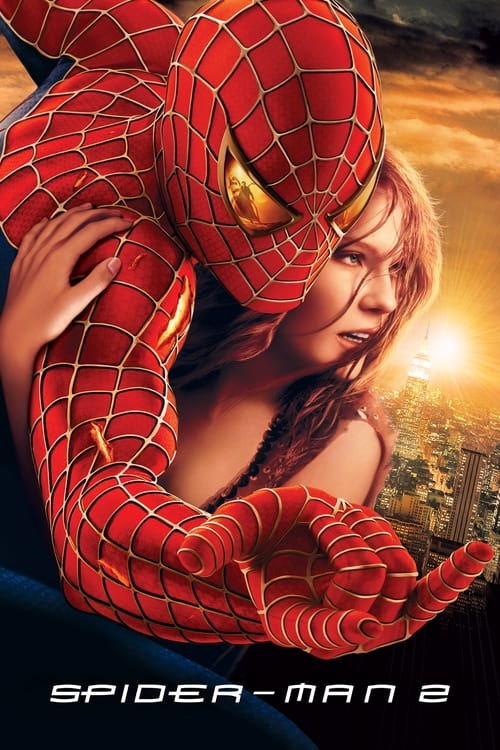
Spider-Man 2
2004 · Sam Raimi
For when you want a blockbuster with a heart — comfort viewing that still earns its emotions, perfect for a crowd-pleasing movie night or introducing someone to what superhero films can be.
What it's about
Peter Parker is falling apart: rent overdue, pizzas delivered late, grades slipping, and his powers sputtering under the strain of a double life. He decides to quit being Spider-Man just as a brilliant scientist's experiment goes catastrophically wrong, unleashing the tentacled Doc Ock on New York — while Mary Jane slips further out of reach and his best friend Harry nurses a grudge.
The experience
Warm, funny, and surprisingly moving, with action that actually means something because you care about the guy in the suit. Raimi's horror-movie glee keeps breaking through the PG-13 surface — one hospital sequence is gleefully unhinged — and the whole thing moves like a rocket.
Performances
Alfred Molina makes Doc Ock a genuinely tragic figure in the classic movie-monster mold — courtly, wounded, terrifying — and Tobey Maguire plays Peter's exhaustion and decency without a hint of irony.
The craft
Sam Raimi directs with slapstick sympathy and a horror veteran's timing, and the elevated-train setpiece remains a benchmark of clear, weighty, emotionally motivated action. Alvin Sargent's screenplay treats duty and renunciation with old-Hollywood earnestness. It's built for the biggest screen you can find.
Why it matters
Widely held up as the high-water mark of the pre-franchise-era superhero film — proof the genre could be personal, funny, and sincere before it hardened into industrial product.
The superhero picture at its most humane, made before the genre hardened into industrial product. Sam Raimi, the Michigan wildman of the Evil Dead films, brought two things the form rarely gets: genuine slapstick sympathy for a hero whose life is falling apart — rent overdue, pizzas delivered late, powers sputtering under psychosomatic strain — and a horror director's glee, unleashed in an operating-room sequence of pure Grand Guignol that has no business in a PG-13 blockbuster. Alfred Molina's Doc Ock is a tragic figure in the Universal-monster mold, and the elevated-train setpiece remains a benchmark of legible, weighty, emotionally motivated action. The screenplay, credited to Alvin Sargent (Ordinary People) from a story co-written by Michael Chabon, treats renunciation and duty with an old-Hollywood earnestness; its debt to Superman II is acknowledged, its influence on every 'burned-out hero' arc since is everywhere. Two decades of multiverses later, it is still the entry filmmakers cite when asked how these movies ought to feel — handmade, sincere, a little screwball, unafraid of corn.
A Deleuzian reading
Two pizzas going cold on the back of a scooter.
The full Deleuzian reading of Spider-Man 2 →
Reception
A critical and commercial smash on release — Roger Ebert called it the best superhero movie since the original Superman — and its stock has only risen since, now routinely invoked as the gold standard the modern superhero glut gets measured against.
How Spider-Man 2 was received, from release to now →
Influences: the films it descends from and the films it influenced
- Evil Dead II (1987) — The deadite rushing-POV 'shaky-cam' and possessed-limb slapstick reappear almost literally in Doc Ock's animatronic arms and the buzz-saw hospital surgery attack, a horror setpiece dropped whole into a superhero movie.
- The Evil Dead (1981) — Raimi's untethered, low-mounted camera charging unbroken through space is the direct grammar behind the web-swinging first-person rushes.
- Darkman (1990) — Raimi's own operatic comic-book melodrama about a disfigured, tragic near-monster is the dry run for turning superhero pathos into full-blown pulp opera.
- Superman II (1980) — The 'hero renounces his powers to live a normal life with the woman he loves, then must reclaim them' arc is lifted structurally intact, including the abdication-and-return beat.
- Superman: The Movie (1978) — Sets the sincere, unironic mythic register and the catching-falling-civilians rescue template that the runaway-train sequence pays off.
- Bride of Frankenstein (1935) — Supplies the sympathetic tragic-monster mold — a decent man deformed by his own science into a rampaging creature he cannot control — that shapes Otto Octavius.
- Raiders of the Lost Ark (1981) — Model for legible geographic action staging in which every beat of a moving-vehicle setpiece reads spatially clear, the discipline Raimi cites for the train fight.
- The General (1926) — Real-space, train-borne physical comedy executed with total spatial clarity — the silent-slapstick DNA of the elevated-train sequence and Peter's pratfall gags.
- King Kong (1933) — Raimi's beloved Harryhausen-lineage creature spectacle, where the tragic beast is animated as a character with pathos, informs the eight-limbed puppetry given genuine menace and grief.
- Spider-Man (2002) — Establishes the whip-pan web-swinging camera and the guilt-engine sincerity of Peter Parker that this sequel refines into its 'burned-out hero' machinery.
- The Matrix Reloaded (2003) — Built its acrobatic set-pieces on fully CG digital stunt doubles seamlessly swapped for actors mid-shot, the technique Reloaded normalized for superhero spectacle.
- Army of Darkness (1992) — The operating-theater massacre is an Army of Darkness sequence in a blockbuster: Deadite-grade shaky-cam POV, Doc Ock's arms puppeteered as practical creature effects with rod operators, and editor Bob Murawski cutting the horror gags to the same percussive rhythm.
- Spider-Man 3 (2007) — Pushes the tragic-villain-as-mirror structure and the horror/slapstick tonal swings of this film further, to the point of overload.
- Drag Me to Hell (2009) — Returns the spring-loaded, gross-out horror-comedy setpiece craft — refined via Doc Ock's surgery scene — to undiluted horror.
- Doctor Strange in the Multiverse of Madness (2022) — Re-imports the Evil Dead rushing camera and jump-scare grammar into a Marvel tentpole, the direct heir of the Doc Ock hospital sequence's horror-in-a-superhero-film move.
- Spider-Man: Into the Spider-Verse (2018) — Inherits the priority on comic-panel action legibility and the everyman-under-the-mask sincerity, translating Raimi's swing kinetics into animated form.
- The Dark Knight (2008) — Escalates the morally-weighted, tragic-cost blockbuster villain and practical large-format setpiece craft that this film proved a comic adaptation could carry.
- Spider-Man: No Way Home (2021) — Establishes the tragic-villain-as-broken-man ethic (cure, don't kill) and Doc Ock's articulated-arm puppetry that No Way Home reprises down to Alfred Molina's restored performance.
- Spider-Man: Brand New Day (2026) — The operatic arc of a Spider-Man who renounces the mask and physically loses his powers is the definitive prior 'loss-of-self' Spider-Man film this one answers.
- The Amazing Spider-Man 2 (2014) — Supplied the structural template of romance-plus-sympathetic-villain, the two-track blockbuster that intercuts a doomed love story against a tragic antagonist's arc.
- Spider-Man: Far From Home (2019) — Source of the horror-inflected, expressionist superhero set-piece (the hospital massacre) that FFH's nightmare illusion updates, and its returning J.K. Simmons Jameson deliberately folds the Raimi trilogy into the MCU's memory.
- How to Train Your Dragon (2025) — Bill Pope's kinetic swinging/flight camerawork here — conveying weight and momentum through the air — feeds his aerial visual vocabulary for the dragon flights.
- X2: X-Men United (2003) — A contemporaneous superhero sequel that plays team morality straight-faced rather than camp, part of the same early-2000s wager on sincerity over irony.
- Batman Returns (1992) — Gothic comic-book opera organized around a deformed, pitiable villain whose tragedy mirrors the hero — the tonal template Raimi extends with Doc Ock.
Similar films
- The Dark Knight (2008) — influence & lineage · same viewing thread
- Spider-Man (2002) — influence & lineage
- Spider-Man: Into the Spider-Verse (2018) — influence & lineage
- Doctor Strange in the Multiverse of Madness (2022) — influence & lineage
- The Avengers (2012) — same viewing thread
- Birdman or (The Unexpected Virtue of Ignorance) (2014) — same viewing thread
- The Dark Knight Rises (2012) — same viewing thread
- The Batman (2022) — same viewing thread
All the films related to Spider-Man 2 →
Watch it with: curated runs of related films
- The Superhero Movie Grows Up — Watch these as one arc — Raimi's warmth into Nolan's gravity into Logan's elegy and The Batman's rain-soaked noir — the two decades the comic-book film reached for real weight.