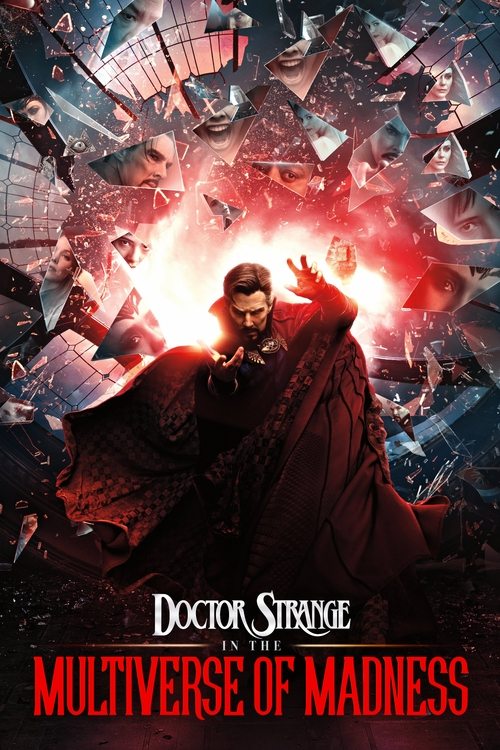
Doctor Strange in the Multiverse of Madness
2022 · Sam Raimi
For a popcorn night when you want spectacle with teeth — big dumb fun that occasionally makes you flinch. Reach for it when a straight superhero movie feels too safe but you're not up for a real horror film.
What it's about
Stephen Strange meets America Chavez, a teenager with a power she can't control — she can punch holes between universes — and something is hunting her for it. The hunter turns out to be Wanda Maximoff, whose grief has curdled into obsession under the influence of a corrupting spellbook, and Strange has to hopscotch across alternate realities to keep America out of her reach. It's a superhero chase movie that keeps swerving into outright horror.
The experience
Fast, loud, and gleefully macabre — Sam Raimi smuggles jump scares, lurching cameras, and gross-out ghoulishness into a Marvel tentpole, so it plays less like a comic-book adventure than a funhouse ride with a body count. More genuinely creepy than you expect from the franchise.
Performances
Elizabeth Olsen is the reason to watch: she plays a woman whose love has rotted into something monstrous and keeps her heartbreakingly human even at her most terrifying — a genuine villain performance inside a franchise machine.
The craft
Raimi's fingerprints are everywhere — whip-pans, canted angles, doors that slam themselves, one bravura sequence that turns music itself into a weapon — and Danny Elfman's score leans into the mayhem. It's a big-screen, big-speaker movie whose reality-hopping visuals go places the franchise rarely dares.
Why it matters
The film that let a horror auteur off the leash inside the biggest franchise in the world, and the moment Marvel's multiverse era showed how weird it was willing to get — a case study in director's-voice-versus-machine that fans still argue about.
Snapshot
Doctor Strange in the Multiverse of Madness is the twenty-eighth feature of the Marvel Cinematic Universe and a sequel to Scott Derrickson's Doctor Strange (2016). It is most usefully understood as a hybrid: a franchise tentpole engineered to advance a continuity-heavy shared universe, directed by a filmmaker — Sam Raimi — whose sensibility was forged in low-budget horror and whose superhero pedigree runs through the foundational Spider-Man trilogy (2002–2007). The film follows Stephen Strange (Benedict Cumberbatch) as he protects America Chavez (Xochitl Gomez), a young woman able to travel between universes, from Wanda Maximoff (Elizabeth Olsen), whose grief over lost, imagined children has curdled into world-devouring obsession under the influence of a corrupting spellbook, the Darkhold. The picture's distinctive character comes from the friction between corporate-blockbuster obligation and authorial voice: it carries the MCU's serialized story load — most crucially the fallout of the Disney+ series WandaVision (2021) — while smuggling in jump scares, possessed corpses, and the frenetic camera grammar of Raimi's earlier work. That tension is the film itself.
Industry & production
The project's production history is legible in its final form. Derrickson, who directed and co-wrote the first film, exited the sequel in early 2020 citing creative differences, remaining as an executive producer. Marvel Studios' subsequent hiring of Raimi was widely read as a deliberate tonal pivot toward horror-inflected spectacle — a genre Marvel had gestured at but rarely committed to. Michael Waldron, fresh from showrunning Loki (2021), wrote the screenplay, reinforcing the studio's mid-Phase-Four strategy of routing feature narratives through its streaming series. The film is deeply enmeshed in that cross-platform continuity: Wanda's motivations are essentially unreadable without WandaVision, and America Chavez arrives as a new franchise asset positioned for future deployment.
Production was affected by the COVID-19 pandemic, which delayed the shoot and, per subsequent reporting, contributed to extensive reshoots — a normal part of MCU practice but here notable given the compressed schedule. The film's release in May 2022 placed it early in the summer season and it performed strongly at the global box office, ranking among the year's largest commercial successes; precise figures are not asserted here, but its commercial standing as a major hit is well established. As with all Marvel Studios output of this period, the film operated inside a rigid institutional machine — Kevin Feige producing, a large visual-effects apparatus, and a house style — within which Raimi's authorship registers as inflection rather than autonomy.
Technology
The film is a fully digital production dependent on large-scale visual effects, executed by multiple vendors under Marvel's supervision. Its most technologically expressive sequences are the multiversal transits, in which Strange and America are hurled through a rapid montage of alternate realities — rendered in radically different visual registers, including a celebrated passage that reduces the characters to flat, paint-like smears of pigment. These sequences foreground compositing and simulation as spectacle in their own right. Elsewhere the film leans on digital de-aging and, more conspicuously, on synthetic recreation of iconography from outside the MCU proper (the "Illuminati" sequence), which required careful effects work to integrate cameo performances into a bespoke reality. The Scarlet Witch's chaos magic, the animated corpse of a variant Strange, and the climactic "dreamwalking" possession all combine practical performance with heavy digital augmentation. The technological achievement is less a single innovation than the seamless orchestration of many pipelines in service of a horror-tinged fantasy palette.
Technique
Cinematography
Photographed by John Mathieson — whose credits include Gladiator (2000), X-Men: First Class (2011), and Logan (2017) — the film adopts a markedly more aggressive visual language than the MCU norm. Mathieson and Raimi favor canted Dutch angles, sudden push-ins, and a mobile, subjective camera that stalks characters and lurches toward threats. The lighting is high-contrast and often gothic, with sequences at Wanda's mountain redoubt and the mirror dimension exploiting deep shadow. This is Raimi's signature "shaky-cam" horror grammar imported into a franchise context, and it is the clearest formal marker separating the film from its predecessor's cleaner, mandala-symmetrical look.
Editing
Bob Murawski, Raimi's longtime editor and an Academy Award winner for The Hurt Locker (2008), cuts the film with the propulsive, sometimes jarring rhythm that defines their collaboration across the Spider-Man trilogy and Drag Me to Hell (2009). The editing is at its most characteristic in the horror set pieces — quick, percussive cutting timed to shock — and in a bravura late sequence in which Strange and a variant sorcerer duel using musical notation as weaponry, a passage where image, cut, and score are tightly interlocked.
Mise-en-scène / staging
The film's production design moves between MCU-standard sorcerous grandeur (Kamar-Taj, the New York Sanctum) and Raimi's more expressionistic instincts. The staging repeatedly quotes horror iconography: a reanimated corpse-Strange draped in the souls of the damned, a witch advancing through rubble, hands bursting from surfaces. Raimi's fondness for grotesque physical comedy and sudden violence shapes blocking that privileges surprise over the clean geometric readability of typical Marvel action.
Sound
Sound design amplifies the horror register — stingers, sub-bass concussions, the crunch and whisper of the Darkhold's corruption. It works in concert with an unusually foregrounded score (see below), and the film's sonic identity is decisively louder, sharper, and more shock-oriented than the first film's.
Performance
Cumberbatch modulates between several variant Stranges, using performance to distinguish the arrogant, the corrupted, and the reflective. Elizabeth Olsen delivers the film's dramatic center: her Wanda is by turns maternal, wounded, and monstrous, and the picture depends on her ability to keep grief legible beneath villainy. Xochitl Gomez introduces America Chavez as the vulnerable audience-surrogate. The film also trades on the frisson of cameo casting in its Illuminati sequence, where the shock is generated as much by casting choices as by the writing.
Narrative & dramatic mode
Structurally the film is a chase — a protector and a hunted asset fleeing an implacable pursuer across worlds — onto which is grafted a redemption/corruption melodrama. Its dramatic mode is fundamentally that of the tragic villain: Wanda's arc, not Strange's, supplies the emotional engine, and the screenplay repeatedly frames her monstrousness as the overflow of maternal love and unbearable loss. Strange's own arc is quieter and more thematic than plotted — a meditation on whether he can be happy, and whether his defining need for control is itself a flaw. The narrative leans heavily on external continuity for backstory, which is both its efficiency and its limitation: it assumes viewers arrive pre-loaded with WandaVision.
Genre & cycle
The film sits at the intersection of two cycles. The first is the mature MCU superhero cycle, by 2022 shifting from standalone origin stories toward multiverse-spanning, continuity-dense event filmmaking — a mode also visible in Spider-Man: No Way Home (2021) and later Everything Everywhere All at Once (2022, a non-Marvel work), reflecting a broader cultural fascination with the multiverse as narrative device. The second is horror. The film consciously operates as a PG-13 horror-adventure, importing the supernatural-menace grammar of the possession film and the reanimated-dead film into the tentpole format. It is one of the clearest examples of Marvel's Phase Four experiment in genre-hybridizing its house product.
Authorship & method
The dossier's central authorship question is what a distinctive director does inside a controlled franchise. Sam Raimi's method — visible from The Evil Dead (1981) through Drag Me to Hell — fuses horror mechanics with cartoonish energy, a roving predatory camera, and a taste for the ghoulish and the gleeful. Multiverse of Madness is the most Raimi-saturated major studio film of its moment: the possessed corpse, the eyeball horror, the Dutch angles, and a cameo by his perennial collaborator Bruce Campbell all function as authorial signatures. Yet the film remains a Marvel Studios product, shaped by Feige's production apparatus, Waldron's screenplay, and the demands of serialized continuity; Raimi's authorship is expressed in texture and staging more than in structure.
His key collaborators reinforce the reading. Cinematographer John Mathieson brought a painterly, high-contrast eye. Editor Bob Murawski, a decades-long Raimi partner, supplied the kinetic cutting. Composer Danny Elfman — who scored Raimi's Darkman (1990) and the first two Spider-Man films — replaced Michael Giacchino from the original Doctor Strange, and his contribution is unusually prominent, culminating in a battle literally fought with music. Screenwriter Michael Waldron carried the multiversal, continuity-braiding logic developed on Loki into the feature. The film is thus best described as a genuine collaboration between an auteur's genre instincts and a studio's serial machinery.
Movement / national cinema
As a Hollywood studio blockbuster it belongs to no art-cinema movement, but it is a significant artifact of the American franchise-cinema regime that dominated global theatrical exhibition in the 2010s and early 2020s — the industrial mode built around interlocking intellectual property, shared universes, and event-scale releases. Its one genuinely distinctive lineage is the American independent horror tradition that produced Raimi himself: the film is a rare case of that low-budget, regional-horror DNA (the Evil Dead pictures were quintessential scrappy independent productions) being transplanted into the most corporate of contexts.
Era / period
The film is a document of the MCU's "Phase Four" — the post-Avengers: Endgame (2019) period in which Marvel Studios expanded aggressively into streaming television and multiversal storytelling while searching, with mixed critical results, for a new organizing throughline after the Infinity Saga. It also bears the marks of pandemic-era production: delays, reshoots, and a theatrical release into a recovering exhibition market. Its reliance on Disney+ series as narrative prerequisites is emblematic of this precise moment in the franchise's history.
Themes
Grief and its refusal to be metabolized is the dominant theme, embodied in Wanda's inability to relinquish the imagined children of her fabricated life. Around this cluster several others: motherhood and the terror of maternal loss; the road not taken, dramatized through the multiverse's parade of alternate selves; the corruption of power, figured in the Darkhold and the seductive logic that one is "the one who should have it"; and control versus surrender, worked through Strange's recurring flaw of needing to hold the knife himself. The multiverse functions thematically as a machine for confronting characters with who they might have been, making self-knowledge — rather than any external MacGuffin — the true stake.
Reception, canon & influence
Critical reception was divided in a revealing way. Many reviewers welcomed the injection of a genuine directorial personality into the increasingly homogenized MCU, singling out Raimi's horror set pieces and Elizabeth Olsen's performance; others found the film narratively thin, over-reliant on WandaVision for emotional coherence, and uneven in tone. This split — auteur texture praised, franchise scaffolding faulted — is itself the film's critical legacy. It became a touchstone in the ongoing debate about whether Marvel's model could accommodate real directorial voice.
Looking backward, the film's influences are unusually traceable: Raimi's own Evil Dead films and Drag Me to Hell supply its horror grammar; the possession and reanimation traditions of the broader genre inform its imagery; and the MCU's own serialized architecture, especially WandaVision and the multiversal groundwork of Loki and Spider-Man: No Way Home, supplies its premise. Looking forward, the film advanced Marvel's multiverse arc and established America Chavez within the franchise; its more durable influence, however, may be as evidence — cited in subsequent industry discourse — that a strong genre stylist could meaningfully reshape the feel of a Marvel film, even as the debate continued over whether the format ultimately constrains such voices more than it liberates them. Where the historical record on internal production specifics is thin, this account declines to speculate; the film's significance rests securely on what is visible in the work: a horror auteur's sensibility rendered legible inside the era's most tightly managed cinematic machine.
A Deleuzian reading
The camera runs the corridor before she does.
The full Deleuzian reading of Doctor Strange in the Multiverse of Madness →
Reception
Divisive on release in 2022 — critics and fans split over its whiplash tone — but as complaints about anonymous MCU house style grew louder, it's increasingly cited as one of the few Marvel films with a visible director, and Raimi devotees have only grown fonder of it.
How Doctor Strange in the Multiverse of Madness was received, from release to now →
How to watch Doctor Strange in the Multiverse of Madness: what to notice on a first viewing
- Watch for shots that arrive low and fast, ahead of anyone. Raimi and cinematographer Mathieson repeatedly send the camera down corridors and toward threats before any character's point of view is established. The camera acts like it belongs to no one, an appetite rather than a person watching.
- Notice the shift to high-contrast, shadow-heavy lighting at Wanda's mountain retreat. Mathieson lights the mirror dimension and Wanda's redoubt in deep gothic shadow, distinct from the first film's cleaner, symmetrical look. The lighting signals when the film shifts from superhero adventure into horror territory.
- Listen for sub-bass stingers timed to sudden shocks throughout the film. Sound design amplifies scares with concussive stingers and a whispering, crunching texture tied to the Darkhold's corruption. The sound tells you this is a horror film wearing a superhero budget.
- Watch Cumberbatch's posture and voice shift across different versions of Strange. Cumberbatch plays arrogant, corrupted, and reflective variants of the same man, distinguishing them through small physical and vocal choices. The multiverse turns one actor into a series of selves, none of them the "real" one.
- Look for hands bursting from surfaces and bodies used as horror props. Raimi repeatedly stages grotesque physical horror, favoring surprise over clean superhero blocking. These are Raimi's own horror signatures, carried intact into a franchise film.
Influences: the films it descends from and the films it influenced
- Drag Me to Hell (2009) — Direct source of the film's horror grammar: percussive jump-scare cutting, sub-bass demonic stingers, and grotesque bodily assault staged for a PG-13 audience through implication rather than gore.
- Spider-Man 2 (2004) — The Doc Ock hospital-massacre sequence is Raimi's proof-of-concept for smuggling a full Evil Dead horror set piece into a studio superhero film — chainsaws, screaming, roving camera — a method the seed scales up.
- Spider-Man: No Way Home (2021) — Immediate sibling that pioneered the MCU's cameo-casting frisson and multiversal-compositing spectacle, and whose serialized continuity the seed's premise directly extends.
- Spider-Man (2002) — Raimi re-imports his horror shock-cutting, jump scares and macabre camera lunges into the industrialized MCU, closing the loop by proving his 2002 grammar still defines superhero action.
- Doctor Strange (2016) — Completes the horror handoff Derrickson began, making explicit the grotesque body-horror and uncanny mode latent in the first film, now inflected with Raimi's Evil Dead kineticism and jump-scare grammar.
- Spider-Man: Far From Home (2019) — Returns Raimi's horror-set-piece craft to the MCU and extends FFH's reality-warping, weaponized-illusion spectacle into full expressionist blockbuster horror.
- Army of Darkness (1992) — Reassembles the same crew grammar at Marvel scale — Murawski cutting, animated skeletons, the severed/possessed hand gag, and horror set pieces smuggled into a fantasy adventure via crash zooms and Dutch-angle chase coverage lifted from the castle sequences.
- The Evil Dead (1981) — The seed inherits Raimi's roving, low-to-the-ground predatory 'force-POV' camera that rushes through space as an unseen malevolent presence — deployed in Doctor Strange when the Scarlet Witch stalks the Illuminati.
- Evil Dead II (1987) — Supplies the fusion of splatstick horror with cartoonish slapstick timing — Dutch-angled ghoulishness played simultaneously for scares and gleeful comedy, the exact tonal register of the possessed-corpse and eyeball gags.
- Darkman (1990) — The template for Raimi directing a comic-book property as gothic-expressionist horror, and the first pairing with Danny Elfman's operatic, foregrounded gothic scoring that returns here.
- The Cabinet of Dr. Caligari (1920) — Ancestor of the gothic high-contrast lighting and canted, unstable geometry that German Expressionism bequeathed to horror, which Raimi and DP John Mathieson channel into the Dutch-angle vocabulary.
- Evil Dead (2013) — Sibling that carries the Raimi possession-and-reanimation grammar forward — the demonically corrupted body and force-POV camera — showing the same authorial toolkit extended by a successor.
- Sam Raimi's Spider-Man (2002) — Established the Elfman-Raimi comic-book collaboration and the practice of building spectacle around a tragic, sympathetically-motivated antagonist, prefiguring Olsen's grief-driven villain.
- Everything Everywhere All at Once (2022) — Sibling exploring the multiverse-as-road-not-taken through a grieving mother's fractured selves, using rapid-fire reality-hopping and compositing spectacle to externalize maternal loss — the same thematic-formal problem in an indie register.
- WandaVision (2021) — The serialized ancestor that built Wanda's grief-and-maternal-loss arc; the seed is narratively dependent on it for the emotional coherence of Olsen's tragic-villain turn.
- Loki (2021) — Screenwriter Michael Waldron's continuity-braiding, multiverse-logic architecture was developed here and carried directly into the feature's narrative scaffolding.
- Poltergeist (1982) — Ancestor of the studio-scale PG-13 haunted-house set piece — foregrounded orchestral menace, reanimated bodies, and family-melodrama-as-horror — the commercial mode Raimi operates within.
- Jacob's Ladder (1990) — Ancestor of the twitching, strobing, percussively-cut horror-vision aesthetic — demonic figures glimpsed in fractured motion — that informs the seed's editing rhythms.
- Constantine (2005) — Sibling in the occult-superhero mode, treating comic-book sorcery through horror iconography and infernal imagery rather than sci-fi gloss.
Similar films
- Spider-Man: No Way Home (2021) — influence & lineage
- Spider-Man 2 (2004) — influence & lineage
- Everything Everywhere All at Once (2022) — influence & lineage
- Doctor Strange (2016) — shared sensibility
- Avengers: Infinity War (2018) — shared sensibility
- The Avengers (2012) — shared sensibility
- Avengers: Endgame (2019) — shared sensibility
- Spider-Man: Across the Spider-Verse (2023) — shared sensibility
All the films related to Doctor Strange in the Multiverse of Madness →