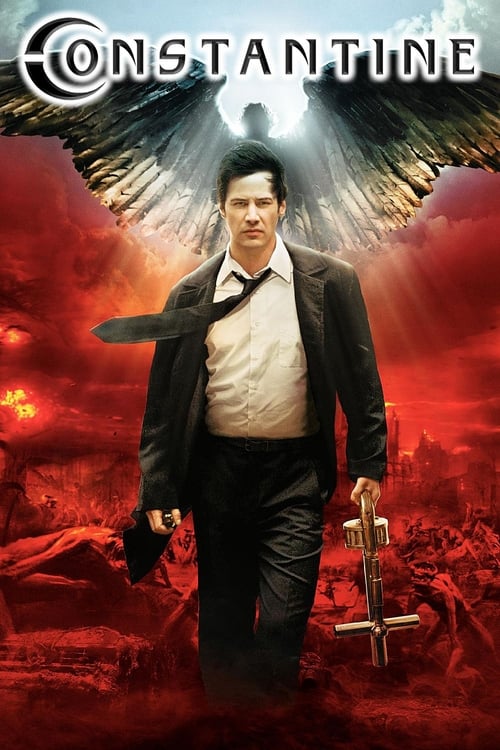
Constantine
2005 · Francis Lawrence
For a night when you want pulpy, confident genre fun with a dark streak — occult mythology, a world-weary hero, and Hell rendered in style. Comfort-food horror-action rather than a true scare.
What it's about
John Constantine is a chain-smoking Los Angeles exorcist who has literally been to Hell and is trying to buy his way back into Heaven's good graces. When a detective asks him to explain her twin sister's impossible suicide, the investigation pulls them both into the hidden war between angels and demons running beneath the city — and toward a scheme that could tip the balance for good.
The experience
Moody, sardonic, and stylish — a detective story that happens to feature holy water and demons. It plays like noir with brimstone: more dread and attitude than jump scares, with bursts of inventive supernatural action.
Performances
Keanu Reeves' deadpan fatalism fits the doomed exorcist like a trench coat, Tilda Swinton is a genuinely unnerving androgynous Gabriel, and Peter Stormare's late-arriving Lucifer is a scene-stealing piece of casting people still talk about.
The craft
Francis Lawrence, in his feature debut out of music videos, gives the film a sleek, sulfurous look — a bleached, burning vision of Hell as an eternal traffic-scorched Los Angeles remains one of the great screen infernos. The demon effects and sound design still hold up, and it plays best loud and dark.
Why it matters
Shrugged off in 2005 as an odd fit in the comic-book boom, it has been steadily reappraised into a cult favorite — the movie fans cite when they argue for the mid-2000s' weirder, R-rated-spirited comic adaptations — and it launched Francis Lawrence's directing career.
Horror · Possession & occult · Religious horror. A chain-smoking exorcist works a noir case through demons, angels and a burning Hell of LA — sulfurous dread with pulpy attitude.
Snapshot
Constantine is a supernatural noir adapted from the DC/Vertigo comic Hellblazer, reworking its chain-smoking English occultist John Constantine into a Los Angeles exorcist played by Keanu Reeves. It was the feature debut of Francis Lawrence, a director who had built a reputation in music videos, and it arrived in early 2005 as Warner Bros. sought to extend the comics-to-screen boom that X-Men (2000) and Spider-Man (2002) had opened. The film welds Catholic cosmology to hard-boiled detective structure: a policewoman, Angela Dodson (Rachel Weisz), enlists Constantine to explain her twin sister's apparent suicide, and the inquiry surfaces a scheme by which the demonic could breach a divinely brokered "balance" between Heaven and Hell. Received at the time as a handsome but uneven studio picture, it has since consolidated a durable cult following, buoyed by Reeves's deadpan gravity and a gallery of stylized supporting turns, and by a long-gestating fan campaign for a sequel.
Industry & production
The project sat at the intersection of two industrial currents: the mining of DC's mature-readers Vertigo imprint for screen properties, and Warner Bros.' ongoing effort to convert its comics library into tentpoles. John Constantine had originated in Alan Moore's Swamp Thing run in the mid-1980s and graduated to his own long-running series, Hellblazer, launched in 1988 under the DC banner that would become Vertigo. Adapting a character defined by grubby British specificity for a globally marketable studio film required substantial transposition, and the production's most consequential decision — relocating Constantine from Britain to Los Angeles and casting an American-inflected Reeves rather than a blond Liverpudlian — was set at the development stage and drew pointed objection from readers of the comic.
The film was produced for Warner Bros. with a roster of production entities including Village Roadshow and the producers associated with the property's development; Lorenzo di Bonaventura, then a prominent studio-executive-turned-producer, was among those steering it. It was a large-budget undertaking — reported in the vicinity of a hundred million dollars, though I would treat any single figure with caution rather than assert it as exact. Its theatrical performance was moderate: a solid but not spectacular domestic run supplemented by international grosses and strong home-video sales, enough to keep the title alive commercially without launching an immediate franchise. The clearest measure of its industrial afterlife is the persistence of sequel development, which recurred over the following two decades with Reeves and Lawrence attached; as of this writing that follow-up remained in a protracted development phase, and I would not state its status more definitively than that.
Technology
Constantine is a product of the mid-2000s moment when digital compositing and CG creature work had matured enough to render a fully imagined Hell but still leaned heavily on practical prosthetics and in-camera atmosphere. The film's signature environment — a Los Angeles rendered as a scorched, wind-flayed underworld, its freeways and skyline reduced to a perpetual firestorm — is a digital-effects set-piece, achieved through matte extension, particle simulation, and composited destruction layered over recognizable geography. The "half-breed" demons combine practical makeup and prosthetic design with digital augmentation, and the film's transitions between the mundane and infernal registers (Constantine dunking his head in a basin of water, a cat used as a conduit) are staged as effects gags that fuse simple practical business with post-production enhancement.
The picture belongs to the last stretch before digital-intermediate color grading became wholly routine and before high-end capture went fully digital; it was shot photochemically and finished with the heavy, controlled color manipulation that defines its look. Its technological ambition is less about a single innovation than about the confident orchestration of many mature tools in service of a coherent metaphysical geography.
Technique
Cinematography
The film was photographed by Philippe Rousselot, a French cinematographer of considerable pedigree (an Oscar winner for A River Runs Through It, with credits including Diva, Interview with the Vampire, and Big Fish). His work here is the picture's most assured technical dimension. The everyday Los Angeles is rendered in a desaturated, slightly sickly palette — greens and steel grays, hard fluorescents — that keeps the "real" world already half-damned. Hell, by contrast, is pushed into scorched amber and sodium-orange, high-contrast and abraded. Rousselot favors controlled, architectural framing and pooled, motivated light that isolates figures against darkness, giving the demonic incursions the quality of noir chiaroscuro rather than horror strobe. The restraint of the camera — measured moves, deliberate compositions — lends the fantastical material a weight that a more frenetic approach would have dissipated.
Editing
Cut by Wayne Wahrman, the film balances the procedural rhythm of its detective plot against the concussive demands of its set-pieces. The editing is at its strongest in dialogue and dread — holding on Reeves, letting exposition-heavy cosmology land — and more conventional in its action grammar, where coverage and impact take precedence. The structure threads a framing device (the recovery of the Spear of Destiny) through the central investigation, and the cutting must manage a fair amount of mythological explanation without stalling; it does so competently, if occasionally at the cost of momentum in the middle passages.
Mise-en-scène / staging
Production design by Naomi Shohan (a frequent collaborator of Lawrence's, and designer on films from American Beauty to Falling Down) is central to the film's identity. The staging insists that the supernatural is not elsewhere but immanent — bowling alleys, hospitals, apartment buildings, and dive bars are the sites of demonic contact. Constantine's arsenal of sanctified objects (cross-etched brass knuckles, a dragon's-breath shotgun, holy water, arcane relics) is treated as blue-collar tooling, and his subterranean bowling-alley lair grounds the occult in a lived-in, slightly seedy urban texture. Papa Midnite's nightclub — a neutral-ground establishment for both sides — is a particularly effective piece of world-building, encoding the film's central conceit of an uneasy détente into a physical space.
Sound
The score is credited to Brian Tyler and Klaus Badelt, blending orchestral menace with electronic and choral textures suited to the film's sacred-profane oppositions. The sound design is expressive in its rendering of the demonic — the pressure-shifts and low-end swells that announce a crossing between worlds — and in the visceral punctuation of the exorcism and combat scenes. Sound is one of the primary means by which the film maintains its atmosphere of immanent dread even in ostensibly ordinary settings.
Performance
Reeves anchors the film with a performance of studied weariness: Constantine as a terminally ill cynic (lung cancer from a lifetime of cigarettes) working off a damnation earned by a youthful suicide attempt. Reeves's characteristic flatness, often held against him, functions here as fatigue and fatalism, and the role's dour minimalism suits him. Around that still center the film arrays deliberately heightened turns: Tilda Swinton's androgynous, chilly Gabriel; Peter Stormare's languid, white-suited Lucifer, whose late cameo is among the film's most cited pleasures; Djimon Hounsou's Papa Midnite; a young Shia LaBeouf as the eager sidekick Chas; and Gavin Rossdale, Pruitt Taylor Vince, and others in the demonic and clerical ranks. Rachel Weisz plays the dual role of the twins Angela and Isabel Dodson, supplying the emotional through-line. The performance strategy — a muted protagonist ringed by baroque figures — is one of the film's defining choices.
Narrative & dramatic mode
Structurally, Constantine is a supernatural detective story overlaid on a redemption drama. Its procedural spine — a death investigated, clues followed, a conspiracy uncovered — organizes what is otherwise a dense mythological exposition, and the film leans on the noir tradition of the compromised investigator moving through a corrupt underworld. The dramatic engine is theological: Constantine seeks to buy his way out of Hell through service, and the plot escalates toward a wager in which his self-sacrifice becomes the instrument of both cosmic rescue and personal salvation. The film's climactic reversal — that an act of genuine, self-abnegating sacrifice earns divine reprieve, and that Lucifer, to spite that grace, cures Constantine's cancer to keep the game going — is a neat theological irony that resolves the redemption arc while denying easy closure. It is a mode that prizes cosmology and mood over psychological interiority.
Genre & cycle
The film sits within the mid-2000s cycle of comic-book adaptations, but genealogically it belongs to a narrower current: the occult-noir supernatural thriller. Its closest kin are films that treat Catholic eschatology as thriller machinery — the End of Days / Prophecy strain of angel-and-demon cinema — and, in its detective-of-the-damned premise, it prefigures and parallels the "supernatural investigator" mode later widespread on television. Within the broader Vertigo-adaptation cycle (which also produced A History of Violence the same year and, later, films drawn from the same mature-readers sensibility), Constantine represents the more overtly commercial, effects-forward end. It is also a horror-inflected action film, importing exorcism-horror iconography into a studio-action frame.
Authorship & method
The screenplay is credited to Kevin Brodbin and Frank Cappello, adapting the Hellblazer material and executing the significant relocation and recasting of its protagonist. The directorial hand belongs to Francis Lawrence, and Constantine is legible as a music-video director's feature debut: strong on image, atmosphere, and set-piece design, more conventional in narrative propulsion. Lawrence's collaboration with Rousselot yields the film's controlled visual scheme, and his partnership with production designer Naomi Shohan — which would continue — establishes the immanent, textured world that is the film's chief asset. The authorial signature is one of tonal control and design coherence rather than idiosyncratic vision; Lawrence's subsequent career (I Am Legend, the Hunger Games sequels) confirms a facility for atmospheric, effects-driven studio filmmaking with a melancholic streak. The key craft collaborators — Rousselot on camera, Tyler and Badelt on score, Wahrman in the cutting room, Shohan on design — together account for much of what distinguishes the picture.
Movement / national cinema
Constantine is a Hollywood studio production and does not belong to a movement in the art-cinema sense. Its most meaningful lineage is industrial and generic: the American comic-book adaptation boom and the studio supernatural-thriller tradition. There is, however, a telling act of national translation embedded in its very premise — the Anglicization of the source material, and the choice to strip Constantine of his British working-class identity and reset him in Los Angeles. That decision, more than any stylistic affiliation, situates the film as an artifact of Hollywood's assimilation of a distinctly British comics sensibility into an American genre idiom, with the friction that transposition generated becoming a lasting part of the film's reception history.
Era / period
The film is very much a product of the mid-2000s. Industrially, it belongs to the pre-Batman Begins, pre-Iron Man phase of comic-book cinema, before the shared-universe model reorganized the whole field — a moment when studios were adapting individual properties opportunistically and tonally, without a franchise blueprint. Technologically, it sits at the hinge between practical and digital effects orthodoxy. And culturally, its earnest engagement with Catholic imagery and post-millennial dread places it alongside a cluster of early-2000s films preoccupied with faith, apocalypse, and the sacred in a secular city. Its "R"-leaning maturity of tone also marks it as belonging to a period before the genre's dominant mode consolidated around a more family-friendly register.
Themes
The film's governing theme is the economy of salvation: damnation and redemption figured as transaction, service, and wager. Constantine is defined by the attempt to purchase grace through works, and the film's climax dismantles that logic by insisting that only unbought sacrifice — self-giving with nothing expected in return — can actually redeem. Around this sit related preoccupations: the idea of "balance," a divinely sanctioned détente between Heaven and Hell in which humanity is the contested prize; free will and the temptation of angelic zealotry (Gabriel's conviction that suffering will make humanity worthy); mortality and the body, with Constantine's cancer as a literalization of a life spent in proximity to damnation; and the immanence of the supernatural within the ordinary fabric of the city. Faith is treated less as consolation than as a hard, transactional reality — belief as knowledge, and knowledge as burden.
Reception, canon & influence
Critical reception in 2005 was mixed. Reviewers frequently praised the film's visual atmosphere, Rousselot's cinematography, and the relish of the supporting cast — Swinton's and Stormare's turns especially — while faulting the muffled protagonist, the exposition-heavy middle, and, from readers of the source, the wholesale departure from Hellblazer's British Constantine. It was widely received as a stylish but somewhat inert studio effort rather than a breakout.
Its backward influences are legible and specific. The film draws on the Hellblazer comics and the broader Vertigo house style of streetwise occultism; on the Catholic-apocalypse thriller tradition; on film noir's compromised-investigator archetype; and on exorcism horror's iconography. Its transposition to Los Angeles places it in dialogue with a long line of films that render that city as a site of hidden corruption beneath a sunlit surface.
Its forward legacy has grown steadily since release. The film is now a recognized cult item, its reputation notably higher among genre audiences than its opening reception would have predicted, and it is regularly cited as one of Reeves's more distinctive vehicles between the Matrix films and John Wick. It stands as an early credit for Francis Lawrence's substantial studio career and for Shia LaBeouf's rise. The character's screen life continued across other media and adaptations in the years that followed, and the enduring campaign for a direct sequel — with Reeves and Lawrence repeatedly attached — is itself a measure of the goodwill the film accrued over time. In sum, Constantine is a picture whose stature has inverted with age: modest in its moment, it has been retrospectively adopted as a stylish, idiosyncratic entry in the supernatural-comics canon.
A Deleuzian reading
A man leans over a bathroom sink, takes a breath, and pushes his face under.
The full Deleuzian reading of Constantine →
Reception
Shrugged off in 2005 as another muddled mid-2000s comic-book movie — and hated by Hellblazer purists for turning a blond Liverpudlian into Keanu in a black tie — it's since been reappraised as one of the era's best-kept secrets, with fans (and Keanu himself) campaigning for a sequel for years.
How Constantine was received, from release to now →
How to watch Constantine: what to notice on a first viewing
- Notice how sickly green ordinary Los Angeles scenes look. Rousselot renders the everyday world in desaturated greens and steel grays, while Hell later burns in scorched amber and sodium-orange. Color tells you which version of the same street you are standing on.
- Watch what Constantine does before he sees anything supernatural. He dunks his head in a basin of water, or uses a cat the same way, as a mechanical technique for crossing into Hell. Hell here is not another place; it is the same city seen as pure appetite beneath its ordinary surface.
- Watch how still Keanu Reeves's face stays throughout. His flatness never breaks, while the supporting cast flicker with constant expression and behave like weather. One face holds a single quality; the others discharge feeling and power.
- Count how often Constantine lights a cigarette. The cigarette recurs at nearly every turn of stress, comfort, and dread, tying his habit to the illness quietly killing him. The cigarette is comfort, clock, and invoice at once: he is dying of the thing that steadies his hands.
- Listen for the low pressure-shift sound before a crossing. A distinct swell or drop in the sound design announces demons breaching into ordinary rooms, hospitals, and bars. Sound tells you the supernatural is already present in the room before anything appears onscreen.
The whole guide to watching Constantine, with the keys for a rewatch →
Influences: the films it descends from and the films it influenced
- The Exorcist (1973) — Establishes the exorcism-as-setpiece grammar — bodily contortion, holy-water combat, ritual against an immanent possessing entity — that Constantine restages in its deliverance sequences.
- Rosemary's Baby (1968) — Codifies the Catholic-apocalypse thriller of Satanic conspiracy hidden inside ordinary urban life, the immanent-evil-among-the-mundane staging Constantine transplants to Los Angeles.
- Angel Heart (1987) — Welds film noir's compromised private investigator to occult damnation, giving Constantine its template of a supernatural detective whose real case is the ledger of his own soul.
- Jacob's Ladder (1990) — Invents the strobed, undercranked, head-shuddering movement of onscreen demons and fleeting hell-glimpses that Constantine reworks into its digital Hell compositing.
- The Prophecy (1995) — Models the baroque, deadpan-eccentric casting of celestial beings (Walken's Gabriel) that Constantine answers with Swinton's androgynous Gabriel and Stormare's dandy Lucifer.
- Se7en (1995) — Supplies the desaturated, silver-retention grime palette and procedural-descent structure applied to a Judeo-Christian sin-and-apocalypse crime narrative.
- The Devil's Advocate (1997) — Casts Keanu Reeves inside a glossy Catholic-damnation thriller opposite a scenery-chewing embodied Satan, prefiguring both his casting and the film's economy-of-salvation stakes.
- Blade Runner (1982) — Renders a city as spiritually corrupt underworld through noir chiaroscuro and rain-and-shadow production design, the LA-as-hidden-corruption scheme Rousselot and Shohan extend.
- The Matrix (1999) — Engineers Reeves's deadpan reluctant-savior persona and black-coated occult-cool that Constantine directly trades on for its muffled, chain-smoking protagonist.
- Blade (1998) — Runs the occult as a licensed institution with jurisdictions and intermediaries, and sends a trench-coated protagonist out after a curated relic loadout — Blade's monster-hunter-with-a-kit cycle restaged in theological dress.
- I Am Legend (2007) — Extends Lawrence's authorial method — melancholic lone protagonist, desaturated atmospheric metropolis, practical-digital hybrid creature compositing — into an apocalyptic city.
- Legion (2010) — Direct heir to the angels-and-Catholic-apocalypse war film, again staging Gabriel as a celestial combatant in a contemporary American setting.
- Priest (2011) — Comic-book-adapted, desaturated occult-action feature extending the Vertigo/dark-fantasy studio cycle Constantine helped seed in the pre-shared-universe era.
- John Wick (2014) — Capitalizes on Reeves's stoic-deadpan minimalism and builds a hidden-institution mythology beneath the visible city, the structural move Constantine pioneered for his post-Matrix roles.
- Doctor Strange (2016) — Mainstream comic-book sorcerer film whose digital-magic compositing and occult-initiation arc extend Constantine's template of arcane spellwork rendered as effects setpiece.
- End of Days (1999) — Contemporaneous millennial Catholic-apocalypse action thriller staging an embodied Satan stalking a modern city, working the same economy-of-salvation subgenre.
- Dark City (1998) — Comic-inflected neo-noir whose desaturated palette and production design build an immanent metaphysical world governed by hidden supernatural powers.
- Hellboy (2004) — Contemporaneous comic-book occult-detective adaptation reframing a wisecracking paranormal investigator through baroque creature design and Catholic demonology.
- Doctor Strange in the Multiverse of Madness (2022) — Sibling in the occult-superhero mode, treating comic-book sorcery through horror iconography and infernal imagery rather than sci-fi gloss.
Similar films
- John Wick (2014) — influence & lineage
- The Devil's Advocate (1997) — influence & lineage
- The First Omen (2024) — same viewing thread
- The Conjuring: Last Rites (2025) — same viewing thread
- Sin City (2005) — shared sensibility
- Bad Lieutenant (1992) — shared sensibility
- Sinners (2025) — shared sensibility
- The Batman (2022) — shared sensibility
All the films related to Constantine →
Watch it with: curated runs of related films
- The Fear of God — A run of horror where faith is the battleground: believers, doubters and zealots meet the devil, damnation and an afterlife that answers back, from Puritan farms and Roman convents to the catacombs under Paris.