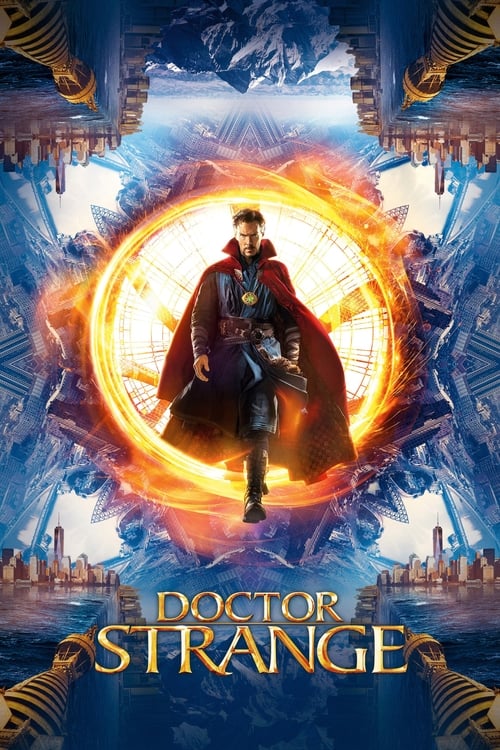
Doctor Strange
2016 · Scott Derrickson
When you want dazzling popcorn spectacle with a trippy edge — an easy, fun night in that occasionally makes your jaw drop. Pure comfort viewing with a visual kick.
What it's about
A brilliant, insufferably arrogant neurosurgeon loses the use of his hands in a car accident and burns through his fortune chasing a cure. The search leads him to a hidden order of sorcerers in Kathmandu, where a teacher known as the Ancient One breaks down his materialist certainty and rebuilds him as a student of magic — just as a rogue disciple threatens the barriers protecting the world.
The experience
A brisk, confident origin story that keeps folding the ground out from under you — literally, in kaleidoscopic set pieces where cities bend like origami. It's witty and propulsive, with a genuine sense of vertigo when the visuals go fully psychedelic.
Performances
Benedict Cumberbatch gives Strange a sharp, prickly charisma that makes the humbling land, and Tilda Swinton brings a sly, serene strangeness to the Ancient One.
The craft
The effects work is the star: fractal mandalas, mirror-dimension cityscapes folding in on themselves, and astral-plane sequences that translate Steve Ditko's psychedelic comic panels into blockbuster scale. It's one of the superhero films that genuinely justifies the biggest, brightest screen you can find.
Why it matters
It opened the mystical wing of the Marvel Cinematic Universe and pushed blockbuster effects toward reality-bending abstraction, proving a mainstream tentpole could go full psychedelic.
Snapshot
Doctor Strange is Marvel Studios' fourteenth feature and the film that formally opened the mystical, metaphysical wing of the Marvel Cinematic Universe. Adapting a character Steve Ditko and Stan Lee introduced in Strange Tales #110 (1963), it follows Stephen Strange, a virtuoso neurosurgeon whose hands are ruined in a car accident and who, in seeking a cure, is remade as a student of sorcery under the Ancient One in Kathmandu. Its distinction within the franchise is less narrative than perceptual: where earlier MCU entries had trafficked in armored spectacle, Doctor Strange built its identity on the plasticity of space itself—folding cities, fractal mandalas, astral projection—translating Ditko's psychedelic comics panels into a mainstream tentpole idiom. Directed by Scott Derrickson, a filmmaker who had previously worked almost exclusively in horror, it is a studio origin story executed with unusual formal ambition and considerable controversy over its casting.
Industry & production
The film sits squarely in Marvel Studios' Phase Three, the post-Avengers expansion in which the studio began mining more esoteric corners of its catalog after the surprise success of Guardians of the Galaxy (2014) demonstrated audience appetite for non-canonical, tonally adventurous properties. Kevin Feige produced. The choice of director was itself an industry story: Derrickson, known for The Exorcism of Emily Rose (2005), Sinister (2012), and Deliver Us from Evil (2014), reportedly pursued the job aggressively and pitched himself with visual concept art, and Marvel's hiring of a horror specialist for a magic-and-multiverse blockbuster fit the studio's then-emerging pattern of recruiting genre and indie directors and shaping them to a house system.
The production carried a budget in the range of $165 million and shot at Longcross Studios in the United Kingdom, with location work in Nepal (Kathmandu), Hong Kong, and New York City—the latter two largely as plate photography and reference for heavily digital sequences. Commercially the film was a solid success, grossing well over $600 million worldwide (widely reported figures put it around $677 million), a return that confirmed the mystical branch as viable and cleared the way for a sequel. Critically it was well received, if with reservations about a formulaic origin structure—praise centered overwhelmingly on its visual invention.
The production's most consequential controversy was the casting of Tilda Swinton as the Ancient One, a character traditionally depicted as an elderly Tibetan man. The decision drew sustained criticism as whitewashing. Derrickson and co-writer C. Robert Cargill defended the choice on the grounds of avoiding an older "wise Asian mentor" stereotype and, more damagingly, Cargill made public remarks framing the Tibetan identity of the character as a geopolitical liability given the Chinese market—comments that intensified rather than quieted the criticism. Derrickson later expressed regret over aspects of the casting. The episode became a recurring reference point in broader industry debates about representation in Hollywood tentpoles.
Technology
Technologically the film is defined by its visual-effects architecture, which was distributed across major houses including Industrial Light & Magic, Framestore, Method Studios, Luma Pictures, and others. Its signature achievement is the "mirror dimension," in which the physical world folds, mirrors, and recombines around the characters in continuously morphing kaleidoscopic geometries—an escalation of the city-bending effect from Christopher Nolan's Inception (2010) pushed toward fractal, endlessly recursive complexity. The technical problem was one of controlled chaos: generating architectural transformations intricate enough to read as impossible yet coherent enough to preserve spatial legibility and choreography for actors and stunt performers moving through them. The film was released in 3D and IMAX, and it is one of the MCU entries most consciously designed around stereoscopic depth, using its recursive corridors and infinite regressions to exploit the format. It was nominated for the Academy Award for Best Visual Effects (it did not win). The reliance on wholly synthetic environments also meant substantial pre-visualization and motion-capture-adjacent planning, with much of the "camera" in the fold sequences being a virtual construct.
Technique
Cinematography
Ben Davis, by then a Marvel regular (Guardians of the Galaxy, Avengers: Age of Ultron), shot the film digitally. His work balances two registers: a relatively grounded, warm-toned naturalism for the hospital and character scenes, and a heightened, saturated palette for the mystical sequences. Because so much of the environment is generated in post, the photography's real task is establishing believable light, lens character, and camera behavior that the effects work then extends—so that the folding city retains the grain of a physically photographed image rather than reading as pure animation. Davis favors clean, classical framing in the dramatic passages, which throws the disorienting geometry of the action into sharper relief.
Editing
Credited to Wyatt Smith and Sabrina Plisco, the editing carries an unusually heavy conceptual load, because several set pieces depend on cutting to sustain spatial and temporal illusions. The astral-plane sequences intercut physical and out-of-body action; the mirror-dimension chases demand rhythmic clarity amid visual overload; and the climax is built on repetition. The film's editorial signature is the time-loop confrontation with Dormammu, where the same beat recurs with escalating variation—an editing problem as much as a writing one, requiring the cutting to make sameness feel like accumulating comedy and dread rather than error.
Mise-en-scène / staging
Production designer Charles Wood grounds the sorcerers' world in tactile, pre-modern materials—Kamar-Taj's timber and stone, aged libraries, relics and sling rings—so that the magic reads as ancient discipline rather than technology. This deliberately opposes the chrome-and-glass MCU house style established by the Stark films. Staging in the action sequences is organized around the idea that the environment is an antagonist and a tool at once: characters run up folding walls, redirect gravity, and weaponize architecture, so blocking must remain readable while the ground literally reorients. The result is choreography closer to dance or gymnastics than to conventional combat.
Sound
Sound design works to give physical weight to abstractions—the whip and snap of conjured mandala shields, the crystalline shatter of the mirror dimension, the low pressure of the Dark Dimension. In sequences without conventional cause-and-effect physics, sound bears much of the burden of making magic feel materially present and dangerous.
Performance
Benedict Cumberbatch plays Strange with clipped arrogance softening into humility, transposing his established register of brilliant, brittle intellect (a lineage running through his Sherlock Holmes) onto a Marvel hero; he performs an American accent throughout. Tilda Swinton gives the Ancient One a serene, androgynous authority. Chiwetel Ejiofor lends Mordo a moral gravity that pays off in his eventual turn; Mads Mikkelsen brings menace to the underwritten villain Kaecilius; Rachel McAdams anchors the film's emotional realism as surgeon Christine Palmer; and Benedict Wong's Wong supplies dry comic ballast.
Narrative & dramatic mode
Structurally the film is a classical origin story—hubris, fall, exile, apprenticeship, mastery, sacrifice—executed within the MCU's established beats, and its most common critical reservation is precisely this familiarity; the arc rhymes closely with Iron Man (2008), another tale of an arrogant genius humbled and reborn. What complicates the formula is the film's dramatic mode in its resolution. Rather than defeating the cosmic threat Dormammu through force, Strange traps him in a time loop, dying repeatedly until the villain relents out of exhaustion—a climax that resolves through intellect, endurance, and self-sacrifice rather than superior power. It is a deliberately anti-spectacular ending for a spectacle film, and one of the MCU's more distinctive narrative choices, aligning the protagonist's defining trait (cleverness) with the mechanism of victory.
Genre & cycle
Doctor Strange belongs to the superhero cycle at its Phase-Three peak, but it hybridizes that genre with the mystical quest, the portal fantasy, and—by way of its director—strains of horror and the uncanny. It functions within Marvel's serialized model as both a self-contained origin and a setup: its post-credits scenes point toward Thor: Ragnarok and Avengers: Infinity War, and the introduction of the Time Stone and the multiverse concept seeded machinery the franchise would exploit for years. Within the broader cycle of 2010s comic-book cinema, it stands as the moment the MCU committed to magic and alternate dimensions as a permanent register alongside its science-and-technology base.
Authorship & method
Derrickson's authorship is visible less in the standardized MCU dramaturgy than in the film's willingness to court the uncanny and the grotesque—faces multiplying, bodies bending, reality decaying—drawn from his horror sensibility. He co-wrote the screenplay with C. Robert Cargill, his collaborator on Sinister, working from an earlier draft by Jon Spaihts (Prometheus); the credited screenplay is attributed to Spaihts and to Derrickson and Cargill. Cinematographer Ben Davis and production designer Charles Wood supplied continuity with the wider MCU look while accommodating the film's departures. The most audible authorial signature belongs to composer Michael Giacchino, whose score reaches back to 1960s and 1970s psychedelia—prominent harpsichord and unconventional instrumentation—to evoke both the era of the character's creation and its countercultural mysticism, giving the film a sonic identity distinct from the brass-heavy Avengers idiom. Derrickson would develop the sequel before departing over creative differences; Doctor Strange in the Multiverse of Madness (2022) was ultimately directed by Sam Raimi, though the horror-inflected direction Derrickson had established arguably persisted.
Movement / national cinema
The film is not the product of a movement in any auteurist sense; it is an artifact of the transnational Hollywood-franchise system, financed and released by a U.S. studio (Marvel/Disney) but physically produced in the United Kingdom with a substantially British and international crew and cast, and engineered for a global, China-inclusive market. Its production geography and its casting controversy both illustrate the pressures of that globalized model—the Ancient One decision was, by the filmmakers' own account, partly shaped by geopolitical market calculation. If it belongs to any "national cinema," it is the placeless, English-language tentpole industry that dominated 2010s exhibition worldwide.
Era / period
Doctor Strange is a document of mid-2010s blockbuster filmmaking at the height of the shared-universe model, when the MCU's commercial dominance licensed increasingly esoteric material and heavy reliance on wholly digital worldbuilding. It arrived in the same window that made the multiverse a mainstream storytelling device, and its 3D/IMAX-forward design reflects a period when premium large-format exhibition was a central commercial strategy. It also lands amid a broader mid-decade reckoning over representation in Hollywood casting, a debate the film became entangled in.
Themes
The film's governing theme is the surrender of control: Strange, whose identity is built on mastery, must accept that he cannot command outcomes—that healing, magic, and even victory require yielding. This resolves in the climax's logic of sacrifice through repetition, where triumph comes from accepting death indefinitely rather than defeating an opponent. Secondary threads include the tension between knowledge and wisdom (the Ancient One's compromised bargains, Mordo's rigid absolutism curdling into villainy), the relationship of ego to service, and time and mortality as forces to be negotiated rather than conquered—fittingly, given the Time Stone at the plot's center. Derrickson's horror instincts also surface a subtler theme: the thinness of ordinary reality, the sense that the material world is a fragile membrane over vast and indifferent dimensions.
Reception, canon & influence
Critical reception was broadly positive, with near-universal praise for the film's visual imagination and Cumberbatch's performance, and recurring criticism of a rote origin structure and a thin antagonist—the villain problem that dogged much of the MCU's first decade. The whitewashing controversy shaped a meaningful portion of the film's discourse and remains part of its historical record.
Its lines of influence run backward and forward. Backward, the most direct debts are to Steve Ditko's original Strange Tales artwork, whose mandala fields and impossible architectures the film translates almost literally, and to the 1960s psychedelic counterculture that Ditko's imagery both fed and reflected—an influence Giacchino's score makes explicit. Christopher Nolan's Inception is the clearest cinematic antecedent for the folding-city effect, which Doctor Strange escalates into fractal recursion. Its time-loop climax draws on a durable comic and cinematic tradition of the repeating day, of which Groundhog Day (1993) is the touchstone.
Forward, the film's most significant legacy is franchise-structural: it established magic, the mystic arts, and—crucially—the multiverse as permanent features of the MCU, machinery that later powered Avengers: Infinity War and Endgame, Spider-Man: No Way Home, Loki, and the Multiverse of Madness sequel. The character became a connective figure across the shared universe. Its visual-effects innovations in reality-bending environments influenced the look of subsequent franchise spectacle, and its casting controversy fed directly into the industry's ongoing recalibration of representation practices. Within its own line of continuation, the handoff from Derrickson to Sam Raimi for the 2022 sequel marks a notable authorial passage—one horror-trained director's groundwork completed by another, more overtly, in the franchise's first sustained embrace of the horror mode.
A Deleuzian reading
Hands first.
The full Deleuzian reading of Doctor Strange →
Reception
Warmly received in 2016 as the MCU's trippiest visual departure, it's since settled into 'gorgeous kaleidoscope, boilerplate origin story' status — everyone praises the folding cities, fewer defend the script.
How Doctor Strange was received, from release to now →
How to watch Doctor Strange: what to notice on a first viewing
- Watch Strange's hands in every scene. Davis shoots the operating theater around fingers doing precise work. After the crash the same hands shake, get braced, get hidden in pockets. Cumberbatch keeps playing the character from the wrists down. A man whose whole identity sits in his hands loses them in the first act. Everything after that is about what replaces them.
- Watch how little Strange does while the city folds around him. In the chases he mostly runs, clings, and falls. Streets rotate, walls become floors, and buildings close like paper. The choreography belongs to the architecture rather than to any fighter. The action gets its excitement from the environment, not from blows landed. The hero is carried through it more than he drives it.
- Notice the timber, stone, and worn books at Kamar-Taj. Charles Wood builds the sorcerers' world out of aged, hand-made materials: courtyards, chained libraries, metal rings worn on the fingers. No screens and no chrome anywhere in it. Magic is presented as an old discipline rather than a technology, which sets this corner of the Marvel films against the Stark workshop look.
- Listen for the harpsichord in Giacchino's score. The music reaches back to late-sixties psychedelia with plucked keyboards and odd instrument choices, instead of the brass the Avengers films run on. The score dates the character to the era of the comics that made him and keeps the film's magic sounding strange rather than heroic.
- Notice how plainly Davis frames the hospital and apartment scenes. The drama is shot in warm, steady, centered compositions with ordinary lens behavior. Derrickson saves every trick for the moment space starts bending. The straight photography is what makes the folding work. Impossible geometry keeps the grain of a real place that was actually filmed.
The whole guide to watching Doctor Strange, with the keys for a rewatch →
Influences: the films it descends from and the films it influenced
- Inception (2010) — The folding-city street-bend that Doctor Strange escalates into fractal, kaleidoscopic recursion descends directly from Nolan's Paris-folding effect, both grounding impossible geometry in grounded, weight-bearing urban surfaces.
- Groundhog Day (1993) — The 'Dormammu, I've come to bargain' finale weaponizes the repeating-day loop as a war of attrition, adopting Ramis's device of the protagonist accruing knowledge across resets while the antagonist is trapped in ignorance of the cycle.
- The Matrix (1999) — Its combat staged across bending, folding architecture treats the built environment as a malleable construct the adept can rewrite—the same 'reality is code you can edit' choreography, minus bullet-time's slow-motion.
- 2001: A Space Odyssey (1968) — The astral/dimensional-travel montage—hurtling through abstract mandala fields and fractal light corridors—is a direct heir to the Star Gate slit-scan sequence as a template for depicting transcendence through non-representational abstraction.
- Sinister (2012) — Derrickson and co-writer C. Robert Cargill carry over their horror grammar—faces multiplying, bodies distending, reality decaying at the edges of frame—supplying the uncanny grotesquerie that distinguishes Strange from standardized MCU dramaturgy.
- Altered States (1980) — The hallucinatory 'astral push' sequence, in which the hero is flung through violent, body-warping psychedelia, echoes Russell's sensory-deprivation freak-outs as a model for rendering mystical experience as physical assault.
- The Cell (2000) — Its surrealist mirror-dimension design—ornate, painterly impossible interiors treated as navigable psychological space—shares Tarsem's approach of building dreamscapes from art-history motifs rather than sci-fi hardware.
- Enter the Void (2009) — The untethered, drifting subjective camera of Strange's out-of-body sequences borrows Noé's disembodied-consciousness POV that floats through and clips into solid architecture.
- Fantasia (1940) — The 'Sorcerer's Apprentice' segment supplies the founding image of mystic arts as choreographed hand-gestures and glowing sigils, a visual vocabulary Strange updates as its Eldritch-magic 'spell-casting as dance.'
- Constantine (2005) — Mainstream comic-book sorcerer film whose digital-magic compositing and occult-initiation arc extend Constantine's template of arcane spellwork rendered as effects setpiece.
- Doctor Strange in the Multiverse of Madness (2022) — Completes the horror handoff Derrickson began, making explicit the grotesque body-horror and uncanny mode latent in the first film, now inflected with Raimi's Evil Dead kineticism and jump-scare grammar.
- Spider-Man: No Way Home (2021) — Runs directly on the multiverse machinery Strange installed as permanent MCU infrastructure, with a botched Strange spell as the plot engine that reopens cross-reality doorways.
- Avengers: Endgame (2019) — Its time-heist and Strange's '14,000,605 futures' foresight extend the film's loop-and-multiverse logic into franchise-scale plotting, where mystic-arts branching timelines become load-bearing narrative structure.
- Loki (2021) — Formalizes the branching-timeline multiverse Strange normalized into an entire series' premise, taking the mystic-arts concept of variant realities and building bureaucratic sci-fi architecture around it.
- Spider-Man: Far From Home (2019) — Established the MCU's fractal, kaleidoscopic reality-bending VFX vocabulary that Mysterio's set-piece deploys not as magic but as literal weaponized, artist-authored spectacle.
- Prometheus (2012) — Shares screenwriter Jon Spaihts's structural DNA—the awe-before-the-cosmic-unknown origin architecture—whose earlier Strange draft Derrickson and Cargill rewrote, linking both to the 'ordinary expert confronts vast metaphysics' template.
- Ant-Man (2015) — Contemporary MCU experiment in scale-and-space distortion, staging action in a reality-bending 'quantum realm'/Escher-space where environmental geometry, not brute force, is the film's central spectacle.
- Everything Everywhere All at Once (2022) — Independently pushes the folding/recursive-reality and rapid multiverse-hopping montage into maximalist absurdism, a parallel evolution of the same 'consciousness flung across impossible spaces' visual craft.
Similar films
- Doctor Strange in the Multiverse of Madness (2022) — influence & lineage
- Spider-Man: No Way Home (2021) — influence & lineage
- Avengers: Endgame (2019) — influence & lineage
- Avengers: Infinity War (2018) — shared sensibility
- The Avengers (2012) — shared sensibility
- Black Panther (2018) — shared sensibility
- Spider-Man: Brand New Day (2026) — shared sensibility
- Avengers: Age of Ultron (2015) — shared sensibility