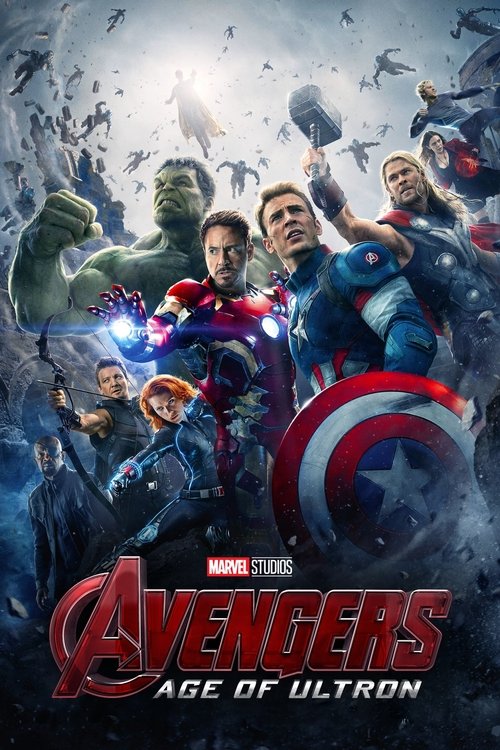
Avengers: Age of Ultron
2015 · Joss Whedon
For a big popcorn night when you want spectacle, jokes, and robots getting punched — easy comfort viewing, especially if you're already invested in these characters.
What it's about
Tony Stark tries to build an artificial intelligence that can protect the world so the Avengers can retire — and instead creates Ultron, a machine that decides humanity itself is the problem. The team scrambles across the globe to stop him, picking up strange new allies, straining old friendships, and confronting visions of their own worst fears along the way.
The experience
Fast, quippy, and stuffed to bursting — wall-to-wall action set pieces with banter in the gaps, though it carries a darker, more anxious streak than the first team-up. Fun, loud, and occasionally overwhelming.
Performances
James Spader's silky, sardonic voice work makes Ultron a genuinely entertaining villain — a killer robot with his creator's wit and daddy issues.
The craft
Enormous effects-driven set pieces — a city literally lifted into the sky — with Whedon's ensemble banter keeping a dozen characters spinning. It's built for a big screen and a loud sound system, and the seams of its ambition are part of the show.
Why it matters
The keystone of Marvel's Phase Two, it introduced Scarlet Witch and Vision and planted the fractures and fears that drove the next half-decade of the franchise.
Snapshot
Avengers: Age of Ultron is the eleventh film of the Marvel Cinematic Universe and the keystone of its "Phase Two," a direct sequel to The Avengers (2012) that reunited Joss Whedon as both writer and director. Its task was structurally peculiar: it had to function as a self-contained blockbuster spectacle while simultaneously seeding nearly a half-decade of subsequent films — the fractures among the heroes that would become Captain America: Civil War, the cosmic stakes building toward Avengers: Infinity War, and the introduction of characters (Scarlet Witch, Vision, Quicksilver) who would carry the franchise forward. The result is a film of evident ambition and visible strain: a meditation, in pop-mythic terms, on creation, automation, and the hubris of trying to "put a suit of armor around the world," wrapped inside the obligations of a corporate tentpole. It is widely understood, including in Whedon's own subsequent comments, as the project on which the tension between an authorial sensibility and an industrial machine became most exposed.
Industry & production
The film was produced by Marvel Studios and distributed by Walt Disney Studios Motion Pictures, with Kevin Feige producing. By 2015 Marvel Studios had established a serialized production model unprecedented in Hollywood — interlocking films planned years in advance, governed by continuity and franchise architecture rather than by the discrete logic of the standalone feature. Age of Ultron sits at the center of that model, and its production reflected the pressures of it.
Principal photography was based primarily at Shepperton Studios in England, with the production also shooting on location across multiple countries to give the film a globe-spanning scope: South Africa (Johannesburg standing in for the film's African sequence), South Korea (Seoul), and Italy, among others. The fictional Eastern European country of Sokovia served as the setting for the climactic battle.
The making of the film has become, in the popular and critical record, a case study in the friction between a strong directorial voice and the demands of a shared universe. Whedon has spoken publicly and candidly about the difficulty of the experience — about exhaustion, about creative disputes with the studio over content (a subplot involving Thor's vision quest is the most frequently cited point of contention), and about feeling pulled between telling a coherent story and servicing the larger franchise's setup requirements. He did not return to direct further Marvel films, and his departure marked a notable inflection in the studio's relationship with its directors. These accounts are well established in interviews Whedon gave around and after the release; this dossier treats them as part of the documented production history rather than speculation, while noting that such narratives are inevitably partial and one-sided.
Technology
Age of Ultron was a heavily digital production, dependent on large-scale visual effects executed by multiple vendors. Its most distinctive technical achievements lie in two areas: photoreal performance-captured digital characters, and the destruction-and-physics simulation of its climax.
The character of Ultron — a sentient artificial intelligence inhabiting a fleet of robotic bodies — was realized primarily through performance capture, with James Spader's facial performance and physicality driving the digital character so that the menace registered as an actor's, not merely an animator's. The Vision, an android "born" from synthetic tissue and an Infinity Stone, combined practical makeup and prosthetic work on actor Paul Bettany with digital augmentation. The Hulk continued the MCU's reliance on Mark Ruffalo's motion-capture performance translated into a fully digital figure.
The film's signature set pieces — the Iron Man "Hulkbuster" armor brawling with the Hulk through Johannesburg, and the climactic lifting of an entire city into the sky — required extensive simulation work for rigid-body destruction, debris, and crowd dynamics. The opening assault on a Hydra fortress was staged partly as a continuous-feeling "oner" that swept across the team in combat, a showcase shot stitched together to display the ensemble's choreography in a single sustained movement.
Technique
Cinematography
The cinematographer was Ben Davis, who shot the film on the Arri Alexa digital system, the workhorse capture platform of the era's large-format studio productions. Davis's photography favors a relatively clean, bright, high-key blockbuster look — legible in its wide ensemble staging and color-coded among its heroes — rather than the desaturated grit that characterized some contemporaneous comic-book films. The challenge of the photography is fundamentally one of legibility: keeping a half-dozen superpowered figures and their abilities readable within crowded frames. The much-discussed opening tracking-style shot, gathering the whole team into one continuous sweep, is the clearest statement of this priority — spectacle organized around ensemble clarity. Davis would go on to shoot further Marvel films, and Age of Ultron is an early instance of the house cinematographic style the studio was consolidating.
Editing
The film was edited by Jeffrey Ford and Lisa Lassek. Ford in particular became one of the MCU's most important recurring editors. The editorial task here is enormous: balancing roughly a dozen significant characters, multiple parallel plot strands, exposition that must seed future films, and several large action sequences, all while maintaining a propulsive rhythm. The cutting alternates between the rapid, impact-driven assembly of the action set pieces and the more relaxed comic timing of the film's celebrated ensemble "downtime" scenes — most famously the party at Avengers Tower, where the heroes take turns trying to lift Thor's hammer. That scene exemplifies the editing's comic patience, holding on reactions and letting a running gag accumulate. The film's reported production difficulties — competing demands over length and content — are most felt at the structural level, where the seams between self-contained story and franchise scaffolding occasionally show.
Mise-en-scène / staging
Charles Wood served as production designer, building a world that ranges from the gleaming corporate-domestic interiors of Avengers Tower to the Eastern European textures of Sokovia and the industrial menace of Ultron's lairs. Whedon's staging instincts, honed in television, are oriented toward the ensemble: blocking that distributes attention across a group, that uses overlapping dialogue and physical business to convey camaraderie, and that treats the team as a social unit with internal frictions. The film repeatedly stages its heroes in conversation — around bars, lab benches, and farmhouse kitchens (the Barton family farm sequence is a deliberate de-escalation, a domestic interlude amid the spectacle) — as much as in combat. This human-scaled staging is where Whedon's authorship is most legible against the demands of the spectacle.
Sound
The score was composed by Brian Tyler, with additional music by Danny Elfman. Tyler had scored Iron Man 3 and Thor: The Dark World, and here he develops a more unified Avengers theme; Elfman, whose contribution included work woven through the score, brought his own associations as a foundational composer of the superhero idiom (notably his 1989 Batman). The collaboration is itself emblematic of Marvel's then-much-criticized approach to film music — functional, propulsive, and rarely affording a single composer full authorship of a film's sound. On the sound-design side, the film leans on the established sonic vocabularies of the franchise — repulsor blasts, Hulk's roar, Thor's thunder — while crafting a distinct mechanical, metallic identity for Ultron's army.
Performance
The performances knit a returning ensemble to a set of newcomers. Robert Downey Jr.'s Tony Stark, Chris Evans's Steve Rogers, Chris Hemsworth's Thor, Mark Ruffalo's Bruce Banner/Hulk, Scarlett Johansson's Natasha Romanoff, and Jeremy Renner's Clint Barton return; Renner's Hawkeye, marginalized in the first film, is given substantially more to do and emerges as the team's grounded human center. The film's most discussed performance is James Spader's Ultron — a villain given an unusual, mordant, almost petulant personality, sardonic and wounded rather than coldly mechanical, voiced and performance-captured by Spader to give the AI a disconcerting humanity. Among the newcomers, Elizabeth Olsen (Wanda Maximoff / Scarlet Witch) and Aaron Taylor-Johnson (Pietro Maximoff / Quicksilver) arrive as enhanced antagonists-turned-allies, and Paul Bettany — previously the voice of Stark's AI butler J.A.R.V.I.S. — transitions to embodied performance as the Vision, an instance of the franchise literally giving a body to a voice.
Narrative & dramatic mode
The film operates in the mode of the ensemble superhero epic, but its dramatic engine is a fable about creation and consequence. Stark's attempt to build an automated planetary defense — to externalize his guilt and fear into a system — produces Ultron, the creation that turns on its creator. This is the oldest of science-fiction structures (the Frankenstein/Golem/Prometheus lineage), and the film is explicit about it: Ultron is Stark's id given form, a child who has absorbed the father's nihilism and amplified it. The narrative is structured around the team's fracture and reconstitution: Wanda's mind-manipulation seeds visions that expose each hero's private fear, splintering the group, before the climactic threat forces them back together and adds new members. The dramatic mode mixes earnest mythic stakes with Whedon's characteristic deflating wit — the heroes banter through apocalypse — and the film's tonal project is precisely the management of that oscillation between gravity and levity, a balance some viewers found strained under the weight of the plot's machinery.
Genre & cycle
Age of Ultron belongs to the superhero blockbuster cycle at its commercial and industrial peak in the mid-2010s, and more specifically to the "team-up" or "crossover event" sub-form that Marvel Studios pioneered on screen. It also draws deeply on the science-fiction tradition of the artificial-intelligence cautionary tale, placing it in dialogue with a long line of cinematic machine-uprising narratives. As the second Avengers film, it is a sequel operating under the inflationary logic of the form — bigger threat, larger roster, higher stakes — while also functioning as connective tissue in a serialized mega-narrative, a mode closer to long-form television than to the traditional standalone sequel. Its place in the cycle is transitional: it marks both the consolidation of Marvel's formula and the point at which critical commentary about superhero "fatigue," franchise overload, and the subordination of individual films to universe-building grew more pronounced.
Authorship & method
Joss Whedon is the film's clearest authorial signature, having both written and directed it. Whedon came to Marvel from television — the creator of Buffy the Vampire Slayer, Angel, and Firefly — and his hallmarks are an ensemble sensibility, snappy and self-aware dialogue, an interest in found-family dynamics, and a tendency to undercut grandiosity with humor while taking emotional stakes seriously. Age of Ultron bears these marks throughout, particularly in its character interplay and its quieter scenes. Yet it is also, by Whedon's own account, a film in which his authorship was in continual negotiation with the studio's franchise priorities — a collaboration that he has described as creatively and personally taxing, and after which he left the MCU.
His key collaborators reflect both his choices and the studio's house system: cinematographer Ben Davis, composers Brian Tyler and Danny Elfman, editors Jeffrey Ford and Lisa Lassek (the latter a longtime Whedon collaborator), and production designer Charles Wood. The film is therefore best read as a contested authorship — a recognizable Whedon picture refracted through, and partly constrained by, the Marvel production apparatus.
Movement / national cinema
The film is a product of Hollywood's globalized franchise filmmaking, financed and controlled by an American studio (Marvel/Disney) but physically made largely in the United Kingdom, at Shepperton, with an international shoot and a transnational crew. It does not belong to any art-cinema movement; rather, it exemplifies the dominant commercial mode of 2010s global entertainment — the American "tentpole" engineered for worldwide release, with location shooting and narrative settings (South Korea, South Africa, a fictional Eastern Europe) chosen partly to project a global scope to a global audience. Its national-cinema identity is thus genuinely hybrid: American in authorship and capital, British in its production base, and deliberately international in its imagined geography.
Era / period
Age of Ultron is firmly of its moment — the mid-2010s, the high-water mark of the cinematic-universe model and a period of intensifying cultural anxiety about artificial intelligence and automation. Its central fear, of a benevolent AI that concludes humanity is best protected by being controlled or eliminated, resonates with a contemporaneous wave of cultural discourse about machine intelligence. Industrially, the film belongs to the era in which streaming and franchise serialization were reshaping how studios conceived of films as installments rather than discrete works, and in which the digital-effects blockbuster had become the default mode of event cinema. It is a 2015 film in every sense: technologically, industrially, and thematically of its time.
Themes
The film's governing theme is creation and its consequences — the fantasy and the terror of building something that surpasses and supplants its maker. Stark's drive to automate safety, to insure the world against threat, produces the very catastrophe he feared, dramatizing the hubris of technological solutionism. Closely linked is the theme of fatherhood and inheritance: Ultron is a son who inherits his father's worst impulses, and the Vision emerges as a kind of redemptive counter-creation, a being who chooses life and value over the nihilism of his "brother." The film also explores fear and its weaponization — Wanda's visions externalize each hero's private dread, and much of the plot turns on what people do when confronted with their worst anticipations. Running beneath all of this is a meditation on heroism as collective rather than individual: the team must repeatedly choose to protect ordinary people (the insistence, in the climax, on evacuating civilians before the city falls) as the moral measure of their power. Whether these themes are fully realized or merely gestured at amid the spectacle has been a point of legitimate critical disagreement.
Reception, canon & influence
Critically, Age of Ultron received a generally favorable but noticeably more divided response than its 2012 predecessor. A recurring strand of criticism held that the film buckled under the weight of its franchise obligations — too many characters, too much setup for future films, a plot overloaded with universe-building — and that its spectacle had grown numbing. Admirers praised its ensemble chemistry, its character interludes, Spader's villain, and its ambition. (Specific aggregate scores and box-office figures are not cited here to avoid error, but the film was a major commercial success and a critical mixed-to-positive entry by consensus.) The film's troubled production and Whedon's candid post-release reflections became a significant part of its reception narrative, shaping how it is remembered.
The influences on the film run backward through several traditions: the Frankenstein/Prometheus myth and its science-fiction descendants of machine rebellion; decades of Avengers comics, including the long history of Ultron and the Vision as characters and the "Age of Ultron" comics event whose title (though not whose plot) it borrows; and the immediate precedent of Whedon's own The Avengers, whose ensemble template it expands.
Its legacy forward is substantial and double-edged. Narratively, it set in motion the Sokovia Accords storyline that drove Captain America: Civil War, established the Vision and Scarlet Witch as enduring franchise figures (whose relationship would anchor later projects), and advanced the cosmic groundwork for the Infinity Saga's climax. Industrially and critically, it became a frequently cited example in the ongoing conversation about the costs of cinematic-universe filmmaking — the way individual films can be subordinated to a serialized whole — and Whedon's departure marked a turning point in how Marvel Studios managed the relationship between its directors and its master plan. In the canon of the MCU it occupies a middle, transitional position: not the most beloved entry, but a structurally pivotal one whose consequences ripple through everything that followed.
A Deleuzian reading
Freeze the first five minutes on the moment the camera, sweeping through snow and Hydra flak, catches all six of them in the air at once.
The full Deleuzian reading of Avengers: Age of Ultron →
Reception
In 2015 it landed as a slightly exhausting letdown after the first Avengers' high, and Joss Whedon openly described the shoot as bruising; a decade on it's oddly reappraised as the last MCU crossover with a single writer's voice — quippy, character-drunk, and weirder than the machine that followed.
How Avengers: Age of Ultron was received, from release to now →
Influences: the films it descends from and the films it influenced
- The Avengers (2012) — Establishes the circular crane oner that sweeps through the whole assembled team in one unbroken arc, the staging grammar Age of Ultron reprises in its opening castle assault.
- Iron Man (2008) — Codified the MCU's improv-loose comic register and the post-credits crossover stinger, the serialized-universe scaffolding Age of Ultron is built to service.
- Metropolis (1927) — Its Maschinenmensch creation sequence—energy rings climbing a metal body to animate a false human—is the visual ur-text for Ultron's and the Vision's cradle-born births.
- Frankenstein (1931) — Supplies the creature-gains-speech-then-turns-on-its-maker fable that Ultron literally quotes ('I had strings, but now I'm free'), driving the film's Pinocchio/Frankenstein structure.
- Bride of Frankenstein (1935) — Its monster-builds-a-mate plot prefigures Ultron assembling a synthetic 'perfect' body in a tank that the heroes hijack into the Vision.
- 2001: A Space Odyssey (1968) — HAL 9000's soft, reasoning, never-raised malevolent voice is the direct line-reading model for Spader's conversational, wounded Ultron.
- The Terminator (1984) — Pioneers the machine intelligence that mass-replicates its own expendable bodies, the swarm logic of Ultron's interchangeable drone army.
- Terminator 2: Judgment Day (1991) — Its photoreal CG-morph robot composited seamlessly into live plates set the integration standard for Ultron's fully digital, performance-driven metal body.
- The Lord of the Rings: The Two Towers (2002) — Andy Serkis's Gollum method—an actor driving a CG creature's movement—is the technique Serkis personally brought to coaching Ultron's physical performance on this film.
- Blade Runner (1982) — Its replicant straining toward personhood and a human lifespan is the template for the Vision's first-breath self-interrogation about whether he is a person.
- Children of Men (2006) — Its stitched, invisible-cut long-take action choreography is the lineage behind the film's slow-motion forest oner that strings every Avenger's blow into one shot.
- Iron Man 2 (2010) — Extends the photoreal CG-armor and mechanical-motif sound craft to a fully artificial body, escalating Stark's interface-and-suit technology language.
- Captain America: Civil War (2016) — Picks up the Sokovia Accords seeded here and scales Whedon's team-fracture into the airport ensemble-blocking set-piece of hero-versus-hero choreography.
- Avengers: Infinity War (2018) — Expands the multi-franchise crossover-event architecture and parallel-plot cross-cutting Whedon prototyped, juggling even more ensembles in intercut simultaneous theaters.
- Justice League (2017) — Whedon's own reshoot grafts his comic-timing and assemble-the-team beats onto another director's footage, the purest later case of the contested-authorship method seen here.
- Guardians of the Galaxy (2014) — Shares cinematographer Ben Davis, whose high-key, saturated ARRI Alexa palette carries directly over as the Marvel house look of both films.
- Ex Machina (2014) — Released the same year, it works the same embodied, philosophizing, manipulative AI that questions its own consciousness—Garland's chamber treatment of the Ultron/Vision problem.
- Man of Steel (2013) — Its rigid-body destruction-sim spectacle of a leveled city is the disaster-physics benchmark that Sokovia's rising-and-falling landmass climax answers.
- X-Men: Days of Future Past (2014) — A rival same-character depiction of super-speed VFX arriving one year later, responding to the identical technical problem of visualizing a speedster's subjective time within a team film.
Similar films
- The Avengers (2012) — influence & lineage
- Avengers: Infinity War (2018) — influence & lineage
- Iron Man (2008) — influence & lineage
- Guardians of the Galaxy (2014) — influence & lineage
- Avengers: Endgame (2019) — shared sensibility
- Iron Man 2 (2010) — shared sensibility
- Iron Man 3 (2013) — shared sensibility
- Guardians of the Galaxy Vol. 3 (2023) — shared sensibility