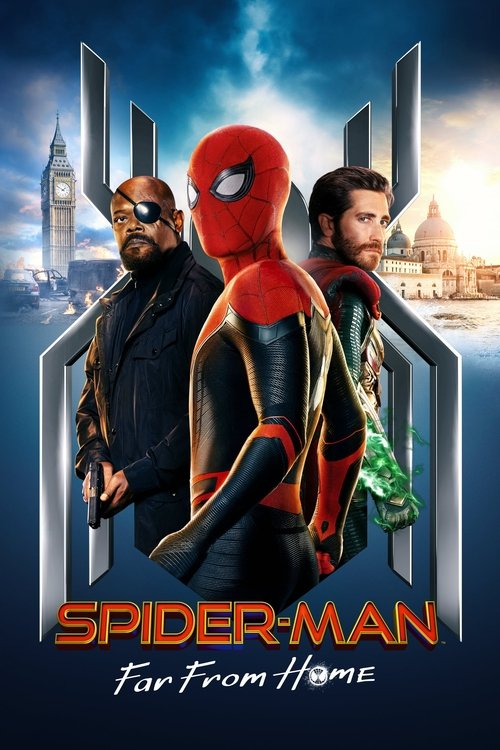
Spider-Man: Far From Home
2019 · Jon Watts
For a light, fun night when you want charm, banter, and spectacle without homework — easy comfort viewing that still has a trick or two up its sleeve.
What it's about
Peter Parker just wants a summer off: a school science trip across Europe, a plan to tell MJ how he feels, and no superheroics. Instead Nick Fury hijacks the vacation, drafting him to fight enormous elemental creatures alongside Quentin Beck, a heroic newcomer from beyond. Underneath the globe-trotting spectacle is a kid grieving his mentor Tony Stark and dodging the question everyone keeps asking: who steps up next?
The experience
Breezy, funny, and fast — a teen comedy wearing a blockbuster's clothes, with an awkward-crush storyline as engaging as the monster fights. The back half springs some genuinely inventive, disorienting visual sequences that jolt it out of formula.
Performances
Tom Holland's flustered, big-hearted Peter remains the most convincingly teenage of screen Spider-Men, and Jake Gyllenhaal has a ball as Beck, playing charisma with an actor's full commitment.
The craft
The European postcard settings — Venice canals, Prague rooftops, London bridges — give it a travelogue sparkle, and the illusion-driven set pieces late in the film are some of the most visually playful in the entire franchise, worth good screen and sound. The script juggles grief, romance, and action with a light touch.
Why it matters
It closed out the twenty-three-film Infinity Saga, became Sony's highest-grossing film to that point, and set the stage for the trilogy's identity-upending next chapter.
Snapshot
Spider-Man: Far From Home is the second solo Spider-Man film produced under the Sony–Marvel co-financing arrangement, and it carries an unusual structural burden: it is the closing chapter of the twenty-three-film "Infinity Saga," released roughly two months after Avengers: Endgame. Where Homecoming (2017) was a self-contained teen comedy, Far From Home is a film about grief, succession, and the manufacture of belief. Peter Parker, mourning Tony Stark, tries to take a European vacation and instead is conscripted by Nick Fury to fight elemental monsters alongside a charismatic newcomer, Quentin Beck—who is revealed to be Mysterio, a con artist weaponizing illusion technology. Jon Watts returns to direct; Tom Holland, Zendaya, Jacob Batalon, Samuel L. Jackson, and Jon Favreau return, with Jake Gyllenhaal joining as the antagonist. The film pairs a genial coming-of-age travelogue with a surprisingly pointed allegory about disinformation and the spectacle of proof.
Industry & production
The film is the product of the singular corporate deal that has defined this incarnation of the character: Sony Pictures retains the film rights to Spider-Man while Marvel Studios (Disney) co-produces and integrates the character into the Marvel Cinematic Universe. Far From Home was the fifth appearance of Holland's Spider-Man and the second solo entry, produced by Kevin Feige and Amy Pascal. Its release position was strategically fraught and fortunate at once: arriving after Endgame, it functioned as an epilogue to the entire saga, tasked with metabolizing the emotional fallout of Tony Stark's death and clarifying the altered world left by the five-year population "Blip."
Production filmed across European locations—Venice, Prague (standing in for multiple cities), London, and other sites—alongside studio work, foregrounding the "summer trip" premise as both narrative engine and visual selling point. The film's commercial performance was substantial: it surpassed one billion dollars worldwide and became, at the time, Sony Pictures' highest-grossing release. That success is inseparable from a notable industry aftershock: shortly after release, negotiations between Sony and Disney over the profit-sharing structure publicly broke down, briefly threatening to remove Spider-Man from the MCU before a revised agreement was reached. The episode is a rare instance of behind-the-scenes deal-making becoming front-page entertainment news, and it frames Far From Home as a pivot point in the character's screen history.
Technology
As an MCU tentpole, Far From Home is built on a heavy digital-effects pipeline, with vendors including Sony Pictures Imageworks and others handling the web-swinging, the Elementals, and the film's centerpiece: Mysterio's illusions. The most technically ambitious sequence is Beck's psychic assault on Peter—a cascade of nested, collapsing realities that recall the reality-bending visuals of Doctor Strange while serving a different thematic purpose. Where Strange used such imagery to convey the sublime, Far From Home uses it to dramatize deception: the audience is made to experience, viscerally, the disorientation of not being able to trust one's own eyes.
Crucially, the film's plot is a fable about its own technology. Beck's team is composed of disgruntled former Stark Industries engineers, and their weapon is a fleet of drones projecting holographic monsters—an in-fiction extension of the "BARF" holographic-memory device Tony Stark demonstrated in Captain America: Civil War. The narrative thus turns visual-effects craft into subject matter: the villain is, essentially, a bitter VFX supervisor staging a blockbuster to defraud the world. The EDITH glasses—an augmented-reality command interface granting control of Stark's drone network—extend the same theme, making surveillance and image-manipulation the literal MacGuffin.
Technique
Cinematography
Shot by Matthew J. Lloyd, the film adopts a bright, saturated, tourist-postcard palette for its European daylight sequences, consistent with the MCU's generally high-key house style and with the coming-of-age tone. The visual strategy sharpens in the illusion set-pieces, where the camera is enlisted in the deception—compositions that appear stable are revealed as fabrications, and the film exploits the viewer's default trust in the frame. The Venice and Prague sequences use recognizable European architecture both for spectacle scale (monsters against historic skylines) and to reinforce the fish-out-of-water register of the teen-travel premise.
Editing
Cut by Dan Lebental (a frequent Watts and MCU collaborator) and Leigh Folsom Boyd, the editing carries the film's tonal balancing act between light teen comedy and thriller. The illusion sequence is the editorial showpiece: its power depends on rhythm and misdirection, on cutting that lets false realities dissolve into one another before the audience can find footing. Elsewhere the picture manages a large ensemble of teenage subplots against the espionage A-plot, and the two mid- and post-credits stingers—now an MCU convention—function as structurally load-bearing rather than decorative.
Mise-en-scène / staging
The staging exploits its locations as spectacle while grounding the emotional material in intimate two-handers—Peter and MJ's tentative courtship, Peter and Happy's shared grief for Tony. The film's central staging conceit is the gap between surface and substance: Mysterio is introduced with heroic framing, caped and backlit, precisely so the reveal of his fraudulence lands as a betrayal of visual convention. His costume—derived from the character's classic fishbowl-helmet comics design—is staged with knowing theatricality.
Sound
Michael Giacchino returns as composer, extending the thematic material he established in Homecoming. The score modulates between buoyant, brassy adventure cues and the more ominous, unstable textures accompanying Mysterio's deceptions. Giacchino's willingness to shift register supports the film's genre oscillation. Sound design in the illusion sequence works alongside the visuals to unmoor the audience, using disorientation as an aesthetic principle.
Performance
Tom Holland anchors the film with the vulnerability that defines his Parker—an adolescent overwhelmed by an inheritance he did not ask for. Zendaya's MJ is drier and more guarded than prior screen incarnations of the character, her deadpan a deliberate counter to romantic-lead convention. Jacob Batalon and Tony Revolori provide comic texture, and Jon Favreau's Happy Hogan carries much of the film's Stark-grief subtext. The performance that most shapes the film is Jake Gyllenhaal's Beck/Mysterio: he plays sincerity and menace as a continuum, making the character's paternal warmth toward Peter genuinely seductive so that the turn to villainy reads as manipulation rather than reveal. J.K. Simmons's single-scene reappearance as J. Jonah Jameson—reprising, in spirit, his role from the Sam Raimi trilogy—is a performance built entirely on iconographic recognition.
Narrative & dramatic mode
The film operates in a hybrid dramatic mode: coming-of-age romance braided with espionage thriller and superhero spectacle. Its through-line is succession and self-doubt—Peter's reluctance to become "the next Iron Man," a role others keep assigning him. The dramatic engine is deception: much of the second act depends on the audience sharing Peter's misplaced trust in Beck, so that the illusion reveal recontextualizes everything preceding it. The narrative also leans heavily on the MCU's serialized architecture, opening with an in-universe memorial montage for the fallen Avengers and closing on two stinger scenes that reframe the entire film—the Jameson broadcast exposing Peter's identity, and the revelation that "Fury" and "Hill" were Skrulls throughout, tying the film back to Captain Marvel. This is narrative as network node: the film is legible on its own but designed to reward, and depend upon, adjacent texts.
Genre & cycle
Far From Home sits at the intersection of several cycles. It is a late-phase MCU installment, bound by the franchise's conventions of interlocking continuity, tonal comedy, and credits-scene serialization. It is also a teen movie in the John Hughes tradition that Homecoming explicitly invoked—here transposed to the European class-trip subgenre, complete with romantic rivalry and adolescent embarrassment. And it is a superhero deconstruction of a specific kind: a film about how spectacle manufactures heroes and villains alike. Within the broader 2010s superhero boom, it belongs to the maturing, self-aware phase of the cycle, in which the genre had become confident enough to make its own machinery—drones, holograms, staged catastrophes, image control—into thematic material.
Authorship & method
Jon Watts, whose earlier features included the smaller-scale thrillers Cop Car and Clown, brought to the Spider-Man films a facility with adolescent perspective and a lightness of touch that distinguished them within the MCU. His authorship is less a matter of visual signature than of tonal calibration—managing comedy, romance, and spectacle without letting any register overwhelm the others. The screenplay is credited to Chris McKenna and Erik Sommers, returning from Homecoming; their sensibility, rooted in television comedy, shows in the film's ensemble banter and its willingness to let the espionage plot serve the character comedy. Key collaborators include cinematographer Matthew J. Lloyd, composer Michael Giacchino, and editors Dan Lebental and Leigh Folsom Boyd. Above the director sits the producorial authorship of Kevin Feige and Amy Pascal, whose franchise-planning shapes the film as decisively as any single craftsperson—the two credits scenes, in particular, are products of saga-level design rather than standalone storytelling.
Movement / national cinema
The film is a product of the contemporary American studio-franchise system, the dominant mode of Hollywood tentpole production in the 2010s. It is not affiliated with any art-cinema movement; its "movement," insofar as one applies, is the industrial phenomenon of the shared cinematic universe, of which the MCU was the defining and most imitated example. Its European settings are tourist iconography rather than engagement with any national cinema tradition—Venice, Prague, and London function as backdrops, filmed by an American production for a global audience.
Era / period
Far From Home is a document of a precise franchise moment: the hinge between the MCU's "Infinity Saga" and its subsequent phase. It is defined by the immediate aftermath of Endgame—the Blip, the death of Tony Stark, the vacuum of leadership among Earth's heroes. More broadly, it is a late-2010s film, and its thematic preoccupation with fabricated media, deepfake-style manipulation, and the erosion of shared reality places it firmly in the cultural anxieties of its era. The doctored video that ends the film—edited footage framing Spider-Man as a murderer and outing his identity—reads as a superhero-movie gloss on contemporary disinformation.
Themes
The film's governing theme is the unreliability of appearances and the manufacture of belief. Mysterio's entire scheme is a critique of a media environment in which spectacle passes for truth; his final act—weaponizing selectively edited footage—makes the allegory explicit. A second, entwined theme is inheritance and worthiness: Peter's arc concerns his fear of stepping into Tony Stark's role, and the EDITH glasses literalize the danger of that inheritance by placing lethal power in an unready teenager's hands. Grief runs beneath both—the film is, in significant part, about mourning a father figure and learning that no mentor can be replaced by a piece of technology. Finally, there is the persistent Spider-Man theme of the ordinary self behind the mask: Peter's longing for a normal adolescence, repeatedly deferred by responsibility.
Reception, canon & influence
Critical reception was broadly positive, with particular praise directed at Gyllenhaal's performance, the film's comedic energy, and the audacity of the illusion sequence; some critics noted the familiar limitations of MCU formula and the film's heavy reliance on connective, franchise-servicing plotting. (Precise aggregate figures and individual quotations are beyond what I will assert from memory.) The film's popular impact was amplified by its cliffhanger—the public exposure of Peter's identity became one of the most-discussed MCU endings and set the direct premise for the follow-up, Spider-Man: No Way Home (2021).
Its influences run backward to the character's own history: Mysterio derives from the Steve Ditko and Stan Lee comics of the early 1960s, where he was conceived as a special-effects man and stuntman turned criminal—a lineage the film honors and updates by making him a disillusioned tech-industry engineer. The reappearance of J.K. Simmons as Jameson deliberately invokes the Raimi trilogy, folding earlier screen Spider-Men into the MCU's memory. Its forward influence is felt most immediately within its own franchise: the identity-reveal cliffhanger dictated the multiverse machinery of No Way Home and contributed to the MCU's broader turn toward multiversal storytelling. More diffusely, the film stands as one of the clearer examples of the superhero genre absorbing the disinformation anxieties of its moment—turning the blockbuster's own tools of illusion into its subject, and casting the visual-effects artist as the era's representative villain.
A Deleuzian reading
The first time you see Mysterio he is backlit and caped, standing in smoke above a Venice canal while something enormous comes apart behind him.
The full Deleuzian reading of Spider-Man: Far From Home →
Reception
A crowd-pleaser on release — the palate-cleanser after Endgame that became the first Spider-Man film ever to cross $1 billion — it's since been recast in fan memory mostly as the setup movie, the film whose final five minutes made No Way Home inevitable.
How Spider-Man: Far From Home was received, from release to now →
How to watch Spider-Man: Far From Home: what to notice on a first viewing
- Watch how Beck is framed the first time he appears. Backlit, caped, standing in smoke above a Venice canal while something enormous comes apart behind him. It is the most conventional hero composition in the picture, and you read it instantly. The framing does the introducing, borrowing everything it needs from heroes you have seen before.
- Watch how bright and postcard-colored the European daylight is. Matthew Lloyd shoots Venice, Prague and London high-key and saturated, with the class trip playing as a holiday. The monsters turn up against recognizable historic skylines in full sun. The brightness holds the film in teen-comedy register.
- Watch how easily Beck takes the weight off Peter's shoulders. Gyllenhaal plays him as paternal: patient, encouraging, ready to carry what Peter cannot. He keeps warmth and composure on a single continuum rather than switching between modes. The offer is made attractive, and you can see why a tired kid would take it.
- Listen for Giacchino's brassy adventure cues against the Elementals' arrival. Giacchino keeps brassy adventure cues for the swinging and the school trip, then slides into wobbling, ungrounded textures whenever the Elementals arrive. The score marks which scenes are a holiday and which are a threat.
- Watch Peter and Happy talk about Tony without saying much. Jon Favreau carries the Stark grief in small scenes: a plane cabin, a workshop, a joke that lands wrong. Tom Holland plays a kid holding an inheritance he never asked for. The film's real subject is who Peter has to become, and these quiet scenes are where that gets decided.
The whole guide to watching Spider-Man: Far From Home, with the keys for a rewatch →
Influences: the films it descends from and the films it influenced
- The Wizard of Oz (1939) — Mysterio's core dramatic device — a booming projected illusion exposed as the desperate fabrication of a small man working the controls — is the 'pay no attention to the man behind the curtain' reveal transposed to drones and holograms.
- North by Northwest (1959) — Supplies the innocent-abroad espionage-tourism scaffold in which romance and mistaken identity ride on top of a glossy globe-trotting spy plot, the exact structure of Peter's European field trip where the caper serves the character comedy.
- Ferris Bueller's Day Off (1986) — Model for Watts's adolescent-POV tonal calibration — teen wish-fulfillment travelogue where comic register and romantic longing are held above the plot rather than crushed by spectacle.
- Total Recall (1990) — Pioneers the unreliable-frame gambit in which the hero and audience are denied any means to verify which layer of experience is 'real,' the perceptual trap Mysterio's illusion sequence weaponizes.
- Wag the Dog (1997) — Establishes the fabrication of media 'events' and manufactured threats for public consumption by a hidden production team — the disinformation-apparatus craft Mysterio's crew of disgruntled ex-Stark techs literalizes.
- Spider-Man 2 (2004) — Source of the horror-inflected, expressionist superhero set-piece (the hospital massacre) that FFH's nightmare illusion updates, and its returning J.K. Simmons Jameson deliberately folds the Raimi trilogy into the MCU's memory.
- Iron Man (2008) — Inaugurated Feige's post-credits-stinger and shared-universe producorial architecture that governs FFH's two saga-designed credits scenes, and seeds the Tony/EDITH mentor-legacy that structures Peter's inheritance-and-worthiness arc.
- Inception (2010) — Blueprint for the illusion sequence's recursive collapsing-dreamscape architecture — stable ground folding into successive false realities beneath a disoriented protagonist.
- Doctor Strange (2016) — Established the MCU's fractal, kaleidoscopic reality-bending VFX vocabulary that Mysterio's set-piece deploys not as magic but as literal weaponized, artist-authored spectacle.
- Avengers: Endgame (2019) — Hands FFH its load-bearing grief-and-succession premise — Tony Stark's death and the 'who inherits the mantle' question the film processes as a direct serialized network-node follow-on.
- WandaVision (2021) — Extends the unreliable-frame / constructed-false-reality deception into a sustained serialized device, the audience trapped inside a manufactured world exactly as Mysterio's projection trapped Peter.
- Loki (2021) — Downstream beneficiary of the multiversal machinery FFH's identity-reveal cliffhanger accelerated, extending the MCU's turn toward saga-level multiverse plotting.
- Spider-Man: No Way Home (2021) — Direct descendant whose entire premise is the FFH stinger's public identity-exposure cliffhanger, converting that reveal into the film's multiverse engine and completing Watts's teen-legacy arc.
- Doctor Strange in the Multiverse of Madness (2022) — Returns Raimi's horror-set-piece craft to the MCU and extends FFH's reality-warping, weaponized-illusion spectacle into full expressionist blockbuster horror.
- Nightcrawler (2014) — Gyllenhaal's method blueprint: the ingratiating, eerily controlled operator who stages and manufactures reality for the camera, the same modulation from earnest-mentor to unhinged-manipulator he runs as Mysterio.
- The Truman Show (1998) — Shares the illusion-as-fully-manufactured-world craft — an entire fabricated environment sustained by a hidden crew and a director-figure at a control desk — which Mysterio miniaturizes into portable drone-projected dioramas.
Similar films
- Spider-Man: No Way Home (2021) — influence & lineage · same viewing thread
- Spider-Man 2 (2004) — influence & lineage
- Avengers: Endgame (2019) — influence & lineage
- Doctor Strange in the Multiverse of Madness (2022) — influence & lineage
- Doctor Strange (2016) — influence & lineage
- Iron Man (2008) — influence & lineage
- Spider-Man: Brand New Day (2026) — same viewing thread
- Spider-Man: Across the Spider-Verse (2023) — same viewing thread
All the films related to Spider-Man: Far From Home →
Watch it with: curated runs of related films
- Anyone Can Wear the Mask — A run of every screen Spider-Man — from Raimi's earnest Queens kid to the multiverse's infinite web-slingers — where the rival reboots stop competing and start rhyming into one myth retold.