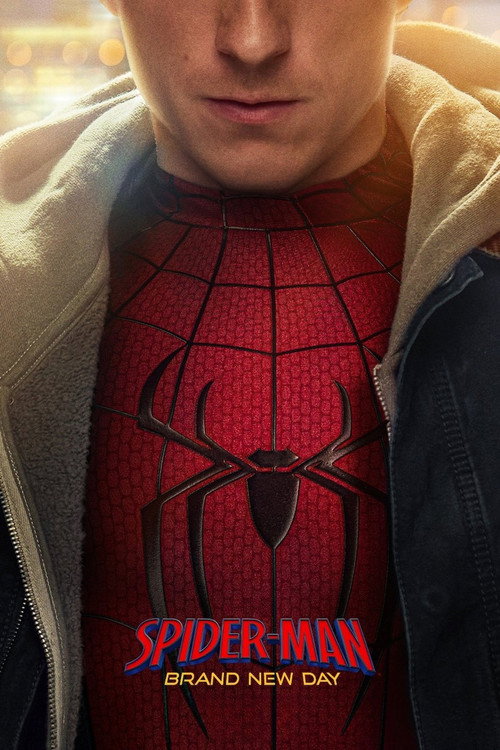
Spider-Man: Brand New Day
2026 · Destin Daniel Cretton
For when you want blockbuster spectacle with an ache underneath — a crowd-pleaser that still gives you something to feel. Comfort food with a bitter edge.
What it's about
Peter Parker is Spider-Man full-time now, in a New York that has no memory of who he is — and watching his old friends move on without him is starting to change him in ways he can't control. Meanwhile a new threat stalks the city: a villain nobody can even see. It's a superhero story about anonymity, sacrifice, and what happens when the mask is all you have left.
The experience
Big swinging action laced with real loneliness — the set pieces thrill, but the undertow is melancholy, a hero grinding through isolation. Tense, kinetic, and more emotionally bruised than the quips suggest.
The craft
Destin Daniel Cretton built his reputation on intimate character dramas before going big-scale, and that mix shows in the pitch here: grounded emotional stakes threaded through city-spanning action. An invisible antagonist is a gift for inventive visual-effects staging — this one is made for the biggest screen you can find.
Why it matters
A pivotal chapter in the Marvel Cinematic Universe's Spider-Man saga, picking up the fallout of the character's most drastic reset and testing whether the world's most popular superhero can carry a darker register.
Snapshot
Spider-Man: Brand New Day is the fourth solo Spider-Man feature in the Marvel Cinematic Universe and the first not directed by Jon Watts, who made Homecoming (2017), Far From Home (2019) and No Way Home (2021). Destin Daniel Cretton directs. His Shang-Chi and the Legend of the Ten Rings (2021) brought him into Marvel after a decade of small independent dramas. The film picks up four years after the spell at the end of No Way Home, in which Doctor Strange erased Peter Parker's identity from the memory of everyone he knew. Tom Holland's Peter now protects New York anonymously. His powers are changing: the webbing that once came from his lab now grows from his own body. He also meets Jean Grey (Sadie Sink), a telepathic teenager searching for a missing sister held by the DODC.
The title comes from the 2008 Marvel Comics run Brand New Day, which followed the continuity reset of One More Day. Like that comic, the film is about a hero whose relationships have been cut away by magic and who has to rebuild his life from nothing. It runs 145 minutes. After a premiere at Hollywood's Dolby Theatre in late July 2026 it opened worldwide, and it became the year's commercial event: the biggest domestic opening on record and the first Spider-Man film to pass $2 billion worldwide. Critics were warm but divided. Audiences were close to unanimous in their approval.
Industry & production
The film rests on one of the odder deals in contemporary Hollywood. Sony Pictures has held the theatrical film rights to Spider-Man since 1999. Marvel Studios, owned by Disney, controls the character's place in the MCU. Under their shared-custody agreement, Marvel co-produces and creatively supervises the Holland films while Sony distributes them. The partnership has frayed in public and been renegotiated, but it has now lasted four features. Kevin Feige produces for Marvel. Amy Pascal, the former Sony chief who shepherded the earlier films, remains a longtime producing partner on the franchise.
Hiring Cretton continued Marvel's habit of recruiting directors from independent film. The studio first took him on for Shang-Chi on the strength of character-driven work like Short Term 12. Here, Chris McKenna and Erik Sommers, who wrote the previous MCU Spider-Man scripts, return as screenwriters. The rest of the core team is drawn heavily from Cretton's own circle:
- Cinematography: Brett Pawlak.
- Editing: Nat Sanders, Gina Sansom and Harry Yoon.
- Production design: Charles Wood.
- Score: Michael Giacchino, who continues the musical line of the Watts trilogy.
The budget was $225 million. Principal photography ran from August to December 2025 in Glasgow, in London and at Pinewood Studios. This follows the wider industry move of large tentpole shoots to British stages and streets. Pawlak has said the UK crews included people who had worked on The Fantastic Four: First Steps and Wicked.
The commercial result was extraordinary:
- Opening weekend: about $360.1 million domestically, beating the record set by Avengers: Endgame.
- Second weekend: a further $145 million in the United States.
- Speed: it reached $1 billion worldwide in six days, the second-fastest film ever to do so.
- Total: by October 2026, roughly $2.52 billion worldwide (about $958 million domestic and $1.56 billion international), more than eleven times its budget.
That makes it the highest-grossing film of 2026, the highest-grossing Spider-Man film and one of the three highest-grossing films of all time. It arrived on digital and VOD in early October. Trade coverage, including a Hollywood Reporter piece on the subject, presented the run as proof that a well-judged superhero film could beat the "superhero fatigue" that had dogged the genre.
Technology
The film belongs to the current era of hybrid production, where stunt work, practical builds and large-scale digital effects are combined rather than set against each other. It was shot for both standard widescreen (2.39:1) and IMAX (1.90:1) exhibition, so the larger format gets more picture in key sequences.
The web-swinging was rebuilt from the ground up:
- Reference footage: the team studied wingsuit flyers and parkour athletes so Spider-Man's movement through the city would feel grounded in real human motion.
- Video games: some stunt design drew on the PlayStation Marvel's Spider-Man games. Several critics noticed this in the rooftop traversal, which echoes the games' sense of momentum and route-finding.
- Organic webbing: the effects track a story change. As Peter's powers shift, his webs move from manufactured lab-made strands to something visibly organic, and that visual change marks his transformation from scene to scene.
Lighting was largely practical, and Charles Wood's sets were designed to allow a range of camera framings. That points to a production weighted toward physical environments, especially for its street-level material.
Technique
Cinematography
Brett Pawlak shot Cretton's Short Term 12 and Just Mercy, and his presence here is the clearest sign of the film's ambitions. Pawlak has recalled that he and Cretton joked about shooting a Spider-Man film the way they shot their first feature. The joke had a serious core: Cretton wanted the personal, intimate feel of that small film inside a blockbuster.
The visual plan came from classic Spider-Man comics and their graphic contrasts:
- Black shadows: shadows are rendered truly black rather than a washed-out grey.
- Strong color: the grade aims for saturated color against deep blacks, in the manner of printed comic art.
- Comic-panel framing: frames within frames and compositions that mirror the panel layouts of a comics page.
- Overcast light: shooting in Britain, Pawlak used the overcast light rather than fighting it, which gives the city a muted, un-sunny tone very different from the bright, sunlit look of much MCU work.
Pawlak names Sam Raimi's Spider-Man (2002) as a formative influence; he projected it himself as a teenager. That gives the film a line of descent back to the first modern Spider-Man feature.
Critics singled the cinematography out. Rahul Menon of Script found the images grittier and more textured than the Watts films, with a color palette that reads like comics. He also saw a clear break from what he considered the generic house style of the earlier trilogy. Jeremy Mathai at SlashFilm praised colors with real contrast and dizzying point-of-view shots. He traced Pawlak's approach both to the PS5 games and to the action staging of The Matrix Reloaded. Kemyron McCoy at the Daily Bruin praised the purposeful camera movement and shifting perspectives of the web-swinging sequences.
Editing
Three editors share credit: Nat Sanders, Gina Sansom and Harry Yoon. That is typical of Marvel's long, iterative post-production, where reshoots and recutting after test screenings are built into the schedule. Pawlak has described Cretton's guiding question for every set piece as whether the sequence moves the story forward. That story-first principle shapes how the action is built and cut.
The result did not please everyone on pacing. Mathai felt the 145-minute running time sometimes sagged into padding. Owen Gleiberman at Variety found the film laborious and disjointedly episodic. Other reviewers, though, found the action easy to follow and well shaped. The split matches a broader divide over whether the film's density is generous or overstuffed.
Mise-en-scène / staging
The premise gives Cretton a striking staging problem: a hero who is effectively a ghost in his own city, moving through a world that has forgotten him. The comic-panel framing serves this well. Frames within frames can set Peter inside doorways, windows and architectural borders, cut off from the people around him. Wood's sets were designed with those framings in mind.
The film works at deliberately street-level, "friendly neighborhood" scale. That is a conscious retreat from the multiverse spectacle of No Way Home. Pawlak points to Frank Castle's boat as one of the film's darker settings, a space whose grim atmosphere sets the Punisher's world apart from Peter's.
Sound
Michael Giacchino scored all three Watts films, and his score here keeps the franchise's orchestral continuity even as the director changes. Reviewers had mixed feelings about it. Mathai found that it sometimes pushes the emotion harder than the images need. The franchise convention of dense, physical sound for web mechanics and impacts holds throughout.
Performance
Tom Holland has played Peter Parker for nearly a decade, beginning with Captain America: Civil War (2016). His Peter has always been the youngest and most emotionally exposed of the screen versions, and this premise strips that Peter of every relationship that held him steady. Critics consistently found Holland at his best here. Menon praised his restraint in playing grief and isolation. The Rotten Tomatoes critics' consensus singled out the soulfulness of his performance.
The supporting cast:
- Zendaya as MJ, now an MIT student. Menon and McCoy both noted how much real dramatic material she is given and how central she is to the story's conflict, a clear step up from the role's earlier scale.
- Sadie Sink as Jean Grey, the telepathic teenager whose search for her sister draws Peter in.
- Jacob Batalon returning as Ned.
- Jon Bernthal as Frank Castle, the Punisher. Menon read the character as a philosophical counterweight to Peter, expressed through action. Fans split on Bernthal's lighter, more comic take: some enjoyed the softer Castle, and others thought Marvel had misjudged the character.
- Mark Ruffalo as Bruce Banner/Hulk.
- Florence Pugh as Yelena Belova.
- Tramell Tillman as Bill Metzger.
- Marisa Tomei returning as May in a memory sequence.
Cretton has said that he reads each actor's state when they arrive on set and shapes the work from there. That actor-centered method runs through his whole career.
Narrative & dramatic mode
The film plays closer to a character study than to a team-up spectacle, though it contains a good deal of both. Its engine runs on two tracks. The first is internal: Peter's body is changing, and the organic webbing is the visible sign of a transformation he does not fully control. That puts the film in the long line of Spider-Man stories in which the hero's powers become a source of unease about who he is. The second is external: Jean Grey's search for her missing sister, held by the DODC, pulls Peter into a wider conflict that also involves the Punisher, Banner and Yelena Belova.
The doubling defines the film's dramatic mode. Peter's private crisis and the public emergency run in parallel. Cretton's long-standing interest in wounded young people working through damage gives the structure its emotional weight. Reviewers disagreed about how well the two tracks fit together. Bob Mondello at NPR found the overstuffed plot both dark and a lot of fun, built on the idea that even a perpetually teenaged hero has to grow up. Gene Park in The Washington Post called it messy but mostly successful. In his view, Peter's real struggle is balancing his humanity against his superhuman job, not fighting any villain. Jesse Hassenger at The A.V. Club saw the film as nearly an ideal model of how to draw characters from a vast shared universe without letting them swamp the lead.
Genre & cycle
The film sits where the superhero blockbuster, science-fiction action-adventure and coming-of-age character melodrama meet. That last strand is unusual for a fourth franchise installment. It arrived at a moment of visible strain in the superhero cycle. After the saturation of the late 2010s and early 2020s, both audiences and studios had signaled impatience with formula. Cretton has described the creative logic in exactly those terms: the franchise could not go bigger, so it had to go deeper. That meant a return to street level and a Peter who has to do everything himself.
On those terms the gamble paid off. The film's box office and audience scores were widely read as proof that the form could renew itself through a smaller emotional scale rather than ever-larger spectacle. Mathai credited it with choosing adaptation over nostalgia and with stepping away from a multiverse he felt had begun to feed on itself. The opposite view was voiced most sharply by David Ehrlich at IndieWire, who graded it C−. He found the film dull and downbeat and thought it created more problems than it solved. Rolling Stone's David Fear objected that it still leans too heavily on fan service and on setting up future MCU films. For these critics, the film's "maturity" is a matter of tone more than substance.
Authorship & method
Destin Daniel Cretton was born on Maui in 1978. He made his name with low-budget humanist drama. Short Term 12 (2013), set in a group home for at-risk youth, is still his signature work. Just Mercy (2019) moved him toward prestige social drama, and Shang-Chi (2021) into blockbuster filmmaking, shot by Bill Pope.
His method has always centered on actors and emotional truth, and Brand New Day confirms how much he relies on long collaborations. Bringing back Brett Pawlak, his cinematographer from Short Term 12 and Just Mercy, links the Spider-Man film directly to the indie work. So does the stated wish to recapture that first feature's intimacy. Michael Giacchino scores rather than Cretton's longtime composer Joel P. West, which keeps the film's music tied to the franchise.
Cretton has also linked the film to his own life. He connects Peter's isolation to the lonely years of his twenties after university. He told interviewers he wanted to explore the character's loneliness above all. The key creative fact is structural. For the first time, the Holland Spider-Man is directed by someone whose sensibility was formed in intimate drama, not in the Watts mode of wry teen comedy in the John Hughes tradition, and the finished film makes the most of that difference.
Movement / national cinema
The film is a product of the American studio franchise system rather than of any national or aesthetic movement. Its production shows how transnational contemporary blockbuster filmmaking has become. It was shot in Glasgow, London and at Pinewood, with British crews drawn from other major productions and a cinematographer who chose to use British overcast light rather than hide it. "American" tentpoles are now routinely built abroad.
Cretton is a Japanese-American filmmaker from Hawaii who brought a perspective from outside mainland, white Hollywood to Shang-Chi, Marvel's first Asian-led feature. His career is part of the industry's uneven, ongoing effort to widen who gets to direct inside the studio system, even as Spider-Man remains a legacy American icon.
Era / period
The film is unmistakably a work of the mid-2020s superhero landscape. It comes after Endgame and No Way Home, in the shadow of the franchise's commercial peak and the audience skepticism that followed. It also comes after the 2023 Hollywood labor stoppages, which reshaped production timelines and thinned release calendars across the industry.
Its premise of a hero rebuilding after a reset reads as a comment on the franchise's own need to start over and shed the continuity and multiverse machinery that made the previous film a grand finale. Released into a summer market that had been told superhero films were in decline, it instead set opening records. It became one of the defining box-office events of the period, a sign that the cycle had more life in it than its own trade press had predicted.
Themes
The dominant themes are loss, isolation and the work of rebuilding a self from nothing. Peter is remembered by no one and protects a city that does not know who he is. The film presents that anonymity as a form of mourning, not as freedom. Critics read the film's themes in overlapping ways:
- Menon: isolation, chosen sacrifice and community, and the question of whether relationships can survive erasure.
- Mathai: consequences, loss and sacrifice.
- McCoy: grief, loss and misunderstanding, and how the film turns conflict into connection, especially in Peter's dealings with Jean Grey, whose search for her sister mirrors his own losses.
A second theme is fear of one's own transformation. The organic webbing makes his growing up physical, a body changing in ways the self has not agreed to. That fits Cretton's career-long attention to young people working through damage, and Mondello's sense that the film is finally about a perennial teenager having to grow up. Underneath both runs the franchise's oldest theme: responsibility that continues without recognition or reward, Spider-Man doing the work when no one knows or remembers that it is him.
Reception, canon & influence
The critical response was broadly positive. On Rotten Tomatoes the film holds 90% from more than 400 reviews, with an average rating of 7.6/10. The critics' consensus praises its spectacular set pieces, its mature emotional stakes and Holland's performance, and calls it a promising reset for the character. Metacritic's aggregate was more moderate, in the "generally favorable" range.
Audience response was stronger still: an A CinemaScore, 88% "definitely recommend" on PostTrak, and a Rotten Tomatoes audience score reported as the highest for any live-action Spider-Man film. Among admirers:
- Pete Hammond at Deadline welcomed a dark, thrilling new chapter.
- Dwight Brown predicted fans would remember this Spider-Man for a long time.
- Hassenger called it Marvel's best crossover in years and the first MCU film in a long while that leaves audiences actually wanting a direct follow-up.
Among dissenters, Gleiberman found it overreaching in its bid for maturity, Ehrlich found it dreary, and Fear found it too beholden to fan service. The critical complaints cluster around tone and density: one camp's "mature" is another's "downbeat," and several reviewers, admirers included, found the plot overcrowded.
The influences that feed into the film are clear. It draws on the One More Day / Brand New Day comics of 2007–2008, associated with writer J. Michael Straczynski and editor Joe Quesada, for its structure of erasure and renewal. Its visual grammar comes from the graphic contrast and panel layouts of classic Spider-Man comics. It inherits from Raimi's 2002 Spider-Man, which shaped Pawlak's sense of the character on screen, and from the movement vocabulary of the PlayStation Spider-Man games. It also builds on Cretton's own body of intimate character drama. It carries over the cast and continuity of the three Watts films while deliberately leaving their comic register behind.
Looking forward, its record-setting commercial run has already made it a reference point for the industry. It is cited as a counterexample to "superhero fatigue" and as evidence that a franchise can grow by going smaller and darker in emotional scale. Whether it becomes the template for a leaner, more character-driven phase of the superhero cycle will depend on the films that follow it, which several critics, unusually for the MCU, said they actually want to see.
A Deleuzian reading
Watch Peter Parker's wrists.
The full Deleuzian reading of Spider-Man: Brand New Day →
Reception
It opened July 31 to a record $360.1 million domestic weekend, edging past Avengers: Endgame, then sprinted to $1 billion in six days (the second-fastest ever) and kept going: by mid-October it stood at roughly $2.5 billion worldwide, the first Spider-Man film past $2 billion and the biggest film of 2026. Critics were warm but not rapturous (90% on Rotten Tomatoes against a 66 Metacritic), while audiences handed it an A CinemaScore and a 97% Popcornmeter.
How Spider-Man: Brand New Day was received, from release to now →
How to watch Spider-Man: Brand New Day: what to notice on a first viewing
- Watch Peter framed inside doorways, windows and panel-like borders. Pawlak and Cretton build frames within frames that echo a comics page. Peter keeps landing behind a border while the people he knew stand on the other side of it. The city has forgotten him, and the framing shows it. He is in every shot and cut off in most of them.
- Look at the true black shadows and the gray, overcast sky. Pawlak grades for deep blacks and saturated color like printed comic art, and he shot under Britain's cloud cover instead of fighting it. The city looks muted, never sunny. The look sets this film apart from the bright earlier trilogy and tells you the mood before a word of dialogue.
- Watch Holland's face when someone he loves looks straight past him. Holland plays the grief small and held in. Cretton, who made Short Term 12 with Pawlak, stays close on him and lets the reaction sit rather than cutting to the next joke. The loss of being forgotten has no villain to fight, so it lives on Holland's face.
- Notice the webbing now grows from Peter's own body. The web-shooters from his lab are gone. The webbing comes from his wrists, organic, and the film keeps reminding you his body is changing in ways he did not choose. The power you know becomes something strange, which makes his growing up physical and a little frightening.
- Follow the swinging shots that put you in Peter's point of view. Cretton's team studied wingsuit flyers and parkour athletes, and Pawlak cuts between wide swings and dizzying first-person angles that shift perspective mid-motion. In the air he is free and fully himself, which makes the ground-level scenes of being unknown hit harder.
The whole guide to watching Spider-Man: Brand New Day, with the keys for a rewatch →
Influences: the films it descends from and the films it influenced
- Short Term 12 (2013) — Cretton's signature method — handheld, close-in coverage that tolerates improvisation and holds on actors' faces to mine raw emotional truth over plot — is the working grammar he imports into a tentpole.
- Just Mercy (2019) — Brett Pawlak's restrained naturalistic lighting and Cretton's patient conversational two-shot blocking privilege performance over spectacle, the prestige-drama toolkit carried forward here.
- Shang-Chi and the Legend of the Ten Rings (2021) — Cretton's own proof-of-concept for embedding a family/identity drama inside MCU action choreography — the direct methodological rehearsal for doing it again on Spider-Man.
- Spider-Man: Homecoming (2017) — Establishes the Holland Peter's grounded high-school milieu and handheld intimacy that Brand New Day inherits structurally while deliberately shedding its John Hughes–inflected comedic register.
- Spider-Man: No Way Home (2021) — Its memory-erasure climax — the world forgetting Peter exists — is the literal narrative machinery the 'erasure-and-renewal' premise picks up and dramatizes.
- Spider-Man 2 (2004) — The operatic arc of a Spider-Man who renounces the mask and physically loses his powers is the definitive prior 'loss-of-self' Spider-Man film this one answers.
- Superman II (1980) — Supplies the structural blueprint of a superhero surrendering his powers and identity to live an ordinary life before being forced to reclaim them.
- A Woman Under the Influence (1974) — The actor-first, emotionally-exposed observational realism that Short Term 12 descends from originates here — the deep source of Cretton's performance-centered method.
- The Wrestler (2008) — Verité follow-cam study of a broken man's body and diminishment models the small, bodily, actor-first register that Cretton favors over comic-book scale.
- Logan (2017) — The model for a stripped-down, mortality-driven comic film that trades spectacle escalation for intimate character stakes and a deliberately reduced scale.
- Joker (2019) — Grafts a 1970s New Hollywood character-study grammar onto a comic property — the same 'indie sensibility over spectacle' gambit applied to a marquee IP.
- The Batman (2022) — Reboots a franchise's tone through a director's personal formal signature — noir procedural rhythm and subjective POV — rather than through plot or universe escalation.
- Fruitvale Station (2013) — The Sundance humanist debut that, exactly like Short Term 12, trained a director later handed a Marvel property — the parallel indie-to-tentpole pipeline Cretton exemplifies.
- Black Panther (2018) — The direct precedent of an intimate-drama director importing an authorial voice and ensemble-driven emotional stakes into the MCU without surrendering personality to formula.
- Creed (2015) — Reinvents a legacy franchise by narrowing to one character's interior life and using handheld, in-the-ring intimacy — franchise renewal through compression rather than expansion.
- Eternals (2021) — Another indie auteur — natural light, magic-hour handheld, landscape realism — transplanted into Marvel, testing whether an intimate formal signature can survive the tentpole apparatus.
Similar films
- Spider-Man: No Way Home (2021) — influence & lineage · same viewing thread
- Spider-Man 2 (2004) — influence & lineage
- The Batman (2022) — influence & lineage
- Logan (2017) — influence & lineage
- Spider-Man: Far From Home (2019) — same viewing thread
- Spider-Man: Across the Spider-Verse (2023) — same viewing thread
- The Amazing Spider-Man 2 (2014) — same viewing thread
- The Amazing Spider-Man (2012) — same viewing thread
All the films related to Spider-Man: Brand New Day →
Watch it with: curated runs of related films
- Anyone Can Wear the Mask — A run of every screen Spider-Man — from Raimi's earnest Queens kid to the multiverse's infinite web-slingers — where the rival reboots stop competing and start rhyming into one myth retold.