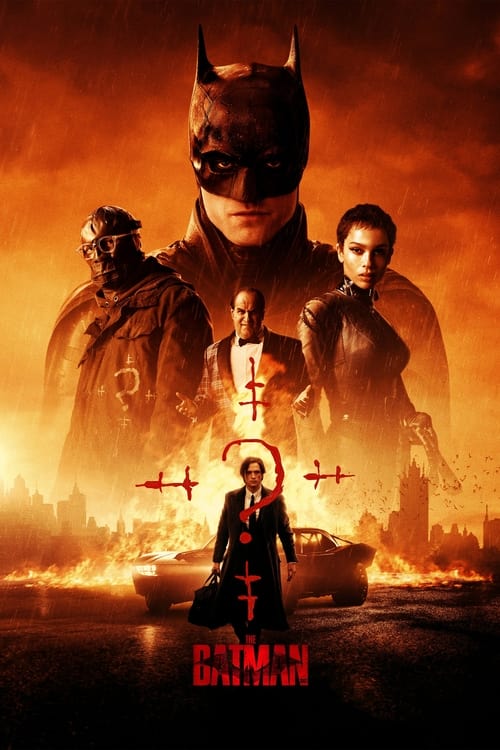
The Batman
2022 · Matt Reeves
When you want a dark, brooding crime thriller to sink into for a whole evening — more grim and immersive than fun, and best when you're in the mood to be swallowed by a mood.
What it's about
In his second year prowling a rain-drenched Gotham, a young, withdrawn Batman is drawn into a serial killer's game: the Riddler is murdering the city's powerful and corrupt, leaving elaborate ciphers addressed to Batman himself. Following the clues pulls him through nightclubs, crooked politicians, and organized crime — and toward secrets tangled up with his own family.
The experience
Slow-burn dread rather than superhero spectacle — it moves like a detective procedural, heavy with rain, shadow, and a thumping sense of menace. At nearly three hours it asks for patience and pays it back in atmosphere.
Performances
Robert Pattinson plays Bruce Wayne as a haunted recluse with almost none of the usual playboy charm — a raw-nerve take that makes the character feel dangerous and sad at once.
The craft
Matt Reeves builds Gotham as a perpetually soaked noir city and slows the genre down into crime scenes, surveillance, and interrogation rather than set-piece overload. The images are inky and rain-slicked, the sound design rumbles — this one genuinely rewards a big screen and good speakers.
Why it matters
It reset expectations for what a comic-book blockbuster could be, proving a franchise tentpole could play as a moody detective picture and pushing the superhero film toward crime-genre seriousness.
Snapshot
The Batman is Matt Reeves's reconception of the character not as a superhero but as a noir detective and a creature of obsessive grief. Set in a perpetually rain-soaked Gotham during Bruce Wayne's second year as a masked vigilante, the film follows a serial murderer, the Riddler, who targets the city's corrupt power structure and leaves elaborate ciphers addressed to Batman himself. Running nearly three hours, it is the longest theatrical Batman film, and its length is a deliberate stylistic argument: it slows the genre down into procedure, surveillance, and dread. Robert Pattinson plays a withdrawn, haunted Bruce Wayne with little of the playboy persona that defined earlier screen incarnations, and the film foregrounds detection — crime scenes, evidence, interrogation — over spectacle. It is at once a franchise tentpole and a self-conscious exercise in genre pastiche, drawing on 1970s American crime cinema, gothic horror, and serial-killer thrillers. The result repositioned a heavily exploited property as a vehicle for auteur-driven mood, and it launched a distinct continuity separate from the broader DC film universe.
Industry & production
The Batman arrived after a turbulent development history at Warner Bros. The project originated as a Ben Affleck vehicle — Affleck having played Batman in the Zack Snyder–led DC films — with Affleck attached to direct, co-write, and star. Affleck departed the directing role, and Matt Reeves, coming off the acclaimed Dawn of the Planet of the Apes (2014) and War for the Planet of the Apes (2017), took over and substantially reconceived the film as a standalone, younger-Batman story rather than a continuation of the Snyder continuity. Reeves co-wrote the screenplay with Peter Craig.
The casting of Robert Pattinson was widely discussed; by 2022 Pattinson had spent a decade rebuilding a reputation through art-house work with directors such as the Safdie brothers, Claire Denis, and Robert Eggers, and his casting signaled the film's auteur ambitions. Production was significantly disrupted by the COVID-19 pandemic: filming, which took place substantially in the United Kingdom, was halted in 2020 when Pattinson contracted the virus, and the shutdown extended the schedule. The release itself was reshaped by the pandemic-era exhibition landscape, opening in theaters in 2022 after multiple industry-wide date shifts. The film was a major commercial success and quickly generated franchise plans, including a sequel and television spin-offs developed for the HBO Max streaming service — a colon-policed example of the early-2020s strategy of extending theatrical IP into prestige streaming. I do not have verified box-office figures to cite precisely and will not invent them; contemporaneous reporting treated it as one of the year's largest grossers.
Technology
The film's most discussed technical choice was its embrace of darkness and low-key digital cinematography. Shot digitally, it pushed the capabilities of contemporary large-format sensors to render scenes lit by single practical sources — a desk lamp, a car's headlights, the muzzle flash of a gun — while retaining detail in deep shadow. This reflects a broader 2020s tendency in which high-sensitivity digital capture allows cinematographers to expose for very dark environments that film stock or earlier digital systems handled poorly. The production made notable use of practical Gotham environments and built sets, supplemented by visual effects for set extensions and large-scale sequences such as the climactic flood. Reeves and his team favored in-camera atmosphere — real rain, haze, and practical lighting — over fully synthetic environments where possible, a methodology consistent with a wider reaction against weightless all-digital backdrops. The Batmobile and Batsuit were realized substantially as physical builds, reinforcing the film's tactile, grounded aesthetic.
Technique
Cinematography
The cinematography, by Greig Fraser, is central to the film's identity and among its most influential elements. Fraser — whose résumé includes Zero Dark Thirty, Rogue One, and Dune — built a palette of near-monochrome darkness punctuated by amber, sodium-vapor orange, and deep blood reds. The film is famously underlit by blockbuster standards: faces fall into shadow, and the camera often discovers light sources within the frame rather than imposing conventional three-point coverage. Several sequences are staged as virtuoso set pieces of restraint — a hallway gunfight rendered largely in the strobing light of muzzle flashes, and an upside-down car-crash shot that lingers on Batman emerging through flame. The compositions favor heavy foreground silhouettes, reflective wet surfaces, and a tactile sense of grain and atmosphere. This commitment to expressive low-key lighting consciously evokes 1970s cinematography and the work of Gordon Willis, the "Prince of Darkness," whose underexposed interiors defined The Godfather films.
Editing
Edited by William Hoy and Tyler Nelson, the film is paced as a slow-burn investigation rather than a propulsive action vehicle. The cutting favors duration and dread — holding on crime scenes, evidence boards, and interrogation exchanges — and integrates the Riddler's video messages and ciphers as procedural beats. The near-three-hour runtime is structured around the detective's accumulation of clues, so the editing rhythm mimics the methodical unraveling of a case. Action sequences, when they arrive, are cut for impact and clarity rather than rapid fragmentation, a choice that distinguishes the film from the faster, more kinetic norms of contemporary comic-book cinema.
Mise-en-scène / staging
Reeves's Gotham is a composite of decaying American urbanism — a city of perpetual night, rain, and institutional rot. Production design renders it as a place of brutalist municipal architecture, neon-soaked underworld clubs, and gothic interiors, blending mid-century decay with art-deco verticality. The staging emphasizes Batman as a watcher who emerges from the dark: he is frequently introduced stepping out of shadow, and the framing treats him as an intrusion of horror into the criminal world. The Iceberg Lounge and the city's flooded climax give the design a register that moves from claustrophobic interiors to apocalyptic scale. Costume and makeup reinforce the grounded approach — a Batsuit that reads as armored homemade gear, and a Riddler whose military-surplus mask and tape recall real-world references to documented serial offenders.
Sound
Sound design works in close concert with the score to build oppression and intimacy. The film foregrounds diegetic texture — rain, footsteps, the throaty roar of the Batmobile engine — and uses near-silence to heighten tension before bursts of violence. Michael Giacchino's score is built around a brooding, repetitive central theme for Batman, a heavy four-note descending motif that functions almost as a funeral march, alongside a more romantic, melancholy theme. The deployment of Nirvana's "Something in the Way," used both as source music and tonal signature, ties Bruce Wayne's interiority to 1990s grunge melancholy and signals the film's emo-inflected reading of the character.
Performance
Robert Pattinson's Bruce Wayne is interior, depressive, and physically guarded — a reclusive figure who narrates in a noir voiceover and shows almost none of the social charm associated with the role. The performance locates the character's pathology in unprocessed grief and a near-addictive compulsion to "the drug" of vigilantism. Zoë Kravitz plays Selina Kyle / Catwoman with a wounded, self-reliant edge, and the film develops a genuine erotic and moral tension between the two. Paul Dano's Riddler is a study in resentful anonymity, modeled in look and method on real serial killers and online radicalization; his unmasked breakdown is a deliberately pathetic rather than grandiose villain reveal. Jeffrey Wright grounds the film as Lt. James Gordon, Batman's procedural partner, and Colin Farrell, under extensive prosthetics, delivers a transformed comic turn as Oz / the Penguin that became a basis for a spin-off series.
Narrative & dramatic mode
The film's dramatic mode is detective noir grafted onto the superhero template. Its narrative engine is investigation: a sequence of murders, each accompanied by a riddle, draws Batman deeper into Gotham's institutional corruption until the trail implicates the legacy of his own father, Thomas Wayne. This structure converts the origin story — usually told as the murder of the Waynes — into a mystery whose solution destabilizes Bruce's self-image as the avenging son of martyrs. The mode is confessional and subjective: Pattinson's hardboiled voiceover frames events through his disturbed psychology, recalling the first-person narration of classic noir. The arc is one of disillusionment followed by reconstruction — Batman must abandon vengeance as his organizing principle and reimagine himself as a symbol of hope, a shift literalized in the flood-rescue climax. This is a film about the limits of vengeance as a moral foundation, dramatized through procedure rather than spectacle.
Genre & cycle
The Batman sits at the intersection of several genres: the serial-killer thriller, the urban crime film, gothic horror, and the superhero blockbuster. It belongs to a cycle of "elevated" or genre-revisionist comic-book films that sought critical legitimacy by borrowing from prestige cinema — a lineage running through Christopher Nolan's grounded Dark Knight trilogy and Todd Phillips's Joker (2019), which similarly reframed Batman mythology through 1970s American models. Within the superhero cycle, it represents the late-2010s/early-2020s impulse toward auteur-branded, tonally darker, standalone reinterpretations, distinct from the interconnected shared-universe model. Its strongest generic allegiance, however, is to the detective film and the serial-killer procedural; the Riddler-as-Zodiac framing aligns it explicitly with that subgenre.
Authorship & method
Matt Reeves approaches franchise filmmaking as character study and atmosphere, a method visible across his career from Cloverfield through the Apes sequels, where spectacle is consistently subordinated to emotional and ethical stakes. His stated method here was to strip Batman to his roots as "the world's greatest detective" and to build the film around mystery and psychology rather than world-ending stakes. Reeves's collaborators are integral to the authorship. Cinematographer Greig Fraser supplied the radical low-key visual grammar. Composer Michael Giacchino, a frequent Reeves collaborator, provided the funereal thematic architecture. Editors William Hoy and Tyler Nelson shaped the procedural pacing. Co-writer Peter Craig worked with Reeves on the screenplay's noir structure. The film is also openly intertextual in its authorship: Reeves has cited the influence of 1970s American cinema, and the film wears those references — Fincher, Pakula, Scorsese-era Gotham analogs — as a deliberate method of reconstruction rather than concealment.
Movement / national cinema
As a major Hollywood studio production financed and distributed by Warner Bros., The Batman is firmly a work of the American commercial mainstream, though shot largely in the United Kingdom using British crews and facilities — a reflection of the globalized, UK-anchored production economy that hosts much contemporary Hollywood blockbuster work. It does not belong to a national art cinema movement, but it self-consciously imports the sensibility of the 1970s "New Hollywood" — particularly the paranoid thrillers of Alan J. Pakula and the urban dramas associated with that era — into a 2020s tentpole. In that sense its "movement" affiliation is retrospective and stylistic: a blockbuster operating in dialogue with American auteur cinema of fifty years earlier.
Era / period
The film is a product of the early-2020s franchise economy and bears the marks of its moment in several ways. Its production was shaped by the COVID-19 pandemic, and its release strategy reflected the disrupted, streaming-anxious exhibition landscape, with planned spin-offs developed for HBO Max as part of Warner's pivot toward platform IP. Thematically, it engages 2020s anxieties: institutional corruption, distrust of elites, online radicalization, and the way a charismatic grievance figure can mobilize anonymous followers — the Riddler's livestreamed manifesto and networked acolytes read as a commentary on internet-era extremism. Aesthetically it belongs to a period in which digital low-light capture and a reaction against weightless CGI converged to make darkness, grain, and practical texture markers of cinematic seriousness.
Themes
The film's governing theme is the moral inadequacy of vengeance. Batman begins as literal "Vengeance" — the name he gives himself — and the narrative dismantles that identity by showing that vengeance, taken to its logical end, produces the Riddler, a mirror who has weaponized the same grievance against corruption. Related themes include inherited guilt and the corruption of legacy: the investigation into Thomas Wayne forces Bruce to confront that his family's mythologized goodness is compromised, undermining the foundational story of his crusade. The film explores institutional rot — a Gotham in which police, politicians, and organized crime are interlocked — and the question of whether a symbol can offer hope rather than only fear. Surveillance, watching, and the gaze recur visually and thematically; Batman is defined as an observer, and the Riddler as a documentarian of others' sins. Finally, the film is a study of depression and isolation, treating Bruce's vigilantism as a self-destructive compulsion he must learn to redirect toward care.
Reception, canon & influence
The Batman was met with strong critical reception, with particular praise for Fraser's cinematography, Giacchino's score, Reeves's atmospheric direction, and Pattinson's interior performance; the most common reservation concerned its length and unrelenting tonal heaviness. It was widely regarded as one of the strongest screen treatments of the character and a vindication of Pattinson's casting, and it was a substantial commercial success that secured a sequel and spin-off development.
Looking backward, the film's influences are openly worn. Its serial-killer procedural structure and cipher-leaving villain draw on David Fincher's Se7en and especially Zodiac. Its paranoid investigation into systemic corruption recalls Alan J. Pakula's 1970s conspiracy thrillers such as Klute and All the President's Men. Its underexposed, source-lit visual scheme is indebted to Gordon Willis's work on The Godfather, and its vision of a decaying nocturnal city carries the inheritance of Taxi Driver-era New York and, within the property itself, Tim Burton's gothic Gotham and Frank Miller's noir-inflected Batman: Year One comics, whose early-career framing the film clearly echoes. The grunge-melancholy needle drop ties it to 1990s alternative culture.
Looking forward, its most immediate legacy was institutional: the Colin Farrell Penguin spin-off series extended its world into prestige television, and a sequel was set in motion, establishing a discrete Reeves-led continuity. Aesthetically, its commercial success reinforced the viability of the dark, detective-driven, auteur-branded comic-book film and the broader 2020s vogue for very low-key digital cinematography in blockbusters. It stands, alongside Joker, as a defining example of the period's attempt to reconcile mass-market superhero IP with the textures and ambitions of 1970s American art cinema. Its longer-term place in the canon remains in formation, but its critical standing and stylistic imprint were established quickly and durably.
A Deleuzian reading
A man stands at a window in the rain, watching another man through the glass.
The full Deleuzian reading of The Batman →
Reception
Landed in 2022 to strong reviews and 'finally, detective Batman' enthusiasm, with the three-hour runtime the main sticking point. As superhero fatigue set in over the following years, its stock only rose — it's now routinely held up as proof the genre can still feel like cinema.
How The Batman was received, from release to now →
Influences: the films it descends from and the films it influenced
- Zodiac (2007) — Supplies the template of the unsolved serial-killer procedural built on a cipher-leaving murderer and obsessive, document-driven investigation rather than action set-pieces, the structural spine Reeves and co-writer Craig adopt wholesale.
- Se7en (1995) — Models the perpetually rain-soaked, unnamed decaying city and the killer who stages didactic clue-laden crime scenes addressed to the detective, the exact rhetoric the Riddler's envelopes mimic.
- The Godfather (1972) — Gordon Willis's 'Prince of Darkness' grammar — radically underexposed frames, top-lit faces with eyes lost in shadow, light motivated by visible practical sources — is the direct model for Fraser's exposure scheme.
- Klute (1971) — Willis again, here fusing low-key photography with a surveillance-and-gaze structure (tape recorders, watched apartments) that prefigures the film's voyeurism-as-investigation and its paranoid framing of the protagonist as observer.
- All the President's Men (1976) — The patient procedural of two investigators methodically tracing institutional corruption upward through a web of compromised officials, the conspiracy architecture the Gotham mob/Falcone reveal is built on.
- Taxi Driver (1976) — Establishes the neon-and-steam nocturnal city as moral underworld viewed through an alienated loner's diaristic voiceover — the literal aesthetic and narrational reference for Batman's journal narration over a rotting Gotham.
- Chinatown (1974) — The neo-noir detective whose case keeps widening until it implicates the city's founding elite, supplying the genre logic by which a single murder exposes systemic civic rot.
- Batman (1989) — Within the property, establishes the gothic, expressionist, perpetually-night Gotham as a designed character-space, the production-design inheritance Reeves darkens and de-stylizes.
- Blade Runner (1982) — The foundational rain-noir city built almost entirely from in-frame practical sources — neon, shafts, flashlights cutting volumetric haze — the practical-source-lighting lineage Fraser extends into large-format digital.
- Rogue One: A Star Wars Story (2016) — Greig Fraser's prior proof-of-concept that a tentpole can be shot with naturalistic, motivated practical light and desaturated grit, the DP method he carries directly into Gotham.
- Dune (2021) — Fraser's parallel large-format digital project using the same low-key, source-driven, near-monochrome exposure philosophy and ARRI/large-sensor capture, a contemporaneous sibling of the same cinematographic experiment.
- Joker (2019) — The defining co-text in grafting 1970s New Hollywood texture (overt Scorsese homage, decaying-city realism, depressive interiority) onto comic-book IP, the same reconciliation project Reeves pursues by other means.
- The Penguin (2024) — The direct continuity descendant, extending Reeves's source-lit, crime-saga Gotham into long-form prestige television and inheriting its noir lighting and organized-crime substrate.
- The Batman: Part II (2026) — The sequel that perpetuates the discrete Reeves-led continuity, detective-first construction, and Fraser/Giacchino craft architecture established by the seed.
- Prisoners (2013) — A grim, rain-dark abduction procedural with a clue-leaving antagonist and a morally exhausted investigator, shot in Deakins's low-key palette — the same tonal register of the elevated genre thriller.
- Logan (2017) — Reframes a comic-book figure through a borrowed adult genre (the elegiac Western) with subdued naturalistic craft, the 'elevated comic-book' move The Batman performs via noir instead.
- Mindhunter (2017) — Fincher's procedural of cataloging a killer's psychology through methodical interview and dossier-building, extending the Zodiac method that underlies the film's detective-first construction.
- Man of Steel (2013) — Descendant of the desaturated, vérité-grounded, somber-scored superhero mode — handheld realism and oppressive low-key cinematography extending the tonal template Snyder/Nolan set for the DC screen icon.
- Spider-Man: Brand New Day (2026) — Reboots a franchise's tone through a director's personal formal signature — noir procedural rhythm and subjective POV — rather than through plot or universe escalation.
- Dawn of the Planet of the Apes (2014) — Reeves extends the grave tonal register and naturalistic, gloss-refusing source lighting he found on Dawn into a live-action tentpole.
- Thunderbolts* (2025) — Parallel move toward naturalistic-grain, silhouette-heavy superhero cinematography and interiorized brooding, downshifting a franchise property into a darkened, psychologically weighted register.
Similar films
- Logan (2017) — influence & lineage · same viewing thread
- Joker (2019) — influence & lineage
- Batman Begins (2005) — same viewing thread
- The Dark Knight Rises (2012) — same viewing thread
- The Dark Knight (2008) — same viewing thread
- Batman: The Dark Knight Returns, Part 1 (2012) — same viewing thread
- Batman: The Dark Knight Returns, Part 2 (2013) — same viewing thread
- Batman: Mask of the Phantasm (1993) — same viewing thread
All the films related to The Batman →
Watch it with: curated runs of related films
- The Superhero Movie Grows Up — Watch these as one arc — Raimi's warmth into Nolan's gravity into Logan's elegy and The Batman's rain-soaked noir — the two decades the comic-book film reached for real weight.