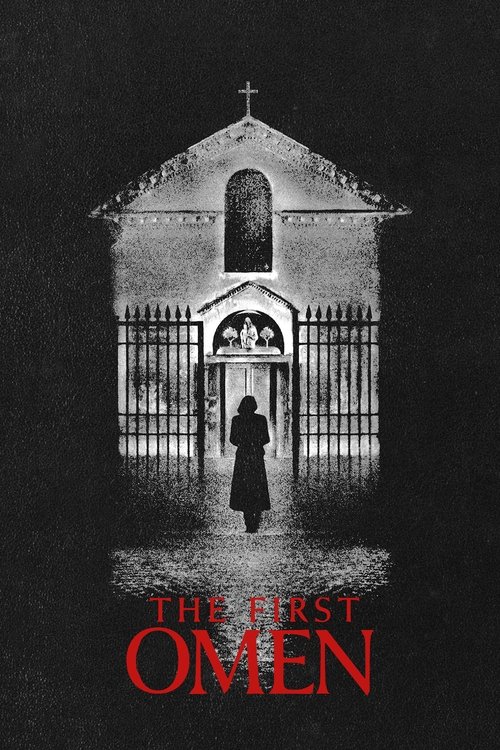
The First Omen
2024 · Arkasha Stevenson
For when you want a serious, full-blooded scare — candlelit corridors, nuns, and real menace — not a jump-scare machine. A challenge rather than a comfort watch, and a strong pick for a Halloween-season night.
What it's about
Rome, 1971: a young American novice arrives to begin a life of service at an orphanage run by nuns, on the path to taking her vows. As she settles into the city and the convent's routines, she starts noticing things that don't add up — and slowly uncovers a conspiracy inside the Church itself, a faction working to bring about the birth of evil incarnate. Her faith, her sanity, and her own body become the battleground.
The experience
Slow-burning dread that keeps tightening, punctuated by genuinely shocking body horror — this is a studio film that goes further than you expect. It's sumptuous and unnerving at once, and the fear is as much about losing control of yourself as about the devil.
Performances
Nell Tiger Free carries the film as Margaret, moving from wide-eyed devotion to raw terror with total commitment — several of the film's most disturbing moments live entirely on her face and body.
The craft
First-time director Arkasha Stevenson shoots 1970s Rome with real period texture and composes images that feel pulled from the golden age of religious horror. The body-horror sequences are frank and practical-feeling, and the sound design earns good speakers; it's a handsome, deliberate film that rewards a dark room and a big screen.
Why it matters
Expected to be a throwaway franchise prequel, it was instead received as one of the more serious studio horror films of 2024, praised for reclaiming its mythology from a woman's point of view and launching Stevenson as a director to watch.
Snapshot
The First Omen is a prequel to Richard Donner's The Omen (1976). It explains how Damien Thorn came to be born. Set in Rome in 1971, it follows Margaret Daino (Nell Tiger Free), a young American novice sent to an orphanage run by nuns. She slowly finds out that a faction inside the Church is breeding an Antichrist. Their aim is to frighten a secularising world back into faith. The film was Arkasha Stevenson's first feature, and 20th Century Studios released it theatrically in April 2024. Most observers expected another legacy-franchise exercise. Instead it was widely received as one of the more serious studio horror films of its year. Critics praised it for its 1970s period craft, its frank body horror and its feminist reading of the original's mythology. It also became part of a brief 2024 cycle of "nun horror" built around forced pregnancy, alongside Immaculate, which came out two weeks earlier. Both are now usually read as a post-Dobbs cultural response.
Industry & production
The film came out of the Walt Disney Company's acquisition of 21st Century Fox, completed in 2019. That deal left Disney holding a large library of Fox genre properties. The renamed 20th Century Studios revived several of them, largely through Hulu and selected theatrical releases, including Prey (2022) and Alien: Romulus (2024). The Omen was a natural candidate. The original franchise had run through two theatrical sequels (Damien: Omen II, 1978; Omen III: The Final Conflict, 1981), a television film (Omen IV: The Awakening, 1991), John Moore's near shot-for-shot remake (2006), and the short-lived A&E/Lifetime series Damien (2016).
The project was produced by David S. Goyer and Keith Levine. Ben Jacoby wrote the original story, and the screenplay is credited to Tim Smith, Arkasha Stevenson and Keith Thomas. That layered credit suggests the director substantially rewrote an existing studio script, and Stevenson has described reshaping the material around Margaret's point of view. The film was shot on location in Rome, which gives it a physical texture of piazzas, convent corridors and stone interiors that a soundstage reconstruction could not easily fake.
The best-documented production story is a ratings fight. The Motion Picture Association first gave the film an NC-17, mainly because of a birth sequence showing a monstrous hand emerging from a woman's body. Stevenson spoke publicly about cutting and reworking the shot to get an R. She framed the fight as a question of what female anatomy American ratings bodies allow on screen. The ratings dispute became part of the film's critical identity and gave weight to its claims about bodily autonomy.
Its commercial results were modest. It opened in a crowded spring and was generally reported as underperforming at the box office, even though reviews were better than for most franchise horror. It soon found a second audience on Hulu. Precise figures are left out here rather than approximated.
Technology
Nothing about the film's technical approach is radical. Its significance lies in its deliberate period emulation: a contemporary production trying to look and feel like a European-American studio horror film of the early-to-mid 1970s. That means a warm, earthen, faintly desaturated palette, visible texture, and lenses and camera movement that recall the zooms and long-focus compositions of the era. Practical and prosthetic effects carry the main horror set pieces, the birth imagery above all, with digital work used for augmentation rather than spectacle. Publicly available detail on capture format and lens packages is thin and is not reconstructed here. What can be said is that the period look is consistent and intentional, not a filter applied afterwards.
Technique
Cinematography
The cinematographer was Aaron Morton, a New Zealander known for Fede Álvarez's Evil Dead (2013), No One Will Save You (2023) and episodes of Black Mirror. His work here is restrained by franchise standards. He often frames Margaret small inside heavy architecture: vaulted corridors, cloister arches, the high walls of the orphanage. The compositions stress how institutions dwarf the people inside them. Symmetry and centred framing carry an ecclesiastical formality, and the film saves handheld instability for moments when Margaret's sense of reality breaks down. The 1970s zoom is used sparingly and on purpose, as a period signature rather than a tic.
The lighting favours murk and practical sources: candlelight, overcast daylight, sodium-orange streets at night. Faces are often half-lit and blacks are allowed to swallow detail. The effect recalls Italian and British horror of the period more than the bright, high-contrast look of modern franchise horror.
Editing
The film was edited by Bob Murawski, a long-time Sam Raimi collaborator who won an Oscar for The Hurt Locker, and Amy E. Duddleston. It holds back for long stretches: scenes of convent routine, conversations with Father Brennan, and Margaret's attachment to the troubled orphan Carlita are given space to settle. That patience sets up sharper, more violent cutting in the set pieces. In the hallucinatory and conspiratorial sequences, the editing blurs Margaret's perception with objective events, so the audience shares her uncertainty about what is happening and what is being done to her. The prologue, a priest killed by falling glass, deliberately echoes the original film's famous decapitation and borrows its rhythm of suspense, then sudden violence.
Mise-en-scène / staging
The production design treats 1971 Rome as a city in turmoil. Student protests and street clashes run through the background as signs of the secularising, rebellious modernity that the conspirators want to crush with fear. Inside, the convent and orphanage are stern and claustrophobic: nuns' habits, iron bedsteads, devotional art. Children's drawings are a recurring motif and carry clues. The staging places many key revelations in tableaux. One example is a mass suicide that restages the nanny's hanging from the 1976 film. Another is the climactic ritual chamber. Staging the past as tableau ties the prequel to its source's visual vocabulary.
The most discussed staging is in the body-horror passages. Margaret's convulsive episode in the street openly cites Andrzej Żuławski's Possession (1981) and Isabelle Adjani's subway breakdown. The birth sequence uses practical prosthetics to make reproductive horror literal rather than implied.
Sound
Mark Korven composed the score. He is best known for Robert Eggers's The Witch (2015) and The Lighthouse (2019) and for Scott Derrickson's The Black Phone (2021). Jerry Goldsmith's Oscar-winning score for the 1976 film, with its "Ave Satani" Latin chant, is one of horror's most recognisable, so any successor has to deal with it. Korven's approach is generally understood to work by allusion more than quotation: choral textures, breathing, guttural and liturgical voices, and dissonant drones, with clear nods to Goldsmith's satanic-mass idiom at key moments. The sound design gives weight to bodily sounds such as breath, gasps and the wet acoustics of the birth scenes. That pushes the horror inward, into the body, in keeping with the film's themes.
Performance
Nell Tiger Free, who had played Leanne in M. Night Shyamalan's Servant (2019–2023), carries the film. Her performance moves from sincere, slightly guarded devotion to paranoia and then to an all-out physical crisis that critics singled out. Her convulsion and birth sequences demand full-body commitment in the tradition of Adjani in Possession and Linda Blair in The Exorcist. Reviewers widely called it a breakout.
The supporting cast is a run of distinguished character actors. Bill Nighy plays Cardinal Lawrence with avuncular warmth that curdles. Sônia Braga is Sister Silva, the orphanage's formidable abbess. Ralph Ineson plays a younger Father Brennan, the role Patrick Troughton originated in 1976. Charles Dance appears briefly as the priest killed in the prologue. Tawfeek Barhom plays Father Gabriel, Maria Caballero plays Margaret's roommate Luz, and Nicole Sorace plays Carlita.
Narrative & dramatic mode
The film is built as a conspiracy thriller wrapped in a coming-of-awareness narrative. Margaret arrives believing in the institution and gradually learns that it sees her as a means to an end. Its main twist is that the "mother" chosen for the Antichrist is not the person the audience is led to suspect. Margaret herself has been bred and groomed for the role. That turns the story from detection into self-recognition, which is close to tragedy.
As a prequel, the film works under a known destination. The baby boy has to end up with the Thorn family, and the 1976 film's events have to happen. Stevenson and her co-writers deal with this by bending the ending. Margaret gives birth to twins. The son, Damien, goes on to his destiny, and Margaret escapes with the daughter, protected by Brennan and Gabriel. That opens a parallel thread the original never imagined while keeping continuity. The mode is grave, slow-burning and mostly humourless. Spectacle is saved for a few large set pieces, and dread builds through suggestion in between.
Genre & cycle
The First Omen belongs to several overlapping genre lines:
- The 1970s satanic/Antichrist cycle. It is a direct descendant of Rosemary's Baby (1968), The Exorcist (1973) and The Omen (1976). These were studio-backed films that treated Catholic and Satanic mythology with prestige seriousness.
- The legacy-sequel/prequel boom. It sits among 2020s returns to dormant horror IP, many of them prequels or "requels." It was received as an unusually authorial example of the form.
- 2024 nun horror and pregnancy horror. It arrived within weeks of Michael Mohan's Immaculate, starring Sydney Sweeney. That film also features an American novice in an Italian convent, a secret pregnancy program and a Church faction with ulterior motives. The overlap was a coincidence, but it was widely remarked on and produced a small cycle that critics discussed together. The two are often compared: Immaculate leaning to provocation and genre bluntness, The First Omen to period classicism.
- Eurohorror and giallo pastiche. Its Roman setting, convent intrigue and stylised violence point to Italian horror of the 1970s, as well as films set in Italy such as Don't Look Now (1973) and Suspiria (1977).
Authorship & method
Arkasha Stevenson came to directing from photography. She worked as a photojournalist, including at the Los Angeles Times. She then made short films, notably Pineapple, and directed television, including episodes of the anthology horror series Channel Zero (the Butcher's Block season, 2018) and Netflix's Brand New Cherry Flavor (2021). Both shows share her interest in bodily transformation, female interiority and surreal horror. The First Omen was her first feature. In interviews she has stressed reworking franchise material around a woman's bodily experience and drawing on 1970s European art-horror, Possession in particular, as a reference point.
Key collaborators:
- Cinematography: Aaron Morton, whose horror résumé includes Evil Dead (2013) and No One Will Save You (2023).
- Music: Mark Korven, a defining sound of the A24-era "elevated horror" score.
- Editing: Bob Murawski and Amy E. Duddleston.
- Screenplay: Tim Smith, Arkasha Stevenson and Keith Thomas (director of The Vigil, 2019, and Firestarter, 2022), from a story by Ben Jacoby.
- Producers: David S. Goyer and Keith Levine.
Records of the precise division of writing labour are limited. As noted above, the film's tone and point of view are generally credited to Stevenson.
Movement / national cinema
This is an American studio production shot in Italy with an international cast, so it fits no national movement neatly. Its main cinematic conversation, though, is with 1970s European horror and with the transatlantic studio horror of that decade. The Omen itself was an American production made largely in Britain. Stevenson's film repeats that hybridity: a Hollywood franchise film using European locations and European art-horror models. It can also be placed loosely within the 2010s–2020s movement critics call "elevated" or "prestige" horror. Through Korven it is linked to Robert Eggers's films. Its concerns with the female body and institutional control also connect it to a wider wave of women-directed body horror, including Julia Ducournau's Raw (2016) and Titane (2021) and Coralie Fargeat's The Substance (2024), released later the same year.
Era / period
The film works in two time frames. Its story is set in 1971. In Italy that was a period of student and labour unrest, the beginning of what became the "Years of Lead," and of Church anxiety in the aftermath of the Second Vatican Council (1962–65), as liberalising currents met conservative resistance. The film's conspiracy is about exactly that anxiety: a Church losing authority over a modernising youth culture decides to make the devil real so that people will need God again. The script does not claim particular historical events as its sources; the backdrop is atmosphere rather than documentary.
It was produced and released in the early 2020s. In the United States, that period was defined by the Supreme Court's Dobbs v. Jackson Women's Health Organization decision (June 2022), which overturned Roe v. Wade. Production timing makes it unlikely that the film was conceived as a direct response. Even so, critics widely read it, and Immaculate, through a post-Dobbs lens: stories of women whose bodies are taken over by institutions claiming religious authority. The ratings controversy over showing female anatomy fed this reading.
Themes
- Institutional control of women's bodies. The core idea is that the Church, or one faction of it, treats women as vessels. Margaret's body is chosen, bred, monitored and finally used. The film's horror comes as much from bureaucratic, paternal men in cassocks as from anything supernatural.
- Faith as an instrument of power. Cardinal Lawrence's plan turns the original's theology upside down. Evil is not an outside invader; it is a tool that the faithful manufacture to restore their own authority.
- Identity and self-recognition. Margaret's arc moves from searching for a vulnerable child to realising that she is the object of the conspiracy. The prequel's mystery becomes a story about discovering one's own manufactured origins.
- Sisterhood and surrogacy. Margaret's bond with Carlita, an orphan who appears to be another candidate, is the film's emotional centre. The protective chain among women runs against the conspiracy's logic of breeding and disposal.
- Revolt versus order. The street protests and the conspirators' ritual chambers stand for opposed answers to modernity. The film's sympathies lie more with disorder than with the Church's enforced obedience.
- Rewriting the father's story. The 1976 Omen is told from the perspective of Robert Thorn, an American diplomat. The First Omen tells the hidden mother's story the original left out. As an act of franchise authorship, that is itself a thematic statement.
Reception, canon & influence
Critical reception. Reviews were broadly positive, and many said they were pleasantly surprised given low expectations for a prequel to a 48-year-old property. Critics most often praised Nell Tiger Free's performance, Stevenson's control of tone, the 1970s craft and the body-horror set pieces, the birth sequence most of all. Weaker points noted included a long middle section, conspiracy exposition that some found heavy, and a final act forced to reconcile its own story with The Omen's continuity. Many reviewers ranked it the best Omen film since the original. Comparisons with Immaculate came up repeatedly, with judgments split on which handled the shared premise better. Box-office returns were, as noted, generally reported as disappointing. That has fed a reputation for the film as underseen and worth rediscovering, especially among genre audiences who found it on streaming.
Influences on the film (backward).
- The Omen (1976, Richard Donner) is the source of the mythology, characters (Father Brennan, the Thorn adoption) and set-piece grammar. The prologue's glass death and the hanging tableau quote it directly.
- Rosemary's Baby (1968, Roman Polanski) supplies the template of a woman whose pregnancy is engineered by a satanic conspiracy in her trusted circle.
- Possession (1981, Andrzej Żuławski) is openly cited in Margaret's convulsive breakdown, and Stevenson has named it as a model.
- The Exorcist (1973, William Friedkin) informs the prestige, bodily, Catholic seriousness.
- Don't Look Now (1973) and Suspiria (1977) inform the Italian setting, Eurohorror atmosphere and threatening institutions.
- Jerry Goldsmith's Omen score is a model that Korven both answers and avoids.
Legacy (forward). It is too early, two years on, to make firm claims about lasting influence, and the record is still being written. A few points can be made with some confidence. The First Omen is regularly named as evidence that legacy-IP horror can support a distinct directorial voice, which helped make the case for giving franchise properties to emerging genre filmmakers. It established Nell Tiger Free as a leading horror performer. Together with Immaculate, it is now treated in critical writing as a marker of 2024's preoccupation with reproductive horror and with women's bodily autonomy under religious and institutional power. Its ending leaves a door open: Margaret and her daughter alive, and Brennan's mission on record. No sequel following that thread has been confirmed in the public record available here. Its ratings fight with the MPA is often cited in discussions of how American classification treats female-centred body horror.
Influences: the films it descends from and the films it influenced
- The Omen (1976) — Gives the film its set-piece grammar: the impalement-by-chance death, the public suicide witnessed by a crowd, and Father Brennan's frantic warnings, which Stevenson restages as deliberate tableaux that point forward to Donner's compositions.
- Rosemary's Baby (1968) — Polanski's method of keeping the camera tied to one woman's point of view, so that kindly elders and helpful clergy slowly turn out to be conspirators managing her pregnancy, is the structure the film's paranoia-to-recognition plot is built on.
- Possession (1981) — Margaret's long, wordless, full-body convulsion in a public passageway is modelled on Isabelle Adjani's subway-tunnel breakdown, which Stevenson has named as a reference: the performer is given space to make her body itself the special effect.
- The Exorcist (1973) — Friedkin's procedural, documentary-sober treatment of Catholic institutions, together with practical on-set effects on a convulsing female body, sets the prestige register Stevenson aims for instead of franchise camp.
- Don't Look Now (1973) — Roeg's elliptical, associative cutting and fleeting glimpses of figures in an Italian city of stone passages show the film how to make a foreigner's perception of Italy itself feel unreliable.
- Suspiria (1977) — An American ingénue arrives at a European institution run by a hierarchy of older women who are secretly a coven, and the architecture swallows her. The First Omen moves this setup from ballet academy to Roman orphanage.
- The Devils (1971) — Its choreographed group hysteria among nuns and its picture of the Church manufacturing possession for political ends lie behind the film's convent convulsions, and its X-rating cuts by Warner Bros. foreshadow The First Omen's NC-17 fight over female bodily imagery.
- Mother Joan of the Angels (1961) — Its stark compositions of white-habited nuns made tiny by bare convent walls and courtyards anticipate the film's architectural framing, where institutional space dwarfs the body.
- Damien: Omen II (1978) — It established the franchise's model of a sequel built around a secret network of adult disciples placed inside institutions, which the prequel turns back into a church-run breeding conspiracy.
- The Substance (2024) — In the same 2024 wave of female-centred practical prosthetic body horror, it uses extreme in-camera bodily rupture as commentary on institutional control of women's bodies.
- Immaculate (2024) — Released three weeks earlier, it shares the premise of an American novice in an Italian convent pregnant against her will, and it also ends on an explicit, practically staged birth that critics read side by side with The First Omen's.
- Suspiria (2018) — Another precise 1970s period emulation set amid European political violence (1977 Berlin, here 1971 Rome), using contorting, broken-body choreography as its central form of horror.
- Saint Maud (2019) — Shot from inside a young devout woman's perception, it renders religious ecstasy and torment through her body's spasms, matching The First Omen's subjective blur and its full-body lead performance.
- Benedetta (2021) — It shows the Church deciding what counts as a miracle or as possession for institutional gain, and treats a nun's body as contested property. It arrived in ratings and censorship controversy, as The First Omen did.
- The Witch (2015) — Mark Korven's nyckelharpa-and-choir dissonance here defined the bowed, liturgical drone palette he extends in The First Omen to replace Goldsmith's Latin chant.
- Evil Dead (2013) — Aaron Morton's cinematography for in-camera prosthetic and fluid gore, lit to let practical effects hold the frame without digital cleanup, carries straight into the birth and self-harm set pieces.
- No One Will Save You (2023) — Morton's camera again carries a near-wordless young woman in a hostile space, staking the film's suspense on one actress's physical performance, which is the brief Nell Tiger Free fulfils.
- Hereditary (2018) — A secret satanic network quietly arranges a family's fate to bring forth a demonic heir, ending on a conspiracy-to-recognition twist and a final tableau of acolytes, which The First Omen's last act mirrors.
Similar films
- The Omen (1976) — influence & lineage
- The Exorcist (1973) — influence & lineage
- Rosemary's Baby (1968) — influence & lineage
- The Devils (1971) — influence & lineage
- Hereditary (2018) — influence & lineage
- Longlegs (2024) — shared sensibility
- Heretic (2024) — shared sensibility
- Nosferatu (2024) — shared sensibility