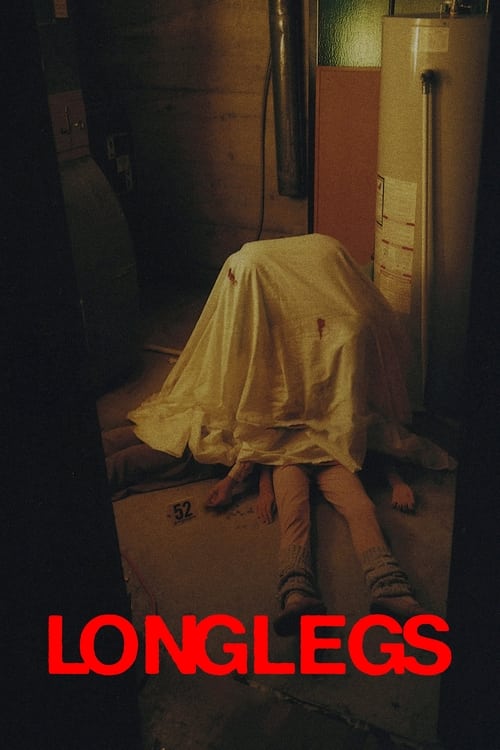
Longlegs
2024 · Osgood Perkins
Neon's cipher-laden, Cage-concealing campaign made Longlegs indie horror's biggest hit and turned marketing itself into the reviewed object — the reference point for post-trailer-era film promotion (see also Skinamarink's TikTok-leak virality and Terrifier 3 beating Joker 2 unrated).
When you're craving a real scare — the slow, oppressive kind that follows you home rather than the roller-coaster kind. One for the lights-off, phone-away crowd; not a casual background watch.
What it's about
Lee Harker, a withdrawn young FBI agent with an uncanny intuition, is assigned to a decades-old case: families annihilated in their own homes with no sign of forced entry, each scene marked by a coded letter signed 'Longlegs.' As she deciphers the killer's ciphers, the evidence bends toward the occult — and toward something buried in her own past.
The experience
Pure creeping dread, sustained for nearly the whole runtime. It's quiet, cold, and wrong-feeling in a way that gets under your skin — less about jump scares than about the sense that something is standing just outside the frame. Expect to check the corners of your bedroom afterward.
Performances
Maika Monroe plays Harker coiled and nearly silent, all held breath and darting eyes, while Nicolas Cage is unrecognizable and genuinely disturbing as the killer — a shrieking, sing-song presence the film wisely rations to a few unforgettable scenes.
The craft
Osgood Perkins builds fear through composition: wide, symmetrical frames with acres of empty space where your eye keeps searching for a figure. The sound design is a weapon — hums, drones, and sudden silences — and the wintry Oregon-set photography gives it a chilly 1990s procedural texture. Best experienced loud and in the dark.
Why it matters
Powered by a famously secretive marketing campaign, it became one of the biggest independent horror hits of its decade and turned Perkins into a marquee name in the genre.
Snapshot
Longlegs is an occult serial-killer procedural directed and written by Osgood Perkins, released in the United States by Neon in the summer of 2024. It follows Lee Harker (Maika Monroe), a reticent, possibly clairvoyant young FBI agent assigned to a long-running case of family annihilations that bear no sign of forced entry and no surviving outside perpetrator — each apparently committed by a father who then kills his family and himself, yet all linked by encrypted letters signed "Longlegs." The killer (Nicolas Cage), it emerges, is not the direct hand of the murders but a Satanic intermediary who works through dolls, suggestion, and a buried connection to Harker herself. The film's significance is twofold. Commercially, it became one of the defining horror successes of its year, powered by an unusually withholding marketing campaign that treated dread as the product. Critically and culturally, it crystallized a late-2010s/2020s strain of "elevated" American horror that fuses the FBI-profiler template of The Silence of the Lambs with the desaturated forensic gloom of David Fincher and a sincere, almost devotional engagement with the supernatural. It also marked the commercial breakthrough of Perkins, a director whose own lineage — he is the son of Anthony Perkins, Norman Bates of Psycho — hangs over the film's preoccupation with monstrous inheritance.
Industry & production
Longlegs is an independent production, made outside the major studios and acquired and distributed by Neon, the specialty label behind Parasite and a run of arthouse-horror titles. The film was shot in and around Vancouver, British Columbia, standing in for an unnamed, perpetually overcast Pacific Northwest (the milieu reads as Oregon) in the period stretching from the 1970s into the mid-1990s. Production design leans on the muted institutional textures of that era — beige FBI field offices, isolated rural houses, rotary phones, station wagons — without tipping into nostalgia.
The picture's industrial story is inseparable from its release strategy. Neon mounted a cryptic, slow-drip campaign built on fragments: coded letters, a disturbing phone number planted in trailers, redacted "case file" materials, and teasers that withheld a clear look at Cage's face. The approach converted curiosity into event-going and produced a genuine sleeper hit — Longlegs was widely reported as among the highest-grossing independent horror releases of its year and a landmark earner for Neon, far exceeding its modest budget. (Precise budget and worldwide-gross figures vary across trade reporting and are best treated cautiously here; the consensus is simply that it was a major, disproportionate commercial success relative to cost.) The film's profitability has since been cited as a model for how a specialty distributor can turn atmosphere and mystery, rather than IP or stars-above-the-title spectacle, into a wide commercial result.
Technology
Longlegs belongs fully to the digital-capture era of mainstream production, but its craft is bent toward concealment rather than the clarity digital affords. The film's most discussed technological-formal choice is its manipulation of the frame itself: scenes set in the past are rendered in a boxier, more constricted aspect ratio, while the "present" of the investigation opens out into widescreen. This shifting of the image's borders is used as a narrative and psychological instrument — memory and childhood are literally hemmed in; the present is exposed and vulnerable across a wide, often under-populated frame. The production also exploits very long lenses and precise framing to keep crucial information — above all the killer's face — at the literal and figurative edge of perception, a deployment of the camera as an instrument of withholding. Within the story, by contrast, the relevant "technology" is anachronistic and analog: cryptography, handwritten ciphers, Polaroid-era surfaces, and the handmade dolls that serve as the supernatural delivery mechanism. The film thus stages a tension between contemporary capture tools and a deliberately retro, pre-digital diegesis.
Technique
Cinematography
The cinematography, by Andrés Arochi, is the film's signature achievement and the clearest statement of its method. Arochi favors stillness, symmetry, and negative space: characters are frequently small within wide, sparsely furnished compositions, leaving large dead zones of the frame for the audience to scan anxiously. The palette is cold and drained — institutional grays, sickly interiors, washed daylight — punctuated by sudden, saturated reds. Most strikingly, the film practices a discipline of partial revelation, repeatedly placing Longlegs at the top edge of the frame, out of focus, or cut off so that only a glimpse of his altered face intrudes. This restraint trains the viewer into a state of dread that the eventual full views can detonate. The shifting aspect ratios (see Technology) are integral to the photographic design, and the long-lens flatness lends even ordinary spaces a watchful, surveilled quality.
Editing
The editing builds suspense through duration and withholding rather than acceleration. Scenes are allowed to extend past the point of comfort, holding on static frames so that the audience's eye searches the image for the threat. Cross-cutting between Harker's investigation and the buried past is used to seed the personal connection gradually, and the film parcels out its revelations — about the dolls, about Harker's mother, about the mechanism of the crimes — in a controlled escalation that withholds the full design until late. The cutting is patient in its first two acts and tightens as the conspiracy closes, a structure that privileges atmosphere over forensic momentum.
Mise-en-scène / staging
Perkins stages the film as a series of charged, often frontal tableaux. Interiors are emptied and precise; the recurring motif of the doll — uncanny, hand-built effigies that double the murdered children — anchors the production design's horror. The Harker family home and the killer's basement workshop are conceived as ritual spaces. Staging repeatedly isolates the single human figure against architecture or landscape, emphasizing exposure and surveillance. The period detail is deployed not for warmth but for a sense of a closed, analog world in which the rational apparatus of the FBI is helpless against something pre-modern.
Sound
Sound is among the film's most aggressive tools. The score, credited to Zilgi — the recording alias of the director's brother, the musician Elvis Perkins — works in low drones, ruptures, and dissonance rather than melody, and the design pairs long silences with sudden, physical bursts of noise. The film also makes pointed diegetic use of glam-rock, particularly the iconography of T. Rex and Marc Bolan, which feeds the killer's aesthetic and threads a queasy 1970s pop-cultural memory through the horror. Cage's vocal performance — keening, cracked, sing-song — is itself treated as a sound-design element, deployed for maximum discomfort.
Performance
The performances are calibrated to two opposed registers. Maika Monroe plays Harker with a flat, dissociated affect — withdrawn, socially halting, her near-psychic intuition expressed through stillness and dread rather than display. The film rests on her contained, interiorized presence, an anti-charismatic lead performance in the procedural tradition of watchful, isolated investigators. Against her, Nicolas Cage delivers a deliberately grotesque, heavily made-up turn as Longlegs: disfigured by prosthetics, androgynous, modeled in part (by Cage's own account in interviews) on his mother and on a glam-rock theatricality, and pitched at an unnerving, childlike falsetto. The contrast between Monroe's minimalism and Cage's baroque excess is the film's central performative engine. Alicia Witt, as Harker's devout mother, supplies the film's late pivot, and Blair Underwood grounds the procedural frame as Harker's supervising agent.
Narrative & dramatic mode
The film's dramatic mode is the occult procedural: it adopts the structure of an FBI serial-killer investigation — the gifted junior agent, the cold case, the cipher to be broken, the race against the next family's death — and then dissolves its rationalist premises into the supernatural. For much of its length it operates as mystery, inviting the viewer to read clues and forensic detail; its turn is the revelation that the murders have no conventional perpetrator on the scene, that the killer's power is genuinely diabolical, and that the investigator is herself implicated by blood and by a childhood encounter. This conversion of detection into damnation — the realization that solving the case means discovering one's own contamination — is the narrative's defining move. The storytelling is elliptical and mood-forward, prioritizing accumulating dread and symbolic resonance over airtight plot mechanics, and it has been both praised for its atmosphere and faulted for the literalness of its third-act exposition.
Genre & cycle
Longlegs sits at the intersection of three cycles. First, the FBI-profiler thriller descended from The Silence of the Lambs (1991) and, in its forensic palette and obsessive investigator, from David Fincher's Se7en (1995) and Zodiac (2007). Second, the contemporary wave of distributor-driven "elevated" or art-horror — slow-burn, atmosphere-first films marketed on dread and authorship — within which Neon and A24 have been central players. Third, a specifically American strain of Satanic-Panic horror that mines the late-1970s-through-1990s cultural fear of occult conspiracy, ritual abuse, and hidden evil in ordinary suburban families. The film's distinctive contribution to the cycle is to take the supernatural entirely seriously where many procedurals would rationalize it, collapsing the profiler genre's faith in evidence and deduction.
Authorship & method
The dominant authorial signature is Osgood Perkins's. Across The Blackcoat's Daughter, I Am the Pretty Thing That Lives in the House, and Gretel & Hansel, Perkins had developed a recognizable method: glacial pacing, formal symmetry, dread over jump-scares, and a fixation on inherited evil, possession, and the family as a site of horror — concerns that Longlegs synthesizes and commercializes. His own biography is unavoidable context: as the son of Anthony Perkins, his work is frequently read through the lens of Psycho and the legacy of playing, and being defined by, a monster — a resonance the film's themes of contaminated lineage and the mother's overwhelming influence amplify, whether or not one presses the autobiographical reading.
The method is realized through a tight set of collaborators. Cinematographer Andrés Arochi executes the withholding, symmetrical visual scheme. The score and sonic identity come from Perkins's brother, Elvis Perkins, recording as Zilgi, making Longlegs a notably familial authorial enterprise on the creative side. And the casting of Nicolas Cage — who also produced — is itself an authorial gambit: harnessing Cage's reputation for unbridled performance and channeling it, through heavy prosthetic concealment and the marketing's refusal to show him, into a figure of pure dread. The collaboration between Perkins's controlled framework and Cage's volatility defines the film's texture.
Movement / national cinema
Longlegs is a North American independent film — American in authorship and setting, Canadian in its physical production base. It claims no formal film movement, but it is firmly within the institutional "movement" of 21st-century specialty-distributor horror, in which labels such as Neon and A24 function as de facto auteur patrons, releasing director-driven genre films pitched to both critics and a young theatrical audience. Its Pacific-Northwest gloom and forensic Americana place it in a recognizable national-cinematic register of cold, conspiratorial American thrillers.
Era / period
The film is doubly period: it is a 2024 production set largely in the 1990s (with roots in the 1970s). That choice is load-bearing. The 1990s setting evokes the height of the FBI-profiler thriller's cultural prestige and the residue of the Satanic Panic, allowing the film to operate in an analog world without cellphones or instant databases, where investigation is slow and the supernatural can hide. As a 2024 release, Longlegs is a document of its own moment in the film economy: the post-pandemic theatrical landscape in which mid-budget originals struggled, and in which atmosphere-driven horror and aggressive, mystery-based marketing proved one of the few reliable routes to a wide, profitable theatrical event.
Themes
Its central theme is inherited evil — the transmission of corruption across generations and the discovery that the investigator is not separate from the horror but produced by it. Closely bound to this is the figure of the mother and the perversion of maternal devotion, which the film locates at the heart of the murders. Religion runs throughout: the literal Satanic mechanism, but also the imagery of devotion, sacrifice, and faith, set against the impotence of secular, rational institutions. The doll — the handmade effigy that carries the killer's power — concentrates the film's dread about childhood, control, and the substitution of the manufactured for the human. And, reflexively, the film meditates on monstrosity and lineage in a way that resonates with its director's own inheritance and with the broader horror tradition of the family as the original crime scene.
Reception, canon & influence
Critical reception was strong and, for a horror release, unusually prominent, with wide praise for Arochi's cinematography, the film's sustained atmosphere, Monroe's controlled lead performance, and Cage's grotesque, concealed turn — frequently singled out as one of his most unsettling. The most common reservation concerned the third act: a number of critics felt the film's exposition and supernatural literalization could not fully sustain the extraordinary dread of its first two-thirds, and that explanation diminished mystery. Even so, the prevailing verdict treated Longlegs as a high point of contemporary studio-adjacent horror and a confirmation of Perkins as a major genre voice.
The influences on the film are clear and openly invoked: The Silence of the Lambs for its template of the watchful young female agent and a charismatic monster; Fincher's Se7en and Zodiac for their cold forensic palette and obsessive investigation; the occult and Satanic-Panic horror of the 1970s–90s for its cosmology; and Perkins's own earlier films for their pacing and preoccupations. The shadow of Psycho — through the Perkins name and the theme of the murderous mother's hold — is part of the film's interpretive frame.
Its forward influence is already legible at the industry level. Longlegs became a reference point for how a specialty distributor can engineer a horror phenomenon through withholding, mystery-driven marketing and a strong authorial brand, and its commercial success has been cited in trade discussion as encouragement for further mid-budget original horror and for Perkins's continued, accelerated output. Whether the film enters a durable canon will depend on how its reputation settles against the reservations about its ending; what is already secure is its standing as one of the signature horror events of its year and a defining example of the 2020s art-horror procedural.
A Deleuzian reading
Watch where they put him.
The full Deleuzian reading of Longlegs →
Reception
Rode one of the most hyped horror rollouts in years to a monster indie opening in July 2024 — critics called it the scariest film of the decade — then word-of-mouth curdled fast, with audiences crying overhype. Two years on it's settled as 2024 horror's great love-it-or-hate-it flashpoint.
How Longlegs was received, from release to now →
Influences: the films it descends from and the films it influenced
- The Silence of the Lambs (1991) — Supplies the core template of a lone watchful junior female agent matched against a charismatic monster, plus Demme's unnerving direct-to-lens frontal close-ups that Perkins reworks into his symmetrical tableaux.
- Se7en (1995) — Establishes the cold, desaturated forensic palette and the structure of an investigation choreographed by an unseen killer whose design only resolves at the end.
- Zodiac (2007) — Models the obsessive period-set procedural assembled from ciphers, documents and dates, with an analog-era texture and a dread that comes from a case that resists solution.
- Psycho (1960) — The murderous mother's psychic hold turning a son into her instrument is the exact lineage the film invokes — amplified by the Anthony/Osgood Perkins name itself.
- Rosemary's Baby (1968) — Provides the occult-conspiracy-in-banal-domesticity blueprint: a coven plotting in plain sight to deliver a child to the Devil, evil hidden behind ordinary surfaces.
- The Exorcist (1973) — Originates the occult-procedural rhythm of rational investigators forced toward literal possession, treating the supernatural with documentary flatness rather than spectacle.
- The Shining (1980) — Source of the one-point-perspective frontal symmetry and glacial dread where rigid formal control, not motion, generates the horror.
- Manhunter (1986) — Introduces the profiler who must inhabit the killer's mind and the killer-to-investigator communication motif (letters/messages) that drives the case forward.
- The Blackcoat's Daughter (2015) — Perkins's own proof-of-method: glacial cross-cut withholding of timeline, demonic possession, and brother Elvis Perkins's dissonant drone scoring recording as Zilgi.
- I Am the Pretty Thing That Lives in the House (2016) — Perfects Perkins's negative-space framing and duration-as-dread, withholding the figure at the edge of the frame and letting empty rooms do the haunting.
- Cure (1997) — Pioneers the long-lens flat compositions and dissociated affect inside a detective procedural where the mesmerist-antagonist is kept barely glimpsed and unknowable.
- The Conjuring: Last Rites (2025) — Extends the occult-procedural-meets-negative-space aesthetic, using wide empty frames and withheld reveals with a period-inflected true-crime texture descended from the Conjuring mode.
- Hereditary (2018) — Shares the inherited-evil cosmology delivered through dollhouse-frontal symmetrical staging and a slow occult-conspiracy reveal that recasts the family as a trap engineered by a cult.
- The Witch (2015) — Parallel art-horror literalization of Satanic-panic material through composed natural-light tableaux and Mark Korven's atonal, dissonant choral score.
- It Follows (2014) — Builds suburban dread from anamorphic long-lens flatness and slow lateral pans across negative space, scored by a deliberately dissonant analog-synth drone.
- Sinister (2012) — Runs the same true-crime/occult procedural engine, with an investigator decoding analog home-movie footage to uncover a serial demonic pattern across decades.
- The Empty Man (2020) — Extends the occult-procedural detective structure in which a missing-persons investigation dissolves into a cult cosmology, the case logic itself becoming the horror.
- Strange Darling (2024) — Runs the same contemporary photochemical elevated-horror playbook — anamorphic dread and against-type star casting deployed for unease — as a 2024 peer of Strange Darling.
- The Black Phone (2022) — Buries a marquee dramatic actor (Cage) under grotesque prosthetics as a 1970s-inflected occult serial killer, extending the same 'prestige actor as concealed monster' and analog-period craft.
- Smile (2022) — Post-Smile theatrical horror that trades on negative-space framing — threat lurking at the edge of the widescreen frame — and the same stunt-driven cryptic viral marketing playbook.
- Bring Her Back (2025) — A contemporary prestige-horror peer that sustains dread through the withholding frame — subjects pushed to the edges or held just offscreen — within the same mid-2020s A24-style wave.
- Hokum (2026) — Perkins composes in boxy static wides that hide the threat at the frame's edge or half out of it and hold the shot past comfort, refusing the cut that would confirm what the viewer thinks they saw — the same negative-space-plus-withheld-cut contract.
Similar films
- Sinister (2012) — influence & lineage
- Late Night with the Devil (2024) — same viewing thread
- Strange Darling (2024) — often watched together
- The Girl with the Needle (2024) — often watched together
- Nosferatu (2024) — shared sensibility
- Oddity (2024) — shared sensibility
- Mandy (2018) — shared sensibility
- The Texas Chain Saw Massacre (1974) — shared sensibility
All the films related to Longlegs →
Watch it with: curated runs of related films
- Fever-Dream Horror — Watch these when you want horror that runs on dream logic — witches, circuses, crematoria and occult dread rendered as hand-crafted, hallucinatory nightmare rather than jump-scare.