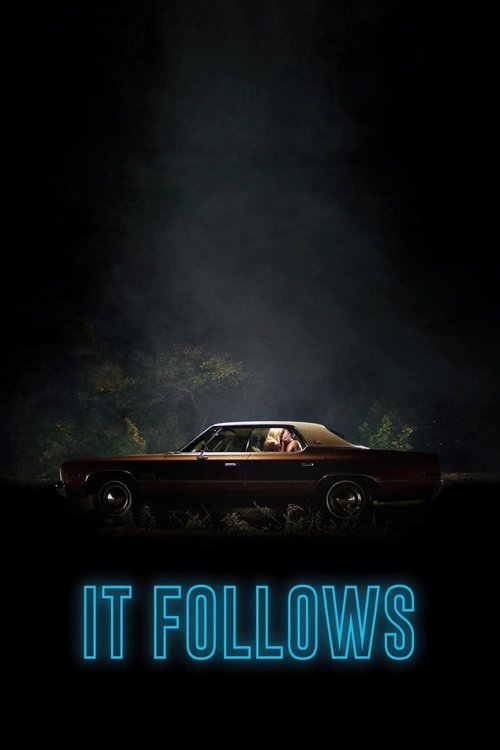
It Follows
2015 · David Robert Mitchell
When you're craving a real scare — the kind that gets under your skin and lingers — rather than gore or cheap jolts. Ideal late-night viewing; expect to eye strangers walking toward you a little differently for a few days.
What it's about
After a sexual encounter, a young woman in suburban Detroit realizes she's being followed — by something only she can see, that can look like anyone, and that walks toward her, slowly and without ever stopping. The only way to get rid of it is to pass it on the same way she got it. With a small circle of loyal friends, she tries to run, hide, and figure out the rules before it reaches her.
The experience
Pure sustained dread — the slow-walking threat turns every wide shot into a threat assessment, and you'll find yourself scanning the background of every frame. It's less about jump scares than a creeping, existential unease that follows you out of the theater.
Performances
Maika Monroe anchors the film with a grounded, sympathetic lead performance that made her one of the era's defining horror stars.
The craft
Mitchell shoots in widescreen with slow, prowling camera moves that weaponize empty space — the horror lives in the background of the frame. A pulsing, abrasive synth score does half the terrifying, and the deliberately timeless suburban Detroit setting gives it the texture of a bad dream. See it big and loud if you can; the compositions and the score are the whole game.
Why it matters
A Cannes-launched indie that became one of the defining horror films of the 2010s, proving a single elegant premise and formal control could out-scare studio budgets and helping open the door for a wave of ambitious independent horror.
Snapshot
It Follows is the second feature by American writer-director David Robert Mitchell, a low-budget independent horror film that premiered in the Critics' Week sidebar at the 2014 Cannes Film Festival before a staggered American release that ran into 2015. Its premise is elegantly economical: after a sexual encounter, a young woman named Jay (Maika Monroe) finds herself pursued by a relentless, shape-shifting entity, visible only to its targets, that walks toward her at an unhurried pace and can be passed to another person only through sex. From this single rule Mitchell builds a film that functions simultaneously as a taut suspense machine and as an extended meditation on mortality, adolescence, and the loss of innocence. Shot in and around Detroit on an anamorphic format, scored with a pulsing synthesizer soundtrack, and steeped in the textures of late-1970s and 1980s horror, It Follows became one of the defining titles of the independent horror revival of the mid-2010s and a frequent reference point in debates over so-called "elevated horror."
Industry & production
It Follows was produced through a constellation of small independent companies — Northern Lights Films, Animal Kingdom, and Two Flints among them — and made on a modest budget that has been widely reported in the low single-digit millions of dollars (figures around two million are commonly cited; the precise number is not authoritatively fixed in the public record, so it should be treated as approximate). The film was Mitchell's follow-up to his well-received but little-seen debut The Myth of the American Sleepover (2010), and it represented a significant scaling-up of ambition while remaining firmly within the economics of American independent cinema.
The picture's commercial trajectory is a notable part of its story. After its Cannes bow and a festival run through 2014, distribution in the United States was handled by Radius-TWC, the genre-and-specialty label affiliated with The Weinstein Company. The film opened in limited release in March 2015 and, on the strength of strong reviews and word of mouth, was expanded into a wider theatrical run — an unusual escalation for a small horror title. It went on to become a sleeper success, earning a worldwide gross many times its production cost (figures in the low-to-mid tens of millions are commonly reported). That performance helped consolidate the commercial case for distinctive, director-driven horror in the period, and it raised Mitchell's profile considerably, though his subsequent feature, the divisive neo-noir Under the Silver Lake (2018), would chart a very different course.
Technology
It Follows was shot digitally and finished in a 2.35:1 widescreen aspect ratio using anamorphic lenses, a choice that gives the image its distinctive shallow-focus fields and gentle edge distortion. The decision to embrace a scope frame is itself a technological and aesthetic statement: it affords the wide, deep compositions the film needs so that the "follower" can be glimpsed as a small figure far behind the protagonists, exploiting the full breadth of the frame to plant dread at its margins.
The film is also notable for its deliberately ambiguous technological texture. Production design layers period and contemporary objects so that no single era is legible: boxy mid-century televisions and rotary-styled telephones share space with a character's distinctly modern clamshell-shaped e-reader, and the automobiles span decades. This anachronistic mixing is a conscious design strategy rather than carelessness, untethering the story from a fixed present and lending it a dreamlike, timeless quality. The result is a film whose "technology" is felt less as gear than as a curated material world designed to evoke memory and unease.
Technique
Cinematography
The cinematography, by Mike Gioulakis in the work that launched his career (he would go on to shoot M. Night Shyamalan's Split and Glass and Jordan Peele's Us), is the film's most celebrated formal element. Gioulakis and Mitchell favor slow, controlled camera movements — measured dolly moves and, most strikingly, full or near-full 360-degree pans that rotate around the characters. These rotations are not merely stylish: because the threat is a figure that simply walks toward its victim, the sweeping camera transforms the entire surrounding space into a zone of potential menace, inviting the viewer to scan the background of every shot for an approaching person. The anamorphic widescreen and frequent use of wide, deep-focus compositions reinforce this, keeping foreground characters and distant figures legible within the same frame so that suspense is generated by what the audience notices before the characters do. The palette tends toward cool, desaturated suburban light and autumnal exteriors, contributing to the film's melancholic atmosphere.
Editing
Edited by Julio Perez IV, It Follows is paced as a slow burn, holding shots long enough to let dread accumulate and trusting the audience to perform the work of vigilance. The cutting tends to preserve spatial clarity — essential to a film whose horror depends on the viewer's ability to track distance and direction. Tension is built less through rapid montage than through duration and the careful timing of reveals, with the editing allowing the relentless, walking-pace approach of the entity to register as an almost geometric inevitability.
Mise-en-scène / staging
Mitchell stages the film around the visual logic of its central conceit. Because the follower can take the form of anyone — a stranger, a friend, a family member, sometimes a grotesque or uncanny figure — staging is organized around the unsettling ordinariness of a person walking steadily forward. Public and domestic spaces alike are blocked so that a single advancing figure can puncture them. The suburban milieu — modest Detroit-area houses, empty streets, a community swimming pool, a decaying urban periphery — is itself part of the mise-en-scène, evoking both the idealized American adolescence of earlier teen films and its hollowed-out, recession-era underside. Recurring motifs of thresholds, doorways, and windows emphasize the futility of barriers against something that cannot be locked out.
Sound
The score, composed by Rich Vreeland under the moniker Disasterpeace — previously best known for the music of the video game Fez — is integral to the film's identity. Built from dense, dissonant synthesizers, the music is overtly indebted to the analog-synth horror scores of the late 1970s and 1980s, John Carpenter's work foremost among them, while pushing toward a more abrasive, maximalist intensity. The score does not merely underline events; it functions as an atmosphere of pervasive anxiety, swelling into clangorous stings and then receding into low, anxious drones. The sound design supports this with attention to ambient suburban quiet, against which the music's eruptions feel all the more violent.
Performance
The performances favor naturalism and understatement appropriate to the film's youthful ensemble. Maika Monroe, in a breakout turn following her role in Adam Wingard's The Guest (2014), anchors the film as Jay, registering exhaustion, fear, and a kind of stunned grief as much as conventional terror. The surrounding teenagers — played by Keir Gilchrist, Daniel Zovatto, Olivia Luccardi, Lili Sepe, and Jake Weary — are sketched with a credible adolescent listlessness, their loyalty and confusion grounding the supernatural premise in recognizable group dynamics. The restraint of the playing keeps the film tethered to the emotional reality of young people confronting something they cannot understand or defeat.
Narrative & dramatic mode
Dramatically, It Follows operates as a chase film governed by a strict, almost fairy-tale set of rules, but it withholds the explanatory backstory that mainstream horror typically supplies. The entity's origin is never explained; there is no curse-lifting ritual, no mythological exposition, no villain to defeat. The narrative instead proceeds as a series of escalations and temporary respites, organized around the moral and emotional dilemma the rule creates: to be safe, Jay must pass the curse to someone else through sex, which means knowingly endangering another person. This gives the film an ethical weight unusual in the genre and shifts it from a plot of solving toward a mode of enduring. The ambiguous, open ending — which refuses to confirm whether the threat has been escaped — reinforces a tone of existential dread rather than catharsis.
Genre & cycle
It Follows belongs unmistakably to the horror tradition, and more specifically to the lineage of the American teen-slasher and supernatural-stalker films of the late 1970s and 1980s. It engages directly with the genre's long-noted association between sex and death — the slasher convention by which sexually active teenagers are punished — and literalizes it, turning that subtext into the film's explicit mechanism. In doing so it both honors and interrogates the form. It arrived as part of a broader cycle of ambitious, atmosphere-forward independent horror in the early-to-mid 2010s, a wave often (and contentiously) labeled "elevated horror" or "post-horror," alongside films such as The Babadook (2014), The Witch (2015), and later Hereditary (2018), many of which were associated with the rise of A24 as a distributor. It Follows, though not an A24 release, is routinely grouped with this cohort.
Authorship & method
It Follows is strongly authored by David Robert Mitchell, who wrote and directed it and has described the central image — a figure that slowly, inexorably follows — as originating in his own childhood nightmares. The film extends preoccupations visible in The Myth of the American Sleepover: adolescence, the bittersweet threshold between youth and adulthood, and the melancholy of suburban American life. What distinguishes It Follows is the marriage of that sensibility to genre machinery.
The authorship is also a story of collaboration. Mitchell's vision was realized through several key partnerships: cinematographer Mike Gioulakis, whose camera language is inseparable from the film's effect; composer Rich Vreeland (Disasterpeace), whose synth score defines its sonic world; and editor Julio Perez IV, whose patient cutting sustains its dread. Maika Monroe's central performance is likewise essential to the film's emotional register. The Detroit shooting locations, drawn from Mitchell's home region of Michigan, supply the specific landscape — both nostalgic and decayed — that grounds the film's dream logic.
Movement / national cinema
The film is a product of American independent cinema, and it bears the marks of a regional sensibility rooted in Michigan and metropolitan Detroit. It does not belong to a formal movement, but it can be situated within a recognizable strain of American suburban-gothic filmmaking — works that find horror and melancholy in the textures of ordinary middle-American adolescence and in the specific landscapes of a post-industrial heartland. The choice to shoot in and around Detroit, including visibly distressed urban areas, gives the film a quietly political undertone of decline and abandonment, even as Mitchell foregrounds mood over message.
Era / period
Although released in 2014–2015, It Follows deliberately resists temporal placement. Its anachronistic production design and its synth aesthetic evoke the late 1970s and 1980s without committing to that era, producing a "no-time" that feels both remembered and unreal. This dislocation is thematically purposeful: by detaching the story from a datable present, Mitchell universalizes its concerns and heightens its dreamlike quality. The film's relationship to period is therefore best understood as one of evocation and homage rather than reconstruction.
Themes
The film's richest and most debated theme is its treatment of sex. The premise — a fatal condition passed through sexual contact — has been widely read as an allegory for sexually transmitted infection, and beyond that for the broader anxieties surrounding the first experiences of sex in adolescence: vulnerability, consequence, and the irreversible loss of a former innocence. Mitchell himself has tended to resist reducing the film to a single STD reading, and the entity is more productively understood as a figure for mortality itself: a slow, patient, unstoppable thing that, once it has fixed on you, never stops coming, and that can only be deferred, never defeated. In this light the film becomes a coming-of-age story about the dawning awareness of death that accompanies the end of childhood. Related themes run throughout: the fragility of the suburban idyll, the helplessness of youth before forces they cannot comprehend, and the ethical cost of self-preservation when survival means imperiling someone else.
Reception, canon & influence
It Follows was met with strong critical acclaim from its Cannes premiere onward, and that enthusiasm carried through its theatrical expansion, where reviewers singled out its formal control, its Carpenter-indebted score, and the originality of its premise. It quickly became one of the most discussed horror films of its moment and a touchstone in the critical conversation about a new, art-conscious wave of genre filmmaking.
Its lines of influence run backward and forward. Looking back, the film is steeped in the work of John Carpenter — the synthesizer score, the suburban stalker structure, and the patient widescreen menace all echo Halloween (1978) — as well as the broader slasher tradition with its sex-and-death logic, the suburban dread of films like Wes Craven's A Nightmare on Elm Street (1984), and the eerie undertow of American directors such as David Lynch, whose influence on the film's dream atmosphere is frequently noted. The recession-era Detroit setting situates it within a real, contemporary landscape even as it reaches for timeless myth.
Looking forward, It Follows became an important node in the independent horror revival of the 2010s, helping to validate the commercial and artistic viability of atmosphere-driven, concept-forward horror. It launched or elevated the careers of several of its makers — most conspicuously cinematographer Mike Gioulakis and lead actor Maika Monroe — and Disasterpeace's score contributed to a renewed vogue for analog-style synthesizer music in horror. Its central image of an unstoppable walking pursuer and its rule-bound supernatural logic have been widely cited and imitated, and the film is now routinely included in critical surveys of the era's most significant horror titles. The breadth of its specific, frame-by-frame influence on later films is harder to document precisely than its general reputation, and on that finer-grained question the scholarly record remains comparatively thin; what is clear is that It Follows stands as one of the defining American horror films of its decade.
A Deleuzian reading
A figure crosses the grass at the far edge of the frame.
The full Deleuzian reading of It Follows →
Reception
No redemption arc needed — it premiered at Cannes' Critics' Week in 2014 to instant raves and arrived in 2015 as 'the best horror film in years.' A decade on, the hype has hardened into consensus: it's now a fixture of every best-horror-of-the-2010s list.
How It Follows was received, from release to now →
Influences: the films it descends from and the films it influenced
- Halloween (1978) — The template debt: Carpenter's slow widescreen stalker who simply walks, his self-composed analog synth ostinato, and the suburban Panavision menace are the direct structural and sonic model Mitchell and Disasterpeace rebuild.
- The Thing (1982) — Carpenter's anamorphic deep-focus framing that hides the threat in the depth of the frame — the same staging logic Gioulakis uses by parking dread in the soft background of widescreen compositions.
- Carnival of Souls (1962) — The regional-American, organ-scored fever dream of a young woman pursued by an inexorable figure only she perceives, with an open metaphysical ending — a near-direct ancestor of It Follows' mortality allegory.
- Let the Right One In (2008) — Sibling in the slow, painterly, anamorphic art-horror mode that treats adolescence and a supernatural curse with naturalistic restraint and cold composed long takes.
- Cure (1997) — Mitchell sources horror from a slow, off-frame presence advancing through deep-focus wide shots and a patient static camera, the held-distance dread and depth-blocking that Cure established as an alternative to the close-up shock.
- Donnie Darko (2001) — Suburban-gothic dread scored with a retro synth pulse and styled in an atemporal 1980s, channeling Darko's mood of melancholic teenage doom.
- The Ring (2002) — A transmissible curse with copy-it-to-survive ticking-clock logic and slow-burn atmospheric dread, echoing the tape's 'pass it on within seven days' mechanic.
- Ring (1998) — Abstracts Ring's transmissible-curse contagion (a death passed by contact and viewing) and pairs it with an anti-melodic analog-synth score and slow, negative-space staging of the approaching figure.
- Night of the Demon (1957) — Makes the pass-it-on curse the whole engine of the film, and adopts Tourneur's staging discipline of forcing the audience to hunt the threat in the deep background of a wide, often daylit frame rather than cutting to it.
- Smile (2022) — Descendant that lifts It Follows' core mechanic wholesale — a curse transmitted between victims, an entity wearing strangers' faces that relentlessly approaches, and an inescapable rule-bound death sentence.
- Leviticus (2026) — The cited touchstone: a monster governed by transmissible, sexually-charged rules and an unhurried ever-walking pursuit that literalizes desire-as-contagion, plus the roving 360° anamorphic frame that makes any background figure a potential threat.
- Fear Street: 1994 (2021) — Precedent for the saturated synth-scored, deliberately un-fixable-period suburban horror and the inexorable slow-walking pursuer, whose neon-and-dread palette informs Heymann's period lighting and Beltrami's pulsing cues.
- Smile 2 (2024) — The explicit reference point: a curse handed person-to-person that manifests as an inexorable figure walking straight at the victim, staged in deep-focus wides that force the viewer to scan frame edges for the approaching threat.
- Split (2017) — Mike Gioulakis's signature is imported wholesale — wide scope compositions parking the threat in dead negative space or just past the frame line, with slow lateral pans that withhold rather than reveal.
- Talk to Me (2023) — A supernatural rule set legible in one sentence and enforced on a clock, with a foregrounded synth score (Disasterpeace, as Wilczek here) carrying the dread that a jump-scare would otherwise have to.
- The End of Oak Street (2026) — The immediate parent: the announced rule-system, Gioulakis's slow 360-degree pans that scan a full horizon and dare the viewer to spot the walker, 35mm origination, and 8 Mile deployed as a hard class boundary the characters narrate as they cross it.
- A Nightmare on Elm Street (1984) — Craven's rule-bound supernatural predator who attacks teens through a sex-and-death logic and erases the boundary between dream and suburban waking life — the bounded-curse mechanic It Follows inherits.
- Cat People (1942) — The Lewton-Tourneur principle of dread built from suggestion, withheld backstory, and an unseen pursuer in negative space rather than a shown monster — atmosphere-as-horror that Mitchell's slow-burn revives.
- Blue Velvet (1986) — Lynch's excavation of menace beneath placid Americana — the dream-logic undertow and uncanny suburban surface that Mitchell cites as his atmosphere's source.
- Invasion of the Body Snatchers (1956) — The paranoid horror of a contagion passed person-to-person where anyone in the crowd may be the threat — the 'it could be anybody walking toward you' transmission structure.
- The Myth of the American Sleepover (2010) — Mitchell's own prior film supplies the authorial DNA: ensemble suburban adolescence, no-time anachronism, and melancholy of the youth-to-adulthood threshold, here welded to genre machinery.
- The Guest (2014) — Sibling of the same 2014 retro-synth revival — a Carpenter-indebted analog score and 80s suburban genre pastiche emerging from the same indie-horror moment.
- The Witch (2015) — Sibling cornerstone of 'elevated horror': period/anachronistic restraint, deliberate pacing, dread-from-composition, and a curse-allegory ending that validated A24-era art-horror alongside It Follows.
- The Babadook (2014) — Sibling in the curse-as-mortality-metaphor wave — a relentless figure that functions as allegory for grief/death and cannot be killed, only managed, mirroring It Follows' rule-bound dread.
- It Comes at Night (2017) — Descendant of the slow-burn, withheld-backstory, naturalistic dread model — atmosphere and open ambiguity over explanation, with menace kept offscreen.
- Under the Skin (2013) — Sibling using a hypnotic Mica Levi synth drone and patient, formally austere staging to make a predatory body-horror premise feel mythic and abstracted.
- Us (2019) — Descendant employing Gioulakis as cinematographer, carrying forward his anamorphic deep-focus 'threat-in-the-frame' camera language and the doppelgänger-pursuer-who-walks motif.
- Halloween III: Season of the Witch (1982) — Sibling Carpenter-produced exercise in synth-scored, rule-based supernatural dread untethered from a slasher villain — atmosphere and inexorable countdown over a knife-wielding killer.
Similar films
- The Babadook (2014) — influence & lineage
- Leviticus (2026) — shared sensibility
- The Ritual (2017) — shared sensibility
- The Invisible Man (2020) — shared sensibility
- The Blair Witch Project (1999) — shared sensibility
- [REC] (2007) — shared sensibility
- The Long Walk (2025) — shared sensibility
- Insidious (2011) — shared sensibility
All the films related to It Follows →