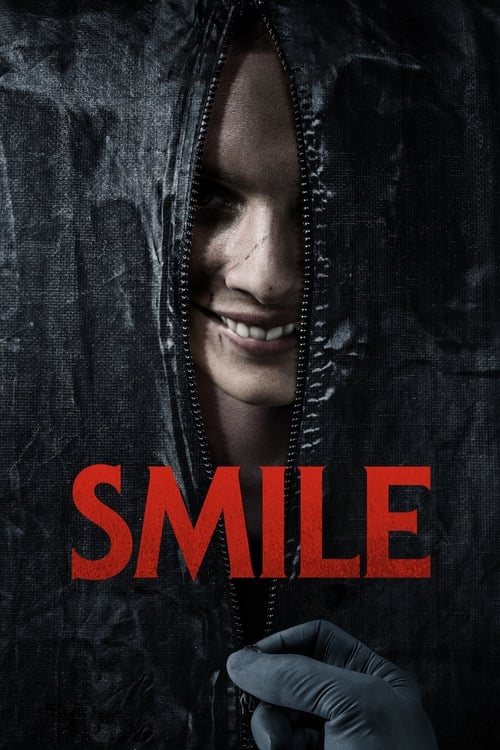
Smile
2022 · Parker Finn
When you're craving a real scare — the kind that makes you check faces on the street afterward. Not a cozy watch; reach for it when you want horror that rattles you, not horror that winks.
What it's about
Dr. Rose Cotter, an overworked emergency-room psychiatrist, watches a terrified patient die violently in front of her — smiling the whole time. In the days that follow, Rose starts seeing that same fixed grin on the faces of strangers, colleagues, and people who shouldn't be there at all, and realizes she's inherited something that passes from witness to witness. With a week or less to understand the pattern, she has to fight a thing no one else can see while everyone around her decides she's losing her mind.
The experience
Relentlessly tense and nasty in the best way — a mounting-paranoia machine built on dread, sharp jump scares, and one deeply unsettling image repeated until it gets under your skin. It's also heavier than it looks: the horror runs on trauma and isolation, so the unease follows you out of the room.
Performances
Sosie Bacon carries nearly every frame as Rose, charting a week-long unraveling with a raw, escalating desperation that keeps the scares emotionally grounded.
The craft
Writer-director Parker Finn, expanding his own short film into a feature debut, shows unusual formal control: disorienting upside-down aerial shots, patient slow-creep compositions, and a sound design that weaponizes silence before it strikes. The craft turns a familiar curse structure into a sustained anxiety attack — worth good speakers and a dark room.
Why it matters
Made on a modest budget and originally destined for streaming, it was rerouted to theaters after strong test screenings and became a major sleeper hit, launching Parker Finn's career and a new horror franchise.
Horror · Psychological horror · Possession & occult. A psychiatrist sees a fixed grin spread from face to face: a mounting-paranoia curse of trauma and isolation, sharp jolts, weaponized silence.
Snapshot
Smile is the feature debut of writer-director Parker Finn, a supernatural psychological horror film that expands his 2020 short Laura Hasn't Slept into a curse narrative about a trauma that propagates from victim to victim. Dr. Rose Cotter, an emergency-room psychiatrist played by Sosie Bacon, watches a patient die by violent suicide while wearing a rictus grin, and thereafter becomes the entity's next carrier — hunspooling over roughly a week as the smiling force wears the faces of people around her. The film matters less for narrative novelty than for the efficiency with which it converts a familiar transmissible-curse structure into a sustained study of PTSD and suicidal contagion, and for its outsized commercial success: made on a modest budget and originally slated for streaming, it was rerouted to theaters after strong test screenings and became one of 2022's most profitable studio horror releases. It anchors a cottage franchise, with Smile 2 following in 2024.
Industry & production
Smile was produced through Temple Hill Entertainment (Marty Bowen and Wyck Godfrey, best known for the Twilight and Maze Runner franchises and The Fault in Our Stars) for Paramount Players, the Paramount label then overseeing mid-budget genre and youth-oriented fare, with Paramount Pictures distributing. It originated as intellectual property Finn already owned: his short Laura Hasn't Slept premiered at SXSW in 2020 and won a jury prize there, functioning as a proof of concept that let a first-time feature director arrive with a demonstrated command of the material. That short-to-feature pipeline — increasingly common in 2010s–2020s horror — gave Paramount a de-risked bet on an unproven director.
The film was shot in and around New Jersey. Its budget has been widely reported in the neighborhood of $17 million, standard for the Blumhouse-era studio horror economy that Smile was designed to exploit: contained cast, present-day settings, no expensive effects tentpoles. The decisive industrial fact is the distribution pivot. Smile had been developed with a Paramount+ streaming release in mind; after test screenings tracked strongly, the studio moved it to a wide theatrical bow on September 30, 2022. It went on to gross well over $200 million worldwide — an enormous multiple on cost — which both validated the theatrical-horror thesis at a moment of industry anxiety about streaming and effectively mandated a sequel. Its marketing became a case study in itself: paid performers with fixed grins were planted in the stands at nationally televised Major League Baseball games, a low-cost, high-visibility stunt that generated organic coverage.
Technology
Smile is a digitally originated film of its moment, shot on modern large-format digital cameras and finished with a conventional digital-intermediate color pipeline; the exact camera package is not something I can attribute with confidence, so I won't specify it. Technologically it is unremarkable at the level of capture — its interest lies in how ordinary contemporary tools are deployed. The film leans on practical staging and in-camera manipulation more than on heavy visual effects: the signature grins are largely performance and makeup, and much of the film's disorientation is achieved through camera movement and mounting rather than post-production. Where digital effects appear — the entity's climactic bodily form, certain compositing seams — they are used sparingly and late. The production's most conspicuous "technology" is arguably its camera rigging, which allows the frame to rotate, invert, and glide in ways that read as authored rather than incidental.
Technique
Cinematography
Charlie Sarroff photographed the film, and the cinematography is its most discussed formal element. Sarroff and Finn organize the image around instability of orientation: the camera frequently cranes and rotates so that establishing shots of the New Jersey landscape arrive upside down or canted, a literalization of a world tipping out of true. Interiors are staged in cold, controlled palettes with pooled light and long negative space, so that the frame constantly invites the viewer to scan its edges for a lurking grin — a Hitchcockian economy of dread in which the composition does the work before any jump. Sarroff favors slow, deliberate movement and wide framings that isolate Bacon within institutional and domestic architecture, reinforcing Rose's growing paranoia and social quarantine.
Editing
Elliot Greenberg cut the film. The editing modulates between long-take patience — holding on faces and empty rooms to accrue tension — and abrupt rupture at the shock beats, a rhythm calibrated for the jump scare while avoiding the choppiness that cheapens the device. Greenberg's cutting also manages the film's central epistemological problem: because Rose hallucinates, the edit must repeatedly stage and then retract reality, and the film's misdirections (a scene revealed as delusion, a phone call that never happened) depend on precise withholding at the cut.
Mise-en-scène / staging
The controlling design idea is the smile itself: an expression normally coded as warmth, staged as threat. Finn distributes uncanny grins across bodies — patients, family, colleagues, a child — so that the film's horror is carried by human faces rather than a masked monster. Production design keeps Rose's world clean, upscale, and muted, the better to make its corruption legible; her home becomes a stage that is progressively unmade. The staging repeatedly places the threat in the deep background or just off Rose's eyeline, trusting the audience to find it.
Sound
The film's sound design is aggressive and central to its effect, built on sudden dynamic contrasts, sub-bass, and the weaponized silence that precedes a scare. Chilean-Canadian composer Cristóbal Tapia de Veer — celebrated for his abrasive, vocal-driven scores for Utopia and The White Lotus — supplies music that is dissonant, percussive, and deliberately unpleasant, using distorted vocalizations and inverted or "wrong"-sounding textures rather than conventional orchestral fright cues. The score refuses reassurance, matching the film's thesis that the horror cannot be resolved.
Performance
Sosie Bacon carries nearly every scene as Rose, and her performance grounds the film's more mechanical scares in a credible arc of sleeplessness, shame, and disintegration; the role asks for exhaustion and mounting terror without much respite, and the film's coherence depends on her. Kyle Gallner brings a weary sincerity as Joel, the ex-partner and detective who becomes Rose's sole ally, and Caitlin Stasey's brief opening turn as the doomed patient sets the film's register of hysterical terror. Robin Weigert (as Rose's therapist), Kal Penn, Rob Morgan, and Jessie T. Usher fill out a supporting cast whose function is largely to disbelieve Rose — dramatizing the isolation of the unwell.
Narrative & dramatic mode
Smile operates in the mode of the contagion or curse narrative crossed with the psychological unraveling. Its dramatic engine is a ticking clock — the entity kills its host within days unless the curse is passed on by making someone else witness a suicide — which gives the film a countdown structure and a moral trap: survival requires victimizing another. The film sustains ambiguity between the supernatural and the psychiatric for much of its runtime, framing Rose's experiences so they could be read as trauma-induced breakdown, before resolving decisively toward the literal. That resolution is bleak and closed: the film denies the cathartic escape its genre often grants, ending on the curse's completion rather than its defeat. Structurally it is a chamber piece of diminishing allies, each act stripping away a relationship until Rose is alone with the thing wearing her own face.
Genre & cycle
The film sits squarely within the 2010s–2020s wave of "elevated" or trauma-forward studio horror, and more specifically within the transmissible-curse cycle. Its most obvious generic sibling is David Robert Mitchell's It Follows (2014), which established the template of a lethal entity passed person-to-person that only the cursed can see; Smile adapts that logic from sexual transmission to traumatic witnessing. It also draws on the J-horror-derived viral-curse film — Ringu (1998) and its American remake The Ring (2002) — in which exposure to an image or event dooms the viewer within a fixed span. Within Paramount's own house style it belongs to the post-Paranormal Activity, post-Blumhouse model of contained, high-margin horror. Its commercial scale helped confirm, in 2022, that theatrical horror remained a reliable engine even as other mid-budget genres migrated to streaming.
Authorship & method
As writer-director, Parker Finn is the film's clear author, and Smile is unusually legible as a debut because it is a deliberate scaling-up of his own short. His method is proof-of-concept-first: Laura Hasn't Slept let him test the central image — the malevolent grin — and secure the goodwill to make the feature on his terms. Finn's approach favors classical suspense architecture (framing, duration, off-screen threat) over gore, and a willingness to end on despair. His key collaborators reinforce that authorial signature. Cinematographer Charlie Sarroff supplies the rotating, orientation-destabilizing camera grammar. Composer Cristóbal Tapia de Veer contributes an anti-comforting sonic identity that distinguishes the film from generic horror scoring. Editor Elliot Greenberg manages the reality/hallucination misdirection that the script requires. Finn returned to write and direct Smile 2 (2024), confirming a sustained authorial control over the property rare for a debut-launched franchise.
Movement / national cinema
Smile is an American studio production and does not belong to a self-conscious movement in the way an art-cinema title might. It can, however, be located within the loosely defined post-2014 American "elevated horror" tendency associated with A24 and Blumhouse — films that foreground psychological and social subtext (grief, trauma, addiction) within genre machinery — even though Smile is a Paramount release and is, in execution, more conventionally commercial and jump-scare-driven than the art-house end of that tendency. Its debts to Japanese horror place it within the long transnational circulation of the J-horror curse film into Hollywood, a lineage running from the American remakes of the early 2000s through to these later native variations.
Era / period
The film is a document of the early-2020s screen economy. It arrives amid pandemic-era anxiety about theatrical viability and the streaming-versus-cinema question, and its rerouting from Paramount+ to theaters — then its large gross — became part of the period's argument that horror could still fill auditoriums. Culturally it belongs to a moment of heightened, mainstream conversation about mental health, trauma, and suicide, which the film both exploits and, at times, is criticized for exploiting. Its baseball-stadium marketing typifies the era's stunt-driven, virality-seeking promotion.
Themes
The film's governing theme is trauma as inheritance and contagion: an unprocessed horror that, once witnessed, must be passed on, allegorizing both PTSD and the documented phenomenon of suicidal contagion. It dramatizes the isolation of the mentally ill — Rose is disbelieved by therapist, sister, fiancé, and colleagues, and the entity thrives precisely because trauma is unspeakable and unsharable. Secondary threads include generational or familial trauma (Rose's history with her own mother) and the professional's blind spot — a psychiatrist unable to secure care for herself. The smile motif encodes the theme neatly: the social mask of "I'm fine" turned monstrous, the demand to perform wellness weaponized against the sufferer. Critics have debated whether the film interrogates these subjects or merely instrumentalizes them for scares; that tension is itself part of its thematic profile.
Reception, canon & influence
Critically, Smile was received as an effective, well-crafted, if not wholly original genre entry — praised for Bacon's performance, Sarroff's photography, and the relentlessness of its dread, while frequently faulted for over-reliance on jump scares and for a curse mythology assembled from recognizable parts. A recurring critical reservation concerned its treatment of trauma and suicide: whether the film's grim spectacle amounted to insight or exploitation. Commercially, its performance was the headline — a modest budget converted into a nine-figure worldwide gross — and this success is the principal reason it registers at all in the broader story of 2020s film.
Influences on the film (backward): the clearest antecedents are It Follows (the visible-only-to-the-cursed transmissible entity), Ringu/The Ring (the deadline-driven viral curse), and a broader tradition of psychological horror in which a protagonist's grip on reality is the true battleground — Mike Flanagan's Oculus (2013) and, further back, films like Jacob's Ladder (1990) sit in this lineage of subjective, reality-eroding dread. The uncanny-smile image also draws on a long horror fascination with the corrupted human face.
Legacy (forward): Smile's most concrete legacy is institutional — it launched a franchise, with Finn's Smile 2 (2024) extending the mythology into the world of a pop star, and it reinforced the studio calculus that contained, original-IP horror remains theatrically potent. Its marketing became a frequently cited template for stunt-based, low-cost virality. As a text, it is young enough that its longer-term canonical standing is genuinely unsettled, and the honest assessment is that its durability will likely rest less on formal innovation than on its efficiency as a fear-delivery machine and its snapshot of an industry moment when theatrical horror reasserted itself.
A Deleuzian reading
The establishing shot comes in upside down.
The full Deleuzian reading of Smile →
Reception
Written off by some in 2022 as another studio jump-scare machine, it became one of the decade's great horror sleeper hits — and when Smile 2 (2024) landed to even warmer reviews, the first film got retroactive credit as the foundation of an actually-good franchise.
How Smile was received, from release to now →
How to watch Smile: what to notice on a first viewing
- Watch the establishing shots of the suburbs arrive upside down. Sarroff cranes and rotates the camera at scene openings, not just at scares, so the world looks tipped off its axis before anything happens. This disorientation tells you, before dialogue does, that reality itself has come loose.
- Notice the wide shots with empty space at the frame's edges. Sarroff holds cold, sparsely lit rooms with long negative space, so your eyes drift to the corners looking for a grin before a cut forces one on you. The frame trains you to search it yourself instead of waiting for the film to point.
- Listen for silence right before a sudden burst of bass. Tapia de Veer's score uses distorted vocals and sub-bass drops after stretches of quiet, never settling into a normal fright cue. The score refuses to comfort you.
- Watch Sosie Bacon's face for micro-movements, not a fixed expression. Bacon's face keeps working, shifting between exhaustion, fear, and disbelief, while the smiling entity's faces never move at all. Her face carries the film's actual terror; the grins around her only display it.
- Count how many different people wear the exact same fixed grin. Finn puts the same rictus smile on strangers, colleagues, family, and a child, so no single body owns the threat. Dread stops having an address; Deleuze's dividual names one affect worn by many bodies at once.
The whole guide to watching Smile, with the keys for a rewatch →
Influences: the films it descends from and the films it influenced
- It Follows (2014) — Supplies the core mechanic Smile rebuilds: an entity visible only to the afflicted that walks steadily toward its victim and is transmitted person-to-person, making the curse a relay rather than a haunting.
- Ringu (1998) — Establishes the countdown viral curse — die within a fixed deadline unless you pass it on — that structures Smile's ticking-clock plot and its 'break the chain by finding a new host' logic.
- The Ring (2002) — Americanizes the J-horror viral curse into a glossy studio deadline-thriller with investigative structure and desaturated palette, the exact commercial template Smile's mythology and marketing inherit.
- Jacob's Ladder (1990) — Pioneers subjective editing that presents hallucination as unbroken reality plus the shutter-speed head-whip distorting human faces, the reality-retraction grammar Elliot Greenberg's cutting descends from.
- Oculus (2013) — Builds its entire architecture on seamless reality/hallucination swaps where the protagonist can no longer trust her own perception, the same misdirection engine Smile runs on.
- Repulsion (1965) — Renders a woman's psychological disintegration from the inside via a sustained solo performance of unraveling, the interior-collapse arc Sosie Bacon's Rose reprises.
- Rosemary's Baby (1968) — Codifies the supernatural-versus-psychiatric ambiguity in which disbelieving authority figures gaslight the heroine, the epistemic trap Smile keeps its protagonist inside.
- The Shining (1980) — Models the orientation-destabilizing camera and vast negative space isolating a lone figure that Charlie Sarroff's rotating, floor-becomes-ceiling photography directly quotes.
- The Exorcist (1973) — Introduces subliminal single-frame inserts of a corrupted grinning face and the medical-authority-versus-demonic framing that Smile deploys for its uncanny-grin jolts.
- The Babadook (2014) — Codifies the elevated-trauma-horror template of grief manifested as a literal, spreading monster — the 'trauma as contagion' conceit Smile literalizes.
- Hereditary (2018) — Perfects the long, static, dread-loaded take that suddenly ruptures and the frozen uncanny human expression as horror image — the tempo and face-motif Smile emulates.
- Truth or Dare (2018) — Prefigures the exact visual signature — a forced supernatural rictus grin marking cursed victims as it passes between them — that Smile isolates and elevates into its whole identity.
- Smile 2 (2024) — Finn extends the same transmissible-curse mythology and inverted-camera/reality-retraction grammar into a pop-star milieu, retaining the disintegrating-lead performance structure.
- Talk to Me (2023) — Contemporary elevated horror built on a transmissible supernatural affliction spread through a communal ritual object, pairing trauma-grief subtext with practical-image shock like Smile.
- Longlegs (2024) — Post-Smile theatrical horror that trades on negative-space framing — threat lurking at the edge of the widescreen frame — and the same stunt-driven cryptic viral marketing playbook.
- Final Destination 3 (2006) — Sibling extending the fatalist-countdown and curse-passed-to-the-next-victim architecture: an inescapable death sentence with rules, transmitted person to person, that the protagonist can decode but not outrun — FD's fatalism minus the machinery.
- Final Destination (2000) — An inexorable curse marks victims for death with decodable omens and insinuating, floating camera moves that make everyday space read as menacing — the insinuating-camera-plus-planted-omen craft applied to a contagion premise.
- Incantation (2022) — Extends the see-it-and-you're-next contagion into a viral chain where witnessing the prior victim's death passes the curse onward, the same transmission-by-observation premise Ko turns on the audience.
- Bring Her Back (2025) — Extends the cursed-transmission contagion model into trauma-horror, escalating through practical facial and bodily distortion as the curse passes host to host.
Similar films
- Smile 2 (2024) — influence & lineage · same viewing thread
- Talk to Me (2023) — influence & lineage · same viewing thread
- Hereditary (2018) — influence & lineage
- Ju-on: The Grudge (2002) — same viewing thread
- Obsession (2026) — same viewing thread
- Oddity (2024) — same viewing thread
- Incantation (2022) — same viewing thread
- The Autopsy of Jane Doe (2016) — same viewing thread
All the films related to Smile →
Watch it with: curated runs of related films
- Cursed and Contagious — Watch these back to back for how each imagines evil as something that moves — a curse handed off by a smile, a demon incubated in a neighbor, a possession creeping family member by family member.
- Curses You Can't Hand Back — They rhyme on one cruel idea: a curse, a ritual or a wish gets passed on or triggered, and after that every film is a countdown — so watch them in a row as variations on the same trap.