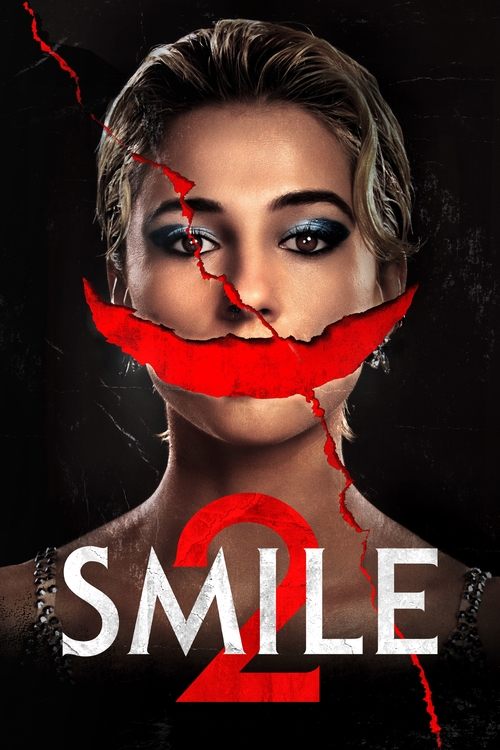
Smile 2
2024 · Parker Finn
For when you're craving a real scare with production value — a big, aggressive theatrical horror night, not a cozy one. Bring a strong stomach and don't watch it right before bed.
What it's about
Pop superstar Skye Riley is a recovering addict on the eve of a comeback world tour when terrifying, inexplicable things start happening around her — grinning strangers, waking nightmares, a past that won't stay buried. As the horrors escalate under the glare of fame, she has to figure out what's hunting her before her carefully rebuilt life comes apart on stage.
The experience
Relentless and loud — a horror film that runs on escalating panic, staged with rug-pull set pieces that keep you off balance for two hours. It's genuinely scary but also strangely sad, watching someone unravel while the world demands she keep smiling.
Performances
Naomi Scott is the film's engine: she sings, dances, and disintegrates on camera, giving a full-bodied pop-star performance and a raw-nerve breakdown at the same time. Most critics singled her out as the reason the movie works.
The craft
Parker Finn escalates everything from the first film — longer takes, disorienting camera moves, original pop songs performed in full, and sound design built to jolt. It's engineered for a big screen and a loud room, where its arena-concert horror lands hardest.
Why it matters
It pushed the surprise-hit original into a bigger 2020s wave of studio horror about fame and trauma, proving the smiling-curse premise could scale up rather than just repeat.
Horror · Psychological horror · Possession & occult · Splatter & gore. A pop star on the eve of her comeback tour unravels under a grinning curse: loud, jolting, gory panic with real sadness under the spectacle.
Snapshot
Smile 2 is Parker Finn's follow-up to his 2022 sleeper hit, expanding a compact chamber-horror premise into a maximalist study of celebrity under siege. Where the first film trapped its curse inside a therapist's careworn suburban life, the sequel relocates it to the sensory overload of arena-pop stardom: Skye Riley (Naomi Scott), a recovering-addict pop icon on the eve of a comeback tour, becomes the entity's newest host and watches her curated public self dissolve into paranoia and hallucination. Released by Paramount Pictures in October 2024, the film is at once a straightforward extension of the "smiling demon" mythology and a sharp escalation in ambition — longer, louder, more formally aggressive, and anchored by a lead performance that most critics singled out as the film's engine. It belongs to the 2020s wave of studio-backed, auteur-inflected horror in which a first-time or second-time director is handed a franchise seed and encouraged to make it strange.
Industry & production
The commercial logic behind Smile 2 is instructive. The original Smile was produced inexpensively and became a substantial theatrical earner, the kind of low-budget, high-margin result that studios in the 2020s prize precisely because it de-risks a sequel. Paramount fast-tracked the follow-up with Finn again writing and directing, and again working through Temple Hill Entertainment (the production company long associated with producers Marty Bowen and Wyck Godfrey). Finn was given a larger canvas — the pop-star setting, concert staging, and extended set pieces all imply a bigger budget than the first film — while retaining the creative control that had made the original distinctive.
I should flag where the public record is thinner than marketing would suggest: precise budget and box-office figures for Smile 2 circulated widely at release, but I will not quote specific numbers here, since I cannot verify them to the dollar. What is well established is the pattern — a modestly budgeted horror hit begetting a somewhat larger sequel that the studio positioned as a Halloween-season tentpole. Paramount also leaned into the franchise's now-signature marketing device: the unsettling static smile deployed in public-facing stunts, an approach that had drawn attention during the first film's campaign (plants smiling in the stands at televised sporting events) and was reprised and amplified for the sequel.
Technology
Smile 2 is a digitally originated, digitally finished studio production, and its technological interest lies less in any novel capture format than in how conventional tools are bent toward disorientation. The film relies heavily on motion-controlled and rigged camera work to execute its slow rotations and inversions — shots in which the horizon quietly tips until the frame is upside down, a technique the film uses to signal the curse's intrusion. Digital compositing and modern color-grading pipelines enable the film's aggressive tonal shifts, particularly the transitions between the saturated, high-key world of pop performance and the desaturated dread that overtakes it.
Crucially, Finn's team foregrounds practical and prosthetic effects for the entity's manifestations — contorted bodies, the rictus grins performed by actors rather than wholly digital faces — with digital enhancement used to extend rather than replace physical work. This hybrid approach is characteristic of contemporary horror craft: audiences have grown wary of weightless CGI, and the "smile" gag depends on the uncanny knowledge that a real human face is producing it. Where digital tools do the heavy lifting is in seamlessness — stitching long takes, erasing rigs, and sustaining the illusion of unbroken duration that the film's most celebrated sequences require.
Technique
Cinematography
Charlie Sarroff, who shot the first Smile, returns, and the visual continuity is deliberate. The house style is built on wide, symmetrical compositions that leave unsettling negative space at the edges of the frame — the viewer is trained to scan for a lurking, grinning figure — and on the slow, unmotivated camera move that turns a stable image into a trap. Sarroff's use of the rotating and inverting frame is the film's most identifiable optical signature, literalizing Skye's loss of orientation. The pop-world sequences are lit in bold, unnatural color; the horror intrusions strip that palette back. The camera favors long lenses and creeping push-ins that isolate Scott's face, making performance and cinematography inseparable.
Editing
Elliot Greenberg, editor of the original, again shapes the film's rhythm, and the sequel's structure is more elaborate than its predecessor's. The editing withholds and misdirects: hallucination and reality are cut together without clear seams, so that reveals of "it was never happening" land as genuine jolts. The film is also notable for extended, sparingly cut passages — set pieces designed to run long and let dread accumulate in real time — which stand against the quick-cut grammar of much mainstream horror. The interplay between these two modes (patient duration punctuated by hard, sudden cuts on the scares) is the film's central editorial strategy.
Mise-en-scène / staging
The production design maps Skye's psychology onto space: the sterile luxury of hotel suites, the cavernous emptiness of rehearsal spaces, and the artificial intimacy of the stage. A recurring tension is between surfaces meant to project control — makeup, wardrobe, the choreographed body — and the chaos erupting beneath. The film's most discussed staged sequence involves choreography weaponized into horror, backup dancers folded into the curse's performance, a set piece that fuses the vocabulary of the pop music video with the logic of nightmare. Staging consistently exploits the gap between the public spectacle of fame and the private terror no one is permitted to see.
Sound
Sound design is central to the film's assault. The entity is announced through distorted, invasive audio cues, and the film exploits the collision between the polished sonics of pop production and abrasive, dread-laden textures. Cristobal Tapia de Veer's score (see below) is inseparable from the design, blurring the line between diegetic pop music and non-diegetic horror scoring. The film repeatedly uses volume and silence as weapons — the crushing sound of a stadium against the dead quiet of a hallucination.
Performance
Naomi Scott's turn as Skye Riley is the film's most acclaimed element, and rightly its focus. The role demands an enormous physical and emotional range: the manufactured radiance of a performer "on," the raw tremor of an addict in recovery, and the escalating bodily panic of possession. Scott performs extended, unbroken breakdowns that the camera refuses to cut away from, and she is required to sell both the glamour and its violent evisceration. Kyle Gallner returns from the first film as Joel, bridging the two installments, and the supporting cast — including Rosemarie DeWitt, Lukas Gage, Dylan Gelula, and Peter Jacobson — populates the apparatus of management, family, and industry pressure that hems Skye in.
Narrative & dramatic mode
The film operates in the mode of subjective psychological horror: because the curse manifests as hallucination, the narration is fundamentally unreliable, and the audience is locked inside Skye's deteriorating perception. This is a horror of interiority dressed as spectacle. The dramatic engine is the classic "contagious curse" structure inherited from J-horror and It Follows — a supernatural affliction passed from victim to victim, with a ticking clock and a set of rules the protagonist scrambles to understand — but Smile 2 refracts that structure through the specific machinery of celebrity: the tour that cannot be canceled, the handlers who read collapse as relapse, the impossibility of being believed. The film's bleakness is structural; like its predecessor, it is drawn to the trap rather than the escape.
Genre & cycle
Smile 2 sits at the intersection of several live cycles. It is part of the 2020s studio-horror franchise boom, in which distributors convert successful original horror into serialized properties. It extends the "curse-as-trauma" cycle that has dominated the genre since the 2010s, in which the monster is an externalization of psychological wound — here, addiction, grief, and the self-erosion of fame. And it participates in a smaller vogue for horror set inside the entertainment industry and celebrity culture. Its innovation within the cycle is tonal: by fusing the pop-concert film with possession horror, it hybridizes two spectacles of the body-on-display — the pop performance and the horror contortion — into a single grammar.
Authorship & method
Parker Finn is the clear author. He came to Smile from the short film Laura Hasn't Slept (2020), which established the smiling-figure motif and won attention on the festival circuit; the feature and its sequel are direct outgrowths of that seed. As writer-director of both films, Finn controls the mythology and the formal vocabulary — the inverting camera, the wide-frame lurker, the refusal of a clean exit. His method is one of escalation-with-continuity: retaining his core creative collaborators while expanding the scale.
Those collaborators are essential to the authorship. Cinematographer Charlie Sarroff and editor Elliot Greenberg carry the visual and rhythmic signature across both films, giving the franchise a consistent formal identity rare in horror sequels that change hands. Composer Cristóbal Tapia de Veer — widely known for his abrasive, percussive, vocal-inflected work on television (his music for The White Lotus and Utopia made him one of the most distinctive screen composers of the era) — provides a score that is genuinely compositional to the film's meaning, especially apt for a story about pop music, since he can toggle between seductive melody and sonic violence. The concentration of authorship in Finn plus a small, returning department-head team is the film's defining production fact.
Movement / national cinema
This is American studio filmmaking, and it does not belong to a formal "movement" in the art-historical sense. Its lineage is better described as the contemporary American independent-to-studio horror pipeline associated in the popular imagination with the "elevated horror" discourse — films that pair genre mechanics with authorial style and thematic seriousness — even as Smile 2 is more overtly a crowd-pleasing studio product than the A24-coded titles that term usually names. Its deeper stylistic debts are transnational: the contagious-curse premise draws on Japanese horror (the Ringu and Ju-On traditions), while its cursed-transmission logic and dread-through-duration recall the American indie It Follows.
Era / period
Smile 2 is a thoroughly 2020s film in both form and content. It reflects a post-pandemic studio strategy of leaning on proven horror IP; a moment of intense cultural scrutiny of celebrity, parasocial obsession, and the mental-health toll of fame; and a media environment saturated by the performed self. The pop-star protagonist and the tour-that-must-go-on read as commentary on an era in which public figures — and, by extension, ordinary users of social platforms — are expected to maintain an unbroken smiling front regardless of private collapse. The film's marketing, built on the viral spread of an image, is itself an artifact of the 2020s attention economy.
Themes
The governing theme is the tyranny of the maintained smile — the demand that suffering be concealed behind performed contentment. From this radiate the film's principal concerns: addiction and recovery, with the curse functioning as a metaphor for relapse and the fear that no one will distinguish crisis from weakness; fame as surveillance and consumption, the star's body owned by handlers, fans, and industry; trauma as contagion, the franchise's foundational idea that pain is passed from person to person; and isolation, the horror of an interior torment that cannot be communicated or believed. The pop-music setting sharpens all of these, because the pop star is the culture's purest emblem of manufactured, mandatory joy.
Reception, canon & influence
Critically, Smile 2 was generally received as a rare sequel that improves on its predecessor's ambition, with near-unanimous praise directed at Naomi Scott's performance and at Finn's willingness to push the formal and tonal extremity of the concept. Reviewers noted the film's confidence with its set pieces and its integration of the pop-spectacle setting into the horror; some registered the familiar objection that the contagious-curse structure and relentless bleakness can feel schematic. I'll note honestly that a full canonical verdict is premature: released in 2024, the film is too recent for its long-term standing to be settled, and I will not attribute specific quotations or aggregate scores I cannot verify.
Looking backward, the film's influences are legible: the transmissible-curse horror of Japanese cinema and its American descendant It Follows; a broader tradition of possession and psychological-breakdown horror; and the show-business horror lineage in which the stage becomes a site of terror. Its pop-video staging draws on the visual language of contemporary music video and concert film.
Looking forward, its influence is still forming, but the likely legacy is twofold. First, it strengthens the industry template of entrusting a horror franchise to a single controlling auteur and letting the sequel grow stranger and more formally aggressive rather than safer. Second, its fusion of celebrity-culture critique with body horror contributes to an ongoing genre conversation about fame, performance, and mental health that other filmmakers are likely to continue. Whether Smile 2 becomes a durable reference point or simply a well-regarded entry in a studio franchise will depend on how the series and its imitators develop — a question the current record cannot yet answer.
A Deleuzian reading
Watch yourself watching the corners.
The full Deleuzian reading of Smile 2 →
Reception
Landed in October 2024 as that rarest thing — a horror sequel critics and audiences agreed beat the original — and its stock has only risen since, with Naomi Scott's performance becoming a rallying point in the annual 'horror never gets awards respect' conversation.
How Smile 2 was received, from release to now →
How to watch Smile 2: what to notice on a first viewing
- Notice the empty space left at the edges of wide shots. Charlie Sarroff composes wide, symmetrical frames with unsettling negative space at the borders, training you to scan the edges rather than follow Skye. You end up patrolling the frame's corners instead of watching the story.
- Notice how the camera tilts and rotates in unsettling ways. The camera performs slow, motion-controlled rotations on rigs rather than handheld, so the vertigo feels mechanical rather than personal. The unease belongs to the camera itself, not just to what Skye is feeling.
- Watch how long the camera holds on Scott's breakdowns. Naomi Scott performs extended, unbroken collapses that the camera refuses to cut away from, holding both manufactured pop radiance and raw panic in the same shot. Staying on her face this long is its own kind of pressure.
- Listen for pop music sliding into pure dread. Cristobal Tapia de Veer's score blurs the line between the polished pop Skye is recording and the abrasive noise the entity makes, using volume itself as a weapon. You often can't tell which side of the screen a sound is coming from.
The whole guide to watching Smile 2, with the keys for a rewatch →
Influences: the films it descends from and the films it influenced
- Smile (2022) — Finn's own first feature establishes the exact vocabulary the sequel inherits — the slow rotating/inverting camera, the wide-frame smiling lurker parked in negative space, and a trauma-curse transmitted by witnessing a death, all executed by the same Sarroff/Greenberg department heads.
- Laura Hasn't Slept (2020) — The originating short that first isolated the fixed, unblinking smiling-figure motif and the dread of a face that won't stop grinning — the literal seed image the franchise is built on.
- It Follows (2014) — The explicit reference point: a curse handed person-to-person that manifests as an inexorable figure walking straight at the victim, staged in deep-focus wides that force the viewer to scan frame edges for the approaching threat.
- Ringu (1998) — The J-horror contagion template — a transmissible death-sentence curse on a countdown clock that can only be survived by passing it on — the structural DNA behind the film's spread-or-die mechanic.
- Perfect Blue (1997) — A pop idol's identity dissolves through match-cut editing that splices hallucination into reality with no marker of which is which — the template for both the celebrity-culture horror and the unreliable-hallucination cut applied to Skye Riley.
- Black Swan (2010) — A performer's psychic collapse rendered as body horror and doubling, camera lashed to her deteriorating subjectivity so the audience shares her unreliable perception, with the live performance as the climactic site of terror.
- Jacob's Ladder (1990) — Pioneered the head-shudder blur and single-frame demonic-glimpse edit, building horror from cuts the protagonist and viewer can no longer trust to be diegetically real.
- Repulsion (1965) — The sustained first-person descent of a woman into psychosis inside claustrophobic space, where hallucination erupts seamlessly into the real — the ur-text for the subjective-unreliable breakdown structure.
- Possession (1981) — Isabelle Adjani's full-body derangement — the subway convulsion scene — treats acting as violent physical choreography, the direct antecedent to staging a performance breakdown as horror set piece.
- The Exorcist (1973) — Codified the possession-horror grammar of the contorted body and unnatural facial distortion — the rictus and rigid, wrong-looking face the franchise's smile weaponizes.
- Hereditary (2018) — Possession horror composed in rigid long-lens wide frames with a lead-actress breakdown performance and unnaturally contorted smiling/rigid bodies presented as clinical, framed spectacle.
- The Substance (2024) — Celebrity-culture body horror about a female entertainer consumed by the fame apparatus, escalating into grotesque physical spectacle — the same fusion of showbiz critique and body deformation, released the same year.
- Pearl (2022) — Weaponizes the held, forced smile as a sustained horror image (the closing rictus over the credits) while charting a performer's showbiz aspiration curdling into violence — a direct sibling to the maintained-smile motif.
- Talk to Me (2022) — A contagious possession spread through a viral ritual object among a phone-camera generation, turning attention-economy transmission itself into the delivery mechanism of the curse.
- Oculus (2013) — Editing that deliberately collapses hallucination and reality so the audience loses the thread of what is actually happening on screen — the same unreliable-perception cut engineered as the primary scare device.
- Nope (2022) — Spectacle-industry horror that stages an approaching aerial threat in long-lens wide compositions and makes the machinery of entertainment the site of terror, sharing the negative-space-and-push-in grammar of dread.
Similar films
- Smile (2022) — influence & lineage · same viewing thread
- The Substance (2024) — influence & lineage · same viewing thread
- Malignant (2021) — same viewing thread
- Oddity (2024) — same viewing thread
- Abigail (2024) — same viewing thread
- Scream (2022) — shared sensibility
- Inside Out 2 (2024) — shared sensibility
- Scream 4 (2011) — shared sensibility
All the films related to Smile 2 →
Watch it with: curated runs of related films
- Cursed and Contagious — Watch these back to back for how each imagines evil as something that moves — a curse handed off by a smile, a demon incubated in a neighbor, a possession creeping family member by family member.
- Blood by the Bucketload — A run of horror that treats gore as showmanship: elaborate death set-pieces, practical effects by the gallon, and the giddy, squirming fun of watching it with a crowd, from Jigsaw's traps and Final Destination's chain reactions to Ready or Not's wedding-night bloodbath and The Substance's body-horror finale.