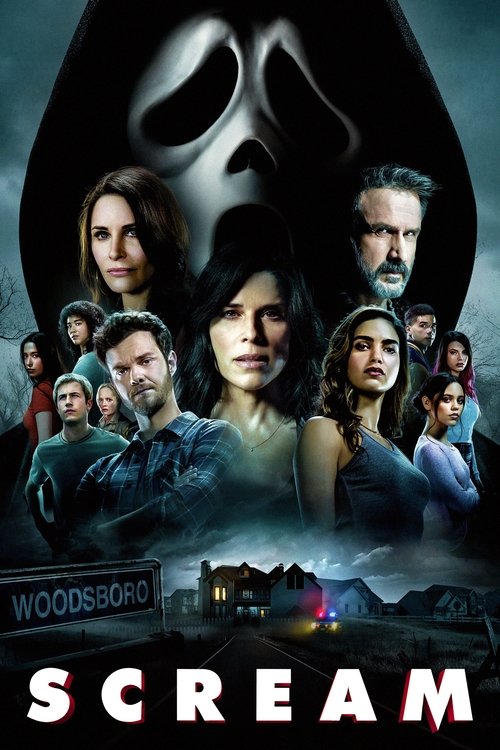
Scream
2022 · Tyler Gillett
For a night when you want to yell at the screen with friends — a scare that's fun rather than bleak, best watched with people who'll argue about who the killer is. Comfort-food horror with actual teeth.
What it's about
Twenty-five years after the Woodsboro murders, someone new puts on the Ghostface mask and starts carving through a group of teenagers with ties to the town's bloody history. The old survivors get pulled back in as the killings force open secrets the town thought were buried, and everyone — new kids and veterans alike — becomes a suspect. It's a whodunit wearing a slasher's clothes, set in a world where the characters have seen the same horror movies you have.
The experience
Jumpy, fast, and knowingly funny — it keeps winking at you about the rules of scary movies right up until it breaks them, and the kills land with real nastiness. You spend half the runtime guessing the killer and the other half being wrong.
Performances
Neve Campbell, Courteney Cox, and David Arquette return to roles they've carried for twenty-five years and give the legacy scenes genuine weight, while Jenna Ortega's terrified opening sequence announces her as a horror natural.
The craft
The script's central trick is naming its own game — the characters coin the term 'requel' and then the film gleefully plays and subverts that exact formula. The kill scenes are staged with brutal, practical-feeling impact, and the misdirection is engineered tightly enough that the reveal plays fair on rewatch. A crowd and a good sound system make the stings hit harder.
Why it matters
It proved the franchise could survive the loss of Wes Craven, revived Ghostface for a new generation, and became the sharpest commentary yet on Hollywood's legacy-sequel era — by being one.
Horror · Slasher · Teen horror. A knowing meta-slasher whodunit: jumpy and funny, with nasty kills. Best yelled at with friends while you guess who's under the mask.
Snapshot
Scream (2022) is the fifth installment in the franchise Wes Craven and screenwriter Kevin Williamson launched in 1996, and the first made without Craven, who died in 2015. Directed by the Radio Silence collective — Tyler Gillett and Matt Bettinelli-Olpin, working with producer Chad Villella — and written by James Vanderbilt and Guy Busick, the film returns to Woodsboro twenty-five years after the original killings and stages a self-aware assault on the very idea of the "legacy sequel." Its central formal gambit is to name its own genre position: the characters coin the term "requel" to describe a film that is neither reboot nor straight sequel but a hybrid that revives old iconography while handing the story to new leads. That doubled address — a slasher that is also a running seminar on slashers and their fandoms — is the picture's organizing principle, extending the reflexive tradition Williamson established while retooling it for the streaming-era discourse of "elevated horror," toxic fandom, and franchise resurrection. It restored the series to commercial life and set up Scream VI (2023).
Industry & production
The film sits at the intersection of a legacy property and a changed rights landscape. The Scream films had been a Dimension Films property under the Weinsteins; after that company's collapse, the rights moved to Spyglass Media Group, with Paramount Pictures handling distribution. This is the crucial industrial fact of the production: a franchise associated indelibly with one auteur and one production house was rebuilt under new corporate custodianship, and the film's text is unusually candid about the anxiety of that inheritance. It is dedicated "For Wes," and Williamson served as an executive producer, lending continuity and a measure of authorial blessing to a project that could easily have read as opportunistic exhumation.
Radio Silence came to the assignment on the strength of Ready or Not (2019), a lean, wit-forward horror-thriller that demonstrated the group could balance suspense, splatter, and comedy — precisely the register the Scream series demands. The producing apparatus paired that fresh directorial voice with returning franchise talent: William Sherak and James Vanderbilt produced through Project X Entertainment alongside Paul Neinstein, and Marianne Maddalena, a longtime Craven collaborator, is credited as an executive producer, again threading old and new. Casting followed the requel logic literally: a young ensemble — Melissa Barrera, Jenna Ortega, Jack Quaid, Mikey Madison, Jasmin Savoy Brown, Mason Gooding, Dylan Minnette — was fronted by the returning trio of Neve Campbell (Sidney Prescott), Courteney Cox (Gale Weathers), and David Arquette (Dewey Riley), with Roger L. Jackson reprising the Ghostface voice he has supplied since 1996.
Production took place largely in and around Wilmington, North Carolina, a region long associated with Williamson's work. The film was released in January 2022 and opened at number one at the domestic box office, reversing the franchise's downward commercial trajectory since Scream 4 (2011) and proving the property viable enough to greenlight a sequel almost immediately. I would flag that precise budget and gross figures circulate in secondary sources with some variance, and I won't assign specific numbers here; what is firmly established is that the film was a clear commercial success relative to its modest scale.
Technology
Scream (2022) is a digitally originated production in the contemporary studio-horror mold, and its most notable technical commitment is old-fashioned rather than novel: a strong preference for practical, in-camera effects over digital augmentation. The Ghostface attacks — stabbings, slashes, blood gags — were staged with physical prosthetics and mechanical rigs wherever possible, in keeping with the tactile brutality the series is known for and with Radio Silence's demonstrated taste on Ready or Not. This is less a technological innovation than a deliberate refusal of one: at a moment when horror increasingly leans on digital blood and CG wounds, the film courts the heavier, wetter physicality of practical splatter.
On the specifics of the camera and lens package, the reliable public record is thin, and I won't speculate about exact bodies or glass. What can be said with confidence is that the film adopts the clean, high-resolution, controlled-lighting aesthetic standard for the current studio slasher, using that clarity deliberately — the crispness makes the domestic spaces feel exposed and legible, so that the audience, like the film-literate characters, is always scanning the frame for the threat.
Technique
Cinematography
Brett Jutkiewicz, who had shot Ready or Not, photographs the film with a glossy precision that is itself part of the argument. Where the original Scream had a certain suburban-video flatness, the 2022 film is smoother and more composed, its Woodsboro interiors rendered in deep, saturated dark tones cut by hard practical sources. Jutkiewicz stages the set-pieces to exploit foreground/background depth — the recurring anxiety of a doorway, a hallway, or a kitchen island behind an unsuspecting character — so that suspense is generated by what the camera lets us see that the victim cannot. The film also quotes the series' visual grammar knowingly, restaging the geometry of famous attacks (the closet, the garage door, the house under siege) in ways that reward viewers who carry the earlier films in memory.
Editing
Cut by Michel Aller, the film moves between two rhythms it must reconcile: the fast, comic patter of its meta-dialogue and the drawn-out, silence-and-strike cadence of the slasher set-piece. The requel-explaining scenes are edited for verbal momentum, while the attacks slow down, holding on empty space to let dread accumulate before the jolt. A structural editorial feature is the film's front-loaded misdirection — the opening sequence with Tara (Jenna Ortega) deliberately echoes and inverts the original's Drew Barrymore prologue, using the audience's foreknowledge of the "phone quiz" ritual as a tool, so the cutting withholds and delivers information against the grain of expectation.
Mise-en-scène / staging
Production designer Chad Keith rebuilds Woodsboro as a place saturated with its own history. The film's key staging conceit is the recreation of the original Macher/Prescott house as a shrine — a location loaded with the series' iconography — which the climax weaponizes: the finale explicitly returns to the "house party under siege" of the 1996 film, and the killers reveal a motive rooted in restaging that history as fan service. The domestic interiors are middle-class and specific, and the blocking repeatedly places characters in the deep, open-plan rooms that let Ghostface materialize from off-screen. Costume and prop continuity — the robe, the mask, the voice-changer — are treated as sacred objects, which is thematically apt for a film about people who fetishize the franchise's relics.
Sound
Roger L. Jackson's returning vocal performance as Ghostface is, as ever, the franchise's most important sonic element: the calm, cajoling, suddenly vicious telephone voice that turns a domestic phone into a murder weapon. The sound design leans on the series' established language — the ring of the call, the sudden absence of score before a strike, the wet foley of the practical gags. Brian Tyler's score (discussed below) integrates motifs from Marco Beltrami's original franchise music, so that the soundtrack itself performs the requel's logic of quotation, folding old themes into new material at moments of legacy-character return.
Performance
The ensemble is split along the requel's fault line. Melissa Barrera anchors the film as Sam Carpenter, carrying its darker interior material — a protagonist defined by inherited guilt — while Jenna Ortega's Tara is the film's most physically punishing role, spending much of the runtime injured and imperiled. Mikey Madison and Jack Quaid modulate carefully to serve the mystery's misdirection. Jasmin Savoy Brown plays Mindy Meeks-Martin, the niece of Randy Meeks, and inherits the franchise's "rules" role, delivering the film's theory in the sardonic register the series requires. Among the legacy players, David Arquette's Dewey is given the most weight, his arc functioning as the emotional throughline that connects old and new casts; Campbell and Cox reprise Sidney and Gale with the authority of characters who have survived four prior films.
Narrative & dramatic mode
The film operates in the whodunit-slasher hybrid that has defined the series since 1996: a masked killer, an escalating body count, and a mystery whose solution is a human unmasking with an articulated motive. Its distinctive dramatic mode is meta-commentary made structural. The characters know they are in a Scream-like situation, discuss the conventions of the "requel" explicitly, and use that knowledge to interpret the danger — yet the film still lands its scares, because knowing the rules does not confer safety. The climactic reveal ties the killers' motive directly to the franchise's own reception: they are aggrieved fans of the in-universe "Stab" movies, enraged by a perceived betrayal of the source material, who commit murders in order to force the creation of a "proper" sequel. The narrative thus makes the audience's own fandom the diegetic engine of violence, a bold self-implication.
Genre & cycle
Scream (2022) belongs to the reflexive slasher, a subgenre the original film effectively canonized, but its more immediate cycle is the 2010s–2020s wave of "legacy sequels" — franchise revivals (in horror, the 2018 Halloween is the obvious neighbor) that bring back aging original stars to bless a new generation. The film's genius, and its risk, is to metabolize that cycle as content: it does not merely participate in the legacy-sequel trend, it dissects it on-screen, coining "requel" to describe exactly what it is. It also engages the discourse around "elevated horror" of the period, explicitly contrasting the franchise's populist slasher pleasures with the arthouse-horror prestige that had come to dominate critical conversation.
Authorship & method
The controlling authorship here is collective and custodial. Radio Silence (Gillett, Bettinelli-Olpin, Villella) direct as a unit whose method blends genre sincerity with comic timing, honed on Ready or Not; their approach is reverent toward the source without being embalmed by it, favoring practical staging and a brisk tonal mix. The screenplay by James Vanderbilt and Guy Busick supplies the structural cleverness, building a mystery whose solution is also a thesis about franchises. Cinematographer Brett Jutkiewicz brings continuity with the directors' prior film and a polished suspense grammar. Composer Brian Tyler scores the film while quoting Beltrami's foundational themes, an act of authorship as curation. Editor Michel Aller manages the tonal oscillation between seminar and slaughter. Overseeing all of it, as executive producer, is Kevin Williamson, whose presence sanctions the new team's reworking of his creation. The film is best read as an act of stewardship: a new authorial collective demonstrating fidelity to an inherited voice while asserting enough of its own.
Movement / national cinema
This is mainstream American studio horror, produced within the Hollywood genre system and shot in the North Carolina production corridor long associated with Williamson's work. It belongs to no art movement; its lineage is industrial and generic — the American slasher tradition and its self-aware, post-Scream variant — rather than national-cinematic in any auteurist sense. If it has a "movement," it is the commercial one of the franchise revival as a dominant 2020s studio strategy.
Era / period
Released in January 2022, the film is a document of its exact cultural moment: the era of streaming-fueled franchise mining, "requels," and intensely polarized online fandoms. Its villains' motive — fury at a beloved property's perceived corruption — reads as a direct response to the toxic-fandom controversies that surrounded major franchise films in the years just before its release. The film's awareness of "elevated horror" likewise pins it to the late-2010s critical vocabulary. It is, in short, a period piece about its own present, using the slasher form to editorialize on how movies were being made, marketed, and fought over circa 2022.
Themes
The film's dominant theme is inheritance — of trauma, of guilt, and of intellectual property. Sam Carpenter's arc externalizes this: her buried lineage links her to the original killings, dramatizing the idea that the sins of the past are literally passed down, just as the franchise itself is passed to new hands. A second theme is fandom as a destructive force. By making the killers entitled devotees who murder to "fix" a story they feel betrayed by, the film critiques the possessiveness of contemporary fan culture and the violence latent in demands for creative control. Related to this is the theme of the past's inescapability — Woodsboro cannot stop restaging its own history — and, threaded throughout, a meta-theme about the value of "low" genre pleasure versus prestige, in which the film defends the slasher's sincerity against both cynical franchise machinery and highbrow condescension.
Reception, canon & influence
Critically, the film was received as a well-crafted, self-aware revival that satisfied series fans while updating its commentary — a warmer reception than the franchise's later entries had drawn, and one that credited Radio Silence with respecting Craven's legacy while finding a fresh angle. I would note that critical consensus, while broadly positive, was not unanimous; some viewers found the meta-layer more clever than frightening. Commercially it was a decisive success, opening at number one and revitalizing a dormant property.
Its influences run backward through the entire Scream series — most directly the 1996 original, whose prologue, house-siege climax, and "rules" scenes it restages — and through the broader reflexive-slasher and legacy-sequel traditions, with the 2018 Halloween as a clear comparison point for the "revive the property with returning stars" strategy. Forward, its most concrete legacy is Scream VI (2023), which carried over the new ensemble and the Radio Silence team and moved the action to New York, extending the "requel" into an ongoing new-generation series. More broadly, the 2022 film's articulation and popularization of "requel" gave critics and audiences a durable piece of vocabulary for the era's franchise revivals — arguably its most lasting cultural contribution beyond the box office. Its reception also crystallized a real-world irony the series had always courted: a movie about toxic fandom became itself a subject of intense fan debate, including subsequent off-screen franchise controversies that would shadow the sequels.
Reception
Landed in January 2022 to the franchise's warmest reviews since the original and a surprise box-office win, and it's since settled in as the rare legacy sequel fans think actually earned it — the film that made the revival (and Scream VI) possible.
How Scream was received, from release to now →
How to watch Scream: what to notice on a first viewing
- Watch for a doorway or hallway behind an unaware character. Brett Jutkiewicz repeatedly stages foreground and background depth, letting the camera show you a threat in a kitchen island or hallway before any character notices it. You are given information the character onscreen doesn't have, and that gap is where the dread lives.
- Listen for Ghostface's calm voice turn suddenly vicious. Roger L. Jackson's telephone performance stays cajoling and almost friendly until it isn't, and the score drops out entirely right before each strike. The silence before an attack is doing as much work as any music would.
- Notice the editing speed up for jokes and slow down for dread. Michel Aller cuts the meta conversations for fast verbal momentum, then holds on empty space during the attacks to let the tension build before the jolt. The film keeps switching gears between a comedy of talk and the patience of a slasher scene.
- Notice how loaded the Macher house is with the past. Production designer Chad Keith rebuilds the original film's house as a shrine to its own history, dense with objects and geometry longtime viewers will recognize. The house itself keeps insisting that the past cannot simply be redecorated away.
- Listen for characters naming the rules of their own situation. The cast explicitly discusses slasher conventions and coins the term 'requel' to describe their own movie, using that knowledge to try to predict the danger. Knowing the formula out loud never actually keeps anyone in the film safe.
The whole guide to watching Scream, with the keys for a rewatch →
Influences: the films it descends from and the films it influenced
- Scream (1996) — Provides the literal blueprint the film restages — the phone-stalked prologue, the 'rules of horror' seminar scene, and the third-act house-party siege are reconstructed beat-for-beat as structural scaffolding.
- Scream 2 (1997) — Established the 'rules of the sequel' lecture as a recurring set piece, the template the 2022 film updates into its 'requel rules' seminar.
- Scream 4 (2011) — Craven's own reboot-era entry satirizing remakes and 'new decade' rules, the direct predecessor to the 2022 film's franchise-revival meta-thesis.
- Halloween (1978) — Codifies the widescreen foreground/background depth staging where the masked killer lurks in soft focus behind an unaware victim — the compositional grammar Jutkiewicz revives.
- Psycho (1960) — Originates the opening-misdirection craft of investing the audience in an apparent protagonist then killing her early, which every Scream cold open weaponizes.
- Black Christmas (1974) — Source of the disembodied threatening phone voice as the killer's primary instrument — the direct forebear of the Ghostface call and its 'the caller is inside the house' terror.
- When a Stranger Calls (1979) — Its babysitter-alone-with-a-ringing-phone suspense set piece is the specific tradition Scream's isolated-teen-on-the-landline prologues quote.
- A Nightmare on Elm Street (1984) — Craven's method of menacing self-aware suburban teens in well-lit, bright-daylight spaces rather than gothic shadow seeds the series' bright, glossy suspense register.
- New Nightmare (1994) — Craven's first meta-slasher, in which characters confront the franchise machinery itself — the reflexive-commentary device Williamson and this film inherit and extend.
- Ready or Not (2019) — Radio Silence's prior feature where they honed their signature method: brisk tonal oscillation between comic timing and brutal practical-effects gore under a polished suspense grammar.
- Scream VI (2023) — Directly carries over the new ensemble and the Radio Silence/Vanderbilt–Busick team, extending the requel into an ongoing new-generation series relocated to New York.
- Halloween (2018) — The explicit 'legacy sequel' strategy model — reviving a dormant property by pairing returning original stars with a new generation, which Scream 2022 adopts as its structural premise.
- The Cabin in the Woods (2012) — Diagrams and critiques horror's 'rules' from inside the machine, extending the reflexive-slasher commentary tradition Williamson launched with the original Scream script.
- Happy Death Day (2017) — Glossy studio slasher-comedy with a masked-killer whodunit and a scares-plus-wit tonal mix aimed at the same crossover audience Scream 2022 courts.
- Freaky (2020) — Swings between practical splatter set pieces and broad comedy in adjacent scenes — the same seminar-to-slaughter tonal oscillation Michel Aller edits in Scream.
- Bodies Bodies Bodies (2022) — A Gen-Z whodunit-slasher where a friend group becomes the suspect pool, sharing the glossy-precision cinematography and toxic-online-fandom framing.
- Knives Out (2019) — Contemporary whodunit revival whose solution doubles as a thesis about its own genre — the mystery-as-argument structure Vanderbilt and Busick build their Ghostface reveal around.
- X (2022) — A same-year self-aware slasher revival trading gritty grain for period-precise, meta-literate craft, extending the subgenre's glossy-reflexive turn in the identical cultural moment.
- Final Destination Bloodlines (2025) — Direct legacy-sequel-cycle sibling sharing screenwriter Guy Busick, whose method of reviving a dormant franchise by fusing a new bloodline of characters to legacy mythology structures Bloodlines' generational-inheritance framing.
Similar films
- Scream 4 (2011) — influence & lineage · same viewing thread
- Scream VI (2023) — influence & lineage · same viewing thread
- Scream 2 (1997) — influence & lineage
- Scream (1996) — influence & lineage
- The Cabin in the Woods (2012) — influence & lineage
- A Nightmare on Elm Street (1984) — influence & lineage
- Halloween (1978) — influence & lineage
- Terrifier 2 (2022) — same viewing thread
All the films related to Scream →
Watch it with: curated runs of related films
- Fresh Blood: 2020s Studio Horror — A run of the decade's mainstream fright machine — abduction shockers, franchise revivals, and one arthouse throwback — best watched back-to-back to feel how modern horror hunts its prey.
- Slashers That Know the Rules — A run of body-count films that know their own genre: requels, camp-slasher love letters, Ti West's X trilogy and outright parodies, all reworking the masked killer, the final girl and the cursed summer camp, so each one sharpens the jokes and scares in the next.