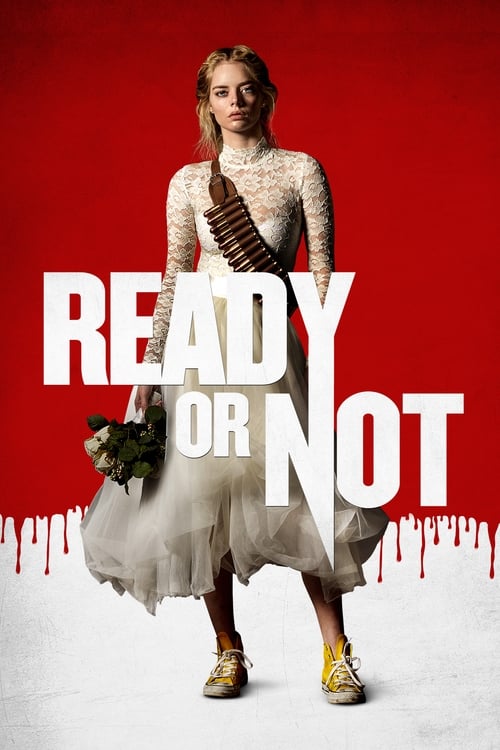
Ready or Not
2019 · Tyler Gillett
When you're craving a scare that's fun rather than bleak — perfect with friends, drinks, and an appetite for watching rich people be terrible. A rowdy Friday-night pick, not a slow burn.
What it's about
Grace, a young woman who grew up with nothing, marries into the Le Domas family — old money built on board games — at their gothic estate. Family tradition demands every newcomer play a game on the wedding night, and the card Grace draws is hide-and-seek: the whole clan, armed with heirloom weapons, must hunt her through the mansion before dawn to honor an old family pact. Still in her wedding dress, she has one night to survive her in-laws.
The experience
A gleeful pressure-cooker — nasty, funny, and fast, with gore played for both shock and laughs. It's the rare horror-comedy that keeps you tense and cackling in the same scene, powered by pure class rage.
Performances
Samara Weaving is a star-making blast as Grace — funny, furious, and completely believable as she curdles from blushing bride into survivor; her escalating exasperation is the film's engine. Adam Brody adds sour, boozy melancholy as the groom's conflicted brother.
The craft
The Radio Silence team wrings a whole film out of one candlelit mansion, with a tight script that keeps the hide-and-seek geography clear and the tone balanced on a knife edge between splatter and satire. The wedding dress alone — increasingly shredded, bloodied, and accessorized — is a costume-design essay in itself.
Why it matters
A sleeper hit that became an instant cult favorite, it sharpened the late-2010s wave of eat-the-rich horror and launched its directors toward major studio franchises.
Horror · Horror comedy & camp · Home invasion · Splatter & gore. A bride in a shredded wedding dress is hunted through a candlelit mansion by her rich in-laws, with gleeful splatter and class rage.
Snapshot
Ready or Not is a lean, savage horror-comedy in which a working-class bride, Grace (Samara Weaving), marries into the fabulously wealthy Le Domas gaming dynasty and discovers that the family's initiation rite is a literal blood sport: on her wedding night she draws the card for "Hide and Seek," and the clan must hunt and kill her before dawn to honor an ancestral pact with a satanic benefactor. Directed by the Radio Silence collective — the film is credited to Matt Bettinelli-Olpin and Tyler Gillett, working from a screenplay by Guy Busick and R. Christopher Murphy — it converts a single gothic mansion into a pressure-cooker of class rage, marital disillusion, and escalating gore. Made cheaply and released through Fox Searchlight in the immediate wake of the Disney–Fox merger, it became a critical and commercial success on the strength of Weaving's breakout performance and a premise that fused "eat the rich" satire with a bloodied-wedding-dress final-girl image. It remains the film that established Radio Silence as bankable studio horror directors, a credential they parlayed directly into the Scream relaunch.
Industry & production
The film was produced by Mythology Entertainment (James Vanderbilt, William Sherak, Tripp Vinson) with Radio Silence's Chad Villella among the producing team, and distributed by Fox Searchlight Pictures. Its release history is inseparable from a corporate inflection point: Searchlight had just passed to Disney control through the 20th Century Fox acquisition that closed in March 2019, and Ready or Not, opening in North America in August 2019, was among the early Searchlight titles to reach theaters under the new ownership — an unusually transgressive, R-rated genre picture to carry the specialty-label banner into the Disney era.
Financially the picture followed the classic low-budget-horror model: a modest production cost recouped many times over at the box office, making it one of the more profitable studio genre releases of its year. (I am confident it was made cheaply and returned a strong multiple; I am deliberately not asserting exact budget or gross figures here, as I cannot verify the precise numbers.) The economics matter to the film's meaning — a picture about predatory wealth was itself a demonstration that a small, well-executed genre film could out-earn far costlier products.
Production consolidated the action in and around a single estate, a choice that served both budget and tone: the mansion is effectively the film's only location, functioning as arena, trap, and character. Filming took place largely in Canada. The compressed single-night timeframe and the near-unity of place lend the production a stage-play efficiency that keeps costs contained while amplifying claustrophobia.
Technology
Ready or Not is not a technologically experimental film, and its craft is deliberately old-fashioned in the best sense. Its most notable technical commitment is to practical, in-camera effects over digital ones, particularly in its gore. Squibs, prosthetics, and physical stunt work carry the violence; the film's grisliest set pieces — a hand impaled, a maid dispatched, and above all the climactic dawn detonation of the Le Domas family — favor tactile physical effects supplemented by, rather than replaced by, digital work. The climactic bodies-bursting imagery is the one sequence that leans on visual-effects compositing, and it is staged for grotesque comic punctuation rather than realism. The overall aesthetic — warm practical lighting inside a period mansion, physical blood, real candles and firelight — reflects a conscious rejection of the weightless digital look, situating the film in the practical-effects revival that ran through 2010s horror.
Technique
Cinematography
Brett Jutkiewicz shot the film, and his camera does much of the tonal work. The photography is rich and painterly in its early passages — the wedding and the wood-paneled interiors are lit with a golden, old-money warmth that curdles as the night goes on. Jutkiewicz uses the mansion's architecture expressively: long corridors, servants' passages, and a dumbwaiter become graphic compartments that frame Grace's flight, and the film exploits the vertical layering of a grand house (attics, cellars, staircases) to keep the geography of the hunt legible. The camera is mobile without being frantic, tracking Grace through space so that the audience always understands where the hunters are relative to the hunted — a discipline crucial to sustaining suspense in a chase confined to one building. The imagery grows progressively more hellish and firelit toward the climax, the warm palette pushed into infernal register as the satanic logic of the plot pays off.
Editing
Terel Gibson cut the film, and the editing is tuned for comic-horror rhythm: it holds long enough for dread to accumulate, then punches violence in with abrupt, often funny timing. The picture cross-cuts between Grace's improvised survival and the family's bickering, incompetent pursuit, using the contrast to mine class comedy — the aristocrats' fumbling with unfamiliar weapons played against Grace's mounting resourcefulness. The pacing tightens as dawn approaches, and the editing's control of information (who knows what, who is where) keeps the single-location structure from feeling static.
Mise-en-scène / staging
The production and costume design are the film's signature. Grace's wedding dress is the central visual idea: pristine white at the ceremony, it is progressively torn, bloodied, and eventually cinched with a bandolier and paired with a yellow high-top sneaker after she abandons one heel — a costume arc that charts her transformation from bride to combatant in a single garment. The Le Domas mansion is dressed as a museum of inherited wealth: heirloom weapons on the walls, board-game imagery everywhere (the family fortune derives from games), and the antique puzzle box that dispenses the fatal card. That the instruments of Grace's near-murder are the family's own decorative antiques literalizes the theme — the rich are armed with the accumulated objects of their privilege.
Sound
Brian Tyler composed the score, which oscillates between mock-genteel elegance and driving horror menace, scoring the family's ritual with a grandeur that the action steadily undercuts. Sound design does pointed comic and suspense work — the mechanical clunk of the box, the creak of the old house, gunfire that is loud and consequential — and the film uses moments of quiet to let Grace's ragged breathing carry tension. The screenplay's dialogue is delivered with a fast, profane wit that the mix keeps forward and crisp.
Performance
Samara Weaving anchors the film in a genuine star-making turn, carrying Grace from bemused outsider through terror to blood-caked, incandescent fury; her final, exhausted delivery of the film's closing line is a piece of comic timing that seals the tone. The ensemble around her plays the Le Domas family as a study in decadent dysfunction: Adam Brody as the disaffected, alcoholic brother-in-law Daniel, whose divided loyalty supplies the film's moral hinge; Henry Czerny as the patriarch Tony, curdling from host to zealot; Andie MacDowell as the matriarch Becky, whose surface graciousness masks lethal commitment; Mark O'Brien as the conflicted groom Alex; and Melanie Scrofano and Kristian Bruun among the broadly comic hunters. The performances are calibrated so the family's murderousness reads as both frightening and ridiculous — entitled people bad at the one violent task their inheritance demands.
Narrative & dramatic mode
The film is built as a compressed real-time (or near real-time) survival thriller structured around a countdown: Grace must last from midnight to dawn. Its dramatic mode is tragicomic — genuine dread braided with class farce — and it belongs to the "trapped protagonist in a single location" tradition, closer to a chase play than to a sprawling horror epic. The narrative engine is a clear, gameable rule set (draw a card, play the game, survive till sunrise), which lends the plot the satisfying clockwork of a puzzle. Its central irony structures everything: the family's genteel rituals are revealed as machinery for murder, and marriage — pitched as welcome into the family — is exposed as a rite that may require the bride's death. The screenplay withholds and then confirms the supernatural stakes, so that a story that could be read as pure metaphor pays off literally in the final act.
Genre & cycle
Ready or Not sits squarely in the late-2010s "eat the rich" cycle, arriving in the same season as Parasite (2019) and Knives Out (2019) and adjacent to Us (2019) and, soon after, The Hunt (2020) — a cluster of films dramatizing class antagonism, several of them literalizing it as the wealthy hunting or preying on the poor. Within horror it hybridizes several older forms: the human-hunt narrative descended from The Most Dangerous Game (1932); the satanic-pact-and-inheritance horror of Rosemary's Baby (1968); the country-house-and-parlor-game framework of Clue (1985) recast as slaughter; and the wedding-and-family-gathering-turned-massacre setup that recalls You're Next (2011), a film from the same broad indie-horror milieu that Radio Silence emerged alongside. It also participates in the durable "final girl" tradition, distinctively refiguring the survivor as a bride in a ruined gown.
Authorship & method
The defining authorial fact is that Ready or Not is a Radio Silence film — the collective of Matt Bettinelli-Olpin, Tyler Gillett, and Chad Villella, who came up through horror-anthology work (segments in V/H/S and the feature Southbound) before this, their first studio feature as a directing duo (Villella producing). Their method here is genre synthesis executed with precision and a strong comic sensibility, prioritizing clear rules, practical effects, and a charismatic lead. The directors' partnership with writers Guy Busick and R. Christopher Murphy produced a screenplay whose tight premise and quotable wit are as responsible for the film's success as the direction. Key collaborators recur in the film's identity: cinematographer Brett Jutkiewicz (who would continue with the team into Scream), composer Brian Tyler, and editor Terel Gibson. The film's success made Radio Silence the studio's choice to reboot Scream (2022), and the Ready or Not creative nucleus — directors, writer Busick, cinematographer Jutkiewicz — carried forward into that project, making this dossier's film the effective launchpad for a franchise-reviving career.
Movement / national cinema
The film is a product of American studio-specialty horror (an American production shot largely in Canada), and its lineage runs through the 2010s U.S. independent-horror ecosystem often loosely termed "mumblegore," out of which Radio Silence and adjacent filmmakers like Adam Wingard and Simon Barrett emerged via the V/H/S anthologies. It is not a national-cinema statement so much as an example of American genre filmmaking's absorption of indie-horror talent into the studio system — the pipeline by which anthology-segment directors graduate to distributed features.
Era / period
Ready or Not is a thoroughly 2019 film in its concerns and its craft. It reflects a post-2008, post-Occupy sharpening of class consciousness in popular cinema, arriving at a moment when mainstream American movies were unusually willing to depict the wealthy as literal predators. Technically it belongs to the practical-effects revival of 2010s horror and to a period when specialty labels were still able (briefly, at a newly Disney-owned Searchlight) to release hard-R, tonally unruly genre pictures. Its release also captures a corporate-historical instant — the first months of the consolidated Disney–Fox landscape — that would soon make such transgressive Searchlight titles rarer.
Themes
The film's controlling theme is class predation: inherited wealth is depicted as founded on a Faustian bargain (the family fortune tied to a pact with a benefactor figure, "Mr. Le Bail"), so that the rich literally owe their comfort to the ritual sacrifice of outsiders. Marriage is its second great subject — courtship as a screening process, the in-law as intruder, "welcome to the family" as a threat. It dramatizes complicity and loyalty: the family members range from true believers to reluctant participants, and the film asks whether anyone born into privilege can refuse its blood-debt (Daniel's arc, and Alex's failure, answer bleakly). Its supernatural apparatus makes a materialist point literal — that great fortunes rest on something monstrous, and that those who benefit will kill to keep it. The climactic image of the family combusting when the pact is broken is the theme's purest expression: the wealth cannot survive the refusal of its terms.
Reception, canon & influence
Critically the film was well received, widely praised as a sharp, funny, and viciously entertaining genre hybrid, with near-unanimous acclaim for Samara Weaving's performance, which reviewers singled out as a breakout. Its timing within the 2019 "eat the rich" moment sharpened its reception, and it has retained a strong reputation as one of the more purely enjoyable horror-comedies of its decade.
Looking backward, its influences are legible and openly worn: The Most Dangerous Game for the human hunt, Rosemary's Baby and the satanic-inheritance tradition for its supernatural class allegory, Clue for its lethal parlor-game framing, and the You're Next strain of family-gathering home-invasion horror from Radio Silence's own indie-horror neighborhood. Looking forward, its most concrete legacy is career-making: it certified Radio Silence as studio horror directors, leading directly to Scream (2022) and Scream VI (2023) and, later, Abigail — and it helped make Samara Weaving a sought-after genre lead. More diffusely, it stands as a defining entry in the class-horror cycle, its blood-soaked-bride iconography and its clean "survive-the-rich-till-dawn" premise recurring as touchstones whenever critics map the late-2010s turn toward eating the rich onscreen.
Reception
A modest $6M sleeper hit in August 2019, it snowballed on streaming and word of mouth into a modern crowd-pleaser — now retroactively filed alongside Parasite and Knives Out as part of 2019's 'eat the rich' moment.
How Ready or Not was received, from release to now →
How to watch Ready or Not: what to notice on a first viewing
- Watch Grace's wedding dress change over the course of the night. The costume department built several versions in progressive states of ruin. It goes from pristine to torn to bloodied, then a bandolier and one yellow high-top after she loses a heel. One garment carries the whole arc from bride to combatant. You can tell how far into the night you are by looking at her.
- Track where the hunters are relative to Grace. Jutkiewicz uses corridors, servants' passages, a dumbwaiter, attics and cellars as compartments. The camera keeps the layout of the house legible instead of shooting the chase as chaos. You always know the distance between hunted and hunter. That knowledge is where the suspense comes from in a one-building chase.
- Look at the weapons the family takes down off the walls. Crossbows, axes, antique guns, all of it decor until tonight. Board-game imagery is everywhere, since the fortune came from games, and the card comes out of an antique puzzle box. The family is armed with the accumulated objects of its own privilege. The inheritance is literally the weapon.
- Watch how badly the family handles their own weapons. The Le Domas hunters bicker, fumble, and miss. Czerny hardens from host into zealot. MacDowell stays gracious while fully committed. They are entitled people bad at the one violent job they inherited. The comedy and the threat come from the same place. Incompetence makes them ridiculous and makes the night last longer.
- Listen for the grand, well-mannered music under the ritual. Tyler scores the family ceremony with mock-genteel elegance, then drives into straight horror menace. The mix also keeps the fast, profane dialogue right up front. The music takes the ritual seriously while the action mocks it. That gap is where the film's tone lives.
The whole guide to watching Ready or Not, with the keys for a rewatch →
Influences: the films it descends from and the films it influenced
- The Most Dangerous Game (1932) — Supplies the estate-bound human-hunt engine — an aristocrat forces a guest to survive a timed pursuit across his grounds — which Ready or Not literalizes as the Le Domas family's dawn deadline 'Hide and Seek.'
- Rosemary's Baby (1968) — Establishes the satanic-inheritance-by-marriage device and the mock-genteel tone, a bride slowly discovering her smiling in-laws have contracted her into an occult bargain behind closed drawing-room doors.
- Clue (1985) — Provides the lethal parlor-game framing in a single mansion — weapon-draw ensemble comedy where drawing-room wit snaps into sudden killing — the exact register of the Le Domas antique-weapons ritual.
- The Texas Chain Saw Massacre (1974) — Models the deranged extended clan as antagonist ensemble whose survival ritual demands an outsider sacrifice, staged around a grotesque family-gathering set-piece.
- You're Next (2011) — Radio Silence's mumblegore next-door blueprint: a resourceful heroine weaponizes the house against a wealthy family's murder conspiracy at a gathering, with practical gore and DIY-survivor mechanics (Simon Barrett script).
- Scream (1996) — Codifies the rules-articulating, self-aware horror-comedy rhythm where characters name the game's logic aloud — the comic-horror editing cadence Radio Silence would later inherit outright.
- The Cabin in the Woods (2012) — Dresses ritual-sacrifice mechanics as comedy — an ancient bargain that demands a death by a deadline or the world pays — the clockwork-rules satire Ready or Not applies to a family fortune.
- Get Out (2017) — Perfects the horror-comedy satire of a beaming affluent family harvesting an outsider, using genteel hospitality as the mask over predation — the class-horror template that primed 2019 audiences.
- Scream (2022) — The direct career descendant: the same directing duo, writer Guy Busick, and cinematographer Brett Jutkiewicz carry Ready or Not's comic-horror precision and rules-play into a studio franchise revival.
- Abigail (2024) — Radio Silence reruns the single-mansion siege-comedy structure — a trapped crew hunted through the halls by a wealthy family's supernatural predator — with escalating practical splatter and tonal whiplash.
- Bodies Bodies Bodies (2022) — Extends the wealthy-party-game-turns-lethal premise into a single mansion, pairing Gen-Z eat-the-rich satire with the comic-horror rhythm and blood-on-the-privileged iconography Ready or Not popularized.
- Knives Out (2019) — Same-year mansion class-predation staged with wit: a grasping wealthy dynasty versus a working-class outsider (Marta), the estate itself weaponized as an architecture of inherited menace.
- Parasite (2019) — The 2019 eat-the-rich touchstone that treats a single wealthy home as class-war architecture, its rooms and hidden passages becoming the battleground between the moneyed and those they consume.
- The Menu (2022) — Runs the same survive-the-night rules game — an elite host stages a ritualized execution of paying guests with dark comedy — literalizing class predation as a scheduled, escapeless ceremony.
- The Hunt (2020) — A literal timed human-hunt of the have-nots by moneyed elites, built on the same prey-to-predator reversal and Blumhouse-era satirical framing of the wealthy treating people as game.
- Fresh (2022) — Weds marriage/romance-as-trap to class consumption — a charming partner procuring the heroine for affluent buyers — extending Ready or Not's 'the person you love delivers you to their family's appetite' twist.
- Scream VI (2023) — Radio Silence's own prior film established their method — kinetic handheld, set pieces built around one strong spatial idea, dread braided with dark comedy — that they carry directly into their Scream work.
- Saw X (2023) — Builds a single-location deadly-game with legible spatial staging and practical splatter, a contemporary cousin to the trap-house survival ordeal.
- Send Help (2026) — Eat-the-rich survival horror-comedy pitting a resourceful victim against wealthy predators, fusing practical blood-gags with comic timing in a closed estate.
Similar films
- Abigail (2024) — influence & lineage · same viewing thread
- The Cabin in the Woods (2012) — influence & lineage · same viewing thread
- Scream (2022) — influence & lineage
- Scream (1996) — influence & lineage
- Fresh (2022) — influence & lineage
- The Menu (2022) — influence & lineage
- Knives Out (2019) — influence & lineage
- Parasite (2019) — influence & lineage · same viewing thread
All the films related to Ready or Not →
Watch it with: curated runs of related films
- Horror That's In on the Joke — A run of horror comedies that know the rules — the slasher's final girl, the cabin in the woods, the zombie survival list, the deadly family tradition — and have a blast bending them, so watching them together turns each one's genre jokes into a running conversation.
- Blood by the Bucketload — A run of horror that treats gore as showmanship: elaborate death set-pieces, practical effects by the gallon, and the giddy, squirming fun of watching it with a crowd, from Jigsaw's traps and Final Destination's chain reactions to Ready or Not's wedding-night bloodbath and The Substance's body-horror finale.
- Uninvited: The Home Under Siege — A run of films where the threat gets inside the house, whether it knocks politely, cons its way in, rings from upstairs or was already living in the basement. Watched together, they show how one premise moves from 1950s noir and the 60s thriller through slashers and French extremity to class satire.